Stan. S. Katz

Author of The Emperor and the Spy

  • Home
  • Author
  • Books
  • Reviews
  • Educators
  • News
  • Audiobook & Timeline
  • Mashbir Archives
  • Tokugawa Archives
  • Contact
Follow Stan on FacebookFollow Stan on TwitterFollow Stan on GoodreadsFollow Stan on RSS

Sign Up for Future Blogs Linked to Colonel Mashbir and Japanese History

Read the Intro Posts

INTRODUCTION TO THE ART OF PEACE

WELCOME!

Recent Posts

  • San Diego Jewish Journal Holocaust Remembrance Edition May 2016 highlights the historical novel, The Emperor and the Spy and the outstanding achievements of Colonel Sidney Mashbir.
  • The Emperor and the Spy, was one of two books highlighted during academic/diplomatic event sponsored by the Prime Minister’s Office of Japan and hosted by San Diego World Affairs Council
  • Osher Lifelong Education Institute – UCSD Presentation. Remarkable story, the alliance between a patriotic U.S. Intelligence Agent, Colonel Sidney Mashbir, and a humanitarian Japanese International Statesman, Prince Iyesato Tokugawa, who heroically delayed and attempted to prevent WWII in the Pacific.
  • Tokugawa & Komatsu, Forgotten Heroes – Until his passing in 1940, Prince Iyesato Tokugawa held back WWII in the Pacific – Tokugawa’s diplomatic legacy lived on after WWII ended, when his protégé, Takashi Komatsu, guided the US and Japan to again become friends and allies.
  • Have you ever wondered how US and Japan re-established their friendship and alliance following the trauma of WWII? Here’s a new biography that honors an amazing Japanese American statesman, Takashi Komatsu, who guided this major achievement.

Archives

Prince Tokugawa as President of the Red Cross Society of Japan, working with US Ambassador Joseph Grew and Jesuit Priest Jacquinot, helped save tens of thousands of Jewish European refugees fleeing the Holocaust and hundreds of thousands of Chinese civilians.

January 26, 2024 by Stan S. Katz Leave a Comment


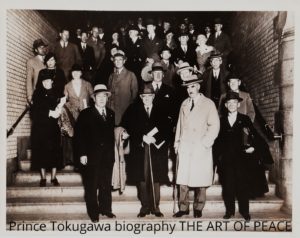
For decades, Prince Tokugawa Iesato (aka Prince Iyesato Tokugawa – 1863-1940) devoted his life to maintaining peace in Asia and specifically preventing Japan from coming into conflict with China. Tokugawa saw the clouds of war growing in Europe, as well as the militants in his own country pushing Japan towards conflict with China. He resisted these aggressions and wished to protect as many innocent lives as he could. As president of the Japanese Red Cross Society, Prince Tokugawa presided over the 1934 International Red Cross Conference in Tokyo (aka XVth International Conference of the Red Cross), where he urged the delegates to “Serve for Humanity.” It was at this gathering, where there was the first known example in history for the international creation of demilitarized Safe Zones, where civilians could find shelter, as outside warring armies fought one another.

The above October 1934 Press photo presents the American delegates to the conference held in Tokyo. Front row: U.S. Ambassador Joseph C. Grew (in light overcoat); on Grew’s right, holding papers and a cane, is Judge John Barton Payne, Chairman of the American Red Cross. (The other Red Cross representatives are not listed.) Ambassador Grew and Judge Barton Payne were close allies of Prince Tokugawa. This was the important conference, where the foundation for Safe Zones in Japanese controlled Chinese cities, such as Shanghai, were established, which helped save so many Chinese and Jewish lives. Up till now, Prince Tokugawa has not been recognized for his guiding role in the creation of these Safe Zones.
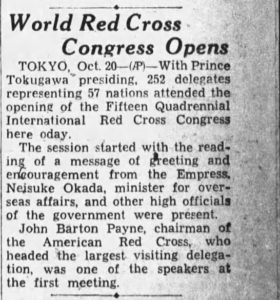


October 20th, 1934, Oakland Tribune (Oakland, California)

Prince Tokugawa presided over the 1934 International Red Cross Conference held in Tokyo, where for the first time in history the concept of creating civilian/refugee Safe Zones in war-torn areas was established. Prince Tokugawa promoted these safe havens which continued to exist throughout WWII. Credit also goes out to the President of the Chinese Red Cross Society Zhengyan Wang (another spelling Zhengyuan Wang 卢敏课题组) 
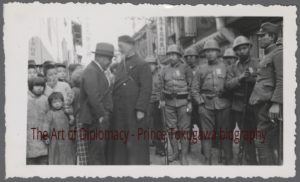


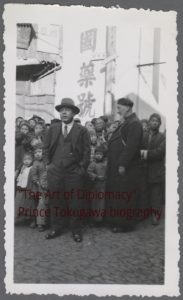
The above and below photo are courtesy of The Archive of the Jesuits in Canada / Archives des Jésuites au Canada  http://jesuitarchives.ca.

The photos were supplied specifically for use in this blog post.

The photos had the below description in French:

“Dans la zone “Jacquinot” avec le consul Japonais”

Below is the English translation:

“In the “Jacquinot” zone [Shanghai, China] with the Japanese consul.”

The date of these photos is estimated to be circa 1937-1940.


In these photos the bearded gentlemen in the French beret is a kind-hearted and heroic Jesuit Priest, Robert Jacquinot de Besange, who spent many years serving in China. He is conversing with one of Prince Tokugawa’s Japanese government representatives.

Father Jacquinot, with Prince Tokugawa’s strong support guided the Japanese military and their Chinese military counter-parts to agree to avoid conflict in these demilitarized Safe Zones.


Once WWII ended, there was the strong desire on the part of both the US and Japan to leave the recent dark war period behind them and expediently move forward again as allies. For this reason, Prince Tokugawa his supporters have become forgotten international heroes, who deserve recognition.

THE ART OF DIPLOMACY AND THE ART OF PEACE versions of Prince Tokugawa’s biography highlight Tokugawa’s significant involvement during the 1920s and 1930s in preventing the growing anti-Semitism in Europe from spreading to Japan and negatively influencing Japan’s treatment of Jews. A great debt is owed to Prince Tokugawa, by many, whose relatives were rescued by this noble individual.

These books also offer important lessons in creative intercultural and political relations for our current and future leaders.

Hopefully, these new insights will help heal some of hard residual feelings in Asia linked to events from WWII.


PRINT & KINDLE EDITION
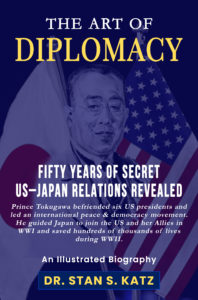


EXPANDED EBOOK EDITION
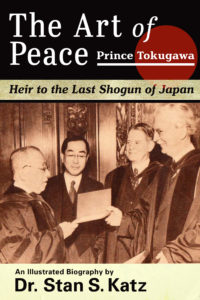


                       Praise


Paul Ringwood U.S. Navy Commander (retired) wrote:

“Amazing little known history. I enjoyed every chapter.”


Kazuo Kodama, former Ambassador of Japan to the United Nations wrote:

“I wish you all the best & best of luck on your new book on ‘’Tokugawa Iesato.”


Professor Benjamin Uchiyama, Ph.D. History, University of Southern California wrote:

“This is a really interesting and understudied topic.”


Suzette Heiman, Director of Planning and Communications – The Missouri School of Journalism at University of Missouri [The first school of Journalism in the U.S.] wrote:

“We look forward to adding this biography to the School’s library collection. Your goal to reach high school and college students with this information is an ambitious – but important – goal.”


Toru Shigehara: Head Librarian/Information Resources Center Shibusawa Eiichi Memorial Foundation and Museum wrote:

“We appreciate your kindness and all the work you have done to promote understanding of Shibusawa Eiichi and US-Japan relations as a whole. I wish you all the best in your current and future endeavors. With gratitude,”


Bill Davison – President of the North County Chapter of the San Diego World Affairs Council wrote:

“Entertaining and Educational! This wonderful book will almost certainly broaden your perspective on US-Japanese relationships.”


Professor Claire Langham, former President of the East-West Center of Southern California wrote:

“The importance of preventing war is rarely given recognition through literature and in accounts of history.  It can be every bit as exciting as glorified accounts of war and certainly a better approach.”


Dr. Gerald Margolis, former Deputy Director of Operations of the University of Pennsylvania’s Museum, the Executive Director of the World Religions Museum in Taipei, Taiwan (1996-97), the Founding Director of the Museum of Tolerance in Los Angeles (1987-96) and the Director of the Simon Wiesenthal Center in Los Angeles (1983-96). Dr. Margolis offers the below description of my books/research:

“Once again, I am impressed by your diligence and adventurous engagement with a difficult subject. Your work is all about discovery. You seek out different tracks – I think you might wish to explore academic University departments that cover diplomacy, and the craft of international relations.”
 

Filed Under: Tokugawa Archives Tagged With: Bill Davison, Chinese History, Chinese Red Cross Society, Diplomacy, Dr. Gerald Margolis, Historical biography, History of Jews in China, Holocaust, Humanitarian efforts, International diplomacy, International Friendship, International Relations, Jacquinot, Jacquinot Safe Zone, Jacquinot Zone, Japan China relations, Japan Society of New York City Archives, Japanese History, Jesuit Priest saves Chinese lives History, Jewish History, Jews fleeing Holocaust, Kazuo Kodama, Kazuo Kodama Ambassador of Japan to the European Union, Kazuo Kodama Ambassador of Japan to the United Nations, Museum of Tolerance in Los Angeles, North County Chapter of the San Diego World Affairs Council, Paul Ringwood U.S. Navy Commander, President of the Chinese Red Cross Society, President of the Chinese Red Cross Society Zhengyan Wang, Prince Iyesato Tokugawa, Prince Tokugawa, Prince Tokugawa Archives, Prince Tokugawa Iesato, Prince Tokugawa Iesato Archives, Professor Claire Langham, Red Cross Society of Japan, Safe Zones, Saving Chinese lives, Saving Jewish Lives, Shanghai Ghetto, Shanghai Safe Zone, Simon Wiesenthal Center, Stan S. Katz, Stan S. Katz blog, Suzette Heiman, Taiwan, The Archive of the Jesuits in Canada, The Archive of the Jesuits in Canada / Archives des Jésuites au Canada, The ArchiveArchives des Jésuites au Canada, The art of diplomacy, The Art of Peace, The Missouri School of Journalism at University of Missouri, Tokugawa Archives, U.S. Japan relations, U.S.-Japan History, University of Pennsylvania’s Museum, US Japan relations, World Religions Museum in Taipei, WWII, Zhengyan Wang, Zhengyuan Wang, 中国红十字会), 卢敏课题组

1915 – Former Presidents Theodore Roosevelt and William Howard Taft secretly attended a diplomatic banquet sponsored by the Japan Society of New York, honoring the visit of Baron Shibusawa Eiichi. Their goal to strengthen the future US Japan alliance for World War One.

February 11, 2020 by Stan S. Katz Leave a Comment


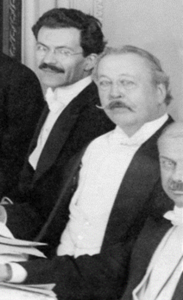
Photo above: William Howard Taft (next to the gentleman whose image reveals only half of his face)

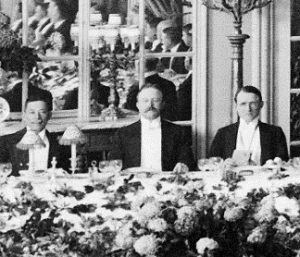
Photo below: Theodore Roosevelt (centered beneath the chandelier)   


These rare photos are segments from a much larger 1915 photo (20 x 12 inches) that presents the many guests at this U.S. Japan diplomatic event. This antique photo appears to be the only one in existence. It was discovered while researching for the illustrated biography on Prince Iyesato Tokugawa, titled: The Art of Peace.

Prince Iyesato Tokugawa (1863-1940) and his close ally Baron Eiichi Shibusawa (1840-1931), along with their Japanese and non-Japanese supporters devoted themselves to creatively encouraging international goodwill and promoting democratic principles.

The entire 1915 group photo is shown within another blog post on this website. That blog post presents enlarged images of all of the sixty-five attendees and there is also a description the significant topics discussed during this gathering – Historians and family members are invited to assist in identifying the guests at this event; a dozen have thus far been recognized.

This 1915 photo is a time capsule which gives a fuller understanding of the history of U.S. Japan relations and a window to the exciting world of New York City during the early twentieth century. Several of the attendees thus far identified were actively part of the goodwill organization the Japan Society of New York City, which began in 1907, and actively continues to this day.

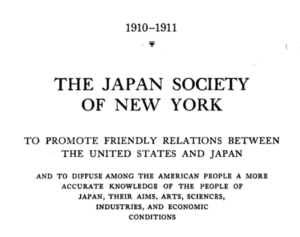
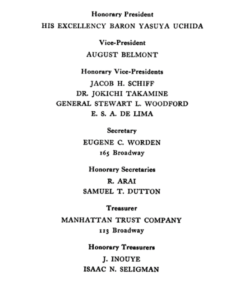
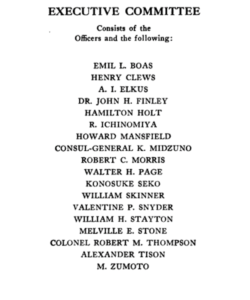
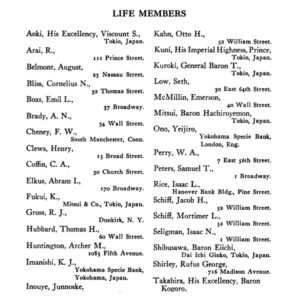
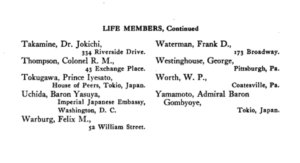
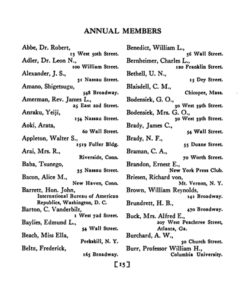
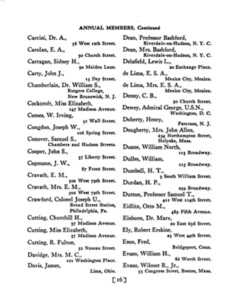
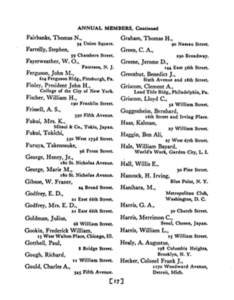
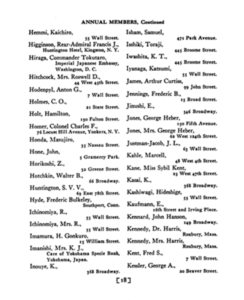
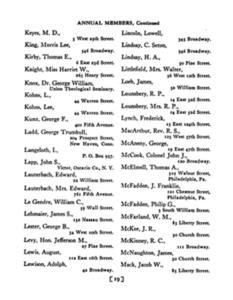
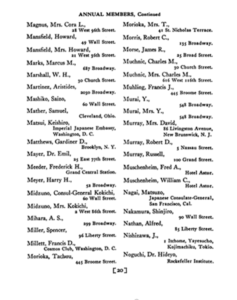
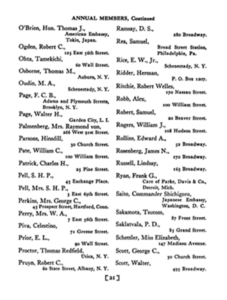
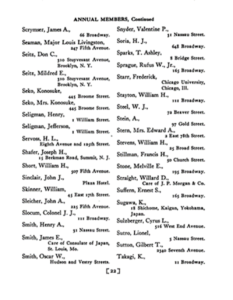
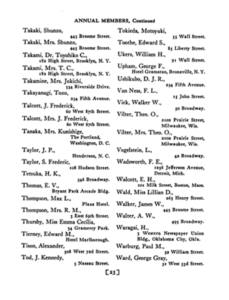
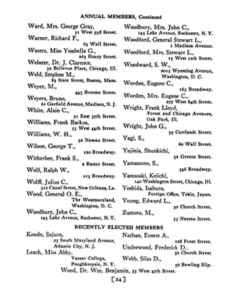
The below illustrations are from a 1910-1911 Japan Society of New York City publication which highlights the membership of the organization. This membership list will likely to be helpful in identifying many of the distinguished guests attending this significant 1915 event linked to the alliance between the U.S. and Japan, and with other Allied nations during World War One.


Below are several leading members of the Japan Society of New York City that have already been identified as attendees at the 1915 banquet event:

Jacob H. Schiff – Honorary Vice-President of Japan Society

Dr. Jokichi Takamine – Honorary Vice-President and Life Member of Japan Society

Consul-General K. Midzuno – Executive Committee of Japan Society

Dr. John H. Finley – Executive Committee of Japan Society

M. Zumoto – Executive Committee of Japan Society

Baron Eiichi Shibusawa – Life Member of the Japan Society

*Prince Iyesato Tokugawa – was a political ally of Baron Shibusawa. Prince Tokugawa was not at the 1915 event, but he is listed as being a Life Member of the Japan Society.


Below is the General Annual Membership List of the Japan Society – Some of these prestigious individuals might also have attended the 1915 dinner event honoring Baron Eiichi Shibusawa’s visit.


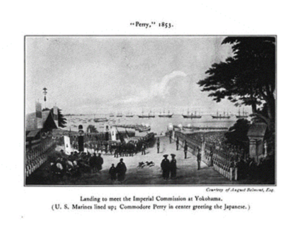
This Japan Society publication highlighted the 1853 visit to Japan by Commodore Perry which helped launch many years of friendship between the U.S and Japan. 


Here is the link to the blog post that presents the entire 1915 diplomatic banquet photo. This blog post gives brief bios on the attendees that have been identified.

1915 Photo: Diplomatic banquet honoring the visit of Baron Shibusawa


To learn more about the Japan Society of New York City and their many social/cultural/educational activities, here is a link to there website:

Japan Society


Filed Under: Tokugawa Archives Tagged With: 1915 New York City History, 1915 U.S. Japan relations, A. A. Coffin, A. I. Elkus, A. N. Brady, Abram I. Elkus, Admiral Baron Gombyoye Yamamoto, Alexander Tison, Archer M. Huntington, August Belmont, Baron Eiichi Shibusawa, Baron Hachiroyemon Mitsui, Baron Kogoro Takahira, Baron Shibusawa, Baron Shibusawa Eiichi, Baron Yasuya Uchida, Baron Yasuya Uchida Japanese Ambassador, Baron Yasuya Uchida Japanese Ambassador to the U.S., Colonel Robert M. Thompson, Consul-General K. Midzuno, Cornelius N. Bliss, Dr. John H. Finley, Dr. Jōkichi Takamine, E. S. A. De Lima, Eiichi Shibusawa, Emerson McMillin, Emil L. Boas, Emil L. Boss, Eugene C. Worden, F. W. Cheney, Felix M. Warburg, Frank D. Waterman, General Baron T. Kuroki, General Stewart L. Woodford, George Westinghouse, Gombyoye Yamamoto, Hachiroyemon Mitsui, Hamilton Holt, Henry Clews, History of the Japan Society, History of the Japan Society of Manhattan, History of the Japan Society of New York City, Honorary President of Japan Society Baron Yasuya Uchida, Howard Mansfield, Imperial Highness Prince Kuni, Isaac L. Rice, Isaac N. Seligman, Isaac Newton Seligman, J. Inouye, Jacob H. Schiff, Japan Society, Japan Society 1910, Japan Society of Manhattan, Japan Society of New York City Archives, John H. Finley, Jokichi Takamine, K. Fukui, K. Fukui Mitsui & Co., K. J. Imanishi, K. Midzuno, Kogoro Takahira, Konosuke Seko, Lindsay Russell, Melville E. Stone, Mortimer L. Schiff, Otto H. Kahn, President Theodore Roosevelt, President William Howard Taft, Prince Kuni, R. Arai, R. Ichinomiya, R. J. Gross, Robert C. Morris, Robert C. Morris U.S. Ambassador to Japan, Roosevelt and Japan, Rufus George Shirley, Samuel T. Dutton, Samuel T. Peters, Seth Low, Sherry's Restaurant, Shibusawa Eiichi, Stan S. Katz, Stan S. Katz blog, Stewart L. Woodford, T. Kuroki, Taft and Japan, The art of diplomacy, The Art of Peace, The Art of Peace biography, The Japan Society of New York City, Theodore Roosevelt, Thomas H. Hubbard, U.S. Japan relations, Viscount S. Aoki, W. A. Perry, W. P. Worth, Walter H. Page, William H. Stayton, William Howard Taft, William Skinner, Yasuya Uchida, Yeijiro Ono

Copyright © 2026 Stan S. Katz