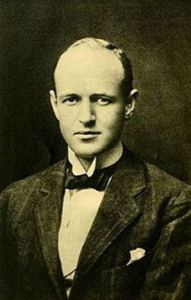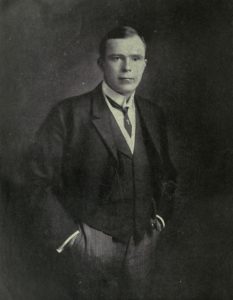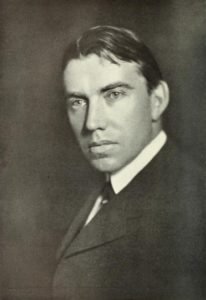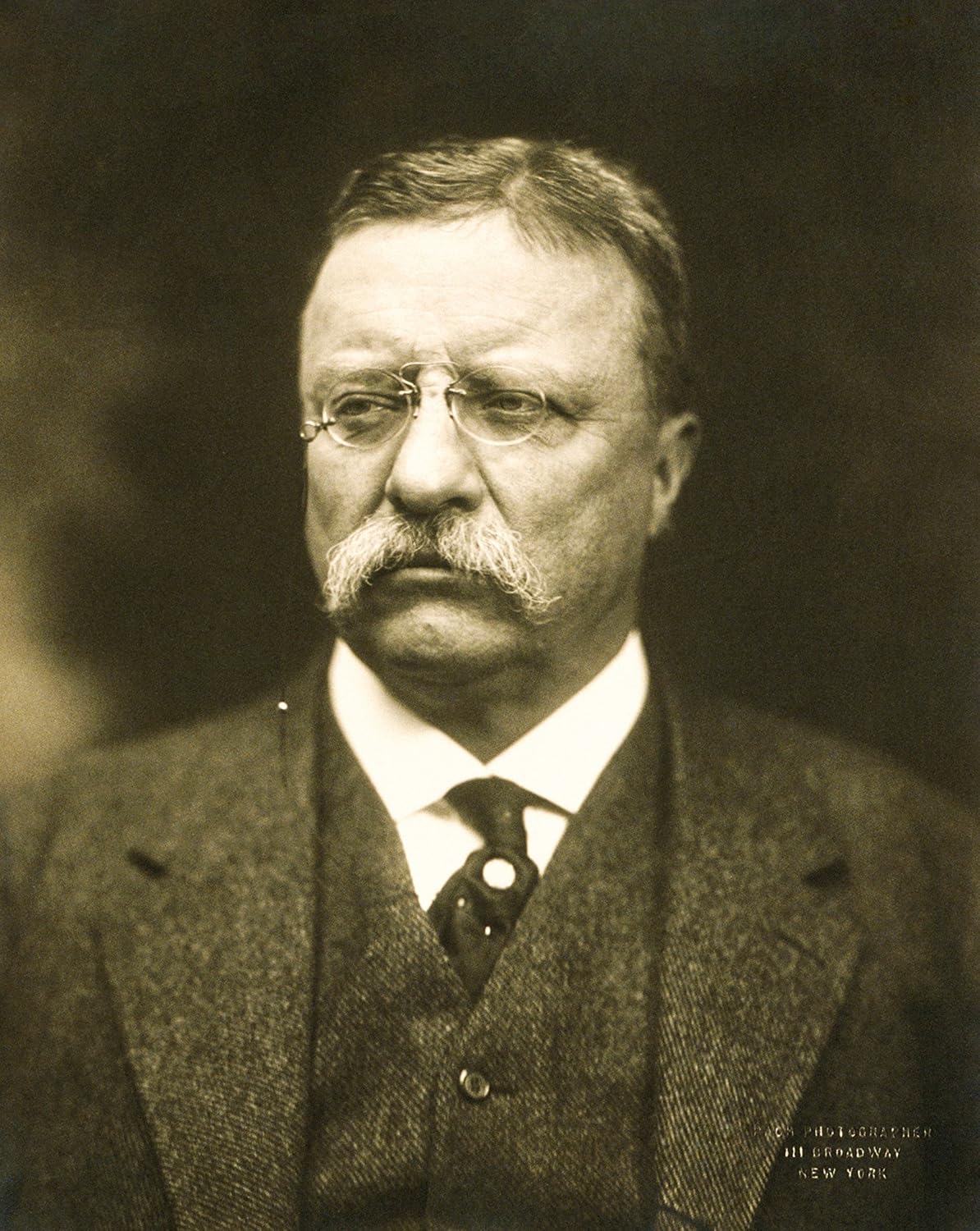
Stan. S. Katz

Author of The Emperor and the Spy

  • Home
  • Author
  • Books
  • Reviews
  • Educators
  • News
  • Audiobook & Timeline
  • Mashbir Archives
  • Tokugawa Archives
  • Contact
Follow Stan on FacebookFollow Stan on TwitterFollow Stan on GoodreadsFollow Stan on RSS

Sign Up for Future Blogs Linked to Colonel Mashbir and Japanese History

Read the Intro Posts

INTRODUCTION TO THE ART OF PEACE

WELCOME!

Recent Posts

  • San Diego Jewish Journal Holocaust Remembrance Edition May 2016 highlights the historical novel, The Emperor and the Spy and the outstanding achievements of Colonel Sidney Mashbir.
  • The Emperor and the Spy, was one of two books highlighted during academic/diplomatic event sponsored by the Prime Minister’s Office of Japan and hosted by San Diego World Affairs Council
  • Osher Lifelong Education Institute – UCSD Presentation. Remarkable story, the alliance between a patriotic U.S. Intelligence Agent, Colonel Sidney Mashbir, and a humanitarian Japanese International Statesman, Prince Iyesato Tokugawa, who heroically delayed and attempted to prevent WWII in the Pacific.
  • Tokugawa & Komatsu, Forgotten Heroes – Until his passing in 1940, Prince Iyesato Tokugawa held back WWII in the Pacific – Tokugawa’s diplomatic legacy lived on after WWII ended, when his protégé, Takashi Komatsu, guided the US and Japan to again become friends and allies.
  • Have you ever wondered how US and Japan re-established their friendship and alliance following the trauma of WWII? Here’s a new biography that honors an amazing Japanese American statesman, Takashi Komatsu, who guided this major achievement.

Archives

An Exciting Upcoming Biography: Teddy Roosevelt’s Secret Mission to Japan

January 31, 2021 by Stan S. Katz Leave a Comment


INTRODUCTION

The people we choose to honor, shape and inspire our future

Theodore Roosevelt (October 27, 1858 – January 6, 1919) a Man of and ahead of his Time.

Launching the creation of this exciting biography was the surprising acquisition of a one-of-a-kind, antique group photo which appeared to include Theodore Roosevelt, taken during a secret visit to Japan in 1909. And if it was Theodore, why had he gone there? The U.S. and Japanese flags attached to the ceiling above the eleven individuals in the photo gave the impression of a diplomatic event. Once you’ve read this biography, you’ll likely agree that Theodore, accompanied by his wife, Edith, their daughter, Alice, and their son, Kermit, along with seven other companions did take part in this most covert operation in U.S. Presidential History.

The research on the below mysterious 1909 photo revealed important new insights about Theodore Roosevelt, both the man and the creative international negotiator – This story will entertain the general public & supply historians with fascinating material for further investigation.
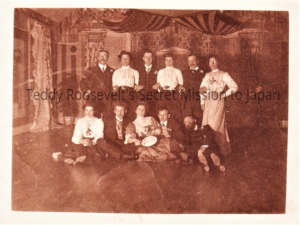


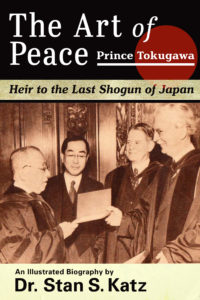
This 1909 Photo was acquired while researching for the author’s historical novel, The Emperor and the Spy, and the illustrated biographies: The Art of Peace and The Art of Diplomacy. These books highlight US Japanese relations. The novel presents a high level U.S. intelligence agent, Colonel Sidney Mashbir (1891-1973), who during the 1920’s and ’30’s formed strong alliances with Japanese leaders, together striving to maintain goodwill between their nations. The biographies spotlight the inspiring Japanese statesmen, Prince Iyesato Tokugawa (1863-1940) and Baron Eiichi Shibusawa (1840-1931), who closely engaged with eight U.S. presidents and other world leaders in the pursuit of peace, democracy, and mutually beneficial business and cultural exchange. Theodore Roosevelt, along with his presidential successor, William Howard Taft, developed a personal friendship and political alliance with Tokugawa and Shibusawa during the first decades of the 20th Century. A largely untold story.
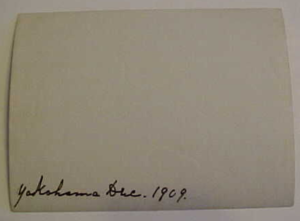
Illustrated above is the back of the mysterious group photo, with the words written in pen:

“Yokohama Dec. 1909.”

The photo measures 4.25″ x 3.25″

*It is worthy of note that in 1905, Alice Roosevelt and William Howard Taft (the then Secretary of War under T.R.), along with a large U.S. political entourage visited Japan and Asia in general. For unknown reasons, Alice required that most the photos of that journey not be shared with the general public until over a century later. When they were made available, they were utilized for an online Smithsonian Museum Exhibit titled: Alice in Asia: The 1905 Taft Mission to Asia. It appears that secrecy was required for T.R. to achieve his diplomatic goals with the Japan in 1909. And for that reason, they delayed sharing Alice’s 1905 photos with the public until the far distant future.

The below 1905 photo illustration is from Alice Roosevelt’s autobiography, Crowded Hours. It shows her and her shipmate companions – The Photo is included in the Smithsonian Museum Exhibit: Alice in Asia: The 1905 Taft Mission to Asia – It is an interesting coincidence that in the above 1909 Photo, Alice is seated cross-legged on the ground in front of her father, while in the below 1905 Photo, she is now seated cross-legged at the feet of William Howard Taft.
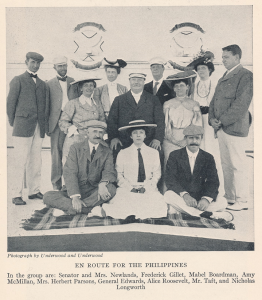
 

Known-photo-of-T.R.-circa-1908

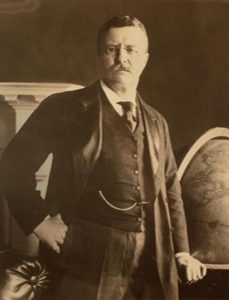
Frequently referred to by his initials T.R. or Teddy Roosevelt, he is one of our most admired and even beloved presidents. Displayed below is circa 1908 Portrait photo of T.R. standing next to a World Globe. Besides being a national statesman, he wished to be recognized as a leader with a global perspective and international influence. Like most powerful presidential leaders, there were successes and controversies linked to his domestic policies and foreign engagements. These topics are explored, using hundreds of illustrations.

On a personal note: from an early age, I’ve had a deep appreciation for Theodore for various reasons, including his sheer determination to overcome his limitations as an unhealthy child, and instead live a robust, adventurous, and accomplished life.

T.R. served as the 26th president of the United States from 1901 to 1909. And before that from March to September 1901, he served under President William McKinley as the 25th vice president. Prior to those highest level national offices, T.R. also held the position as the 33rd governor of the influential State of New York from 1899 to 1900, emerging as a dominant political leader and a driving force for antitrust legislation supporting Progressive policies in the early 20th century. T.R. also wore the hat of a conservationist, naturalist, and writer. And he is respectfully depicted on Mount Rushmore, alongside George Washington, Thomas Jefferson, and Abraham Lincoln.

A great deal of new historical material was discovered that highlighted Theodore Roosevelt’s strong desire to improve the lives of Black Americans. T.R. strongly looked up to President Abraham Lincoln and his struggle to eliminate slavery. This biography highlights inspiring actions on the part of T.R. to improve Black / White race relations. Based on earlier writings and research linked to eliminating racism, the author of this biography was in 2023 nominated for the Dr. Martin Luther King Community Service Award, by the City of Oceanside, California and a Chapter of the NAACP.

T.R. looked out for the average citizen and wasn’t afraid to face off with powerful corporations in order to defend America’s natural environment. Accompanied by the naturalist, John Muir, they once embarked on a three-night camping trip exploring the most beautiful and pristine areas of Yosemite. This inspired Theodore to realize that many of America’s most beautiful areas needed protection – So he established the U.S. National Park Service which watches over this precious legacy. And during his 1909 Smithsonian Museum African Safari adventure, he used his influence to inspire the creation of the great game parks of East Africa that continue to this day.

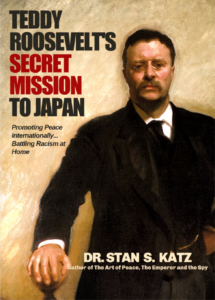
Teddy Roosevelt’s Secret Mission to Japan

Like a Sherlock Holmes mystery, unravelling clues and finding hidden meanings, recognizing the collaborators in their 1909 mission to Japan, and those dangerous forces who stood in their way – Supporting the veracity of this extraordinary story are “Highly Top Secret” classified Japanese diplomatic letters recently unearthed from the National Archives of Japan from over a century ago. These 1908-1909 correspondences strategized how best to encourage T.R. to pay a friendly visit to Japan during his term in office or after his presidency, just as the dark storm clouds of  World War One were rapidly approaching.

It appears that it was towards the conclusion of his African Safari, and before embarking on his European Peace Tour that T.R. and members of his family and their companions secretly visited Japan. The recent impressive military victory of the Japanese over the Russians in the Russo-Japanese War of 1904-1905, added importance to the US and Japan maintaining good relations. T.R.’s leadership role in bringing that conflict to an end resulted in him receiving a Nobel Peace Prize in 1906 – So US / Japan relations was a topic very close to his heart.

The amazing search capabilities of the internet assisted in the retrieval of historical newspapers/magazines and in the acquisition of long forgotten personal and official primary source materials. Included in this biography is a 1908 photo of T.R. secretly accompanied by Andrew Carnegie, attending a Memorial Ceremony for Abraham Lincoln – Carnegie wished to meet with T.R. prior to T.R.’s departure on his African Safari Adventure and European Peace Mission, which Carnegie funded.

There is also a rare 1910 photo of T.R. being met by his much younger cousin, F.D.R., upon T.R.’s return from Africa and Europe.

Another fascinating photo only recently discovered presents the then former Presidents Theodore Roosevelt and William Howard Taft  in 1915, secretly attending a diplomatic banquet in N.Y.C. honoring the visit of  the Japanese statesmen, Baron Shibusawa. There was a pattern of secrecy when it came to U.S. / Japan political relations.

This biography highlights T.R.’s alliances with the world’s most influential international political leaders, the wealthiest individuals, as well as European and Japanese nobility. Strategic statecraft lessons are revealed in this fascinating story, providing significant perspectives on matters that continue to influence U.S. Asian relations to this day.
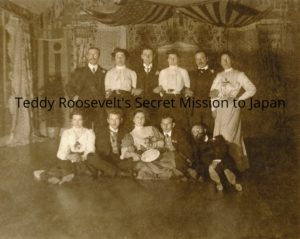


Color enhanced version of the original 1909 photo.


The book is Dedicated to these organizations

World Affairs Councils of America (WACA) – a national, non-profit, non-partisan, educational/political affairs association whose goal is international cooperation and understanding. The author is on the board of directors of the San Diego World Affairs Council, a local chapter. On a yearly basis, WACA and her many chapters across the U.S. organize exciting local and national high school competitions called Academic World Quest, where students display their knowledge of significant world events.

Rotary International promotes good-will projects in local communities and internationally. Their motto, “Service Above Self.”

Japan Society of New York City has a long history of supporting good relations between U.S. and Japan.

America-Japan Society headquartered in Tokyo, celebrated its 100th Year Anniversary in 2017. They promote peace and stability for Japan-U.S. relations, as well as for the world, encouraging educational and cultural exchange.

Shibusawa Eiichi Memorial Foundation and Museum located in Japan. Baron Shibusawa Eiichi and Prince Tokugawa Iesato were friends and allies with President Theodore Roosevelt and with other U.S. presidents in the promotion of goodwill between their nations.

National Association of Japan-America Societies (NAJAS), a private, non-profit, non-partisan organization that offers educational, cultural, and business programs about Japan and U.S./Japan relations. Located in 32 cities in the U.S., their mission to strengthen cooperation and understanding between Japan and the U.S.

*Appreciation is also given to other organizations promoting inter-racial goodwill within the U.S. and internationally.


TABLE OF CONTENTS

Chapter One                                                                          1

-Early Research to Identify the Individuals in the 1909 photo

-Overview of U.S. Japan relations mid-1800s thru early 1900s

-T.R. combats Racism against Japanese Americans


Chapter Two                                                                        31

-Economic Instability and an International Arms Race


Chapter Three                                                                     48

-Six of the Eleven Individuals in the Mystery Photo are identified

– T.R.’s exciting 1909-1910 Smithsonian African Expedition


Chapter Four                                                                      73

-Theories as to why Teddy Roosevelt might have Secretly Visited Japan in late 1909


Chapter Five                                                                       89

-Theodore Roosevelt Advances the Rights and Respect of Black Americans


Chapter Six                                                                       109

-Logistics as to how T.R. & his companions might have covertly travelled to Japan?

–The Cornelius Vanderbilt Family connection.                                                                                                                                                                                                                                      

Chapter Seven                                                                   127

-Andrew Carnegie and the Beginnings of an International Peace Movement, Supported by T.R. & influential Japanese statesmen.

–Was History Repeating Itself? Was T.R.’s 1909 visit to Japan with his family, similar to that of former President Grant, a half-century earlier?


Chapter Eight                                                                   146     

-‘Highly Classified Secrets’ at THE NATIONAL ARCHIVES OF JAPAN offers a potential key to the mysterious 1909 visit to Japan.                                                                                                                                                                                                                                   

Chapter Nine                                                                  172           

-T.R.’s fascinating 1909-1910 WORLD TOUR INCLUDES EGYPT AND EUROPE.                                                                                                                                                                                                                        

Chapter Ten                                                                    194     

-With WORLD WAR I closing in, a strong U.S. Japan Alliance was more Important than Ever.                                                                                                                                                                                                                                 

CLOSING REMARKS                                                        210

ACKNOWLEDGEMENT                                                   219

NOTES SECTION                                                              220

Additional Research Resources                                      265

Index                                                                                   267


Praise for Author’s Prior Books

The Emperor and the Spy historical novel

‘’I have learned a lot about Colonel Mashbir and his real friendship with Prince Tokugawa which was a pleasant surprise for me. Your stories about Japanese-American Military Intelligence Service have also done a great justice to so many unsung heroes.”  Kazuo Kodama, former Japanese Ambassador to the United Nations


“I realize how difficult it is to weave fact and fiction but you did a masterful job. I have often wondered about the closing of WW II and how Japan got its new system of governance.” J. L. Ruthenberg, Lieutenant Colonel, USMC, Retired


“A fascinating story . . . a fine book,”

Lisa Wolff, past Managing Editor of Simon & Shuster


BARNES & NOBLE chose this novel to honor Veterans Day Weekend with a Book signing at their Oceanside, California Store.


“Novelist brings spy out of the shadows. Looking forward to the movie.”

Pam Kragen, SAN DIEGO UNION TRIBUNE


“The Emperor and the Spy…I couldn’t put it down.”

Hilliard Harper, Retired Naval Reserve Commander and former Writer for the Los Angeles Times


“My mother is a history expert. She taught history to high schoolers. She read your book in a day over the weekend and is now rereading it. These are her comments: It’s a fun read, page turner, shows tremendous research, historical novels don’t get better than that, intelligently written book, informative, conversations enlightening, she learned a lot…In sum, she said this is an outstanding book. Congratulations!”

Dave Edick Jr., President of San Diego World Affairs Council & President of San Diego International Sister Cities Association


“The book is fast-paced yet thoroughly researched. I compare the depth and factual detail of Katz’s writing with those of Wilbur Smith and Dick Francis. You’ll appreciate the weaving of concurrent events, and the nuances only an expert in the field can convey. Like Frederick Forsyth’s books, the international intrigue with imminent national security threats keep one in suspense . . . Katz’s narrative subtly demonstrates the pivot points around which the arc of history may have been so very different… It’s deliciously epic.”

Rita Lim Wilby PhD., Rotarian and Chairman of Programming at San Diego World Affairs Council


“Thank you for having interest in Japanese History. Looking forward to your new book! [The biography of Prince Tokugawa]

Kenko Sone Director of Global Communications for Shinzō Abe Prime Minister of Japan


The Art of Peace & The Art of Diplomacy illustrated biographies

“The importance of preventing war is rarely given recognition through literature and in accounts of history.  It can be every bit as exciting as glorified accounts of war and certainly a better approach.” Professor Claire Langham, former President of the East-West Center of Southern California


“We look forward to adding The Art of Peace to the School’s library collection. Your goal to reach high school and college students with this information is an ambitious – but important – goal. Best wishes with your project.”

Suzette Heiman, Director of Planning and Communications Missouri School of Journalism at University of Missouri


“We appreciate your kindness and all the work you have done to promote understanding of Shibusawa Eiichi and US-Japan relations as a whole. I wish you all the best in your current and future endeavors. With gratitude,”  Toru Shigehara: Head Librarian/Information Resources Center, Shibusawa Eiichi Memorial Foundation and Museum located in Japan


Include your Contact info on TheEmperorAndTheSpy.com website to be notified when the Theodore Roosevelt Biography is published.

You’re also invited to Like the Facebook Author Page: https://www.facebook.com/TheEmperorAndTheSpy/
 

Filed Under: Tokugawa Archives Tagged With: Abraham Lincoln, Abraham Lincoln Birthplace Memorial, Alice in Asia The 1905 Taft Mission to Asia, Alice Longworth Roosevelt, Alice Roosevelt, Alice Roosevelt autobiography, Andrew Carnegie, Baron Eiichi Shibusawa, Baron Shibusawa, Colonel Theodore Roosevelt, Cornelius Vanderbilt, Crowded Hours, Edith Roosevelt, Eiichi Shibusawa, Emperor Meiji, Hilliard Harper, Iyesato Tokugawa, Kazuo Kodama, Kenko Sone Director of Global Communications, Kermit Roosevelt, Pam Kragen, President Taft, President Theodore Roosevelt, President William Howard Taft, Prince Iyesato Tokugawa, Professor Claire Langham, Secret Diplomacy, Secret Presidential missions, Shibusawa Eiichi Memorial Foundation and Museum, Smithsonian exhibit on Japan, Stan S. Katz, Stan S. Katz archives, Stan S. Katz blog, Taft and Japan, Teddy Roosevelt, Teddy Roosevelt's Secret Mission to Japan, The Art of Peace, The Art of Peace biography, The Emperor and the Spy, THE NATIONAL ARCHIVES OF JAPAN, Theodore Roosevelt, Theodore Roosevelt and Andrew Carnegie, Theodore Roosevelt and F.D.R., Theodore Roosevelt and Franklin Delano Roosevelt, U.S. Japan, U.S. Japan Diplomacy, U.S. Japan relations, Unknown History about Theodore Roosevelt, Unknown stories about Theodore Roosevelt, William Howard Taft

1915 – Former Presidents Theodore Roosevelt and William Howard Taft secretly attended a diplomatic banquet sponsored by the Japan Society of New York, honoring the visit of Baron Shibusawa Eiichi. Their goal to strengthen the future US Japan alliance for World War One.

February 11, 2020 by Stan S. Katz Leave a Comment


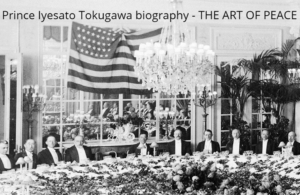
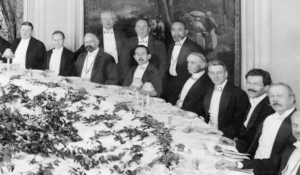
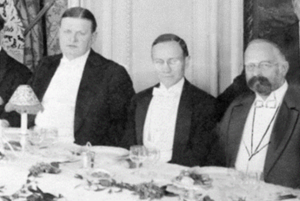
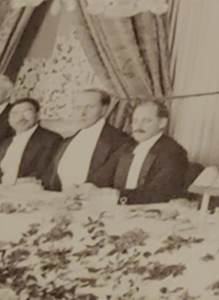
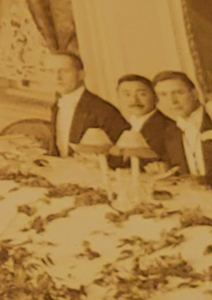
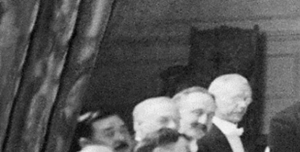
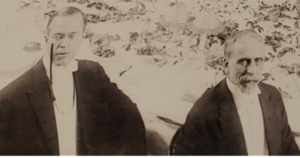
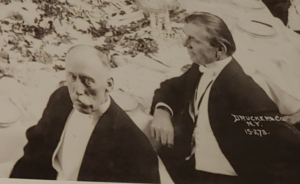
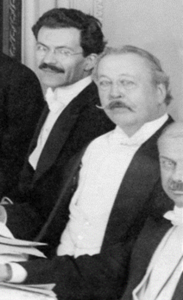
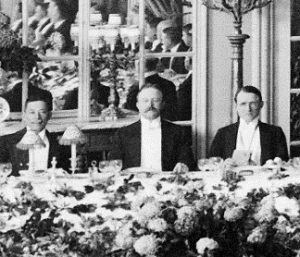
Photo above: William Howard Taft (next to the gentleman whose image reveals only half of his face)

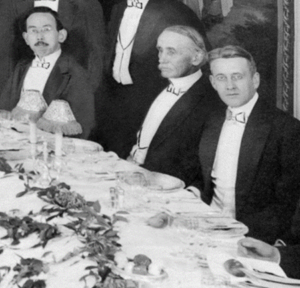
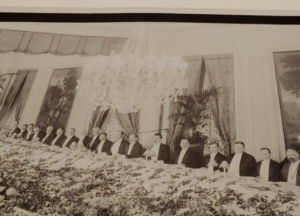
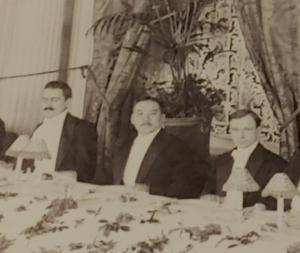
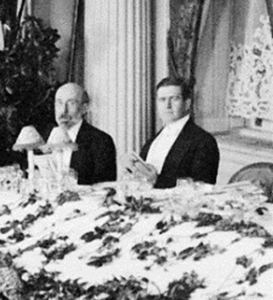
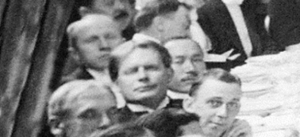
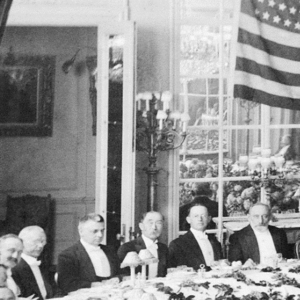
Photo below: Theodore Roosevelt (centered beneath the chandelier)   


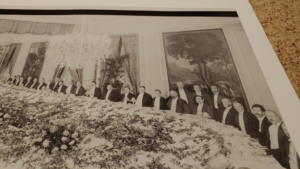
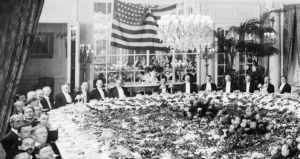
These rare photos are segments from a much larger 1915 photo (20 x 12 inches) that presents the many guests at this U.S. Japan diplomatic event. This antique photo appears to be the only one in existence. It was discovered while researching for the illustrated biography on Prince Iyesato Tokugawa, titled: The Art of Peace.

Prince Iyesato Tokugawa (1863-1940) and his close ally Baron Eiichi Shibusawa (1840-1931), along with their Japanese and non-Japanese supporters devoted themselves to creatively encouraging international goodwill and promoting democratic principles.

The entire 1915 group photo is shown within another blog post on this website. That blog post presents enlarged images of all of the sixty-five attendees and there is also a description the significant topics discussed during this gathering – Historians and family members are invited to assist in identifying the guests at this event; a dozen have thus far been recognized.

This 1915 photo is a time capsule which gives a fuller understanding of the history of U.S. Japan relations and a window to the exciting world of New York City during the early twentieth century. Several of the attendees thus far identified were actively part of the goodwill organization the Japan Society of New York City, which began in 1907, and actively continues to this day.

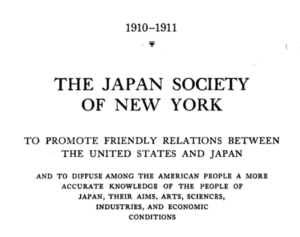
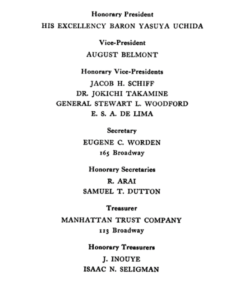
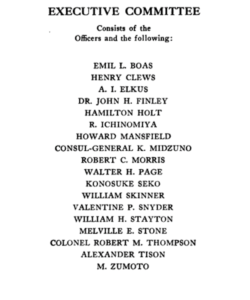
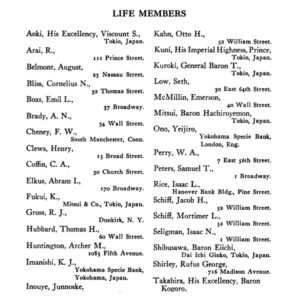
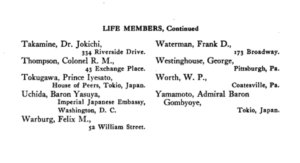
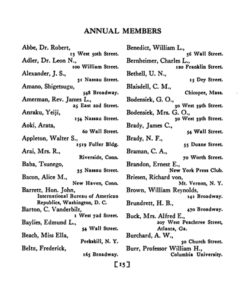
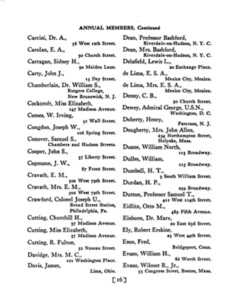
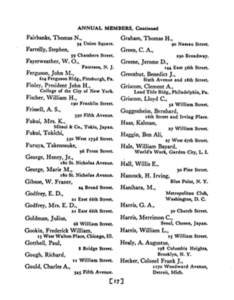
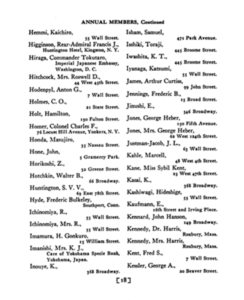
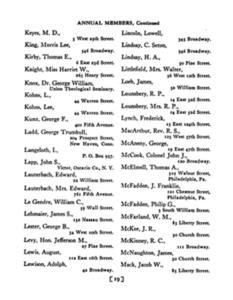
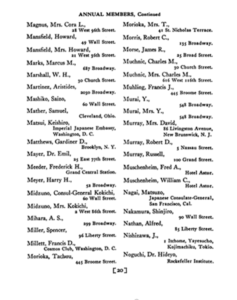
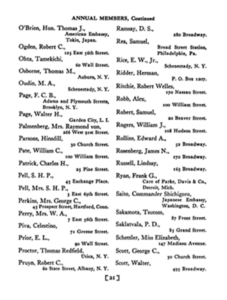
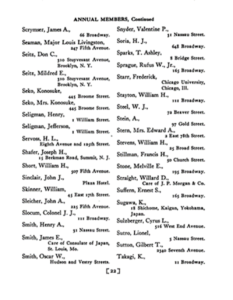
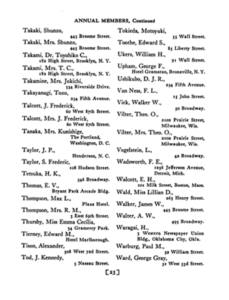
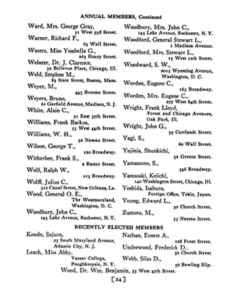
The below illustrations are from a 1910-1911 Japan Society of New York City publication which highlights the membership of the organization. This membership list will likely to be helpful in identifying many of the distinguished guests attending this significant 1915 event linked to the alliance between the U.S. and Japan, and with other Allied nations during World War One.


Below are several leading members of the Japan Society of New York City that have already been identified as attendees at the 1915 banquet event:

Jacob H. Schiff – Honorary Vice-President of Japan Society

Dr. Jokichi Takamine – Honorary Vice-President and Life Member of Japan Society

Consul-General K. Midzuno – Executive Committee of Japan Society

Dr. John H. Finley – Executive Committee of Japan Society

M. Zumoto – Executive Committee of Japan Society

Baron Eiichi Shibusawa – Life Member of the Japan Society

*Prince Iyesato Tokugawa – was a political ally of Baron Shibusawa. Prince Tokugawa was not at the 1915 event, but he is listed as being a Life Member of the Japan Society.


Below is the General Annual Membership List of the Japan Society – Some of these prestigious individuals might also have attended the 1915 dinner event honoring Baron Eiichi Shibusawa’s visit.


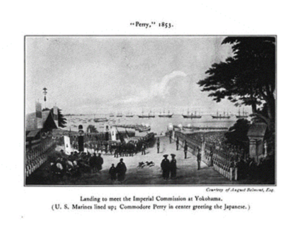
This Japan Society publication highlighted the 1853 visit to Japan by Commodore Perry which helped launch many years of friendship between the U.S and Japan. 


Here is the link to the blog post that presents the entire 1915 diplomatic banquet photo. This blog post gives brief bios on the attendees that have been identified.

1915 Photo: Diplomatic banquet honoring the visit of Baron Shibusawa


To learn more about the Japan Society of New York City and their many social/cultural/educational activities, here is a link to there website:

Japan Society


Filed Under: Tokugawa Archives Tagged With: 1915 New York City History, 1915 U.S. Japan relations, A. A. Coffin, A. I. Elkus, A. N. Brady, Abram I. Elkus, Admiral Baron Gombyoye Yamamoto, Alexander Tison, Archer M. Huntington, August Belmont, Baron Eiichi Shibusawa, Baron Hachiroyemon Mitsui, Baron Kogoro Takahira, Baron Shibusawa, Baron Shibusawa Eiichi, Baron Yasuya Uchida, Baron Yasuya Uchida Japanese Ambassador, Baron Yasuya Uchida Japanese Ambassador to the U.S., Colonel Robert M. Thompson, Consul-General K. Midzuno, Cornelius N. Bliss, Dr. John H. Finley, Dr. Jōkichi Takamine, E. S. A. De Lima, Eiichi Shibusawa, Emerson McMillin, Emil L. Boas, Emil L. Boss, Eugene C. Worden, F. W. Cheney, Felix M. Warburg, Frank D. Waterman, General Baron T. Kuroki, General Stewart L. Woodford, George Westinghouse, Gombyoye Yamamoto, Hachiroyemon Mitsui, Hamilton Holt, Henry Clews, History of the Japan Society, History of the Japan Society of Manhattan, History of the Japan Society of New York City, Honorary President of Japan Society Baron Yasuya Uchida, Howard Mansfield, Imperial Highness Prince Kuni, Isaac L. Rice, Isaac N. Seligman, Isaac Newton Seligman, J. Inouye, Jacob H. Schiff, Japan Society, Japan Society 1910, Japan Society of Manhattan, Japan Society of New York City Archives, John H. Finley, Jokichi Takamine, K. Fukui, K. Fukui Mitsui & Co., K. J. Imanishi, K. Midzuno, Kogoro Takahira, Konosuke Seko, Lindsay Russell, Melville E. Stone, Mortimer L. Schiff, Otto H. Kahn, President Theodore Roosevelt, President William Howard Taft, Prince Kuni, R. Arai, R. Ichinomiya, R. J. Gross, Robert C. Morris, Robert C. Morris U.S. Ambassador to Japan, Roosevelt and Japan, Rufus George Shirley, Samuel T. Dutton, Samuel T. Peters, Seth Low, Sherry's Restaurant, Shibusawa Eiichi, Stan S. Katz, Stan S. Katz blog, Stewart L. Woodford, T. Kuroki, Taft and Japan, The art of diplomacy, The Art of Peace, The Art of Peace biography, The Japan Society of New York City, Theodore Roosevelt, Thomas H. Hubbard, U.S. Japan relations, Viscount S. Aoki, W. A. Perry, W. P. Worth, Walter H. Page, William H. Stayton, William Howard Taft, William Skinner, Yasuya Uchida, Yeijiro Ono

Former Presidents Theodore Roosevelt & William Howard Taft secretly attend a 1915 diplomatic banquet in N.Y.C. honoring the visit of Baron Shibusawa. Their goal to establish a strong US Japan alliance for World War One. This photo was only recently discovered.

February 6, 2020 by Stan S. Katz 7 Comments

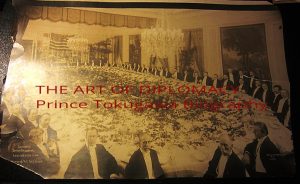
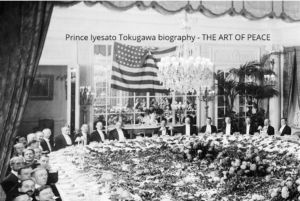
This is the only known photo of a significant 1915 U.S. Japan diplomatic event. The description on the photo’s lower left corner states:

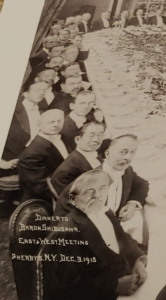
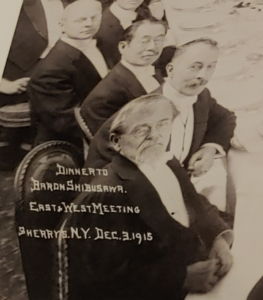
Dinner to Baron Shibusawa. East & West Meeting, Sherry’s [Restaurant] New York City, December 3, 1915.  (Actual photo size: 20 by 12 inches.)

This original photo is age-darkened and missing a small segment in the lower left. These imperfections have been corrected during the restoration process as shown in the photos below:


INTRODUCTION

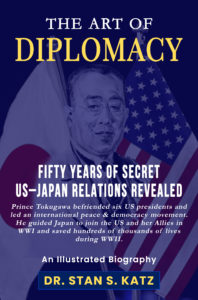
This almost discarded photo was acquired by the author of this blog post while researching for  a biography on Prince Tokugawa Iesato (1863-1940) titled The Art of Peace, which is also now available in a “general reader” edition titled: The Art of Diplomacy. Both versions also highlight Baron Shibusawa Eiichi (1840-1931). Prince Tokugawa & Baron Shibusawa were lifelong friends and allies who promoted successful domestic policies in Japan and strove for peace internationally. They were among the most powerful and inspiring leaders of Japan during the first decades of the twentieth century.

Prince Tokugawa held the influential position of President of Japan’s upper house of congress, the House of Peers, for thirty years, and was so politically influential in promoting democracy and international goodwill, that it was only after his death in 1940, that Japan was pressured into allying with the Axis Powers during World War Two.  

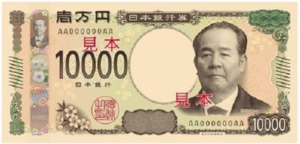
Baron Shibusawa is known as the ‘Father of Japan’s Modern Economy of Japan,” and recognized for having launched Japan’s first national bank, as well as helping start hundreds of other business ventures, many of which exist to this day. He also supported hundreds of social welfare organizations. To honor his memory in 2024, Baron Shibusawa’s likeness will be on the face of the highest denomination Japanese currency bill, the ten thousand yen note.


General visitors are most welcome to explore this material, while at the same time this blog post invites those who are able to kindly assist in identifying the attendees at this important 1915 diplomatic event. Small segments of the restored 1915 photo have been enlarged and each attendee has been given an ID number, with the numbering starting from the upper right corner of the photo and moving counterclockwise around the large banquet table.

Thanks go to out to the American Historical Association for highlighting this blog post in their website discussion room, so my fellow AHA members from around the world  might contribute to the identification of the unknown guests at this 1915 event. AHA membership includes university professors, high school teachers, archivists, librarians, general historians, historical writers, along with many other professionals who share a passion for history.

Of the sixty-five guests, thus far a dozen prominent individuals have either been identified or their names are known as having been at this event. They include: presidents of universities, political and social rights activists, founders of publishing firms, newspaper editors, journalists, biographical and historical fiction authors, also business/finance and government leaders. This photo offers a new perspective on early U.S. Japan relations, while highlighting many of the most influential individuals in the U.S. over a century ago.

-This is an invitation to those individuals or organizations who are able to identify any of the as-of-yet unknown individuals in the 1915 Photo, please share your insights thru the Comment section at the end of this blog post. Please include the attendee’s ID number and anything else you might know about that person, including internet links when available. Thank you so much for being part of  what I believe will be an engaging and enjoyable historical research project, and how exciting to see from where around the world this information will come from.

Thank you.


The Shibusawa Eiichi Memorial Foundation / Shibusawa Memorial Museum


This fine organization located in Tokyo commemorates the legacy of Baron Shibusawa Eiichi, known for his high ethical values in business and for his many social welfare/humanitarian contributions. The museum collects and displays documents and artifacts from his life. Adjoining the main museum building is the tranquil Old Shibusawa Garden. That garden and two structures from the original Shibusawa estate, the Bankoro Cottage and the Seien Bunko Library, date from the Emperor Taisho era (1912–26). These buildings have been designated as Important Cultural Properties by the Japanese government.

The Head Librarian for the Information Resources Center of the Shibusawa Eiichi Memorial Foundation, Toru Shigehara, kindly assisted in my research. They knew of the December 3rd 1915 banquet event based on a December 4th, 1915 New York Times article which mentioned the event and gave the names of some attendees, but they weren’t aware a photo had been taken of this event. They found it most surprising and exciting to hear that former U.S. Presidents Theodore Roosevelt and William Howard Taft had attended, because the December 4th, 1915 New York Times article made no mention of this. Below is a Review:

“Dear Dr. Stan S. Katz,
We appreciate your kindness and all the work you have done to promote understanding of Shibusawa Eiichi and US-Japan relations as a whole. I wish you all the best in your current and future endeavors.

With gratitude,”

Toru Shigehara: Head Librarian/Information Resources Center,
Shibusawa Eiichi Memorial Foundation and Museum located in Japan

——————————————————————————————————-

Of the sixty-five attendees at the event, the December 4th, 1915 New York Times article only mentioned the below ten individuals: Comparison photos could be found online for nine of them. Only one, M. Zumoto, had no photos available.  Four additional attendees have since also been identified, leaving fifty-two guests yet to be recognized. One possible clue: some attendees might have been members of the Japan Society or the Nippon Club. Both are U.S. Japan goodwill organizations that continue to be active to this day and are located in New York City.

Below are the names given in the New York Times article.

  • Baron Shibusawa Eiichi
  • Willard D. Straight
  • Osward G. Villard
  • William Morgan Shuster
  • Dr. Albert Shaw 
  • Don C. Seitz 
  • Edward J. Wheeler
  • Dr. Toyokichi Iyenaga (one of the two hosts for the 1915 event)
  • Dr. Jōkichi Takamine (the other host for the 1915 event)
  • M. Zumoto – both the translator and secretary for Baron Shibusawa. He was also a part owner and editor of The Japan Times – Japan’s largest and oldest English-language daily newspaper, currently  published by The Japan Times, Ltd. (株式会社ジャパンタイムズ) of Tokyo. M. Zumoto was also the Director of the Oriental Information Agency of New York.


During the 1915 diplomatic event there was a frank discussion presented between Baron Shibusawa and Willard D. Straight on the following topics:

-How to improve relations between the U.S. and Japan.

-How to eliminate injustices and discrimination against Japanese-Americans living in the U.S.

-Both Shibusawa and Straight felt optimistic about Japan-U.S. relations and that problems could be solved with justice and benefit to both nations.

– They discussed the possibility of the U.S. and Japan working together to peacefully assist China in her development, to the economic gain of all three nations. The translator for Baron Shibusawa was M. Zumoto.

-Another discussion was between Osward G. Villard and Morgan Shuster regarding the recent outbreak of war in Europe. They recognized the U.S. might soon find itself in that conflict. They discussed how America’s resources might best be spent in preparation for that conflict. They commented that Japan and America should work together to go against the “criminal” powers who had started the war.

-Other speakers at the Baron Shibusawa event were Dr. Albert Shaw, Don C. Seitz, and Edward J. Wheeler.

Source: New York Times, December 4th, 1915: “Plea for Japanese Now in California: Baron Shibusawa Asks That Fair Treatment Be Accorded in Land Legislation. / Opportunities in China / He Urges That This Country Combine with Japan in Developing New Republic.”

During his 1915 visit to the U.S., Baron Shibusawa also met with President Woodrow Wilson.

What is most surprising about this 1915 banquet event is that in spite of the many magazine and newspaper editors and journalists in attendance, the media made no mention of Theodore Roosevelt and William Howard Taft being in attendance to honor Shibusawa – The reasons for this secrecy are open to conjecture, perhaps, with WWI having just begun in Europe, it was considered prudent not to advertise where U.S. and Japanese leaders could be targeted, in that these two nations would find themselves playing an essential role in the Allies’ victory in that major conflict.


TABLE OF CONTENTS

Prior Introduction

Section I – Presentation of larger segments from the 1915 banquet photo.

Section II – Presentation of smaller segments from the 1915 banquet photo, which have been further enlarged to aid in individual identification.

Section III – List of the already recognized attendees, with the source photos that helped identify them. This section will include crediting those who assisted in identifying them.


Section I

Below are some larger sections of the restored 1915 photo:

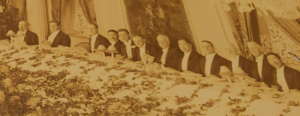
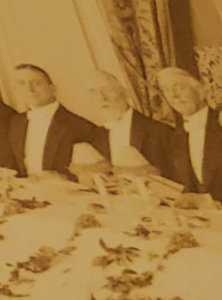
The first two photos highlight where during the event, Baron Shibusawa had probably been seated near Theodore Roosevelt – Roosevelt is centered beneath a grand chandelier and just two seats to his right is the vacant chair where Shibusawa sat. It took creativity on the part of the photographer to capture such a large gathering in one photo. Shibusawa went to the other end of the table to stand near William Howard Taft, allowing the photographer to incorporate all the attendees into one photo, while at the same time capture a larger image of their honored guest, Shibusawa. [Notice the reflection in the mirror behind Roosevelt, it reveals the front section of the table.] This event took place at Sherry’s, one of the most impressive New York City banquet facilities of its time.  


Enlarged segment from the restored photo.


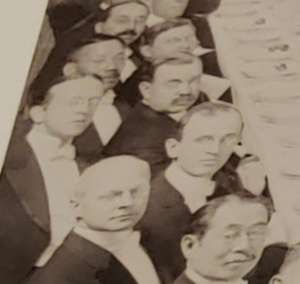
Further enlarged section from the prior photo, highlighting Theodore Roosevelt centered beneath the chandelier.   

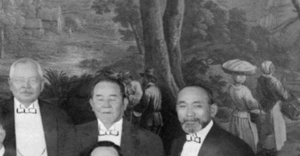
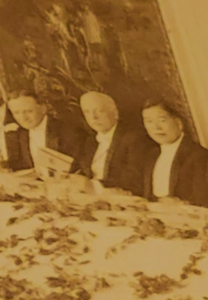
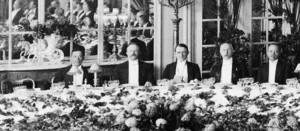
Shown below, Shibusawa is at the other end of the table closer to William Howard Taft (seated far right, next to the gentleman whose image reveals only half of his face).


Standing at Shibusawa’s right is the Japanese-American Dr. Jōkichi Takamine, one of the two hosts for this event. Dr. Takamine was a highly successful and respected chemist and businessman who helped establish a pharmaceutical company that continues to this day. Standing at Shibusawa’s left side is Count Chinda Sutemi Japanese Ambassador to the U.S.

Dr. Takamine, Ambassador Sutemi, Prince Tokugawa, and President Taft were all closely linked to the gifting of the cherry blossom trees to Washington, D.C. in 1912. Further details of this Japanese gift are presented in another blog post on this website.


Section II – Presentation of smaller segments of 1915 banquet photo:


Attendees Right to Left: 1, 2, 3

1- Unknown

2- William Howard Taft (September 15, 1857 – March 8, 1930) the 27th president of the United States (1909–1913). Taft was the chosen successor of Theodore Roosevelt, and was succeeded by Woodrow Wilson. After Taft’s presidency, he became the 10th Chief Justice of the United States from July 11, 1921 – February 3, 1930, the only individual to hold both offices.

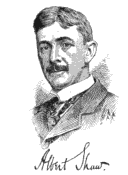
3- Albert Shaw (July 23, 1857 – June 25, 1947) was a prominent American journalist and academic of the early 20th century. In 1890, Shaw was elected professor of international law and political institutions at Cornell University, but resigned the post in 1891 to establish an American edition of the Review of Reviews. The Review of Reviews was a noted family of monthly journals founded in 1890-1893 by British reform journalist William Thomas Stead (1849–1912): It was established across three continents in London (1891), New York (1892) and Melbourne (1893). Shaw served as editor-in-chief of this publication until it ceased publication in 1937. Shaw was also a member of the American Antiquarian Society (AAS), located in Worcester, Massachusetts. This AAS was both a learned society and national research library of pre-twentieth century American history and culture. Founded in 1812, it is the oldest historical society in the United States with a national focus.


Attendees Right to Left: 4, 5, 6


4- Unknown


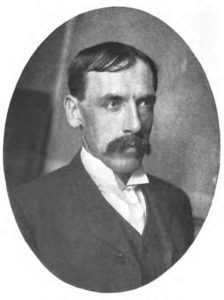
5- Edward Jewitt Wheeler (1859-1922) was the Editor of The Literary Digest. The Literary Digest was an influential American general interest weekly magazine published by Funk & Wagnalls. Founded by Isaac Kaufmann Funk in 1890, it eventually merged with two similar weekly magazines, Public Opinion and Current Opinion. Beginning with early issues, the emphasis was on opinion articles and an analysis of news events. It offered condensations of articles from American, Canadian and European publications. Type-only covers gave way to illustrated covers during the early 1900s. In the 1920s, the covers carried full-color reproductions of famous paintings. By 1927, The Literary Digest climbed to a circulation of over one million. In 1938, it merged with the Review of Reviews, only to fail soon after. Its subscriber list was bought by Time.

Wheeler was also the Editor of The Voice, 1884-1898; President of the Poetry Society of America, 1909-1919; Trustee of Ohio Wesleyan University; Officier de l’Instruction Publique. He was also Managing Editor of The Homiletic Review, a temperance publication.

Wheeler also served as Secretary of the Westerleigh Collegiate Institute (1896–1900). Westerleigh Collegiate Institute was the first school on Staten Island to provide a complete kindergarten-to-college education; the surrounding neighborhood, previously called National Prohibition Park, gradually came to be known as Westerleigh.


6- Unknown


Attendees Right to Left: 7, 8, 9

7- Count Chinda Sutemi (珍田 捨巳, January 19, 1857 – January 16, 1929) was the Japanese Ambassador to the U.S. at the time of the 1915 banquet event. Sutemi studied at DePauw University and got his B.A. in 1881, and M.A. in 1884. From 1890 to 1894, he served as Japanese Consul in San Francisco, California. In 1897, he was appointed first Japanese Minister Plenipotentiary to Brazil, following the establishment of diplomatic relations between the two states in 1895. He served as Japanese Ambassador to Germany from 1908 to 1911, to the United States from 1912 to 1916, and to the United Kingdom from 1916 to 1920, during which time he took part in the Japanese delegation to the Paris Peace Conference in 1919 at the end of WWI…Sutemi was also a Methodist minister.

Count Chinda stood at Shibusawa’s left side, and Dr. Jōkichi Takamine was on Shibusawa’s right side in the photo: Ambassador Chinda and Dr. Jōkichi Takamine are closely linked to the gifting of cherry blossom trees to Washington, D.C. in 1912. It was Ambassador Chinda’s wife Japanese Viscountess Iwa Chinda and President Taft’s wife First Lady Helen Herron Taft, who each ceremonially planted one of the first two Japanese gifted cherry blossom trees in the U.S. Capital in 1912. This diplomatic gesture has since become the annual National Cherry Blossom Festival, one of the most celebrated goodwill events in Washington, D.C., attended by hundreds of thousands of Americans and visitors from around the world.


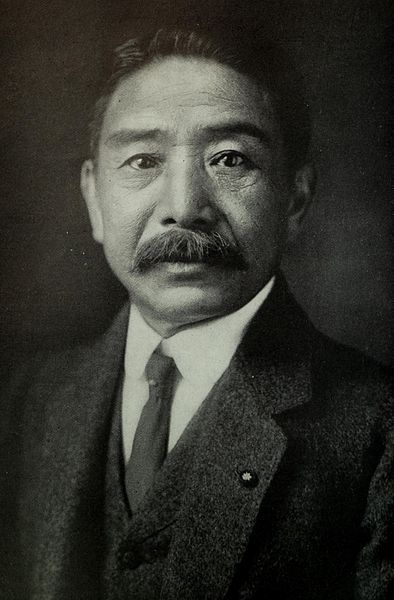
8- Baron Shibusawa Eiichi (渋沢 栄一, March 16, 1840 – November 11, 1931)


9- Dr. Jōkichi Takamine (高峰 譲吉, November 3, 1854 – July 22, 1922) a famous chemist and highly successful businessmen, who became the first President of Sankyo Company, Ltd., a pharmaceutical company. Sankyo Company Ltd. was founded in 1899, and was initially named Sankyo Shoten Company Ltd. It was launched through a joint investment by businessmen Matasaku Shiobara, Shotaro Nishimura and Genjiro Fukui. Two of their first successful products were the digestive enzyme Taka-Diastase® (launched in 1894, Dr. Jokichi Takamine discovered the enzyme from a fungus). In 1902, they launched Adrenalin®, an adrenal cortex hormone agent. Dr. Jokichi Takamine had discovered and patented the isolation of adrenalin. In 1910, Dr. Umetaro Suzuki, a future Sankyo scientific adviser, made the world’s first discovery of vitamin B1 (Orizanin®) in rice bran and established a foundation for the theory of vitamins.

In 1913, Sankyo Shoten Company, Ltd., changed its name to Sankyo Co., Ltd, and appointed Dr. Jokichi Takamine as its first president. He remained its president from March 1913 – July 1922.

In 2005, Sankyo Shoten Company, Ltd., merged with Daiichi Pharmaceutical Company, Ltd., both of them were century-old pharmaceutical companies. The name of the company from this merger is Daiichi Sankyo Company Ltd., a global company and the second largest pharmaceutical company in Japan. It is a producer of medical equipment, pharmaceutical products, and veterinary medicines. Number of employees 32,229 (as of December 2013). Company headquarters: Tokyo, Japan.

Sources: Wikipedia and the pharmaceutical company website: www.daiichisankyo.com

Additional information about Dr. Jōkichi Takamine: in 1905, he established The Nippon Club, to tighten the unity of the Japanese community and to develop a better relationship with the American people. Since then, The Nippon Club, which is the only Japanese social club in the U.S., has contributed to the continued friendship, not to mention ongoing business and cultural exchange between the two countries through various events, workshops and cultural classes. By holding athletic events and cultural activities, as well as by providing the facilities where these events can occur, The Nippon Club has cemented itself as one of New York City’s oldest cultural institutions. It continues to serve the community from the center of the world’s most international metropolitan area. Source: The Nippon Club website.


Attendees Right to Left: 10, 11, 12

10- Unknown

11- Willard Dickerman Straight (January 31, 1880 – December 1, 1918) American investment banker, publisher, reporter, Army Reserve officer, diplomat and by marriage, a member of the Whitney family. Straight was the founder of the American magazine: The New Republic, which remains one of the most influential liberal magazines in the United States from its launch in 1914. The magazine was begun by Straight with Herbert David Croly as its editor. The New Republic reflected the progressive movement and sought reforms in American government and society. Among its early editors or contributors were Randolph Silliman Bourne, Walter Lippmann, and Malcolm Cowley. The journal supported the formation of labour unions, the eight-hour workday, and woman suffrage. It also supported President Woodrow Wilson’s foreign policy during World War I, but later broke with him and opposed the Treaty of Versailles. The magazine’s popularity declined in the 1920s, when its liberal viewpoint was out of favour, but it revived in the 1930s. After earlier opposing him, The New Republic ended up supporting President Franklin D. Roosevelt’s administration and the New Deal. Source: The Editors of Encyclopaedia Britannica…Today, The New Republic continues to take a largely modern liberal stance on governmental fiscal policies and social issues.

12- Unknown


Additional notes:

During Baron Shibusawa’s 1915 visit to New York City, he was also the luncheon guest of Colonel Theodore Roosevelt (oldest son of former President Theodore Roosevelt) at Oyster Bay in Nassau County, on the North Shore of Long Island, 25 miles east of Manhattan. George Walbridge Perkins and Clarence H. Mackay were present at this luncheon to meet Baron Shibusawa.

While in the U.S., Baron Shibusawa also enjoyed a visit to the Pan-Pacific Exposition of 1915-1916, held in San Diego, California. The current expansive Balboa Park in San Diego, is largely composed of exhibition buildings from that wonderful event. The first beginnings of the Japanese Friendship Garden in Balboa Park, began with a popular Japanese Teahouse at that exposition.


Below are some larger segments from the 1915 restored photo. Certain segments of the photo have greater clarity in the half-tone versus the black and white version:


Right to left: Attendees numbered from 1 to 27


Right to left: Attendees numbered 10 to 27


Attendees Right to Left: 13, 14, 15

13- William Morgan Shuster (23 February 1877 in Washington, D.C. – 26 May 1960 in New York City), was an American lawyer, civil servant, and publisher, who is best known as the treasurer-general of Persia by appointment of the Iranian parliament, or Majles, from May to December 1911. Shuster tried to free Persia from Russian and British colonialism, so Persia could gain independence and control its own destiny. Shuster felt he could improve the Persian economy. However, due to great pressure put on him by Russia and Britain, Shuster was forced to leave Persia. He felt bitter and wrote a book condemning the colonial powers. Upon his return to the U.S., Shuster entered the publishing industry and became president of Century Publishing in New York. He led the firm, which had been established in 1870, through a merger with Appleton in 1933 and Crofts in 1947. By his death in 1960 the firm was known as Century-Appleton-Crofts.

14- Unknown

15- Unknown


Attendees Right to Left: 16, 17, 18

16- Unknown

17- Unknown

18- Unknown


Attendees Right to Left: 18 to 29


Attendees Right to Left: 19, 20, 21

19-  Don Carlos Seitz (1862-1935) American newspaper correspondent and manager. He was also an accomplished biographer and historian. He served as city editor (1889–91) of the Brooklyn Eagle, assistant publisher of the New York Recorder (1892–93) and managing editor of the Brooklyn World (1893–94), and thenceforth was connected with the New York World as advertising manager (1895–97) and as business manager after 1898.  Note: The Brooklyn Eagle, originally The Brooklyn Eagle and Kings County Democrat, was a daily newspaper published in the city and later borough of Brooklyn, New York, for 114 years from 1841 to 1955.

Don Carlos Seitz’s historical books and biographies include: Discoveries in Everyday Europe (1907), Writings by and about James McNeill Whistler (1910), Elba and Elsewhere (1910), Letters from Francis Parkman (1911), The Buccaneers (1912), Whistler Stories (1913), Braxton Bragg, general of the Confederacy (1924), Joseph Pulitzer; HIs Life and Letters (1924), Under the Black Flag: Exploits of the Most Notorious Pirates (1925), The Great Island: Some observations in and about the Crown Colony of Newfoundland (1926), and The James Gordon Bennetts: Father and Son Proprietors of the New York Herald (1928, a biography about newspaper publishers).


20- Unknown

21- Unknown


Attendees Right to Left: 22, 23, 24

22- Unknown

23- Unknown

24- John Huston Finley (October 19, 1863 – March 7, 1940) was a Professor of Politics at Princeton University from 1900 to 1903, and the third President of the City College of New York from 1903 until 1913, when he was appointed President of the University of the State of New York and the 2nd Commissioner of Education of the State of New York from 1913–1921. He was also the 9th President of the American Geographical Society from 1925–1934 – His position in the American Geographical Society placed him in contact with the great explorers and fliers of the day, who signed their names for him on a terrestrial globe, which he presented to the Society in 1929. During World War I he headed the Red Cross Commission in Palestine.

In 1921 Finley was appointed The New York Times associate editor. On April 21, 1937, The Times announced Dr. Finley’s appointment as editor-in-chief. He held that position until Nov. 16, 1938, when because of poor health he took the title of editor emeritus. During his long distinguished career he received honorary degrees from over thirty colleges and universities, and twelve governments bestowed thirteen decorations on him.

During the 1915 banquet event honoring Shibusawa, John H. Finley recalled an incident when the Baron visited the U.S. back in 1902. Mr. Finely stated that writing poetry was a passion for Baron Shibusawa. Finley related that Baron Shibusawa had become friendly with Townsend Harris, the first American Minister to Japan, who went there in 1856 and stayed many years. Mr. Harris died in New York in 1878, and on the day of Baron Shibusawa’s arrival to New York in 1902, he asked to be taken to his friend’s grave. When he reached it he pinned a personal poem he had written to Mr. Harris upon the tree overhanging the grave.


Attendees Right to Left: 25, 26, 27

25- Unknown

26-Unknown

27- Unknown

Vacant Seat between 27 and 28: presumed to be where Count Chinda Sutemi Japanese Ambassador to the U.S. sat during this event.


Attendees Right to Left: 28, 29

28- Unknown

29- Unknown


Attendees Right to Left: 28 to 54  


Attendees Right to Left: 30, 31, 32, 33, 34

30- Unknown

31- Unknown

32- Unknown

33- Theodore Roosevelt (October 27, 1858 – January 6, 1919) 26th President of the United States: in office September 14, 1901 – March 4, 1909

34- Dr. Toyokichi Iyenaga (1862-1936) one of the two hosts of the 1915 banquet. Dr. Iyenaga was Japanese by birth, but came to America early in his life, where he received a PhD degree from Oberlin in 1887 and a PhD degree from Johns Hopkins in 1890. After his education in the United States, he returned to Japan and from 1890 to 1895 he was professor of political science at Waseda University and Higher Commercial College in Tokyo, Japan. In 1895 he was appointed secretary for the Department of Foreign Affairs, and in 1898 he became a commissioner of the Formosan government to India, Persia, Turkey, and China. He was also lecturer at the University of Chicago from 1901 to 1920 and at Columbia University from 1913 until retirement. While in New York he operated a news bureau known as the East and West. He also spent some time in Washington, D.C. as an aide to the Japanese ambassador to the United States.


The Vacant seat between 34- Dr. Toyokichi Iyenaga and 35- Jacob Henry Schiff is presumed to be where Baron Shibusawa Eiichi sat during this event. This would place Dr. Toyokichi Iyenaga between Baron Shibusawa and Theodore Roosevelt to assist in translation between these two statesmen.


Attendees Right to Left: 35, 36, 37, 38, 39, 40

35- Jacob Henry Schiff (born Jakob Heinrich Schiff; January 10, 1847 – September 25, 1920) was a Jewish-American banker, businessman, and philanthropist. He helped finance the expansion of American railroads and the Japanese military efforts against Tsarist Russia during the 1904-1905 Russo-Japanese War.

Born in Frankfurt, Germany, Schiff migrated to the United States after the American Civil War and joined the investment firm Kuhn, Loeb & Co. From his base on Wall Street, he became a foremost Jewish leader from 1880 to 1920 in what later became known as the “Schiff era.” He grappled with all major Jewish issues and problems of the day, including the plight of Russian Jews under the Tsar, American and international anti-Semitism, care of needy Jewish immigrants, and the rise of Zionism. He became a director of many important corporations, including the National City Bank of New York, Equitable Life Assurance Society, Wells Fargo & Company, and the Union Pacific Railroad. As a sign of the close relationship with Baron Shibusawa, in the 1915 banquet, Mr. Schiff sits at the right side of Baron Shibusawa.

36- Unknown

37- Unknown

38- Unknown

39- Unknown


Attendees Right to Left: 39, 40, 41, 42,

40- Oswald Garrison Villard (1872–1949), was the publisher of both the New York Evening Post (which describes itself as the nation’s oldest continuously published daily newspaper), and The Nation (the oldest continuously published weekly magazine in the United States, covering progressive political and cultural news, opinion, and analysis). Oswald was the son of railroad tycoon Henry Villard and grandson of abolitionist William Lloyd Garrison. He used his fortune to promote liberal causes, including women’s suffrage, anti-imperialism, and Negro uplift. Villard originally supported Booker T. Washington, believing education was the solution to the “Negro problem,” but the Brownsville affair and Atlanta riot convinced him of the need for a stronger strategy. The “Committee for the Advancement of the Negro Race” (1906) he envisioned became the blueprint for the NAACP. Villard funded the NAACP’s budget and provided free office space in the New York Evening Post building.

41- Unknown

42- Believed to be Motosada Zumoto (aka M. Zumoto) the Japanese with dark mustache. Zumoto was both the translator and secretary for Baron Shibusawa – He was also a part owner and editor of The Japan Times – Japan’s largest and oldest English-language daily newspaper, currently  published by The Japan Times, Ltd. (株式会社ジャパンタイムズ) of Tokyo. M. Zumoto was also the Director of the Oriental Information Agency of New York. A full facial image of M. Zumoto is presented at the end of this blog in Section III. This image comes from another blog post on this website that presents a 1934 diplomatic event. 


Attendees 39 to 54, starting from the back of the photo and moving forward


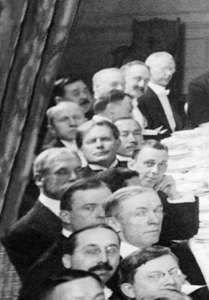
Attendees 43 to 48 starting with the individual furthest back and moving forward:

43- Unknown (not looking forward)

44- Unknown

45-Unknown

46- Unknown

47- Unknown (resting head on his hand)

48- Unknown (eyes looked closed)

49- Unknown [only the top of his head is shown and his face does not appear in the following photo. A mystery guest.


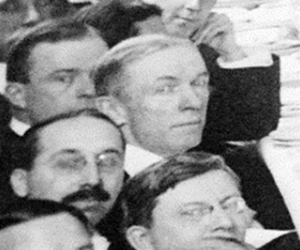
Attendees 50 to 53 starting with the individual furthest back and moving forward:

50- Unknown

51- Unknown (entire face shown)

52- Unknown (has mustache)

53- Unknown (wearing glasses, chin is not visible)


Larger view of the left side of the banquet table: Attendees 35 to 61


Attendees 52 to 59 starting with the individual furthest back and moving forward:

52- Unknown (has dark mustache; was shown in prior photos)

53- Unknown (shown in prior photos)

54- Unknown (looks Asian or African American?)

55- Unknown (brown mustache)

56- Unknown

57- Unknown

58- Unknown

59- Unknown


Attendees 58 to 61 starting with the individual furthest back and moving forward:

58- Unknown (also listed in earlier photo)

59- Unknown (also listed earlier photo)

60- Unknown

61- Unknown


Left to Right: Attendees 61 to 65

The Vacant chair between attendees 63 and 64 is presumed to be where Dr. Jōkichi Takamine sat during this event. As one of the two hosts of this event, Dr. Takamine likely sat at one end of the large banquet table near William Howard Taft, while the other host, Dr. Toyokichi Iyenaga, sat at the other end of the table between Baron Eiichi Shibusawa and Theodore Roosevelt, allowing him to serve as a translator for these two statesmen.


Left to Right: Attendees 62 to 63

62- Unknown

63- Unknown


From Left to Right: Attendees 64 to 65

64- Unknown

65- Unknown


Based on suggestions from The American Historical Association fellow members and further research, here are the names of some Japanese who accompanied Baron Shibusawa during his 1915 visit to the U.S., who might be in the 1915 photo:

  • M. Zumoto – editor/part-owner of Japan Times, Director of the Oriental Information Agency of New York, both the translator and secretary for Baron Shibusawa.
  • The Baron’s son: T. Shibusawa
  • The Baron’s son M. Shibusawa
  • M. Masuda, the private secretary for Baron Shibusawa
  • Z. Horikoshi, a silk merchant who also accompanied Baron Shibusawa during his 1909 visit to the U.S.
  • K. Noguni
  • S. Hoyomi
  • I. Wakita, managing Director of the Tokyo-Sakaye Bank
  • T. Yokoyama – businessman 
  • K. Noguchi on the staff of the First Bank of Tokyo


Section III

As displayed above in Section II, there were many fascinating and inspiring individuals who attended the 1915 event honoring Baron Shibusawa’s visit. 

Below are the photos that were utilized for comparison.

This section will also include the names of those individuals and organizations who assist in identifying the guests at this event.


2-    William Howard Taft

Image result for william howard taft

Circa 1915  Photo source: Biography.com


3-           Albert Shaw

File:Portrait of Albert Shaw.jpg

Circa 1910                                             Circa 1989  

Photo source: Wikipedia


5-      Edward Jewitt Wheeler


Circa 1900. In the above photo he is forty-one years old.

In 1915, during the Shibusawa banquet, he was fifty-six years old.


7-     Count Chinda Sutemi Japanese Ambassador to the U.S.

File:Picture of Chinda Sutemi.jpg

Circa 1913 Photo source: Harris & Ewing


8-      Baron Shibusawa Eiichi

Circa 1918  Photo source: Wikipedia


9-          Jōkichi Takamine

File:Jokichi Takamine.jpg

Circa 1920  Photo source: Science History Institute


11-   Willard Dickerman Straight


Circa 1915  Photo source: Geni.com


13-      William Morgan Shuster


Circa 1912  Photo source: Wikipedia


19-       Don Carlos Seitz (1862-1935)


1931  Photo Source: The Library of Congress

In the above photo he was 69 years old.

In the 1915 photo, he was 53 years old.


24-     John Huston Finley (October 19, 1863 – March 7, 1940)


The above photo is labelled as no later than 1903 – Source: Wikipedia

John Huston Finley appears to be 40 years old.

How would he look twelve years later? 

In the 1915 banquet photo, he was 52 years old.


33-       Theodore Roosevelt

1911  Photo source: U.S. National Park Service


34-      Dr. Toyokichi Iyenaga


March 10, 1918  Photo source: Underwood & Underwood 


35-    Jacob Henry Schiff


1903 – Photo source: Wikipedia


40-             Oswald Garrison Villard


 Circa 1910  Photo source: NAACP Collection, Prints and Photographs Division, Library of Congress.


42-          M. Zumoto


February 27th, 1934 – Source: TheEmperorAndTheSpy.com photo archives


Section IV

The illustrated biography of Prince Tokugawa Iesato brings to life this fascinating period of history and the friendship and alliance between Prince Tokugawa and Baron Eiichi Shibusawa, as they promoted goodwill between the US and Japan.


Available in a Print and Kindle EBook Edition


Prince Tokugawa Iesato’s biography is also available in an expanded digital edition titled: THE ART OF PEACE. 

This edition is similar to THE ART OF DIPLOMACY, but it presents an additional 100 pages of historical notes to assist researchers.

Both versions offer a new significant perspective on U.S. Japan relations during the first half of the 20th Century.


Filed Under: Tokugawa Archives Tagged With: 1915, 1915 Diplomatic Banquet event, American Antiquarian Society, American edition of the Review of Reviews, Baron Eiichi Shibusawa, Baron Shibusawa, Baron Shibusawa Eiichi, Booker T. Washington, Century-Appleton-Crofts, Clarence H. Mackay, Colonel Theodore Roosevelt, Count Chinda Sutemi, Count Chinda Sutemi Japanese Ambassador to the U.S., December 3, Dinner to Baron Shibusawa. East & West Meeting, Don C. Seitz, Don Carlos Seitz, Don Seitz, Dr. Albert Shaw, Dr. Jōkichi Takamine, Dr. Takamine, Dr. Toyokichi Iyenaga, Editor of The Literary Digest, Edward J. Wheeler, Edward Jewitt Wheeler, Eiichi Shibusawa, Father of Japan’s Modern Economy of Japan, George Walbridge Perkins, Henry Villard, Herbert David Croly, History of American edition of the Review of Reviews, History of Century Publishing, History of Equitable Life Assurance Society, History of Japanese Friendship Garden, History of Kuhn, History of National City Bank of New York, History of New York Evening Post, History of the Japan Times, History of the Japanese Diet, History of the NAACP, History of The Nation magazine, History of the National Cherry Blossom Festival, History of the Nippon Club, History of the Poetry Society of America, History of the Union Pacific Railroad, History of Wells Fargo & Company, Isaac Kaufmann Funk, Jacob Henry Schiff, Jacob Schiff, Japan and WWI, Japan Times, John H. Finley, John Huston Finley, Loeb & Co., M. Zumoto, M. Zumoto - translator for Baron Shibusawa, NAACP, National Cherry Blossom Festival, Oswald Garrison Villard, Osward G. Villard, Pan-Pacific Exposition, Poetry Society of America, President of the Japanese Diet, President Taft, President Theodore Roosevelt, President Woodrow Wilson, Prince Iyesato Tokugawa, Prince Tokugawa, Prince Tokugawa Iesato, Prince William Howard Taft, Roosevelt and Japan, Russo-Japanese War, Sankyo Shoten Company, Sherry's Restaurant, Sherry’s New York City, Shibusawa Eiichi, Shibusawa Eiichi Memorial Foundation, Shibusawa Memorial Museum, Stan S. Katz, Taft and Japan, The Art of Peace, The Art of Peace biography, The Emperor and the Spy, The New Republic magazine, The Nippon Club, The Shibusawa Eiichi Memorial Foundation / Shibusawa Memorial Museum, TheEmperorAndTheSpy.com, Theodore Roosevelt, Townsend Harris, U.S. Japan relations, U.S.-Japan History, Whitney family, Willard D. Straight, Willard Dickerman Straight, William Howard Taft, William Lloyd Garrison, William Morgan Shuster, William Shuster, World War One, WWI and Japan, www.shibusawa.or.jp/english/museum/, 渋沢 栄一, 珍田 捨巳, 高峰 譲吉

Copyright © 2026 Stan S. Katz