Stan. S. Katz

Author of The Emperor and the Spy

  • Home
  • Author
  • Books
  • Reviews
  • Educators
  • News
  • Audiobook & Timeline
  • Mashbir Archives
  • Tokugawa Archives
  • Contact
Follow Stan on FacebookFollow Stan on TwitterFollow Stan on GoodreadsFollow Stan on RSS

Sign Up for Future Blogs Linked to Colonel Mashbir and Japanese History

Read the Intro Posts

INTRODUCTION TO THE ART OF PEACE

WELCOME!

Recent Posts

  • San Diego Jewish Journal Holocaust Remembrance Edition May 2016 highlights the historical novel, The Emperor and the Spy and the outstanding achievements of Colonel Sidney Mashbir.
  • The Emperor and the Spy, was one of two books highlighted during academic/diplomatic event sponsored by the Prime Minister’s Office of Japan and hosted by San Diego World Affairs Council
  • Osher Lifelong Education Institute – UCSD Presentation. Remarkable story, the alliance between a patriotic U.S. Intelligence Agent, Colonel Sidney Mashbir, and a humanitarian Japanese International Statesman, Prince Iyesato Tokugawa, who heroically delayed and attempted to prevent WWII in the Pacific.
  • Tokugawa & Komatsu, Forgotten Heroes – Until his passing in 1940, Prince Iyesato Tokugawa held back WWII in the Pacific – Tokugawa’s diplomatic legacy lived on after WWII ended, when his protégé, Takashi Komatsu, guided the US and Japan to again become friends and allies.
  • Have you ever wondered how US and Japan re-established their friendship and alliance following the trauma of WWII? Here’s a new biography that honors an amazing Japanese American statesman, Takashi Komatsu, who guided this major achievement.

Archives

Establishing the “Prince Tokugawa US Japan Memorial Fund” – promoting peace, democracy, and a love of music.

September 29, 2021 by Stan S. Katz Leave a Comment

A MEMORIAL FUND THAT ENCOURAGES PEACE, DEMOCRACY, AND A LOVE OF MUSIC.

Your suggestions are welcome. 

[email protected]

*****************************************************************************
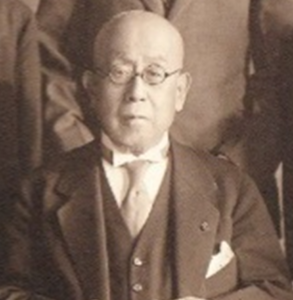
 

Prince Tokugawa Iesato (aka Prince Iyesato Tokugawa, 1863-1940) 

Potential names for the foundation:

Tokugawa US Japan Memorial Fund: honoring the memory of Prince Tokugawa, promoting global peace and democracy, and a love for music in children. 

Tokugawa Memorial Fund: honoring the memory of Prince Tokugawa, promoting global peace and democracy, and a love for music in children. 


MISSION STATEMENT:

This non-profit memorial fund would emphasize the strong continuing alliance between the US and Japan, and the broader message of international peace and democracy. Grants would be given to organizations and individuals who have contributed to these admirable goals.

Based on Prince Tokugawa’s strong connections to the visual arts and music, the theme for this foundation might also go the route of supporting children’s access to the wonderful world of music. Prince Tokugawa encouraged the sharing of Japanese music with the Western world, and brought an appreciation to Japan of music from the West.

It is believed there would be strong support for this memorial fund from a wide array of individuals and businesses who encourage the ongoing amity between the US and Japan. 

This memorial fund would give recognition to the educational / political affairs organization the San Diego World Affairs Council (SDWAC) and its national organization, the World Affairs Councils of America (WACA), the largest non-profit, non-partisan, educational/political affairs organization in the United States.

Prince Tokugawa held distinguished leading roles in many diplomatic organizations during his career, some of these organizations continue to this day. There are also other more recent Japanese and US Japan international goodwill organizations who might well have interest in assisting in the launching of a memorial fund that honors one of Japan’s great humanitarian statesmen.

Below is a growing initial list of organizations in the fields of education/diplomacy/cultural exchange, who would be contacted. 

–Japan Society of New York

–America-Japan Society headquartered in Tokyo.

–Sasakawa Peace Foundation USA

–East West Center

–Praemium Imperiale: Honors the memory of Prince Takamatsu (who was the nephew of Prince Tokugawa).

–Tokugawa Art Museum in Japan

–Tokugawa History Museum in Japan

-National Museum of American Diplomacy – A Museum in Development. Located at the U.S. Department of State in Washington, D.C., the National Museum of American Diplomacy is a public-private partnership between the State Department and the Diplomacy Center Foundation. For the first time, visitors will have a unique experience at the only museum in the United States dedicated to the subject of diplomacy. No other museum brings diplomatic history to the forefront in its exhibits; no other institution is solely dedicated to collecting the artifacts of diplomacy.


POSSIBLE DISTRIBUTION OF GRANTS FROM THIS FOUNDATION

– 50% would on a yearly basis go to a non-profit organization such as Classics For Kids, which is an educational performing arts organization dedicated to inspire children through the experience of live music, generate creativity, academic success, and cultural understanding. Classics For Kids would oversee the Tokugawa Memorial Fund.

– The other 50% would on a yearly basis be gifted to non-profit organizations and/or individuals in recognition of their efforts to promote better international understanding, peace, and democracy. A ceremony honoring the recipients might be part of this gifting process.

For instance:

*10% might go to US Japan international goodwill organization, such as a student exchange program between Japan and the U.S.

*10% going to the World Affairs Councils of America to support their ongoing efforts to promote better international understanding.

*10% going to the San Diego World Affairs Council, a local chapter of the World Affairs Councils of America.

*10% going to the San Diego Diplomacy Council.

*10% going to a different nonprofit goodwill organization each year. Chosen by the administrators of the memorial fund.


Overview of some of Prince Tokugawa’s leadership positions and noble achievements

Prince Iyesato Tokugawa (1863-1940) was a Renaissance man, an adept diplomat and politician, who shared his passion for the arts, music, science, and nature to create cultural and political bridges between the East and the West, while also promoting mutual respect within Asia. He is was in many ways the leading diplomatic face of Japan during the first four decades of the 20th Century. Tokugawa befriended six US presidents and many other world leaders in the pursuit of peace. If not for his untimely passing in 1940, Japan would not have become an adversary of the Allies in WWII. 

However, during the aftermath of WWII, there was a joint US Japan political goal to expediently leave the war years behind them and reestablish a strong US Japan Alliance. And in that process, Prince Tokugawa’s amazing legacy has been forgotten and almost erased from history. It is hoped that by honoring the memory of this great statesman that it will result in a reduction of international tensions in Asia that are still linked to Japan’s role in WWII.

A man ahead of his time, Prince Tokugawa supported higher education and a greater voice for women in public affairs, and despite his powerful influence, he maintained his humility, often working behind the scenes, remaining unrecognized for many of his significant achievements.

Based on his adept domestic and international leadership skills, Prince Tokugawa would make a fine role model for our current leaders dealing with the urgent issues of today that require international cooperative efforts to solve. Below is a list of some of his prominent positions and accomplishments: 

–President of the Upper House of the Japanese Congress for thirty years.

–President of the Red Cross Society of Japan

–President of the Japanese Medical Association

–Took a pivotal role in establishing the  National Cherry Blossom Festival, the largest international goodwill celebration in the US Capital.

–Honorary Member of Rotary International, he was the Keynote Speaker at the 25th Anniversary of Rotary International, attended by 15,000 attendees from around the world. 

–President of the America-Japan Society

-Held many other Honorary positions with other organizations.

-Promoted the sharing/exchange of art and music, and even athletic sporting events to encourage international goodwill. 

-With the goal of preventing wars during the 1920s, Tokugawa took a leading role in the Washington Naval Conference, promoting the first international military arms limitations conference in history.

–Prince Tokugawa strove to maintain peace with China. When hostilities arose, he wished to protect innocent lives. Tokugawa led the Red Cross Society of Japan and the Red Cross International Conference to create demilitarized Safe Zones in Japanese controlled regions of China, such as in the city Shanghai. These safe havens helped save the lives of hundreds of thousands of Chinese civilians and tens of thousands of Jewish refugees fleeing the Holocaust in Europe.


–Lincoln Essay Contests in all Japanese public schools and public universities. Prince Tokugawa was quite aware of the discrimination that the Western powers had towards Asians during the age of colonialism and up into the first few decades of the 20th Century. Tokugawa, himself, had a British education and respected the many of the values of the Western nations. However, in order to eliminate their anti-Asian prejudices, Tokugawa guided Japan to set the example by sharing the humanitarian principle of treating others, as he would wish others to treat his fellow Asians. To achieve this, he incorporated Lincoln Essay Contests into all Japanese public schools and public universities. The goal of these writing contests was to honor the values of Abraham Lincoln in his efforts to eliminate racism against Blacks.
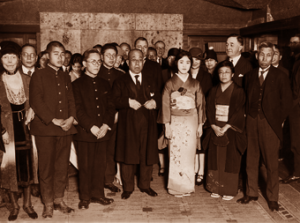
Prince Tokugawa honoring the university winners of the Lincoln Essay Contest during the 1920s

Photo courtesy of the Japan Society of New York.

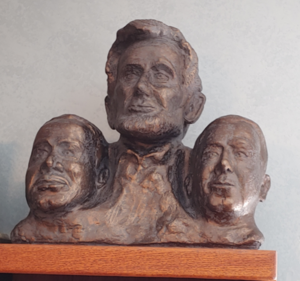
In recognition of Prince Tokugawa’s efforts to combat racism, the below bronze sculpture was created by the Stan S. Katz, the author of Prince Tokugawa’s biography. Replicas of this sculpture will be gifted to international goodwill organizations that wish to honor the memory of Prince Tokugawa. Prince Tokugawa is shown accompanied by President Abraham Lincoln and Dr. Martin Luther King Jr.
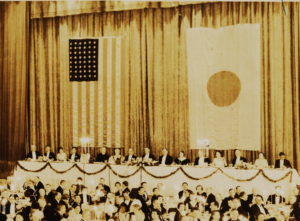


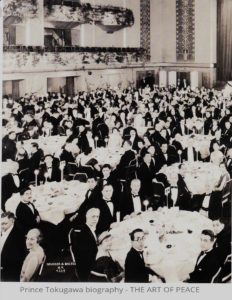
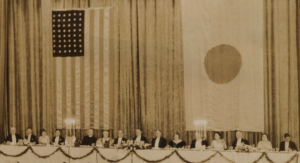
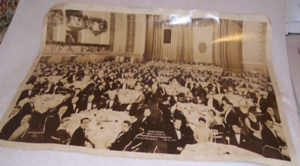
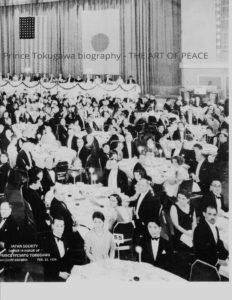
Japan Society’s Annual Dinner event honors Prince Tokugawa – Feb. 27, 1934. This diplomatic goodwill gathering took place at the Waldorf-Astoria Hotel, New York City. This photo is a segment of a much larger photo, where over 200 attendees showed their esteem for Prince Tokugawa during his visit to the US.

[Source of this rare photo: TheEmperorAndTheSpy.com website ]


In 1935 Prince Tokugawa invited thousands of educators from around the world to visit Japan for a one week academic conference. The goal to create a school curriculum that would encourage respectful treatment of other cultures and international peace.


One of Prince Tokugawa‘s closest Japanese allies in promoting international goodwill was Baron Shibusawa Eiichi (aka Baron Eiichi Shibusawa, 1840-1931).

Shibusawa was great humanitarian. He is also known as the “Father of the Japanese Modern Economy and Japanese Capitalism.”
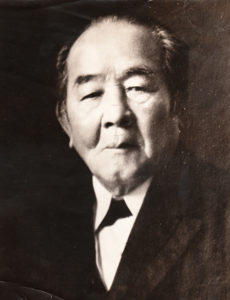
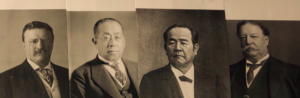
Presented above are two of the half dozen US Presidents that Prince Tokugawa and Baron Shibusawa allied with to promote US Japan goodwill: Theodore Roosevelt and William Howard Taft. 


Among his many creative efforts during the 1920s and ’30s to maintain friendship between Japan and the US, Prince Tokugawa allied with US military intelligence agent Colonel Sidney Mashbir during the 1920s and ’30s.
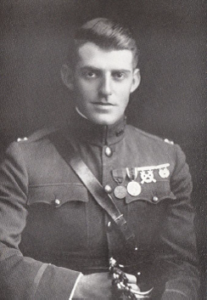
 Colonel Sidney Mashbir (1891-1973)

For more information about the alliance between Prince Tokugawa and this US intelligence agent, below is a link to a one hour YouTube video presentation given to Osher Lifelong Education Institute – University of California San Diego – January 8th, 2020.

https://www.youtube.com/watch?v=lu45j0XoO6k&t=9s


DESPITE PRINCE TOKUGAWA’S MAJOR ACCOMPLISHMENTS, HE HAS REMAINED RELATIVELY UNKNOWN, UNTIL NOW.

His biography is Available in two versions:

THE ART OF DIPLOMACY & THE ART OF PEACE

Future plans include the translation of the this biography into Japanese, and perhaps other languages.


PRINT & KINDLE EDITION
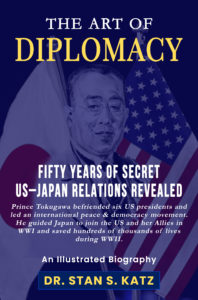


EXPANDED EBOOK EDITION
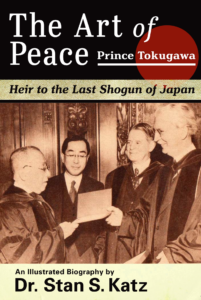
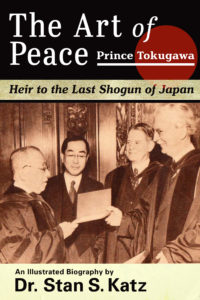
THE ART OF PEACE book cover presents a recently discovered photograph of Prince Tokugawa receiving an Honorary Doctor of Laws Degree from the University of Southern California (USC), during a special luncheon given March 19th, 1934 in Los Angeles.

The Los Angeles Times stated that this honorary degree was given to Prince Tokugawa:

“In recognition of distinguished service in international statesmanship,” and for his “support of many philanthropic and educational movements.”

In accepting the honor, Tokugawa respectfully said,

“He wished to receive this honor in the name of the Japanese people as a whole rather than as a personal distinction.”

The Los Angeles Times also stated that a banquet dinner was to be hosted that evening, by the Japan-America Society of Los Angeles, to honor Prince Tokugawa’s visit. The Governor of California and the former Mayor of Los Angeles planned to attend.


       Praise for the biography


Paul Ringwood U.S. Navy Commander (retired) wrote:

“Amazing little known history. I enjoyed every chapter.”


Kazuo Kodama, former Ambassador of Japan to the United Nations wrote:

“I wish you all the best & best of luck on your new book on ‘’Tokugawa Iesato.”


Professor Benjamin Uchiyama, Ph.D. History, University of Southern California wrote:

“This is a really interesting and understudied topic.”


Suzette Heiman, Director of Planning and Communications – The Missouri School of Journalism at University of Missouri [The first school of Journalism in the U.S.] wrote:

“We look forward to adding this biography to the School’s library collection. Your goal to reach high school and college students with this information is an ambitious – but important – goal.”


Toru Shigehara: Head Librarian/Information Resources Center Shibusawa Eiichi Memorial Foundation and Museum wrote:

“We appreciate your kindness and all the work you have done to promote understanding of Shibusawa Eiichi and US-Japan relations as a whole. I wish you all the best in your current and future endeavors. With gratitude,”


Bill Davison – President of the North County Chapter of the San Diego World Affairs Council wrote:

“Entertaining and Educational! This wonderful book will almost certainly broaden your perspective on US-Japanese relationships.”


Professor Claire Langham, former President of the East-West Center of Southern California wrote:

“The importance of preventing war is rarely given recognition through literature and in accounts of history.  It can be every bit as exciting as glorified accounts of war and certainly a better approach.”


-One half of author’s profits from Prince Tokugawa’s biography will be gifted to the Tokugawa US Japan Memorial Fund.


Filed Under: Tokugawa Archives Tagged With: 1934 Japan Society Annual Dinner, Abraham Lincoln, Abraham Lincoln and Japan, Ambassador Grew, Ambassador Katsuji Debuchi, America-Japan Society, Baron Eiichi Shibusawa, Baron Shibusawa, Baron Shibusawa Eiichi, Chinese History, Classics 4 Kids, Classics Four Kids, Colonel Mashbir, Colonel Mashbir Archives, Colonel Sidney Mashbir, Diplomacy, Dr. Martin Luther King, East-West Center, East-West Center of Southern California, Eiichi Shibusawa, General Douglas MacArthur, Historical biography, History of the Cherry Blossom Festival in Washington D.C., History of the Japan Society, History of the Japan Society of Manhattan, History of the Japan Society of New York, History of the National Cherry Blossom Festival, History of USC, Holocaust, International Friendship, International Relations, Iyemasa Tokugawa, Japan China relations, Japan History, Japan Society of Manhattan, Japan U.S. Relations, Kazuo Kodama, Kazuo Kodama Ambassador of Japan to the European Union, Kazuo Kodama Ambassador of Japan to the United Nations, Mashbir Archives, Missouri School of Journalism, North County Chapter of the San Diego World Affairs Council, Praemium Imperiale, President Abraham Lincoln, President Theodore Roosevelt, Prince Iyesato Tokugawa, Prince Takamatsu, Prince Tokugawa, Prince Tokugawa Archives, Prince Tokugawa Iesato, Prince Tokugawa Iesato Archives, Princess Takamatsu, Professor Claire Langham, San Diego World Affairs Council, Sasakawa Peace Foundation USA, SDWAC, Shibusawa Eiichi, Shibusawa Eiichi Memorial Foundation and Museum, Stan S. Katz, Stan S. Katz blog, Statue of Abraham Lincoln, Statue of Dr. Martin Luther King, Statue of Prince Tokugawa, Takashi Komatsu, The art of diplomacy, The Art of Diplomacy biography, The Art of Peace, The Art of Peace biography, The Emperor and the Spy, The Prince Tokugawa Foundation, The Prince Tokugawa US Japan Foundation, TheEmperorAndTheSpy.com, Theodore Roosevelt, Tokugawa Shogun History, U.S. Japan relations, U.S.-Japan History, US Japan relations, WACA, William Howard Taft, World War One, World War Two, 徳川 家達

The Japan Society of New York City Honors the Visit of Prince Iyesato Tokugawa – Recently Discovered 1934 Photo

February 22, 2020 by Stan S. Katz Leave a Comment

Here is an important moment in history, when the leader of the Japanese peace and democracy movement met with his counterparts in the United States during a challenging period of U.S. Japan relations. This rare, perhaps one of a kind photo presents the Japan Society’s Annual Dinner event honoring Prince Tokugawa on Feb. 27, 1934 – This diplomatic goodwill gathering took place at the Waldorf-Astoria Hotel. [Source of photo: TheEmperorAndTheSpy.com archives – The actual photo is 14 x 22 inches in size.]


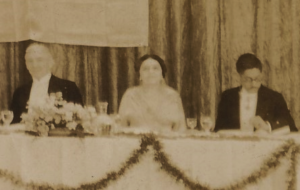
Above: Right half of the Feb. 27, 1934 photo: Prince Tokugawa and other dignitaries sit at a table on the front stage, with an American and Japanese flag hanging behind them. It is amazing how a photo can almost bring people and events back to life. As a potential, future, historical project, it would be interesting to identify as many guests as possible who attended this celebratory event. This current presentation will focus on the individuals seated at the front table.


Above: Left half of the Feb. 27, 1934 photo


Historical note

The global economic depression of the 1930s, combined with the spread of communism and fascism contributed to an internationally unstable and dangerous period in history. Prince Iyesato Tokugawa (aka Prince Tokugawa Iesato 1863-1940), supported by his Japanese and non-Japanese allies, heroically devoted his diplomatic/political career to creatively striving to maintain goodwill between Japan and the U.S., as well as other nations.

Over the many years it took to create the recently published, illustrated biography on Prince Tokugawa, titled The Art of Peace, the author of this blog post was constantly surprised how this great statesman had largely been forgotten, despite Tokugawa having been the diplomatic face of Japan internationally for the first forty years of the 1900s, while also holding significant political influence domestically, as the President of Japan’s upper house of congress, The House of Peers.


During the 1934 Japan Society Annual Dinner, Prince Tokugawa eloquently declared:

“The bulk of public opinion and the best of character and intelligence was on the side of peace,” and that it was “most regrettable, that statements predicting war (between their nations) had been circulated on both sides of the Pacific and even on the other side of the Atlantic.”

“Thinking men in Japan do not wish to disturb the traditional goodwill and friendship that unite us with America, and I believe that sentiment is reciprocated by sensible people in this country. You on this side of the Pacific and we on the other side, all know that a war between our two countries would not only be unprofitable, but highly disastrous to both of us.”

To prove his above statement, Prince Tokugawa gave specific details highlighting the enormous economic interdependence of the U.S. and Japan, and clarified just how mutually beneficial America/Japan trade was. Prince Tokugawa admitted that Japan-U.S. relations had occasionally experienced some strains in the past, but that was true of many other nations as well. He recalled the success of the Four-Power Pacific Pact (signed on Dec. 13, 1921, during the Washington Naval Conference) between Great Britain, France, Japan and the U.S. The Four-Power Pacific Pact required any controversy arising out of any Pacific question, if not settled satisfactorily by diplomacy, should be considered and settled at a joint conference. These four nations agreed to respect the status quo in the Pacific and respect the territorial holdings of these countries and not attempt to pursue further territorial expansion.

Some of the other speakers at this gathering were: Reverend James DeWolf Perry, presiding Bishop of the Protestant Episcopal Church of the United States, and great-nephew of Commodore Perry; former Ambassador to Japan Roland S. Morris of Philadelphia; and Henry Waters Taft President of the Japan Society of New York City, who presided over this 1934 event. Henry W. Taft was the brother of former President William Howard Taft.

During this February 27th event, Henry W. Taft said, “Japan and the Americans were increasingly making themselves understood one to the other,” and that he believed that “despite occasional differences in national policies, the spirit of mutual helpfulness will grow and abide.”

Source: The New York Times article, February 28, 1934: “Japan Shuns War, Says Tokugawa”


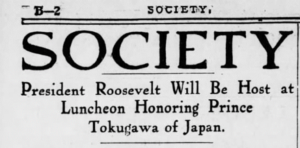
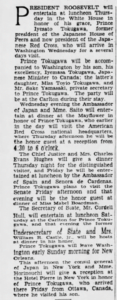
-The below newspaper article comes from the Evening Star (Washington, District of Columbia) 26 Feb 1934, Monday Page 16. It highlights some of Prince Tokugawa’s other diplomatic engagements during his 1934 visit to the U.S. 

The Society Section headline stated: President Franklin Delano Roosevelt was going to hold a luncheon honoring Prince Tokugawa.


The news article also mentioned that during his 1934 visit, Prince Tokugawa was hosted at other diplomatic events given by:

–Ambassador of Japan and Madame Saito

–U.S. Chief Justice and Mrs. Charles Evans Hughes 

–Ambassador of Spain Juan Francisco de Cardenas and his wife Senora de Cardenas 

–Miss Mabel Thorp Boardman – philanthropist involved with the American Red Cross

–Secretary of State Cordell Hull

– Under Secretary of State William R. Castle Jr. 

-Former Japanese Consul General and Madame Horinouchi

-While in Washington, D.C., Prince Tokugawa visited the American Red Cross National Headquarters and the U.S. Senate.


Prince Iyesato Tokugawa, supported by his Japanese and non-Japanese allies, was so influential in Japan & internationally, it was only after his passing in 1940, that a global war erupted in Pacific.


The Japan Society which sponsored the 1934 Annual Dinner that honored Prince Tokugawa’s visit, continues to this day as a leading U.S. organization committed to deepening mutual understanding between the United States and Japan in a global context. Now in its second century, the Society serves audiences across the U.S. and abroad through innovative programs in arts and culture, public policy, business, language and education.

Japan Society was founded on May 19, 1907 by a group of prominent New York business people and philanthropists, many of whom shaped the policies of exchange and collaboration that guided the Society until the outbreak of World War II. After the war, activities slowly resumed. The stewardship of John D. Rockefeller 3rd from 1952 to 1978 led to a unified vision, a firm financial foundation, and a revitalized mission that continues to inspire and sustain the organization.

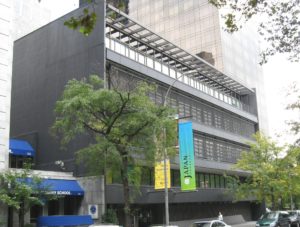
Today, Japan Society, located at 333 East 47th Street, New York City, has evolved into a world-class, multidisciplinary hub for global leaders, artists, scholars, educators, and English and Japanese-speaking audiences. At the Society, more than 100 events each year feature sophisticated, topically relevant presentations of Japanese art and culture, and also open, critical dialogue on issues of vital importance to the U.S., Japan, and East Asia.

Photo taken Oct. 2008: (Source: Wikipedia, contributor Jim Henderson)

Source for the above description: the Japan Society website.

To learn more about this fine organization, here is their internet link:

https://www.japansociety.org/


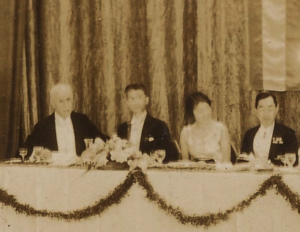
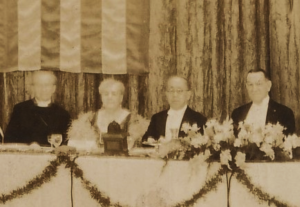
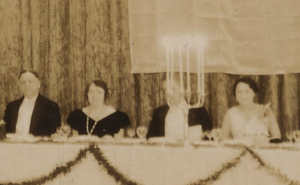
To better recognize the guests seated at the front table with Prince Tokugawa, below are some enlarged segments of the photo. The guests have been numbered to assist in identifying them. Some have been identified, but if you recognize any who haven’t, please send this information thru the comment section at the end of this blog post. Thank you.


Prince Tokugawa sits (seventh seat from the left), accompanied his son, Iyemasa Tokugawa, and their hosts. Obtaining good scanned images of the front table was challenging, in that the photographer took this photo from the furthest position from those being honored on the front stage, but an attempt has currently been made to add contrast and modify the lighting to enhance the image. The below sectional views used slightly different modifications to bring out the details as best as possible.


Starting on the Left and moving right, the attendees have been given identifying numbers 1 to 15 to assist in identification. Below are further enlarged segments of the above photo.


Starting on the Left and moving right:

  • 1- Unknown


  • 2- Probably the former Japanese Consul General Horinouchi


  • 3- Probably the wife of former Japanese Consul General Horinouchi


  • 4- Iemasa Tokugawa (徳川 家正, March 23, 1884 – February 18, 1963, aka Tokugawa Iemasa, Iyemasa Tokugawa, Tokugawa Iyemasa, and Yoshihisa Tokugawa) – Iemasa Tokugawa was the son and supporting ally of Prince Iyesato Tokugawa. Iemasa was a political/diplomatic figure of the Taishō and early Shōwa periods. He was the 17th hereditary head of the former shogunal branch of the Tokugawa dynasty and the final President of the House of Peers in the Diet of Japan. At the time of this 1934 event, he was the Japanese Minister to Canada.


Starting on the Left and moving right:

  • 5- Reverend James DeWolf Perry, presiding Bishop of the Protestant Episcopal Church of the United States, and great-nephew of Commodore Perry.


  • 6- Probably the wife of Reverend James DeWolf Perry


  • 7- Prince Iyesato Tokugawa


  • 8- Henry Waters Taft President of the Japan Society, presided over this 1934 event – He was the brother of former President William Howard Taft.In 1929, Emperor Hirohito honored Henry Waters Taft with the insignia of the Second Class of the Order of the Rising Sun, together with a diploma signed by the Emperor. This Insignia was presented to Taft by the Japanese Consul-General, in recognition of Taft’s fostering of international friendship.Source: The New York Times, June 28, 1929, Page 15Biographical note: In 1882, Henry W. Taft was admitted to the bar, and began the practice of law in Ohio. Shortly afterward, he joined Strong & Cadwalader, in New York City, later known as Cadwalader, Wickersham and Taft. Taft became one of the most noted lawyers in New York – The law firm that continues to honor his name, Cadwalader, Wickersham and Taft is headquartered at 200 Liberty Street in Lower Manhattan, and is New York City’s oldest law firm and one of the oldest continuously operating legal practices in the United States. It operates out of five offices across the United States and Europe. In addition to its Wall Street location, it has offices in Washington, D.C., Charlotte, London, and Brussels. 


Starting on the Left and moving right:

  • 9- Roland Sletor Morris (March 11, 1874 – November 23, 1945) was a U.S. diplomat and politician, and one of the founding partners of the international law firm of Duane Morris, in Philadelphia. Morris served as U.S. ambassador to Japan from 1917 to 1920 – To improve U.S. Japan relations in April 1917, the America-Japan Society, located in Japan, was born pledging friendly interexchange and fosterage of mutual understanding between the Japanese and American people. The first president of the Society was Kentaro Kaneko, a Harvard University graduate and one of the members involved in drafting the Constitution of the Empire of Japan; Roland Morris, US Ambassador to Japan at the time, was nominated as honorary president; Iyesato Tokugawa, Eiichi Shibusawa, Korekiyo Takahashi, Jokichi Takamine were honorary vice presidents; Inazo Nitobe, Takuma Dan, Junnosuke Inoue were on the list of the Executive Committee. They were leaders from political and business establishments, as well as from the academic community of that era.


  • 10- Probably the wife of Roland Morris: Augusta Twiggs Shippen West Morris, a relative of both Levi Twiggs and Edward Shippen.


  • 11- Unknown gentlemen behind candelabra


  • 12- Unknown lady


Starting on the Left and moving right:

  • 13- Unknown gentlemen


  • 14- Unknown lady


  • 15- Unknown gentlemen


The 1934 Japan Society Annual Dinner photo was discovered while doing research for the illustrated biography on Prince Iyesato Tokugawa titled THE ART OF PEACE.

The book cover presents Prince Tokugawa receiving an Honorary Doctor of Laws Degree from the University of Southern California during his 1934 visit to the United States – This degree was bestowed upon him by the president of USC, in recognition of  Prince Tokugawa’s many academic, diplomatic, and philanthropic contributions.


LINK TO THE INTRODUCTION OF THE BIOGRAPHY


Filed Under: Tokugawa Archives Tagged With: 1934 Japan Society Annual Dinner, Ambassador of Japan and Madame Saito, Ambassador of Japan Saito, Ambassador of Spain and Senora de Cardenas, Ambassador Saito, America-Japan Society, American Red Cross, Baron Eiichi Shibusawa, Baron Shibusawa, Baron Shibusawa Eiichi, Baron Takuma Dan, Cadwalader, Charles Evans Hughes, Commodore Perry, Cordell Hull, Diplomacy, Dr. Jōkichi Takamine, Eiichi Shibusawa, Emperor Hirohito honored Henry Waters Taft, Henry W. Taft, Henry Waters Taft, Historical biography, History of Cadwalader, History of the Japan Society, History of USC, Honorary Doctor of Laws Degree from the University of Southern California, https://www.japansociety.org/, International Friendship, Iyemasa Tokugawa, Japan History, Japan Society’s Annual Dinner Event, Japanese Consul General and Madame Horinouchi, Japanese Consul General Horinouchi, Junnosuke Inoue, Kentaro Kaneko, Korekiyo Takahashi, M. Zumoto, M. Zumoto and The Japan Times, Miss Mabel Thorp Boardman, New York City’s oldest law firm, Order of the Rising Sun, President Franklin Delano Roosevelt, President Roosevelt, Prince Iemasa Tokugawa, Prince Iyesato Tokugawa, Prince Tokugawa, Prince Tokugawa Iesato, Prince Tokugawa Yoshihisa, Reverend James DeWolf Perry, Roland S. Morris, Roland S. Morris U.S. Ambassador to Japan, Roland Sletor Morris, Secretary of State Cordell Hull, Shibusawa Eiichi, Stan S. Katz, Stan S. Katz blog, Takuma Dan, The Art of Peace, The Art of Peace biography, The Japan Society of New York City, TheEmperorAndTheSpy.com, Tokugawa Iemasa, Tokugawa Iyemasa, U.S. Chief Justice Charles Evans Hughes, U.S. Japan relations, U.S.-Japan History, Under Secretary of State William R. Castle Jr., US Japan relations, Wickersham and Taft, William Howard Taft, William R. Castle Jr., Yoshihisa Tokugawa, 徳川 家正

Copyright © 2026 Stan S. Katz