Stan. S. Katz

Author of The Emperor and the Spy

  • Home
  • Author
  • Books
  • Reviews
  • Educators
  • News
  • Audiobook & Timeline
  • Mashbir Archives
  • Tokugawa Archives
  • Contact
Follow Stan on FacebookFollow Stan on TwitterFollow Stan on GoodreadsFollow Stan on RSS

Sign Up for Future Blogs Linked to Colonel Mashbir and Japanese History

Read the Intro Posts

INTRODUCTION TO THE ART OF PEACE

WELCOME!

Recent Posts

  • San Diego Jewish Journal Holocaust Remembrance Edition May 2016 highlights the historical novel, The Emperor and the Spy and the outstanding achievements of Colonel Sidney Mashbir.
  • The Emperor and the Spy, was one of two books highlighted during academic/diplomatic event sponsored by the Prime Minister’s Office of Japan and hosted by San Diego World Affairs Council
  • Osher Lifelong Education Institute – UCSD Presentation. Remarkable story, the alliance between a patriotic U.S. Intelligence Agent, Colonel Sidney Mashbir, and a humanitarian Japanese International Statesman, Prince Iyesato Tokugawa, who heroically delayed and attempted to prevent WWII in the Pacific.
  • Tokugawa & Komatsu, Forgotten Heroes – Until his passing in 1940, Prince Iyesato Tokugawa held back WWII in the Pacific – Tokugawa’s diplomatic legacy lived on after WWII ended, when his protégé, Takashi Komatsu, guided the US and Japan to again become friends and allies.
  • Have you ever wondered how US and Japan re-established their friendship and alliance following the trauma of WWII? Here’s a new biography that honors an amazing Japanese American statesman, Takashi Komatsu, who guided this major achievement.

Archives

Tokugawa & Komatsu, Forgotten Heroes – Until his passing in 1940, Prince Iyesato Tokugawa held back WWII in the Pacific – Tokugawa’s diplomatic legacy lived on after WWII ended, when his protégé, Takashi Komatsu, guided the US and Japan to again become friends and allies.

November 12, 2024 by Stan S. Katz Leave a Comment

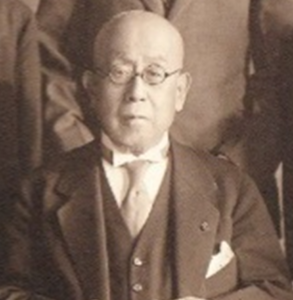
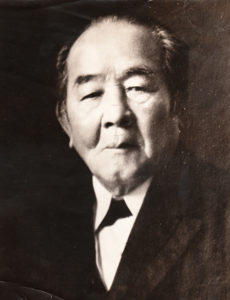
                             Prince Iyesato Tokugawa (1863-1940)      Takashi Komatsu (1887-1965)

Prince Tokugawa was the Heir to the last Shogun, a dynasty that had ruled Japan for 260 years. He served as President of Japan’s Upper House of Congress, was President of the Japanese Medical Association. And held many other leadership positions, shaping international and domestic policies of Japan. Based on his humanitarian accomplishments, US newspapers called him The Prince of Peace. It was only after his passing in 1940, that Japan was pressured by militants to enter WWII against the Allies.

Announcing an important new biographical work released in late 2024:

The Cherry Blossom Weeps for Me:  A Quest for the Dawn of Peace, by James Mikel Wilson.

This illustrated biography highlights the untold story of how Prince Tokugawa’s outstanding legacy lived on through his impressive protégé, the Japanese American statesman, Takashi Komatsu. Komatsu relit the torch of friendship and alliance between the US and Japan following WWII. Working with influential American leaders such as General MacArthur, John D. Rockefeller III, and Secretary of State Henry Kissinger, as well as many others.

Print and Kindle Edition


When the author, James Mikel Wilson, first contacted me several years ago, it was a pleasant surprise. Wilson had read the The Emperor and the Spy, I’d written and was familiar with the illustrated Prince Tokugawa biographies that followed: The Art of Peace and The Art of Diplomacy. Those biographies described Komatsu during the years proceeding WWII. However, Wilson felt Komatsu deserved a biography to reveal how significant Komatsu was during the decades following WWII in re-kindling the strong friendship and alliance between the US and Japan.

“The Cherry Tree Weeps For Me” gives an intimate view of US / Japanese relations during the first 70 years of the 20th Century, beginning the journey through the eyes of twelve old, Komatsu. Who immigrated alone to America to seek his fortune. He would become a vital bridge between the East and West, meeting with Prime Ministers, Generals, US Presidents, and Secretaries of State. While maintaining his integrity and humility. This biography is also a testimonial to Monmouth University in Illinois, which Takashi Komatsu and the James Wilson attended. The book highlights many other alumni from that fine learning institution who took heroic and humanitarian roles linked to international relations – You’ll likely find yourself becoming a friend of Takashi Komatsu, seeing his life devoted to the highest values of humanity: joy, peace, love, and mutual respect.

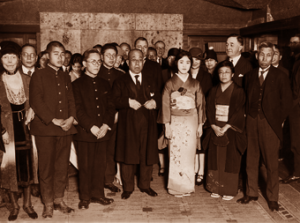
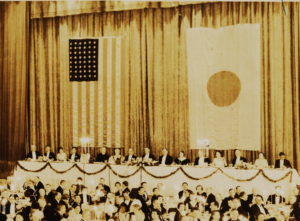
Circa 1935: Takashi Komatsu takes the place for Prince Tokugawa, who was unable to attend the above diplomatic event. Source: America-Japan Society Press Photo [color enhanced].

Below is a description from the back of the above Photo.

American “Embassy Day” held in Tokyo to Honor New American Consul General and Secretaries. Takashi Komatsu, pinch-hitting for Prince Tokugawa as toastmaster at a recent luncheon of the America-Japan Society held in the Imperial Hotel. This event honored the Consul General and Mrs. George A. Makinson (of San Francisco), first Secretary of the Embassy and Mrs. Stuart E. Grummon (of Newark, N.J.), and Second Secretary and Mrs. W.T. Turner (from Emory, Georgia). Mr. Komatsu [standing], and to his right: Mrs. Makinson (with fur), Mr. Grummon and Mrs. Turner: and to his left: Mrs. Grummon and Consul General Makinson (baldish).

Mr. John L. Curtis, Far Eastern manager of the National City Bank of New York, said he was glad to return to Tokyo, his second home, after a summer in New England. Non-Embassy guests present included Mr. John Moorris, chief of the Far East bureau of the United Press, from Shanghai: Mr. Archibald T. Steele, of the Far East Bureau of the Chicago Daily News; and Captain Maxwell representing the Chicago Tribune, en route from the United States to Berlin via Siberia.


In many ways, The Cherry Tree Weeps for Me, is a sequel to the below books.


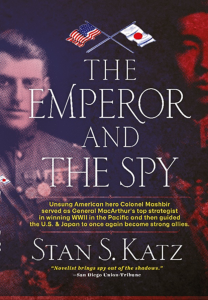
Mashbir was a brilliant US intelligence agent. During the 1920 and ‘30s, he allied with Prince Tokugawa, promoting amity between their nations. It was only after Tokugawa’s passing that militants pushed Japan into war. 
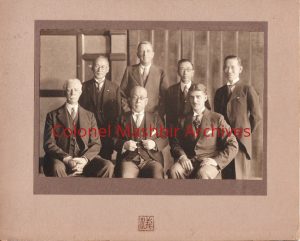
April, 1937: Imperial Hotel, Tokyo, following a Pan Pacific Club luncheon hosted by Prince Iyesato Tokugawa to honor Colonel Sidney Mashbir’s return visit to Japan. Tokugawa is seated adjacent to his American friend and ally, Mashbir. Accompanying them are several of Tokugawa’s other Japanese and American advisers. There was a rising militant movement in Japan and Mashbir was on a dangerous undercover mission. During Mashbir’s visit, Tokugawa heroically placed his own life in danger by sharing top secret intelligence information with Mashbir to bring back to the U.S. that might have preserved peace between their nations. However, their efforts were undermined. The novel The Emperor and the Spy highlights this untold story.

  • Despite their best efforts, WWII could not be stopped….Colonel Mashbir was then recruited by General Douglas MacArthur to command a top-secret intelligence organization ATIS (Allied Translator and Interpreter Section). ATIS grew to almost 5,000 members, and significantly shaped the successful Allied battle strategy in the Pacific, dramatically shortening the war. ATIS was mainly composed of thousands of first generation Japanese Americans (Nisei) who patriotically volunteered to serve under Mashbir’s command, translating and interpreting strategic military documents coming in from the Pacific battlefields. While also interrogating Japanese prisoners of war. And many also heroically went into the battlefield to serve at the front lines. Based on their major contributions, Colonel Mashbir felt the injustice of Presidential Executive Order 9066 that resulted in the illegal imprisonment of  loyal Japanese. Approximately 112,000 persons were sent  to “relocation centers” that would be their home for the duration of the war. Nearly 70,000 of the evacuees were American citizens. There were no charges of disloyalty against any of these citizens. Nor was there any means they could appeal their loss of property and personal liberty. 
  • Colonel Mashbir swore that once the war was over, he would devote himself to letting the world know of the major contributions made by patriotic Japanese Americans who had served under his command in ATIS.
  • Colonel Mashbir took a major role in ending WWII and orchestrated the Japanese Surrender Signing Ceremony. Thereby avoiding a major destructive battle on mainland Japan.
  • Mashbir arranged for General MacArthur and Emperor Hirohito to meet, to plan the rebuilding of Japan and the rekindling of US / Japan friendship. Mashbir served as the translator and facilitator.


 Back cover: The Emperor and the Spy

Published 2015, 2017, 2019

Available in Print, Kindle, and Audiobook


Here are biographies that highlight the fascinating life of Prince Iyesato Tokugawa.

  Published 2019

KINDLE EDITION

DESCRIPTION OF BOOK COVER PHOTO:

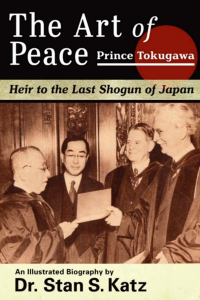
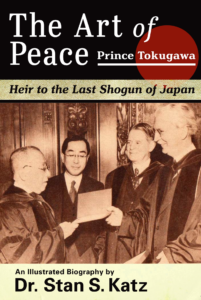
When WWII ended, for various geopolitical reasons there was an urgent agenda in place to leave behind the details of the period leading up to that tragic conflict. And instead, the goal was to expediently reestablish Japan and the U.S. as friends and allies. This resulted in much of the significant peaceful Japanese diplomatic engagement during the prior decades to that war being lost, forgotten, or destroyed – For instance, the above book cover photo comes from what might well be the last remaining crumbling copy of a 1934 Japanese magazine. It presents Prince Tokugawa receiving an Honorary Doctor of Laws Degree from the University of Southern California. The president of the university Dr. Rufus B. von Kleinsmid hands the certificate to Prince Tokugawa. (Left to right in photo: Prince Iyesato Tokugawa; Iyemasa Tokugawa; George I. Cochran; Dr. Rufus B. von Kleinsmid.)

This presentation took place during a special luncheon given March 19, 1934 in Los Angeles, hosted by George I. Cochran, the president of the school’s Board of Trustees. Prince Iyesato Tokugawa was accompanied by his son Iyemasa, the newly appointed Japanese Minister to Canada.

The Los Angeles Times stated that this honorary degree was given to Prince Tokugawa “in recognition of distinguished service in international statesmanship,” and for his “support of many philanthropic and educational movements.”

In accepting the honor, Tokugawa respectfully responded, 

“He wished to receive it in the name of the Japanese people as a whole rather than as a personal distinction.” 

The Los Angeles Times stated that a banquet dinner was to be hosted by the Japan-America Society of Los Angeles to honor Prince Tokugawa’s visit. The Governor of California and the former Mayor of Los Angeles planned to attend.

Surprisingly, the University of Southern California currently has no record of this event having taken place. 

And it’s an intriguing coincidence that during the following year, 1935, President Franklin D. Roosevelt was also awarded an Honorary Doctor of Laws Degree from USC, on October 1, 1935. Prince Tokugawa and President FDR knew each other well. During Tokugawa’s 1934 visit to the U.S. the  two men met and discussed ways in which they could maintain amity between their nations. Prince Tokugawa invited FDR to visit Japan with hope that a face to face meeting between US and Japanese leaders including the Japanese Royal Family might strengthen their friendship and understanding.

*The publication of THE ART OF PEACE was brought to the attention of the leadership of USC, revealing significant forgotten history about their school from over 85 years earlier – It is exciting that not long afterwards, USC awarded honorary degrees to former USC Nisei (first generation Japanese-American) students who had not been allowed to continue their education at USC following their release from internment camps. In which they had been unfairly imprisoned during WWII – Many of these former students were deceased, so their honorary degrees were conferred to their families. There is a USC Annenberg Media article about this college degree presentation titled: “President Folt conferred honorary degrees to the families of 33 former Nisei students.” Written by Clara Preve-Durrieu, April 06, 2022. Thus correcting an injustice from the distant past.


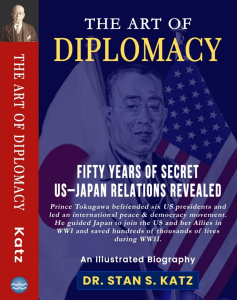
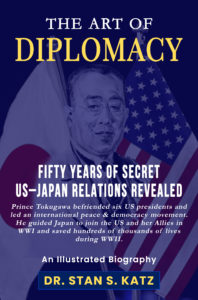
The ART OF PEACE was republished in a General Reader Edition titled: THE ART OF DIPLOMACY.

(Note:  THE ART OF PEACE  has an additional 100 pages of historical notes to assist researchers.)

Print and Kindle Edition


Our times need inspiring role models in the art of peaceful and respectful international diplomacy – It would improve international relations in Asia to recognize Prince Tokugawa’s major humanitarian achievements as President of the Red Cross Society of Japan, promoting the creation of demilitarized safe zones in China. These havens helped protect the lives of hundreds of thousands of Chinese civilians during the years leading up to and during WWII. They also served as refuge for tens of thousands of European Jews fleeing the Holocaust. 

During 1921-1922, Prince Tokugawa headed the Japanese Delegation to the Washington Naval Arms Limitation Conference, hoping to maintain peace.

To combat racism, during the 1920s and ’30s, Prince Tokugawa incorporated Lincoln Essay Contests into all Japan’s public schools and universities. Giving awards to students who wrote the best essays honoring the humanitarian principles of Abraham Lincoln.  

Prince Tokugawa took a guiding role in 1912 Japanese gifting of Cherry Trees to Washington, D.C. evolving into the National Cherry Blossom Festival, Our capital’s largest annual international goodwill celebration. This achievement has also surprisingly not yet been recognized.

The timing is right to bring deserved international attention to these outstanding statesmen: Prince Tokugawa and Takashi Komatsu.


Reader Praise for:

The Emperor and the Spy

The Art of Peace

The Art of Diplomacy

The Cherry Tree Weeps For Me


Filed Under: Tokugawa Archives Tagged With: 1934 USC Bestows Honorary Doctor of Laws Degree on Prince Tokugawa, Abraham Lincoln, Abraham Lincoln and Japan, Abraham Lincoln Commemorative Medal, Ambassador Grew, Ambassador Grew and Prince Tokugawa, Ambassador Joseph C. Grew, Ambassador Joseph Grew, American “Embassy Day” held in Tokyo, Anti-Asian Racism, Archibald T. Steele, Baron Eiichi Shibusawa, Baron Shibusawa, Baron Shibusawa Eiichi, Captain Maxwell representing the Chicago Tribune, Carol L. Folt, chief of the Far East bureau of the United Press, Clara Preve-Durrieu, Colonel Mashbir, Colonel Sidney Forrester Mashbir, Colonel Sidney Mashbir, Consul General George A. Makinson, Dr. Rufus B. von Kleinsmid, Eiichi Shibusawa, Far Eastern manager of the National City Bank of New York, FDR, Frank A. Vanderlip, Frank Vanderlip, General Douglas MacArthur, General MacArthur, George A. Makinson, George I. Cochran, Heir to the Last Shogun, Heir to the last Tokugawa Shogun, Henry Kissinger, Henry Kissinger and Japan, History of Racism, History of the University of Southern California, History of University of Southern California, History of USC, Honorary Doctor of Laws Degree from USC, Honoring Abraham Lincoln, Iesato Tokugawa, Iyemasa Tokugawa, Jacquinot Safe Zone, James Mikel Wilson, Japanese Internment Camps, Japanese Racism at USC, John D. Rockefeller III, John L. Curtis, John Moorris, Komatsu and Tokugawa, Komatsu Takashi, Lincoln Essay Contest, Lincoln Essay Contests, Monmouth University, Monmouth University History, of the Far East Bureau of the Chicago Daily News, president abraham, President Abraham Lincoln, President Folt conferred honorary degrees to the families of 33 former Nisei students, President Franklin D. Roosevelt, Prince Iyemasa Tokugawa, Prince Tokugawa Iesato, Prince Tokugawa Iesato Archives, Racism at USC, Shanghai Safe Zone, Shogunate, Stan S. Katz, Stan S. Katz archives, Stan S. Katz blog, Stuart E. Grummon, Takashi Komatsu, Takashi Komatsu and Prince Tokugawa, Takashi Komatsu businessman, Takashi Komatsu diplomat, Takashi Komatsu industrialist, Takashi Komatsu international statesman, The art of diplomacy, The Art of Diplomacy biography, The Art of Peace, The Art of Peace biography, The Cherry Blossom Weeps for Me, The Cherry Blossom Weeps for Me:  A Quest for the Dawn of Peace, Tokugawa and Grew, Tokugawa and Komatsu, Tokugawa Iesato, US Japan relations, USC and Japan, USC Annenberg Media, USC Bestows Honorary Doctor of Laws Degree, USC Bestows Honorary Doctor of Laws Degree on Prince Tokugawa, USC History, USC President Folt, W.T. Turner

Have you ever wondered how US and Japan re-established their friendship and alliance following the trauma of WWII? Here’s a new biography that honors an amazing Japanese American statesman, Takashi Komatsu, who guided this major achievement.

October 11, 2024 by Stan S. Katz Leave a Comment


The Cherry Tree Weeps for Me: A Quest for The Dawn of Peace chronicles one man’s lifelong pursuit of peace before and after the Pacific War. Takashi Komatsu’s incredible story is told alongside Japan’s pre- and post–WWII history and the country’s remarkable rebirth as a vibrant democratic global economic powerhouse. Komatsu’s life journey from a 12-year-old immigrant living in New York City’s YMCA  to his delivery of Harvard’s 1911 commencement address—proves that real life can be stranger than fiction.

Komatsu’s rose to become the head of a large shipping company in Japan, allied with Prince Tokugawa heir to the last Shogun and the US Ambassador to Japan Joseph Grew, and became a respected international businessman and statesman. Risking incarceration and assassination, Komatsu made choices that defied military rulers and right-wing extremists as they edged Japan toward war and devoured a democracy.

Within days of the war’s end, inconceivable events led General MacArthur, the Supreme Commander of the Occupation Forces, to seek Komatsu’s aid to help rebuild Japan and restore amity with the United States. Repairing friendship between the two countries was complex and daunting. Komatsu went far beyond this, forging relationships with US presidents, ambassadors, scholars, philanthropists, and leaders in the public and private sectors of both Japan and the United States. His legacy is a powerful reminder of the importance of tenacity, empathy, and understanding in international affairs, offering an intimate view of US/Japanese relations during the first 70 years of the 20th Century.

If you enjoy books like Malcolm Gladwell’s The Bomber Mafia, you’ll love The Cherry Tree Weeps for Me. Find out what transpired after the devastation and one man’s unsung influence that restored a stolen democracy.


About the Author

Born during World War II in Moline, Illinois, James Mikel Wilson grew up in the lingering dark shadows of that era. His father and uncles fought in WWII, moved on with their lives, and rarely ever discussed it.

Over four decades, Wilson’s work in international marketing and personal travel took him to five continents, thirty-three countries, and forty-seven states. He craved to understand the history, culture, and politics of each place visited. Wilson’s lingering itch to better grasp the fuses that sparked WW II in Europe and Asia led to two meticulously researched books.

His first book, Churchill and Roosevelt: The Big Sleepover at the White House (2015), earned an Author Academy Award. Wilson was invited to participate in a book signing during America’s National Churchill Museum’s 50th-anniversary celebration. In 2020, the International Churchill Society’s annual meeting in London featured the book and a reading of Alliance, a stageplay version of the book.

All book sale proceeds from “The Cherry Tree Weeps for Me: A Quest for The Dawn of Peace” will be donated to Monmouth College, located in Monmouth, Illinois, the alma mater of the Author and of Takashi Komatsu.


Publication date November 1st, 2024.

Available through the links below:

Amazon eBook: https://www.amazon.com/dp/B0DHV1RPHH  

Amazon Paperback: : https://www.amazon.com/dp/1662952775

Barnes and Noble: https://www.barnesandnoble.com/w/9781662952777     On this site, enter the author name James Mikel Wilson or Book Title and then select eBook or paperback.


READER PRAISE FOR THIS BOOK

“James Mikel Wilson’s The Cherry Tree Weeps for Me is a gripping journey through time. With the skill of a seasoned storyteller, Wilson paints a vivid portrait of a man who straddled two worlds, from Takashi Komatsu’s beginnings as a twelve-year-old boy venturing overseas to seek his destiny to his pivotal role in shaping Japanese-American relations in the wake of World War II. Meticulously researched and utterly absorbing, Wilson’s book delves deep into the complexities of Komatsu’s life. What emerges is a tale of resilience, sacrifice, and unwavering dedication to peace and democracy. The Cherry Tree Weeps for Me is not just a historical account; it is a testament to the power of compassion, courage, and diplomacy in the face of adversity, a poignant story that lingers in the mind long after the final page is turned.”

—Monte Francis. Multiple Emmy Award-winning journalist and News Presenter, France 24; Author of Ice and Bone and By Their Fathers Hand.


“Wilson puts on full display in this book his liberal arts education to tell the story not only of the unsung hero, Takashi Komatsu, who was educated at Wilson’s and my alma mater, but of the history of the relationship between Japan and the United States. Wilson ties together these threads and alerts us to the incredible coincidences. These included living next door to a curious younger boy in Monmouth, Illinois, who would later become responsible for one-half of the US occupation of Japan and, by happenstance, cross paths with Komatsu in Tokyo after 35 years of separation. They would collaborate to begin reconstruction, and their sons would become Monmouth College classmates after the war.”

—Dan Cotter. Author of The Chief Justices –The Seventeen Men of the Center Seat; Member of the Board of Trustees of Monmouth College, and 2024–25 President of the National Board of Bar Presidents.


“Unearthing the obscure life of an unsung hero, Wilson’s newest book masterfully unravels how Komatsu emerges as a catalyst for unity and prosperity in post-WWII Japan. The Cherry Tree Weeps for Me provokes introspection of the age-old quandary of ‘what next’ after conflict termination. Perhaps Wilson employs Komatsu’s character and actions to inspire Americans during this time of extreme political divisiveness and mistrust. Will we forsake revenge and retribution by uniting to fortify peace, democracy, and prosperity? If so, who will emerge as our Komatsu?”

—Colonel Kay A. Smith. Colonel, USAF (Retired).


“James Mikel Wilson’s book takes us on a wonderful deep dive into the incredible life of Takashi Komatsu and his dedication to peace and friendship between the US and Japan. I particularly enjoyed Wilson’s exploration of Shofuso House, which I have had the privilege of experiencing firsthand. It is a living symbol of the enduring friendship between the two nations, largely thanks to Komatsu’s efforts. In the years following the San Francisco Peace Treaty, Komatsu played a pivotal role in fostering cultural exchange and understanding between the US and Japan, including his work with John D. Rockefeller III to bring Shofuso to life. This traditional Japanese house and garden, originally exhibited at the Museum of Modern Art in NYC and now permanently displayed in Philadelphia, captivated American audiences and reignited interest in Japan’s rich heritage.”

—Alan Wilkis. Artist (Big Data), Music Producer, and Composer for Film and TV.


“I applaud James Mikel Wilson for his insightful narrative of Takashi Komatsu. When conflicts end, like the current Russian-Ukrainian War, who will be the artist of peace to bring warring partners past the residual anger to cooperation and perhaps friendship? Komatsu was such a man, and his impact seems incomprehensible.”

—Dr. Stan S. Katz. Author of The Art of Diplomacy and former San Diego World Affairs Council Board Member.                                                                   

*The Art of Diplomacy is the illustrated biography of Prince Iyesato Tokugawa (1863-1940), an international statesman who promoted peace and democracy. Tokugawa was so influential that it was only after his passing in 1940, that militants were able to push Japan into joining the Axis Powers during WWII. Prince Tokugawa allied with and mentored Takashi Komatsu.  Tokugawa’s peace-loving legacy would live on after WWII, through the creative efforts of Takashi Komatsu, who took a pivotal role in bringing the US and Japan together again as friends and allies.


“I was absolutely blown away by the volume of Wilson’s research on Japan’s geopolitical history and the details of Takashi Komatsu’s life—particularly how they intersected with important global events. Komatsu’s influence on the early years of Japan’s post-WW II recovery and renewed friendship with the US is still felt today, as evidenced by their strong strategic and economic alliances. Wilson’s book illustrates that real life can be as captivating as fiction.”

—Jeff Rankin. Retired Editor and Historian, Monmouth College.


Wilson’s new book helps readers understand how Takashi Komatsu was influenced by his mentors in the US and Japan. These influences played a major role in his ability to form alliances and work as a catalyst to building the Japanese economy and the strong economic ties between Japan and the US. —Gary Randazzo. Sr Lecturer, C.T. College of Business, University of Houston; Former EVP and General Manager, San Francisco Chronicle and Sr. VP Houston Chronicle.


BELOW IS A MESSAGE FROM THE AUTHOR:

To guide others to discover Komatsu’s unheralded contributions to peace, I respectfully ask that you share this announcement with family, friends, and acquaintances so they can know how this remarkable man shaped our history.

I would also appreciate your posting a reader review on Amazon or Goodreads to help others learn about Komatsu and his astonishing true story. Amazon elevates the visibility of a new book based on sales and the number of reviews posted.

I hope you enjoy the front cover of The Cherry Tree Weeps For Me. After researching hundreds of images and dozens of photographers, I selected one of Kunihito Ohtsubo’s stunning photos. He graciously allowed me to use his work for the cover. Ohtsubo is among Japan’s finest photographers and has my sincere gratitude and appreciation. (Instagram @kunihito_ohtsubo)

Sincerely,

Jim

James Mikel Wilson

Houston, TX

Author: www.jamesmikelwilson.com
Instagram: @jamesmikelwilson


Below is a link to the Harvard Magazine Jan.-Feb. 2026 article titled: A Congenial Voice in Japanese-American Relations, about Takashi Komatsu and Prince Tokugawa.

https://www.harvardmagazine.com/alumni/harvard-takashi-komatsu-japanese-american-relations

Filed Under: Tokugawa Archives Tagged With: A Congenial Voice in Japanese-American Relations, Alan Wilkis, Ambassador Grew, Baron Shibusawa, Baron Shibusawa Eiichi, Colonel Kay A. Smith, Dan Cotter, Dr. Stan Katz, Eiichi Shibusawa, Gary Randazzo, General MacArthur, Harvard Law School, Harvard Magazine, Harvard Magazine and Takashi Komatsu, Harvard Magazine Jan.-Feb. 2026, Harvard University and Takashi Komatsu, Henry Kissinger and Japan, Historical biography, International diplomacy, James Mikel Wilson, James Wilson, Japanese / American History, Japanese History, Jeff Rankin, John D. Rockefeller and Japan, John D. Rockefeller III, Kissinger and Japan, Komatsu Takashi, Kunihito Ohtsubo, Monmouth College, Monte Francis, Post-WWII History, Prince Iyesato Tokugawa, Prince Tokugawa, Prince Tokugawa and Ambassador Grew, Prince Tokugawa Iesato, Prince Tokugawa Iesato Archives, Rockefeller Family and Japan, San Diego World Affairs Council, Shofuso House, Stan S. Katz, Stan S. Katz archives, Stan S. Katz blog, Takashi Komatsu, The art of diplomacy, The Art of Diplomacy biography, The Art of Peace biography, The Cherry Tree Weeps for Me: A Quest for The Dawn of Peace
For Highlighting the Legacy of Great Leaders who Strove for Peace & Democracy and Fought Against Racism, Author/Historian Dr. Stan S. Katz was nominated for the Dr. Martin Luther King, Jr., Community Service Award

February 13, 2023 by Stan S. Katz 6 Comments

Dear Friends,

Here is an illustrated article which honors the memories of significant Black, Asian, and Caucasian historical figures who creatively and peacefully utilized the intercultural exchange of art, music, education, and diplomacy as well as working through the political and legal systems to improve race relations – International disrespect and racism has often been a catalyst towards conflict. By gaining new insights from history, we discover better answers for dealing with our challenging issues of today.

Over the past twenty years, I’ve written historical works which honor significant, but often forgotten individuals who devoted their lives to promoting peace, democracy, and strove to confront racism. Based largely on this, in combination with volunteer activities and membership in public affairs organizations, such as the San Diego World Affairs Council, I was nominated for the Dr. Martin Luther King, Jr. Community Service Award. The below article highlights the Award Ceremony and Prayer Breakfast honoring the memory of MLK, and gives an introduction to the historical work I’ve written, including some rare photos discovered during my research.

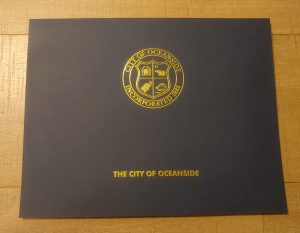
Dr. Martin Luther King, Jr. Community Service Award for 2023

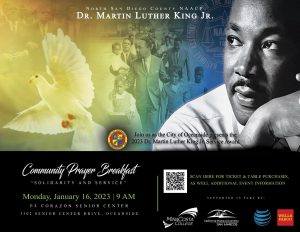
Above is the Front Cover of the Event Booklet distributed at this Community Prayer Breakfast and Award Event. It contains short bios of the nominees for the award, and includes descriptions of the speakers and honors various organizations that supported this inspiring gathering.

Sponsored by City of Oceanside and North San Diego County NAACP

Award Ceremony took place on MLK Day, January 16th, 2023.

This article was written by Dr. Stan S. Katz, who felt gratitude and was emotionally touched to be one of the nominees.


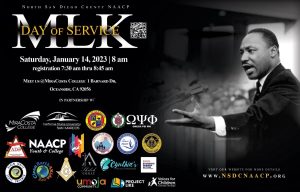
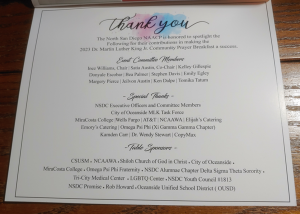
Below is the Back Cover of the Event Booklet – During the weekend prior to the above event, members of the North San Diego County NAACP working in partnership with other community organizations, held a DAY OF SERVICE to honor the memory of Dr. King – Volunteers came together to to help those in need in our community.


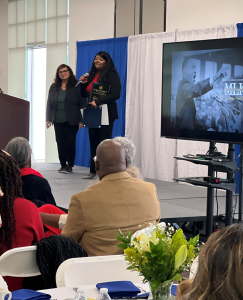
US Congressman Mike Levin gives a stirring speech, describing how he once personally accompanied US Congressman John Lewis (1940 – 2020) over the Edmund Pettus Bridge in Selma, Alabama. This was done in commemoration for that important historical event in the movement towards a more inclusive democracy and equal treatment of the races. Levin stated this important moment helped shape his social values to improve the treatment of all of our nation’s citizens. John Lewis  was often called the conscience of the congress.

Uplifting speeches were also given by Senator Catherine Blakespear, District 38, California State Legislature, and Mayor Esther Sanchez of the City of Oceanside.


The Dr. Martin Luther King, Jr. Community Service Award is an annual award given to a resident of the City of Oceanside or member of the U.S. Armed Forces stationed at Marine Corps Base (MCB) Camp Pendleton. The award is given to a resident who exemplifies the ideals and teachings of Dr. Martin Luther King, Jr. who worked to advance civil rights, equal education, labor, and voter rights and who fought racial inequality through non-violence and civil disobedience. The Community Service Award began thirty years ago as a way to recognize persons in the community who have given time and energy through volunteerism to improve community life, develop positive relations in the community, and enhance the lives of individuals. The award has no restrictions as to race, ethnicity, gender, or type of service and is open to any resident of Oceanside or MCB Camp Pendleton. The North San Diego County Chapter of the NAACP partners with the City of Oceanside in presenting this Community Award.

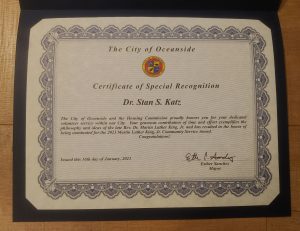
All nominees for the 2023 Dr. Martin Luther King, Jr. Community Service Award receive the following:

– A Certificate of Special Recognition from the City of Oceanside, issued January 16th, 2023 from Esther Sanchez Mayor

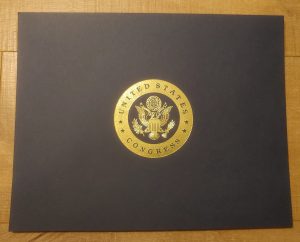
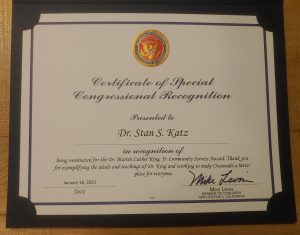
– A Certificate of Special Congressional Recognition from Mike Levin, Member of the U.S. Congress 49th District, California, issued January 16th, 2023

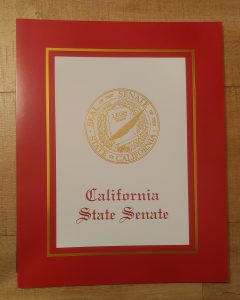
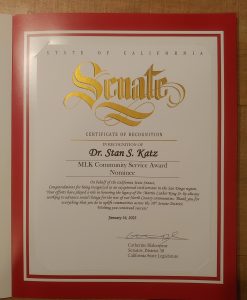
– A Certificate of Recognition on behalf of the California State Senate, from Catherine Blakespear Senator, District 38, issued January 16th, 2023


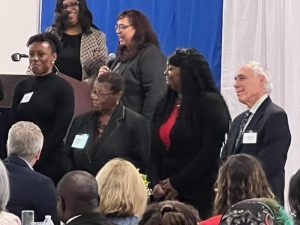
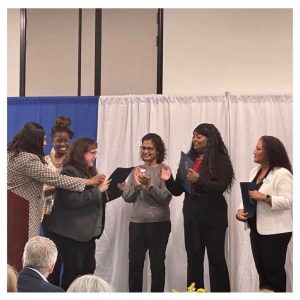
Upon the stage, behind the podium, in the brown jacket is Inez Williams, Events Chairman for the North San Diego County NAACP – Holding the microphone is Mayor Esther Sanchez of the City of Oceanside – In front of them are four of the five nominees for the 2023 Dr. Martin Luther King, Jr. Community Service Award. Mrs. Karen Williams Graham was one of the nominees, but is out of the frame of the above photo. The four nominees present in the above photo from left to right: Captain Lakyra Pharms; Eleanor Juanita Evans; Satia O. Austin; and Dr. Stan S. Katz.


Satia O. Austin receives the Dr. King Community Service Award.

Then Mayor Esther Sanchez presents the proclamation for Dr. King Day of Service and Community Breakfast Weekend, with special acknowledgement to NSDC NAACP, MiraCosta College Service Learning and Beatriz “Bea” Palmer.


Satia O. Austin, after winning the Dr. Martin Luther King, Jr. 2023 Community Service Award, gives an acceptance speech describing her passion to help others in our community. A most inspiring woman.


All of the Dr. Martin Luther King, Jr. Community Service Award nominees received Certificates of Recognition from US Congressman Mike Levin, California State Senator Catherine Blakespear, and Oceanside Mayor Esther Sanchez.


Over the past twenty years, I’ve done historical research and written books honor great individuals who promoted peace and democracy, and sought to eliminate racism. Below are books I’ve written linked to these goals. My nomination for the MLK Community Service Award from the City of Oceanside and the NSDC NAACP was based on these books and research, as well as community volunteer service I’ve given over many years.

This historical novel reveals the thrilling adventures of a brilliant US Army Intelligence Agent, Colonel Sidney Mashbir (1891-1973). Mashbir’s fascinating career in espionage began in the American Southwest during the early 1900’s, maintaining stability along the U.S.- Mexico border during the Mexican Revolution.

During the 1920s, Mashbir moved to Japan and became a Japanese linguist. Throughout that decade and through the 1930s, he befriended some of the most influential Japanese leaders. And together, at great personal risk, they heroically resisted militarists pushing towards war. Instead, Mashbir and his Japanese allies creatively supported goodwill between the US and Japan, delaying and almost preventing WWII in the Pacific – However, that conflict could not be avoided.

The novel highlights the great contributions that Japanese Americans gave to their adopted nation during the war, despite the discrimination and injustices they faced in the United States prior to, and then greatly magnified during those war years. When 120,000 mainly Japanese American US citizens were incarcerated in internment camps, when they had done nothing wrong. Often with the loss of their possessions and the major disruption of their personal, educational, vocational lives. It was a dark moment in US History.

As for Colonel Sidney Mashbir, with the outbreak of war, he became General MacArthur’s top military strategy advisor in winning that conflict. And once it was over, he helped guide the US and Japan to once again become strong allies.

Mashbir often worked with his Navy buddy, the future Rear Admiral and Deputy Chief of Naval Intelligence, Ellis Zacharias (1890 – 1961). These good friends were early pioneers in the creation of the CIA.

To learn more, you’re invited to visit: TheEmperorAndTheSpy.com


-Colonel Mashbir’s most influential Japanese ally and close friend was Prince Iesato Tokugawa – aka Iyesato Tokugawa (1863-1940). Tokugawa was the leading advocate of Japan’s international peace and democracy movement during the first four decades of the 20th Century.

For 30 of those years, he served as President of Japan’s upper house of congress, the House of Peers. I felt privileged to have the opportunity to write about this unsung hero and humanitarian, who deserved a biography highlighting his fascinating life and outstanding accomplishments.

During the 1920s and 1930s Prince Tokugawa incorporated Lincoln Essay Contests into all Japanese Public Schools and Colleges to Fight Racism and Honor the Values of President Lincoln. Recognition was given to the students who best described those values.

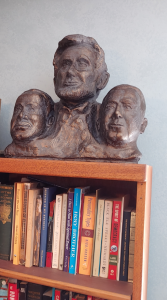
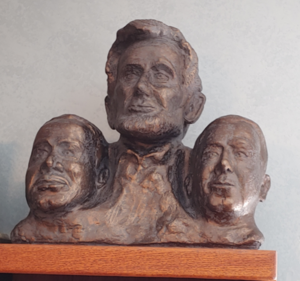
I created the below sculpture in order to capture and honor the essence of three significant Men of Peace, who promoted Human Dignity and Racial Equality,

President Abraham Lincoln (February 12, 1809 – April 15, 1865)

Dr. Martin Luther King, Jr. (January 15, 1929 – April 4, 1968)

Prince Iyesato Tokugawa (徳川 家達, August 24, 1863 – June 5, 1940)


Tokugawa loved his own Japanese culture. He also came to love the peoples and cultures of the West. This was despite the anti-Asian and anti-Black racism he often saw during his travels across the US. Prince Tokugawa, like Dr. King, recognized the common brotherhood of humanity.

Photo: February 19, 1929 Award Presentation for the student winners of the Third Lincoln Essay Contest which was held at the Imperial Hotel, Tokyo. Prince Tokugawa was the President of the America-Japan Society which sponsored the event.

Prince Tokugawa (front center) and Count Aisuke Kabayama (at far right). This illustration is courtesy of the America-Japan Society. This fine organization, located in Japan, was founded in 1917 and continues to this day to promote amity and mutual understanding between the Japanese and American people. Prince Tokugawa was its 2nd president from 1924 until his passing in 1940. To learn more, here is the internet link to the America-Japan Society:    http://ajstokyo.org/en-home/


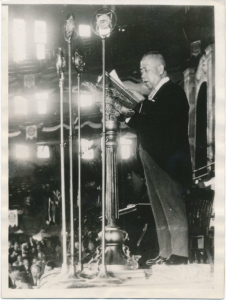
In 1930, Tokugawa was selected as the Keynote Speaker at the 25th Anniversary Celebration for Rotary International held in Chicago. There, he presented a speech encouraging peaceful international relations to 15,000 fellow Rotarians gathered from around the world.

The New York Times, June 27, 1930, press photo: “Japanese Prince Addresses Rotarian Convention: In an address of international importance, before 15,000 Rotarians assembled in Chicago for their Silver Anniversary Jubilee.” The following are two excerpts his inspiring speech, which was titled ‘National Aspirations.’

“Japan’s foremost aspiration is to cultivate the arts of peace and live at peace with her neighbors, near or distant, great or small.”

“Peace is a continuous process. Like liberty, peace demands “eternal vigilance” as its price. To the goal of peace, there can be no short cut.”


Prince Tokugawa was to be the Heir to the last powerful ruling Shogun. However, when that 265 year old dynasty ended in 1868, he instead took to the world stage as an international statesman. As a Renaissance man and adept diplomat, he creatively shared his passion for the arts, music, culture, science, athletic sports, and nature to establish bridges of friendship and understanding between the East and the West, while also promoting mutual respect within Asia. He is a fine role model for our current leaders dealing with the urgent issues of today that require international cooperation to solve.

Tokugawa supported higher education and a greater voice for women in public affairs. And despite his major influence, he maintained his humility. Often working behind the scenes, remaining unrecognized for many of his important achievements. Colonel Mashbir described Tokugawa as the true hidden power behind the Japanese Imperial Throne, and that he was so influential, that it was only after his passing in 1940, that militants were able to push Japan towards war with the Allies.

Two versions of the Prince Tokugawa’s biography were written: The Art of Diplomacy & The Art of Peace.

The Art of Peace book cover displays a 1934 photo of Tokugawa receiving an Honorary Doctor of Law Degree from the President of the University of Southern California for his lifelong philanthropic & academic contributions and for his promotion of respectful East / West relations. Tokugawa’s son is also in the photo, as is the President of USC’s Board of Directors. The following year, USC presented the same honorary award to President FDR.


To encourage respect between Japan and China, Prince Tokugawa and his influential Japanese industrialist ally & friend, Baron Shibusawa, incorporated Chinese literature courses into Japan’s colleges with hopes it would encourage better inter-cultural understanding and prevent conflict.


However, WWII could be delayed, but not prevented. So as to save innocent civilian lives, Prince Tokugawa, as President of the Red Cross Society of Japan, served as Chairman of the 1934 International Red Cross Conference held in Tokyo – During that significant global gathering, they approved the establishment of demilitarized “safe zones” in war-torn China, which prior to, and during WWII, provided refuge for tens of thousands of European Jews fleeing the Holocaust and also offered safety for hundreds of thousands of Chinese civilians.

  • One would hope that recognition of this major Japanese humanitarian achievement might help improve current strained relations between China and Japan, leading to greater regional stability, cooperation, and amity.


And to establish an ongoing legacy of U.S. – Japan friendship, Prince Tokugawa guided the Japanese gifting of cherry blossom trees to the U.S. in 1912, into becoming the National Cherry Blossom Festival in 1935. This delightful yearly celebration continues to this day in Washington, D.C., and is one of our nation’s largest and most popular international goodwill events.


The Legacy of Prince Tokugawa’s Respect for Human Equality linked to President Abraham Lincoln Lives On

Prince Tokugawa went beyond judging others by their race, creed, or color, as revealed by his sponsorship of Lincoln Essay Contests in all Japanese public schools and universities during the 1920s and ’30s. He would be delighted to know of the continued friendship between the U.S. and Japan, and that future Japanese and U.S. leaders would join together to recognize the importance of President Lincoln’s universal message. Perhaps, someday, Essay Contests will be sponsored in schools of the U.S., Japan, and other nations, honoring the fine values of Iesato Tokugawa.

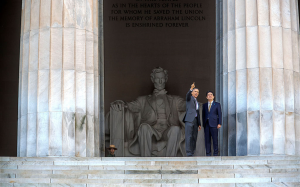
April 27, 2015: U.S. President Barack Obama and Prime Minister of Japan Shinzo Abe tour the Lincoln Memorial. They are looking towards the Washington Monument on the National Mall in Washington, D.C. Prime Minister Abe was in Washington, D.C. for meetings with President Obama. Abe also attended a state dinner in his honor at the White House the following night. A U.S. administration official described the above photo as follows:

“This is an opportunity before the formal events tomorrow to spend time together one-on-one at a place of historical significance for the United States, as this month marks both the 150th anniversary of the Civil War’s end as well as President Lincoln’s passing…”

The above photo and description of the diplomatic meeting between President Obama and Prime Minister Abe, comes from the conclusion of the Prince Tokugawa biography. The goal of my books is that they bring inspiring leaders from the past, back to life, igniting an interest, even a passion for history. To be enjoyed by the general public and shared in academic curriculum.


MORE INFORMATION ABOUT THE DR. MARTIN LUTHER KING, JR. EVENT

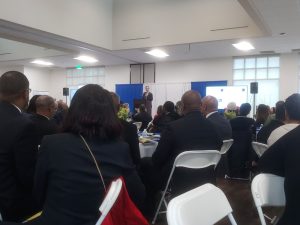
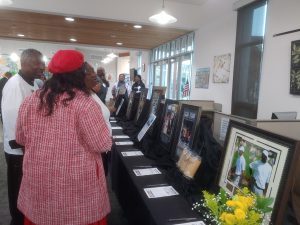
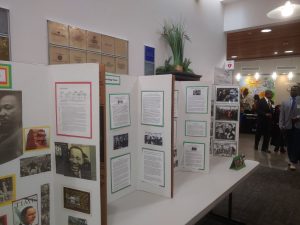
It was inspiring seeing the 300 attendees to the Dr. King Community Prayer Breakfast. Many of these individuals are active in organizations that work to create a more positive and inclusive community where we look out for one another with friendship and respect. In the below photo, Silent Auction items are on display – Proceeds going to support the many fine services given by the North San Diego County Chapter of the NAACP.

During this gathering:

Two talented high school teenagers were recognized as part of this wonderful event. One sang an emotionally connecting song, another contributed artwork for the Silent Auction Fundraiser for the NSDC NAACP.

There was also an impressive 7 year old girl who expressively danced on the front stage as uplifting music was played, the audience came to their feet in applause.

The breakfast was delicious and the company friendly and welcoming to one another.

Representatives of Mira Costa College, also the Captain and several City of Oceanside police officers were in attendance. Other City of Oceanside officials and other San Diego community groups were also represented.

A Reverend gave a meaningful prayer of appreciation before a delightful breakfast was served.


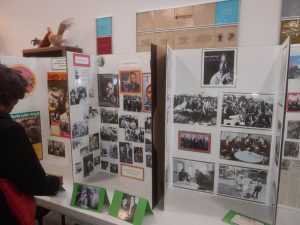
Gary Rossell (shown below), and his wife Carolyn, are founders of the Rossell African-American History Awareness Museum. They regularly travel around the county to bring their beautifully illustrated and inspiring exhibits to public social justice commemorative events, such as this Dr. Martin Luther King, Jr. community gathering.


Carolyn Rossell (above, her side view to the camera), along with her husband, Gary, created this wonderfully inspiring educational exhibit.

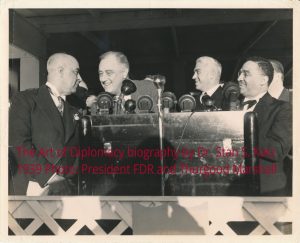
I showed Gary and Carolyn Rossell the rare 1939 photo below. This Photo was discovered and identified while doing historical research that honors the legacy of Thurgood Marshall (Marshall is at far right in photo).

Gary and Carolyn expressed great interest in utilizing this unique piece of history as part of an upcoming exhibit to honor the accomplishments of Thurgood Marshall, our nation’s first Black US Supreme Court Judge.

Marshall took a major role in gaining equal rights for all citizens in our nation and was a driving force in the growth of the NAACP. In the above photo, the 31 year attorney Marshall allies with President FDR to advance the treatment of Black Workers. Marshall was then on the Legal staff of the NAACP. The following year, 1940, he was selected Chief of the NAACP Legal Defense and Educational Fund, which was created to mount a legal assault against segregation. Marshall became one of our nation’s leading judicial voices. He argued 32 cases before the U.S. Supreme Court, winning 29.

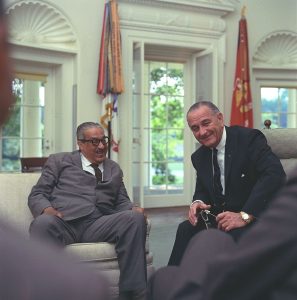
June 13th, 1967: Thurgood Marshall meets in friendship and mutual respect with President Lyndon B. Johnson in the Oval Office of the White House on the day that Marshall was nominated by Johnson to serve on the Supreme Court. Photo courtesy of the LBJ Museum & Library


Acknowledgments

  • It was a pleasure to meet Joe Farmer, who was seated at my same table. In 2009, he was the recipient of the Dr. Martin Luther King, Jr. Community Service Award. During his 40 years of service at Camp Pendleton, he oversaw upkeep and maintenance. In addition, he served as Commissioner of Housing for the City of Oceanside.
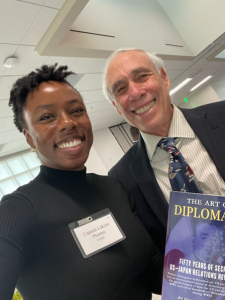
  • Also seated at our table was US Marine Captain Lakyra Pharms (shown below), one of the five nominees for the 2023 award.

During the event, I gifted a copy of the illustrated biography, The Art of Diplomacy to Captain Lakyra Pharms. Lakyra suggested we take a photo, and above is results. Lakyra’s significant community achievements, as that of the other nominees are included in the Event booklet shown at the top of this article, which was distributed at the event. Lakyra mentioned the future possibility of going towards a career in the diplomatic service.

Several of the above photos of the MLK Community Service Award nominees were kindly provided by Joseph Farmer, the 2009 Recipient of the Dr. Martin Luther King, Jr. Community Service Award.

Thanks also go to Bea Palmer, an active member of the NAACP, who helped bring about this MLK commemorative event. Bea Palmer is Vice-President – Board of Directors of “Operation HOPE” – North County San Diego, whose mission is to provide a safe environment for both families with children and single women who are experiencing homelessness and to help support them as they rebuild their lives and regain HOPE.” Bea Palmer is also actively involved at MiraCosta College, encouraging bright young students to engage with and improve their community.

Below is a link to learn more about Bea Palmer and the MiraCosta College Service Learning program mentioned above:   https://hub.miracosta.edu/meet/profile.aspx?id=65

I also had the pleasure of meeting Margery Pierce, who took an active part in setting up this MLK event. She was the Director of Neighborhood Services for the City of Oceanside.

Appreciation goes out to the representatives of the North San Diego County NAACP for supporting this community event. “The NAACP’s mission is to achieve equity, political rights, and social inclusion by advancing policies and practices that expand human and civil rights, eliminate discrimination, and accelerate the well-being, education, and economic security of Black people and all persons of color.”

There were many other individuals and organizations who took a significant role in making this wonderful event come to life. Gratitude goes out to all of them! The following illustration was the last page of the booklet that was distributed at this gathering. It highlights many of those who generously supported this event.


Filed Under: Tokugawa Archives Tagged With: Anti-Asian Racism, Anti-Black Racism, Beatriz “Bea” Palmer, Black History, Black History Month, Black Supreme Court Judge, Captain Lakyra Pharms, Carolyn Rossell, Colonel Mashbir, Colonel Mashbir Archives, Diplomacy of Peace, Dr. Katz, Dr. King Community Prayer Breakfast, Dr. Martin Luther King, Dr. Martin Luther King Jr. Community Service Award, Eleanor Juanita Evans, Emperor Hirohito, FDR, Gary Rossell, History of the NAACP, Japan History, Jean Rossell, Joseph Farmer, Margery Pierce, Mayor Esther Sanchez, MiraCosta College, MiraCosta College Service Learning, MLK Day, Mrs. Karen Williams Graham, NSDC NAACP, Oceanside, Operation HOPE” - North County San Diego, Peace Diplomacy, President Lyndon B. Johnson, Prince Iyemasa Tokugawa, Prince Iyesato Tokugawa, Prince Iyesato Tokugawa Archives, Prince Tokugawa, Representative John Lewis, Representative Mike Levin, Rossell African-American History Awareness Museum, Satia O. Austin, Senator Catherine Blakespear, Stan S. Katz, Stan S. Katz archives, Stan S. Katz blog, Stan S. Katz nominated for Dr. Martin Luther King Jr. Community Service Award, Takashi Komatsu, The art of diplomacy, The Art of Diplomacy biography, The Art of Peace, The Art of Peace biography, The Emperor and the Spy, Thurgood Marshall, U.S.-Japan History, US Congressman Mike Levin, US Supreme Court

Establishing the “Prince Tokugawa US Japan Memorial Fund” – promoting peace, democracy, and a love of music.

September 29, 2021 by Stan S. Katz Leave a Comment

A MEMORIAL FUND THAT ENCOURAGES PEACE, DEMOCRACY, AND A LOVE OF MUSIC.

Your suggestions are welcome. 

[email protected]

*****************************************************************************


Prince Tokugawa Iesato (aka Prince Iyesato Tokugawa, 1863-1940) 

Potential names for the foundation:

Tokugawa US Japan Memorial Fund: honoring the memory of Prince Tokugawa, promoting global peace and democracy, and a love for music in children. 

Tokugawa Memorial Fund: honoring the memory of Prince Tokugawa, promoting global peace and democracy, and a love for music in children. 


MISSION STATEMENT:

This non-profit memorial fund would emphasize the strong continuing alliance between the US and Japan, and the broader message of international peace and democracy. Grants would be given to organizations and individuals who have contributed to these admirable goals.

Based on Prince Tokugawa’s strong connections to the visual arts and music, the theme for this foundation might also go the route of supporting children’s access to the wonderful world of music. Prince Tokugawa encouraged the sharing of Japanese music with the Western world, and brought an appreciation to Japan of music from the West.

It is believed there would be strong support for this memorial fund from a wide array of individuals and businesses who encourage the ongoing amity between the US and Japan. 

This memorial fund would give recognition to the educational / political affairs organization the San Diego World Affairs Council (SDWAC) and its national organization, the World Affairs Councils of America (WACA), the largest non-profit, non-partisan, educational/political affairs organization in the United States.

Prince Tokugawa held distinguished leading roles in many diplomatic organizations during his career, some of these organizations continue to this day. There are also other more recent Japanese and US Japan international goodwill organizations who might well have interest in assisting in the launching of a memorial fund that honors one of Japan’s great humanitarian statesmen.

Below is a growing initial list of organizations in the fields of education/diplomacy/cultural exchange, who would be contacted. 

–Japan Society of New York

–America-Japan Society headquartered in Tokyo.

–Sasakawa Peace Foundation USA

–East West Center

–Praemium Imperiale: Honors the memory of Prince Takamatsu (who was the nephew of Prince Tokugawa).

–Tokugawa Art Museum in Japan

–Tokugawa History Museum in Japan

-National Museum of American Diplomacy – A Museum in Development. Located at the U.S. Department of State in Washington, D.C., the National Museum of American Diplomacy is a public-private partnership between the State Department and the Diplomacy Center Foundation. For the first time, visitors will have a unique experience at the only museum in the United States dedicated to the subject of diplomacy. No other museum brings diplomatic history to the forefront in its exhibits; no other institution is solely dedicated to collecting the artifacts of diplomacy.


POSSIBLE DISTRIBUTION OF GRANTS FROM THIS FOUNDATION

– 50% would on a yearly basis go to a non-profit organization such as Classics For Kids, which is an educational performing arts organization dedicated to inspire children through the experience of live music, generate creativity, academic success, and cultural understanding. Classics For Kids would oversee the Tokugawa Memorial Fund.

– The other 50% would on a yearly basis be gifted to non-profit organizations and/or individuals in recognition of their efforts to promote better international understanding, peace, and democracy. A ceremony honoring the recipients might be part of this gifting process.

For instance:

*10% might go to US Japan international goodwill organization, such as a student exchange program between Japan and the U.S.

*10% going to the World Affairs Councils of America to support their ongoing efforts to promote better international understanding.

*10% going to the San Diego World Affairs Council, a local chapter of the World Affairs Councils of America.

*10% going to the San Diego Diplomacy Council.

*10% going to a different nonprofit goodwill organization each year. Chosen by the administrators of the memorial fund.


Overview of some of Prince Tokugawa’s leadership positions and noble achievements

Prince Iyesato Tokugawa (1863-1940) was a Renaissance man, an adept diplomat and politician, who shared his passion for the arts, music, science, and nature to create cultural and political bridges between the East and the West, while also promoting mutual respect within Asia. He is was in many ways the leading diplomatic face of Japan during the first four decades of the 20th Century. Tokugawa befriended six US presidents and many other world leaders in the pursuit of peace. If not for his untimely passing in 1940, Japan would not have become an adversary of the Allies in WWII. 

However, during the aftermath of WWII, there was a joint US Japan political goal to expediently leave the war years behind them and reestablish a strong US Japan Alliance. And in that process, Prince Tokugawa’s amazing legacy has been forgotten and almost erased from history. It is hoped that by honoring the memory of this great statesman that it will result in a reduction of international tensions in Asia that are still linked to Japan’s role in WWII.

A man ahead of his time, Prince Tokugawa supported higher education and a greater voice for women in public affairs, and despite his powerful influence, he maintained his humility, often working behind the scenes, remaining unrecognized for many of his significant achievements.

Based on his adept domestic and international leadership skills, Prince Tokugawa would make a fine role model for our current leaders dealing with the urgent issues of today that require international cooperative efforts to solve. Below is a list of some of his prominent positions and accomplishments: 

–President of the Upper House of the Japanese Congress for thirty years.

–President of the Red Cross Society of Japan

–President of the Japanese Medical Association

–Took a pivotal role in establishing the  National Cherry Blossom Festival, the largest international goodwill celebration in the US Capital.

–Honorary Member of Rotary International, he was the Keynote Speaker at the 25th Anniversary of Rotary International, attended by 15,000 attendees from around the world. 

–President of the America-Japan Society

-Held many other Honorary positions with other organizations.

-Promoted the sharing/exchange of art and music, and even athletic sporting events to encourage international goodwill. 

-With the goal of preventing wars during the 1920s, Tokugawa took a leading role in the Washington Naval Conference, promoting the first international military arms limitations conference in history.

–Prince Tokugawa strove to maintain peace with China. When hostilities arose, he wished to protect innocent lives. Tokugawa led the Red Cross Society of Japan and the Red Cross International Conference to create demilitarized Safe Zones in Japanese controlled regions of China, such as in the city Shanghai. These safe havens helped save the lives of hundreds of thousands of Chinese civilians and tens of thousands of Jewish refugees fleeing the Holocaust in Europe.


–Lincoln Essay Contests in all Japanese public schools and public universities. Prince Tokugawa was quite aware of the discrimination that the Western powers had towards Asians during the age of colonialism and up into the first few decades of the 20th Century. Tokugawa, himself, had a British education and respected the many of the values of the Western nations. However, in order to eliminate their anti-Asian prejudices, Tokugawa guided Japan to set the example by sharing the humanitarian principle of treating others, as he would wish others to treat his fellow Asians. To achieve this, he incorporated Lincoln Essay Contests into all Japanese public schools and public universities. The goal of these writing contests was to honor the values of Abraham Lincoln in his efforts to eliminate racism against Blacks.

Prince Tokugawa honoring the university winners of the Lincoln Essay Contest during the 1920s

Photo courtesy of the Japan Society of New York.

In recognition of Prince Tokugawa’s efforts to combat racism, the below bronze sculpture was created by the Stan S. Katz, the author of Prince Tokugawa’s biography. Replicas of this sculpture will be gifted to international goodwill organizations that wish to honor the memory of Prince Tokugawa. Prince Tokugawa is shown accompanied by President Abraham Lincoln and Dr. Martin Luther King Jr.


Japan Society’s Annual Dinner event honors Prince Tokugawa – Feb. 27, 1934. This diplomatic goodwill gathering took place at the Waldorf-Astoria Hotel, New York City. This photo is a segment of a much larger photo, where over 200 attendees showed their esteem for Prince Tokugawa during his visit to the US.

[Source of this rare photo: TheEmperorAndTheSpy.com website ]


In 1935 Prince Tokugawa invited thousands of educators from around the world to visit Japan for a one week academic conference. The goal to create a school curriculum that would encourage respectful treatment of other cultures and international peace.


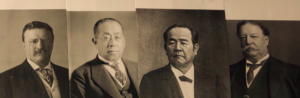
One of Prince Tokugawa‘s closest Japanese allies in promoting international goodwill was Baron Shibusawa Eiichi (aka Baron Eiichi Shibusawa, 1840-1931).

Shibusawa was great humanitarian. He is also known as the “Father of the Japanese Modern Economy and Japanese Capitalism.”

Presented above are two of the half dozen US Presidents that Prince Tokugawa and Baron Shibusawa allied with to promote US Japan goodwill: Theodore Roosevelt and William Howard Taft. 


Among his many creative efforts during the 1920s and ’30s to maintain friendship between Japan and the US, Prince Tokugawa allied with US military intelligence agent Colonel Sidney Mashbir during the 1920s and ’30s.

 Colonel Sidney Mashbir (1891-1973)

For more information about the alliance between Prince Tokugawa and this US intelligence agent, below is a link to a one hour YouTube video presentation given to Osher Lifelong Education Institute – University of California San Diego – January 8th, 2020.

https://www.youtube.com/watch?v=lu45j0XoO6k&t=9s


DESPITE PRINCE TOKUGAWA’S MAJOR ACCOMPLISHMENTS, HE HAS REMAINED RELATIVELY UNKNOWN, UNTIL NOW.

His biography is Available in two versions:

THE ART OF DIPLOMACY & THE ART OF PEACE

Future plans include the translation of the this biography into Japanese, and perhaps other languages.


PRINT & KINDLE EDITION


EXPANDED EBOOK EDITION

THE ART OF PEACE book cover presents a recently discovered photograph of Prince Tokugawa receiving an Honorary Doctor of Laws Degree from the University of Southern California (USC), during a special luncheon given March 19th, 1934 in Los Angeles.

The Los Angeles Times stated that this honorary degree was given to Prince Tokugawa:

“In recognition of distinguished service in international statesmanship,” and for his “support of many philanthropic and educational movements.”

In accepting the honor, Tokugawa respectfully said,

“He wished to receive this honor in the name of the Japanese people as a whole rather than as a personal distinction.”

The Los Angeles Times also stated that a banquet dinner was to be hosted that evening, by the Japan-America Society of Los Angeles, to honor Prince Tokugawa’s visit. The Governor of California and the former Mayor of Los Angeles planned to attend.


       Praise for the biography


Paul Ringwood U.S. Navy Commander (retired) wrote:

“Amazing little known history. I enjoyed every chapter.”


Kazuo Kodama, former Ambassador of Japan to the United Nations wrote:

“I wish you all the best & best of luck on your new book on ‘’Tokugawa Iesato.”


Professor Benjamin Uchiyama, Ph.D. History, University of Southern California wrote:

“This is a really interesting and understudied topic.”


Suzette Heiman, Director of Planning and Communications – The Missouri School of Journalism at University of Missouri [The first school of Journalism in the U.S.] wrote:

“We look forward to adding this biography to the School’s library collection. Your goal to reach high school and college students with this information is an ambitious – but important – goal.”


Toru Shigehara: Head Librarian/Information Resources Center Shibusawa Eiichi Memorial Foundation and Museum wrote:

“We appreciate your kindness and all the work you have done to promote understanding of Shibusawa Eiichi and US-Japan relations as a whole. I wish you all the best in your current and future endeavors. With gratitude,”


Bill Davison – President of the North County Chapter of the San Diego World Affairs Council wrote:

“Entertaining and Educational! This wonderful book will almost certainly broaden your perspective on US-Japanese relationships.”


Professor Claire Langham, former President of the East-West Center of Southern California wrote:

“The importance of preventing war is rarely given recognition through literature and in accounts of history.  It can be every bit as exciting as glorified accounts of war and certainly a better approach.”


-One half of author’s profits from Prince Tokugawa’s biography will be gifted to the Tokugawa US Japan Memorial Fund.


Filed Under: Tokugawa Archives Tagged With: 1934 Japan Society Annual Dinner, Abraham Lincoln, Abraham Lincoln and Japan, Ambassador Grew, Ambassador Katsuji Debuchi, America-Japan Society, Baron Eiichi Shibusawa, Baron Shibusawa, Baron Shibusawa Eiichi, Chinese History, Classics 4 Kids, Classics Four Kids, Colonel Mashbir, Colonel Mashbir Archives, Colonel Sidney Mashbir, Diplomacy, Dr. Martin Luther King, East-West Center, East-West Center of Southern California, Eiichi Shibusawa, General Douglas MacArthur, Historical biography, History of the Cherry Blossom Festival in Washington D.C., History of the Japan Society, History of the Japan Society of Manhattan, History of the Japan Society of New York, History of the National Cherry Blossom Festival, History of USC, Holocaust, International Friendship, International Relations, Iyemasa Tokugawa, Japan China relations, Japan History, Japan Society of Manhattan, Japan U.S. Relations, Kazuo Kodama, Kazuo Kodama Ambassador of Japan to the European Union, Kazuo Kodama Ambassador of Japan to the United Nations, Mashbir Archives, Missouri School of Journalism, North County Chapter of the San Diego World Affairs Council, Praemium Imperiale, President Abraham Lincoln, President Theodore Roosevelt, Prince Iyesato Tokugawa, Prince Takamatsu, Prince Tokugawa, Prince Tokugawa Archives, Prince Tokugawa Iesato, Prince Tokugawa Iesato Archives, Princess Takamatsu, Professor Claire Langham, San Diego World Affairs Council, Sasakawa Peace Foundation USA, SDWAC, Shibusawa Eiichi, Shibusawa Eiichi Memorial Foundation and Museum, Stan S. Katz, Stan S. Katz blog, Statue of Abraham Lincoln, Statue of Dr. Martin Luther King, Statue of Prince Tokugawa, Takashi Komatsu, The art of diplomacy, The Art of Diplomacy biography, The Art of Peace, The Art of Peace biography, The Emperor and the Spy, The Prince Tokugawa Foundation, The Prince Tokugawa US Japan Foundation, TheEmperorAndTheSpy.com, Theodore Roosevelt, Tokugawa Shogun History, U.S. Japan relations, U.S.-Japan History, US Japan relations, WACA, William Howard Taft, World War One, World War Two, 徳川 家達

Copyright © 2026 Stan S. Katz