Stan. S. Katz

Author of The Emperor and the Spy

  • Home
  • Author
  • Books
  • Reviews
  • Educators
  • News
  • Audiobook & Timeline
  • Mashbir Archives
  • Tokugawa Archives
  • Contact
Follow Stan on FacebookFollow Stan on TwitterFollow Stan on GoodreadsFollow Stan on RSS

Sign Up for Future Blogs Linked to Colonel Mashbir and Japanese History

Read the Intro Posts

INTRODUCTION TO THE ART OF PEACE

WELCOME!

Recent Posts

  • San Diego Jewish Journal Holocaust Remembrance Edition May 2016 highlights the historical novel, The Emperor and the Spy and the outstanding achievements of Colonel Sidney Mashbir.
  • The Emperor and the Spy, was one of two books highlighted during academic/diplomatic event sponsored by the Prime Minister’s Office of Japan and hosted by San Diego World Affairs Council
  • Osher Lifelong Education Institute – UCSD Presentation. Remarkable story, the alliance between a patriotic U.S. Intelligence Agent, Colonel Sidney Mashbir, and a humanitarian Japanese International Statesman, Prince Iyesato Tokugawa, who heroically delayed and attempted to prevent WWII in the Pacific.
  • Tokugawa & Komatsu, Forgotten Heroes – Until his passing in 1940, Prince Iyesato Tokugawa held back WWII in the Pacific – Tokugawa’s diplomatic legacy lived on after WWII ended, when his protégé, Takashi Komatsu, guided the US and Japan to again become friends and allies.
  • Have you ever wondered how US and Japan re-established their friendship and alliance following the trauma of WWII? Here’s a new biography that honors an amazing Japanese American statesman, Takashi Komatsu, who guided this major achievement.

Archives

Colonel Mashbir was instrumental in correcting an injustice that made a life-changing difference to a couple of young soldiers he never met. This historical material also gives insights into U.S. Korean relations and the rise of communism just prior to the outbreak of the Korean War (1950-1953).

April 1, 2021 by Stan S. Katz 1 Comment

Shown below are a letter, a photo, and a four page document that were sent to me by Jody Baltz, the son-in-law of Robert Wilson Murphy, of one of those two soldiers.

Jody and his wife Lesa, who is the youngest of Wilson’s three daughters, contacted me to let me know that Colonel Mashbir was a hero not only to his father-in-law, but also to Jody and Lesa’s entire family, who deeply respected Colonel Mashbir for what he did.

Jody and Lesa live in Tullahoma, Tennessee.
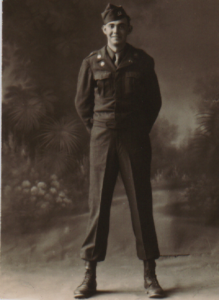


Circa 1950, Robert Wilson Murphy

Robert Wilson Murphy was restored to duty on 25 March 1949.

——————————————————————————————————

September 2020

Stan:

Attached is the Memo that Col. Mashbir wrote in 1948 that restored my future father-in-law, Robert Wilson Murphy (1928-2017), to duty. He was in the 6th Division, 20th Infantry Regiment, during the Korean occupation (post-WWII) and stationed in Kwangju. The unit was involved in demobilizing the Japanese forces and providing back up to the Korean constables as Korea was overrun at that time by organized criminal and/or communist gangs. During his tour of duty he and another soldier were attacked, but blame was assessed against them, and both were court-martialed and sentenced to long terms of imprisonment. Eventually they were pardoned and restored to duty.

For over fifty years my father-in-law had a lot of guilt and embarrassment about being court-martialed and imprisoned. He would never talk about his service, but since we were interested he finally let us digitize his photo scrapbook that covered his time in the army and began to tell us about what had happened. In 2006 he obtained a copy of his service file (scorched and partially burned, but it survived the infamous 1973 St. Louis fire) and that is when we found out that Col. Mashbir was instrumental in correcting an injustice. He had written a memo that analyzed the case and recommended his restoration to duty, which was ultimately approved.

After reading about Col. Mashbir’s background and service, we soon realized that it was a miracle that Wilson’s case crossed his desk at that time – first, in that Mashbir was at the Pentagon only a short time before retiring, so the window of opportunity for him to review the case was small, and secondly, in that no one could better appreciate the Korean/Far East situation at the time.

We know it was not a big incident in Mashbir’s career, but it sure made a life-changing difference to a couple of young soldiers he never met and that is why I thought you would be interested in it.

If you have any questions, or need more info, just let me know. If convenient, please reply so that I know the email with the attachments got through to you.


Regards,

Jody Baltz

P.S. As an aside, for many years we could not understand why one of Wilson’s favorite movies was “A Few Good Men” since he rarely watched movies with profane language; that is, until we heard his story.


——————————————————————————————————

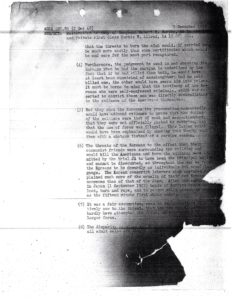
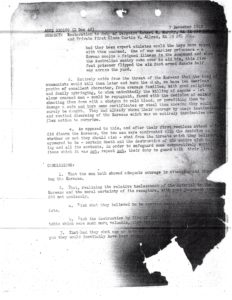
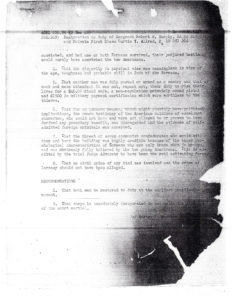
The following four page document highlights Colonel Mashbir’s decision to exonerate Robert Wilson Murphy and another young soldier.

-Below the images of this document is a Transcription of the four pages.

This document almost didn’t survive a major fire, but it now lives on as a tribute to one of Colonel Mashbir’s many worthy achievements.

Colonel Mashbir’s father was an attorney, who went blind, and at the age of 13 Sidney Mashbir assisted his father in reading his legal documents to him, and various other legal responsibilities. His attorney  skills are apparent in the below document.

Thanks go out to you Jody and your family for sharing this material.
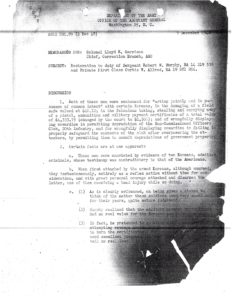


TRANSCRIPTION OF THE ABOVE FOUR PAGE DOCUMENT:


COPY:

DEPARTMENT OF THE ARMY

OFFICE OF THE ADJUTANT GENERAL

Washington 25, D. C.

AGEZ 220.89   (2 Dec 48)                                                  7 December 1948


MEMORANDUM FOR:    Colonel Lloyd R. Garrison, Chief, Correction Branch, AGO


SUBJECT:       Restoration to duty of Sergeant Robert W. Murphy, RA 14 219 538 and Private First Class Curtis V. Allred, RA 19 281 204.


DISCUSSION


  1. Both of these men were sentenced for “acting jointly and in pursuance of common intent” with certain Koreans, in the damaging of a field safe valued at $40.12; in the felonious taking, stealing and carrying away of a pistol, ammunition and military payment certificates of a total value of $4,333.75 (changed by the court to $1,500); and of wrongly displaying cowardice in permitting depredation of the Non-Commissioned Officers Club, 20th Infantry, and for wrongly displaying cowardice in failing to properly safeguard the contents of the club after overpowering the attackers, by permitting them to commit depredations of government property.


  1. Certain facts are at once apparent:


a. These men were convicted by evidence of two Koreans, admitted criminals, whose testimony was contradictory to that of the Americans.


b. When first attacked by the armed Koreans, although unarmed, they instantaneously, entirely as a reflex action without time for consideration, and with great personal courage attacked and disarmed the latter, one of them receiving a hand injury while so doing.


c. (1) As is clearly evidenced, on being given a chance to think of the matter these soldiers used very sound and, for their years, quite mature judgement.


(2) Murphy realized that the military payment certificates had no real value for the Koreans and told them so.


(3) In fact, he pretended to go along with their [illegible – fire damaged]

attempting revenge on the 1st Sergeant, and [illegible – fire damaged]

to burn the certificates. This clearly shows that he

used excellent judgement in that destruction [illegible – fire damaged]

entail no real loss. It must have been obvious to him


[Page 1]


AGEZ 220.89 (2 Dec 48)                                7 December 1948

SUBJECT:       Restoration to duty of Sergeant Robert W. Murphy, RA 14 219 538 and Private First Class Curtis V. Allred, RA 19 281 204.


that the threats to burn the club would, if carried out, be much more costly than some certificates which could be and were for the most part recaptured.


(4) Furthermore, the judgement he used in not shooting the Koreans when he had the shotgun is underlined by the fact that if he killed them both, he would have at least been convicted of manslaughter; had he only killed one, the other would have sworn him into prison. It must be borne in mind that the testimony of the Koreans who were self-confessed criminals, which was accepted to convict these men was directly contradictory to the evidence of the Americans themselves.


(5) Had they shot the Koreans the prosecution undoubtedly would have adduced evidence to prove that the duties of the soldiers were that of cook and mess-attendant; that they were not officially posted as sentries, and that the use of force was illegal. This latter point would have been emphasized by showing that Murphy shot them with a shotgun instead of a service weapon.


(6) The threats of the Koreans to the effect that their communist friends were surrounding the building and would kill the Americans and burn the building were admitted by the trial JA to have been the principal motive and cannot be discounted, as throughout the war we found the Koreans to be cowardly as individuals but cruel in gangs. The Korean conscript laborers when captured complained much more of the cruelty of their own Korean non-coms than that of the Japs. After the earthquake in Japan (1 September 1923) bands of Koreans began to loot, burn and rape, and to poison wells almost as soon as the fifteen minute first shock ended.


(7) It was a fair assumption, even to two youngsters relatively new to the Orient, that the two men alone would hardly have attempted the crime, unless covered by a larger force.


(8) The disparity in sizes was meaningless [this page section was fire destroyed]

all adult males are taught some form [this page section was fire destroyed]


-2-


AGEZ 220.89 (2 Dec 48)                                                                            7 December 1948

SUBJECT:       Restoration to duty of Sergeant Robert W. Murphy, RA 14 219 538 and Private First Class Curtis V. Allred, RA 19 281 204.


Had they been expert athletes could the boys have coped with them unarmed. One of our earlier prisoners – a Korean coolie – feigned illness in the compound and when the Australian sentry came over to aid him, this five foot prisoner flipped the six foot armed Aussie half way across the yard.


  1. Entirely aside from the threat of the Koreans that the band of communists would kill them later and burn the club, we have two American youths of excellent character, from average families, with good religious and family upbringing, to whom undoubtedly the killing of anyone – let alone unarmed men – would be repugnant, faced with the decision of calmly shooting them down with a shotgun in cold blood, or permitting them to damage a safe and burn some certificates or steal them knowing they would surely be caught. They had already shown their courage by their instinctive reflex action to surprise.


  1. As opposed to this, and after their first reckless attack which did disarm the Koreans, the two men were confronted with the decision as to whether or not they should risk – what from the threats which they believed, appeared to be – certain death and the destruction of the entire club building and all its contents, in order to safeguard some comparatively worthless items which it was not, repeat not, their duty to guard with their lives.


CONCLUSIONS:


  1. That the men both showed adequate courage in attacking and disarming the Koreans.


  1. That, realizing the relative uselessness of the material to the Koreans and the moral certainty of its recapture, with good judgement the did not uselessly,


  1. Risk what they believed to be certain death from the communists.


  1. Risk destruction by fire of the clubhouse and all [illegible – fire damaged] tents which were much more valuable, than the articles taken.


  1. That had they shot one or both of the unarmed Koreans [illegible – page section fire damaged]

gun they would inevitably have been charged with murder [illegible – page section fire damaged]


-3-


AGEZ 220.89 (2 Dec 48)                                               7 December 1948

SUBJECT:       Restoration to duty of Sergeant Robert W. Murphy, RA 14 219 538 and Private First Class Curtis V. Allred, RA 19 281 204.


convicted, and had one or both Koreans survived, their perjured testimony would surely have convicted the two Americans.


  1. That the disparity in physical size was meaningless in view of the age, toughness and probable skill in Judo of the Koreans.


  1. That neither man was duly posted or armed as a sentry and that as cook and mess attendant it was not, repeat not, their duty to risk their lives for a $40.00 field safe, a non-regulation privately owned pistol and $1500 in military payment certificates which were worthless to the thieves.


  1. That for some unknown reason, which might possibly have political implications, the sworn testimony of two American soldiers of excellent character, who could not have and were not alleged to or proven to have derived any pecuniary benefit, was disregarded and the evidence of self-admitted foreign criminals was accepted.


  1. That the threat of seven communist confederates who would kill them and burn the building was highly credible… and was obviously fully believed by the two young Americans. This is admitted by the trial Judge Advocate to have been the real activating force.


  1. That no civil crime of any kind was involved and the crime of larceny should not have been alleged.


RECOMMENDATIONS


  1. That both men be restored to duty at the earliest practicable moment.


  1. That steps be immediately inaugurated to set aside the findings of the court martial.


/s/ Sidney F. Mashbir


SIDNEY F. MASHBIR

Colonel [illegible – fire char]

Branch [illegible – fire char]


-4-


TO LEARN MORE ABOUT COLONEL MASHBIR, YOU’RE INVITED TO VISIT THE WEBSITE:

TheEmperorAndTheSpy.com


Filed Under: Mashbir Archives Tagged With: 20th Infantry Regiment, 6th Division, Colonel Lloyd R. Garrison, Colonel Mashbir, Colonel Mashbir Archives, Colonel Sidney Forrester Mashbir, Colonel Sidney Mashbir, Curtis V. Allred, History of Communism, Jody Baltz, Korean occupation, Korean War, Lesa Baltz, Mashbir Archives, Military Justice, Private First Class Curtis V. Allred, Robert Wilson Murphy, Stan S. Katz, Stan S. Katz blog, U.S. Korean relations

Sept. 20th, 1917 Dinner Event to Honor the new U.S. Ambassador to Japan Roland S. Morris at the Bellevue Stratford, Hotel, Philadelphia. This event is linked to the 1917-1918 Viscount Ishii goodwill delegation visit.

April 10, 2019 by Stan S. Katz Leave a Comment


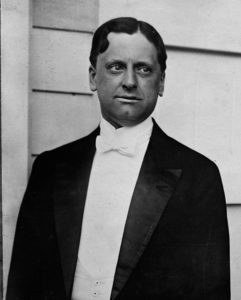
Circa 1917: Roland Sletor Morris. Following his Sept. 20th, 1917 reception in Philadelphia, Morris soon proceeded to Japan. Source: Library of Congress /Bain News Service.


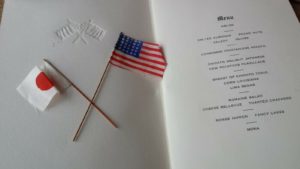
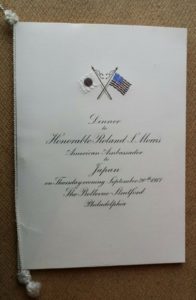
The interior of the Program/Menu to the reception is presented below.

This diplomatic event and the prominent individuals who attended it, offers a window to several significant international issues of that day.


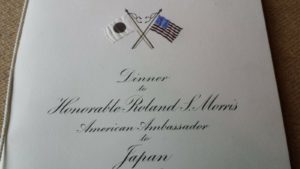
Dinner to Honorable Roland S. Morris

American Ambassador to Japan

on Thursday evening September 20th, 1917

The Bellevue-Stratford [Hotel], Philadelphia


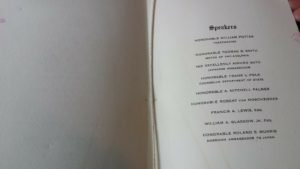
Speakers

–Honorable William Potter (ex-Minister to Italy)

Toastmaster

–Honorable Thomas B. Smith (November 2, 1869–April 17, 1949) served as a member of the Pennsylvania House of Representatives and was the 82nd Mayor of Philadelphia from 1916 until 1920.

–His Excellency Aimaro Sato (aka Yoshimaro Satō (佐藤 愛麿, April 22, 1857 – January 12, 1934) was the Japanese Ambassador to the United States from 1916 to 1918.

–Honorable Frank Lyon Polk Frank Lyon Polk (September 13, 1871 – February 7, 1943) was a prominent United States lawyer and diplomat, who was also a name partner of the law firm today known as Davis Polk & Wardwell. At the time of this reception he held the position of Counselor Department of State

–Honorable Alexander Mitchell Palmer (May 4, 1872 – May 11, 1936), was United States Attorney General from 1919 to 1921. He is best known for overseeing the Palmer Raids during the Red Scare (U.S. efforts against communists in America) of 1919–20. Palmer selected J. Edgar Hoover to his position in newly formed federal intelligence organization that would become the F.B.I.

–Honorable Robert von Moschzisker (March 6, 1870 – November 21, 1939) a Justice of the Supreme Court of Pennsylvania from 1909 to 1921 and Chief Justice from 1921 to 1930.

–Francis A. Lewis, Esq.

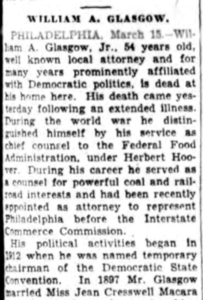
–William A. Glasgow, Jr., Esq. (April 29, 1865 – March 14, 1930) [Note 8]                  

–Honorable Roland S. Morris

American Ambassador to Japan


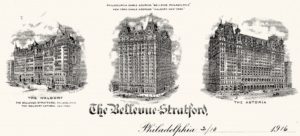
The reception for Morris took place at the Bellevue-Stratford Hotel, a landmark building at 200 S. Broad Street at the corner of Walnut Street in Center City, Philadelphia, Pennsylvania.


Engraved 1916 letterhead of the Bellevue-Stratford Hotel, Philadelphia, PA, with vignettes of both that hotel, as well as those of the Waldorf and Astoria Hotels in New York all of which were then operating under the management of George Boldt. Source courtesy of: “The Cooper Collection of U.S. Hotel History” [1]


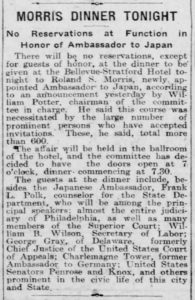
The below news article describes this festive diplomatic ballroom event, with 600 attendees, including many members Philadelphia’s judiciary, two U.S. senators, a fellow U.S. ambassador, and many other prominent supporters of the civic life in this city and State.

The Philadelphia Inquirer, Philadelphia, Pennsylvania, Sept. 20th, 1917, Thu • Page 10


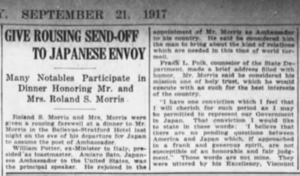
Below is another news article that described the Sept. 20th diplomatic event:

Evening Public Ledger, Philadelphia, Pennsylvania, Sept. 21, 1917, Friday • Page 9


At the event His Excellency Aimaro Sato Japanese Ambassador to the United States, stated that, “He rejoiced in the appointment of Mr. Morris as Ambassador to his country. He said he considered him the man to bring about the kind of relations which are needed in this time of world turmoil.”

Ambassador Morris stated, “I believe there are no pending questions between America and Japan which, if approached in a frank and generous spirit, are not susceptible of an honorable and fair judgement.” Those are not. They were uttered by his Excellency, Viscount Ishii.


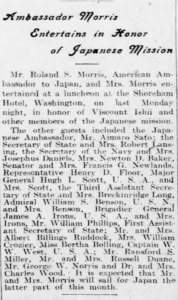
Eleven days earlier, Ambassador Morris and his wife entertained Viscount Ishii and his peace mission. During 1917-1918, Ishii and his delegation travelled the U.S., attempting to negotiate a compromise with the U.S. to ease U.S. Japan tensions. See below news article:

The Philadelphia Inquirer, Philadelphia, Pennsylvania, Sept. 9th, 1917, Sunday • Page 64


The result of Ishii’s visit was the Lansing: Ishii Agreement a diplomatic note signed between the U.S. and Japan on November 2, 1917 linked to their disputes with regards to China. In the published text of the Agreement, signed by U.S. Secretary of State Robert Lansing and Japanese special envoy Ishii Kikujirō, both parties pledged to uphold the Open Door Policy in China, with respect to its territorial and administrative integrity. However, the U.S. acknowledged that Japan had “special interests” in China due to its geographic proximity, especially in those areas of China adjacent to Japanese territory, which was in full alignment to the Open Door Policy. [2]

In a secret protocol attached to the public Agreement, both parties agreed not to take advantage of the special opportunities presented by World War I to seek special rights or privileges in China at the expense of other nations allied in the war effort against Germany.

Note: An upcoming blog post on this website will focus on the Lansing: Ishii Agreement


Some general biographical information about Roland Sletor Morris (March 11, 1874 – November 23, 1945): Morris was a U.S. diplomat and politician. He served as U.S. Ambassador to Japan from 1917 to 1921, and is perhaps best remembered for his special missions to Siberia in 1918 and 1919. He was one of the founding partners of the law firm of Duane Morris, in Philadelphia. For additional biographical info about Ambassador Morris see notes: [3] [4] [5] [6] Morris’ official papers are in the Library of Congress.


Some pivotal issues of the day during Morris’s time as Ambassador to Japan, which affected U.S., European, Russian, Chinese and Japanese relations:

-The Bolshevik Revolution of 1917 combined with destruction of World War One destabilized mainly Europe and Russia, and in its aftermath, created uncertainties as to who would now take the leadership roles in Asia. Would the prior now weakened European colonial powers retain their positions, and to what degree would the rise Japanese influence impact the situation? [7]

-Japan had been an active ally of the democracies in WWI, and she felt she deserved to be treated as an equal to the European powers and the U.S. Despite her support in WWI, she felt dishonored when she saw racism shown against Japanese Americans living in the U.S. She viewed the great instability and civil war in Russia, and felt she was justified to have a larger presence in China, so as to contain the Russian Bolshevik movement from moving into China.

-The U.S. took the stance that the best way for China to resist moving towards communism, was for China’s territory to remain intact. The U.S. accepted that prior colonial powers could continue to hold significant influence in China, but that China not be divided up by those nations. Instead, the U.S. promoted the Open Door Policy with the hope China would move towards democracy. There was idealism and optimism to this approach, which could not stand up to the future destabilizing rise of communism and fascism leading to World War Two.


                  AMBASSADOR MORRIS ARRIVES IN JAPAN


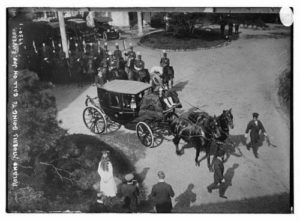
Circa 1918: U.S. Ambassador Roland Sletor Morris going to call on Japanese Emperor Taisho. Source: George Grantham Bain Collection (Library of Congress).


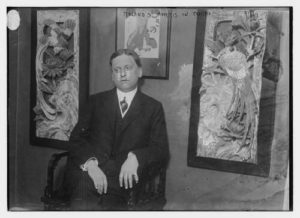
Circa 1918: Roland S. Morris in Tokyo, seated in front of artwork.

Source: George Grantham Bain Collection (Library of Congress).


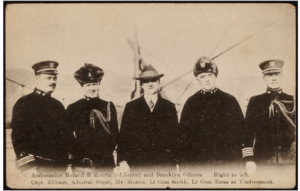
Ambassador Roland S. Morris accompanied by U.S. naval officers of the U.S.S. Brooklyn (ACR-3) – Right to left, Captain Althaus, Admiral Roger, Ambassador Morris, Lt. Commander Smith, and Lt. Commander Estes at Vladivostok, Russia. Circa 1918 to 1919.


Postcard: Springfield College Archives and Special Collections

Courtesy of: Cliff Smith YMCA Postcard Collection


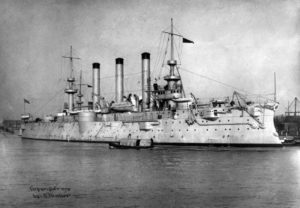
U.S.S. Brooklyn (ACR-3) at anchor, c. 1898.

United States Navy

Built: 1893–1896

In commission:     1896–1921

Namesake:  City of Brooklyn, New York


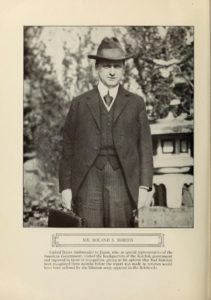
Portrait photo of Roland Sletor Morris

Book source: The World’s Work, 1919: https://archive.org/stream/worldswork38gard#page/566/mode/2up

Ambassador Morris was in Japan, taking a supportive role for the White Russians who are resisting the Bolshevik takeover of the important port city of Vladivostok.


The historical novel The Emperor and the Spy dramatically presents the exciting events surrounding this period of history in Vladivostok, and how a regional war almost erupted, but was prevented in 1922 by an American military intelligence agent Captain Sidney Mashbir.


Available in Print, EBook, and Audiobook:

Here are links to the book.

Barnes & Nobles link

Amazon Link


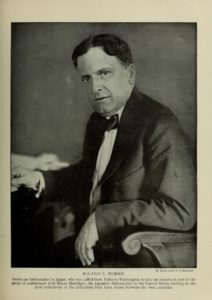
1921 Ambassador Roland S. Morris is called back from Japan to Washington, D.C. to negotiate with Japanese Ambassador to the U.S. Baron Shidehara. In 1921, Baron Shidehara accompanied Prince Iyesato Tokugawa, who headed Japanese delegation to the Washington Naval Arms Conference in the U.S. capital – Where they met with the leaders of many other nations to work out a naval arms limitation treaty, which was signed in 1922.

Book source for the photo: The World’s Work, 1921: https://archive.org/stream/worldswork41gard#page/318/mode/2up

Author: Underwood & Underwood


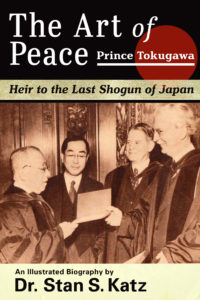
The Art of Peace illustrated biography highlights the diplomatic engagements between leaders of the U.S. and Japan during the first four decades of the twentieth century, in their support of democracy and their creative pursuit of goodwill, in spite of the turbulent times they lived. So influential was Prince Tokugawa and his Japanese supporters, that it would only be after Tokugawa’s passing in 1940, that Japan was pressured to ally with the Axis Powers in WWII.


Link to the Introduction:

THE ART OF PEACE


NOTES

[1] Constructed in 1904 and expanded to its present size in 1912, Bellevue-Stratford Hotel has continued as a well-known institution for more than a century and is still widely known by that original, historic name. In 1988 the building was converted to a mixed-use development. It has been known since then as The Bellevue. The hotel portion is currently managed by Hyatt as The Bellevue Hotel.]

[2] Tuchman, Stilwell and the American Experience in China, 1911–1945, page 48

[3] Biography and History from: Princeton University Library Finding Aids: Morris, Roland S. (Roland Sletor), 1874-1945.

“Roland S. (Sletor) Morris was a leader of the Democratic Party in Pennsylvania and was the ambassador to Japan from 1917-1921…born in Olympia, Washington on March 11, 1874 to Thomas Burnside Morris and Sarah Arndt Sletor. Morris attended the Lawrenceville School before entering Princeton University in September 1892. He graduated in June 1896, and went to the University of Pennsylvania Law School from 1896-1899, graduating cum laude. After receiving his law degree, Morris practiced law in Philadelphia at the firm of Duane, Morris and Heckscher. Morris was also politically active; he was the Chairman of the Democratic State Finance Committee in 1908 and from 1913-1916; additionally, he was a delegate or delegate at large to the Democratic National Convention in 1904, 1908, 1912, 1920, and 1928. President Woodrow Wilson appointed him as Ambassador to Japan from 1917-1921, and sent him on a special mission to Siberia from 1918-1919. Morris was a professor of international law at the University of Pennsylvania beginning in 1924, President of the American Philosophical Society, a trustee of both Princeton University and Temple University, and a Regent of the Smithsonian Institute.”

[4] In 1934, Morris lost the Pennsylvania Democratic U.S. Senate primary to Joseph Guffey, who was subsequently elected. Source: “Pennsylvania Oracle”. Time Magazine. 1934-05-28.

[5] Morris was one of the founding partners in 1904, of the law firm Duane, Morris, Heckscher and Roberts that is currently known as Duane Morris, which has offices in the United States, London, Singapore, Viet Nam, Oman, Myanmar, Shanghai and Taiwan. Morris also served as the Chancellor of the Philadelphia Bar Association, 1933 to 1935.  Source: The Duane Morris firm website.

[6] Morris was one of the reception hosts at the 1934 Japan Society of New York City Annual Gala Dinner event honoring the visit of Prince Iyesato Tokugawa. A blog post for that event is included on this website. Source: TheEmperorAndTheSpy.com blog
[7] The Russian Revolution began during the First World War. The revolution erupted in the context of Russia’s major military losses during that War, which resulted in much of the Russian Army being ready to mutiny. The situation climaxed with the October Revolution in 1917, a Bolshevik-led armed insurrection by workers and soldiers in Petrograd that successfully overthrew the Provisional Government, transferring all its authority to the Soviets.

The Russian Revolution was a period of political and social revolution across the territory of the Russian Empire, commencing with the abolition of the monarchy in 1917, and concluding in 1923 after the Bolshevik establishment of the Soviet Union, resulting in the end of the Civil War. They also established Soviet power in the newly independent republics of Armenia, Azerbaijan, Belarus, Georgia and Ukraine, and brought these jurisdictions into unification under the Union of Soviet Socialist Republics (USSR) in 1922. Victorious, they reconstituted themselves as the Communist Party.

[8] William A. Glasgow, Jr., Esq. (April 29, 1865 – March 14, 1930) was one of the speakers at the Ambassador Morris dinner event.                        Source: Ancestry.com. Since there is no Wikipedia page, the below obituary announcement is included to honor his memory.

Filed Under: Tokugawa Archives Tagged With: Admiral Roger, Aimaro Sato, Alexander Mitchell Palmer, Ambassador Aimaro Sato, Ambassador Morris, Ambassador Satō, Baron Eiichi Shibusawa, Baron Shibusawa, Baron Shibusawa Eiichi, Baron Shidehara, Bellevue-Stratford Hotel, Bolsheviks, Capt. Althaus, Captain Althaus, Chinese History, Colonel Mashbir, Colonel Sidney Mashbir, Communism, Diplomacy, Duane Morris, Duane Morris Law Firm, Eiichi Shibusawa, Emperor Taisho, Esq., Francis A. Lewis, Frank Lyon Polk, Historical biography, History of Communism, Honorable Thomas B. Smith, Honorable William Potter, in Philadelphia, International Friendship, International Relations, J. Edgar Hoover, Japan China relations, Japan History, Japan U.S. Relations, Jr., Lansing: Ishii Agreement, law firm of Duane Morris, Lt. Commander Estes, Lt. Commander Smith, Mayor of Philadelphia Thomas B. Smith, Mayor Thomas B. Smith, Prince Iyesato Tokugawa, Prince Tokugawa, Prince Tokugawa Iesato, Robert von Moschzisker, Roland S. Morris, Roland Sletor Morris, Russian History, Shibusawa Eiichi, Stan S. Katz, Stan S. Katz blog, The Art of Peace, The Art of Peace biography, The Emperor and the Spy, TheEmperorAndTheSpy.com, U.S. Japan relations, U.S.-Japan History, U.S.S. Brooklyn, U.S.S. Brooklyn (ACR-3), Viscount Ishii, Vladivostok, Washington Naval Arms Conference, William A. Glasgow, William Potter, William Potter (ex-Minister to Italy), World War One, World War Two, Yoshimaro Satō, 佐藤 愛麿

Copyright © 2026 Stan S. Katz