Stan. S. Katz

Author of The Emperor and the Spy

  • Home
  • Author
  • Books
  • Reviews
  • Educators
  • News
  • Audiobook & Timeline
  • Mashbir Archives
  • Tokugawa Archives
  • Contact
Follow Stan on FacebookFollow Stan on TwitterFollow Stan on GoodreadsFollow Stan on RSS

Sign Up for Future Blogs Linked to Colonel Mashbir and Japanese History

Read the Intro Posts

INTRODUCTION TO THE ART OF PEACE

WELCOME!

Recent Posts

  • San Diego Jewish Journal Holocaust Remembrance Edition May 2016 highlights the historical novel, The Emperor and the Spy and the outstanding achievements of Colonel Sidney Mashbir.
  • The Emperor and the Spy, was one of two books highlighted during academic/diplomatic event sponsored by the Prime Minister’s Office of Japan and hosted by San Diego World Affairs Council
  • Osher Lifelong Education Institute – UCSD Presentation. Remarkable story, the alliance between a patriotic U.S. Intelligence Agent, Colonel Sidney Mashbir, and a humanitarian Japanese International Statesman, Prince Iyesato Tokugawa, who heroically delayed and attempted to prevent WWII in the Pacific.
  • Tokugawa & Komatsu, Forgotten Heroes – Until his passing in 1940, Prince Iyesato Tokugawa held back WWII in the Pacific – Tokugawa’s diplomatic legacy lived on after WWII ended, when his protégé, Takashi Komatsu, guided the US and Japan to again become friends and allies.
  • Have you ever wondered how US and Japan re-established their friendship and alliance following the trauma of WWII? Here’s a new biography that honors an amazing Japanese American statesman, Takashi Komatsu, who guided this major achievement.

Archives

Dec. 23, 1929 – J. Edgar Hoover oversees the protection detail for the visiting Japanese Naval Delegation in Washington, D.C. – U.S. Secretary of State Stimson and the Japanese Ambassador Debuchi greet the visitors and escort them to the White House to meet with President Hoover

July 8, 2019 by Stan S. Katz Leave a Comment

Dec. 23, 1929 – A rare photo of J. Edgar Hoover as he oversees the protection detail for the visiting Japanese Naval Delegation in Washington, D.C. The Japanese delegation were were on their way to attend negotiations in Europe for the ratification of the 1930 London Naval Treaty (officially the Treaty for the Limitation and Reduction of Naval Armament). The delegation was greeted at the Washington Union (Train) Station by U.S. Secretary of State Henry L. Stimson and the Japanese Ambassador Katsuji Debuchi; the delegation then visited the White House to meet with President Herbert Hoover.
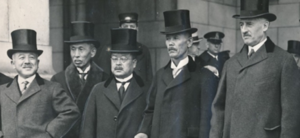


December 23, 1929 – This photo offers rare candid view of J. Edgar Hoover, who is wearing the straw hat in the background and standing near a policeman. This photo is a sectional view of the larger group photo. This sectional view allowed the enlargement necessary to clearly view J. Edgar Hoover. This photo presents a unique glimpse of Hoover during a Bureau of Investigation (prior name of the FBI) field operation, when he wasn’t posing for the camera.

This photo highlights the arriving Japanese Naval Delegation in Washington, D.C., prior to the delegation being received by President Herbert Hoover at the White House. We see U. S. Secretary of State Henry L. Stimson (1867 – 1950) at the far right, with Japanese Ambassador to the U.S. Katsuji Debuchi  at the far left. They are greeting the arriving Japanese Naval Delegation at the Washington Union (Train) Station. The delegation was passing thru the U.S. on their way to Europe for the negotiations that would ratify the 1930 London Naval Arms (limitation) Conference. The 1930 The London Naval Treaty (officially the Treaty for the Limitation and Reduction of Naval Armament) was an agreement between Great Britain, Japan, France, Italy and the United States, signed on 22 April 1930. Seeking to address a loophole in the formidable 1922 Washington Naval Treaty (that created tonnage limits for each nation’s surface warships), it regulated submarine warfare and limited naval shipbuilding. Ratifications were exchanged in London on 27 October 1930, and the treaty went into effect on the same day.

One of the significant benefits of this treaty, beyond attempting to maintain peace, was that the Great Depression had just begun in late 1929, and the treaty encouraged less funds be spent in an international Arms Race, when that money could better be used for urgently needed social support programs during the economic downturn.
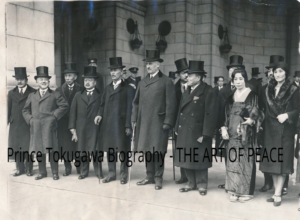


Above is the larger version of the December 23, 1929 photo as the Japanese Naval Delegation arrive in Washington, D.C., on their way to the 1930 London Naval Conference.

Front row, Left to right: Admiral Seizō Sakonji; Japanese Ambassador Katsuji Debuchi; , T. Kawasaki, Reijiro Wakatsuki chief of delegates; U.S. Secretary of State Stimson: Hirosi Saito, Madame Takarabe, and Madame Debuchi. Back row right side: Takeshi Takarabe, assistant chief delegate (wearing glasses and standing behind his wife).


The individual in the background wearing a straw hat, adjacent to the policeman is J. Edgar Hoover (see below photo enlargements):
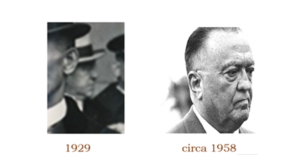


John Edgar Hoover (January 1, 1895 – May 2, 1972) was the first Director of the Federal Bureau of Investigation (FBI) of the United States and an American law enforcement administrator. He was first appointed as the director of the Bureau of Investigation – the FBI’s predecessor – in 1924 and was instrumental in founding the FBI in 1935, where he remained director for another 37 years until his death in 1972 at the age of 77.

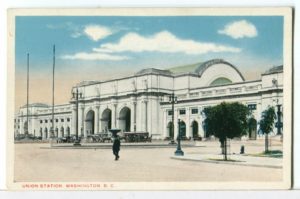
The Dec. 23, 1929 group photo was taken in front of the south main entrance to the Washington Union Station. Below is a circa 1929 postcard of the train station. The descriptive reverse side of the postcard is also displayed below:
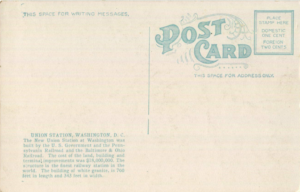


It was a surprising discovery noticing that J. Edgar Hoover appeared in the Dec. 23rd, 1929 photo. The photo was acquired while doing research for the historical novel The Emperor and the Spy: The Secret Alliance to Prevent WWII, and the illustrated biography The Art of Peace by Stan S. Katz.

The Emperor and the Spy focuses on the life of a high level U.S. intelligence agent Colonel Sidney Mashbir who befriended and allied with Japanese leaders, including members of the Japanese royal family during the 1920s and 1930s, in a valiant attempt to maintain goodwill between their nations.

The Art of Peace biography is in many ways a nonfictional sequel to the novel and highlights the pivotal behind the scenes events in U.S. Japan relations during the first half of the twentieth century. The book highlights one of Colonel Mashbir’s closest and most influential Japanese allies Prince Iyesato Tokugawa (1863-1940).

For further information visit the website TheEmperorAndTheSpy.com
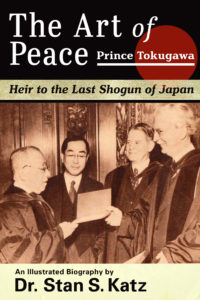


Link to the Introduction of THE ART OF PEACE
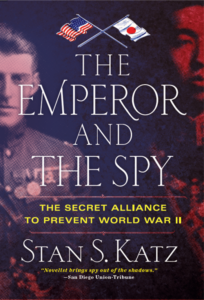


Link to Introduction for THE EMPEROR AND THE SPY
 

Filed Under: Tokugawa Archives Tagged With: 1915 U.S. Japan relations, 1930 London Naval Treaty, Admiral Seizō Sakonji, Aisuke Kabayama, Ambassador Katsuji Debuchi, Count Aisuke Kabayama, F.B.I., Federal Bureau of Investigation, Henry L. Stimson, Herbert Hoover, Hirosi Saito, J. Edgar Hoover, Japanese Ambassador Katsuji Debuchi, Katsuji Debuchi, London Naval Treaty, Madame Debuchi, Madame Takarabe, President Herbert Hoover, President Hoover, Prince Iyesato Tokugawa, Prince Tokugawa Iesato, Reijiro Wakatsuki, Secretary of State Henry L. Stimson, Seizō Sakonji, Stan S. Katz, Stan S. Katz blog, T. Kawasaki, Takeshi Takarabe, The Art of Peace, The Art of Peace biography, The Emperor and the Spy, TheEmperorAndTheSpy.com, Tokugawa Iesato, U.S. Japan Diplomacy, U.S. Secretary of State Henry L. Stimson

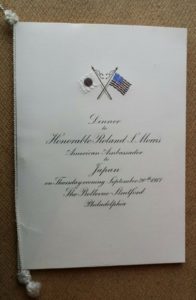
Sept. 20th, 1917 Dinner Event to Honor the new U.S. Ambassador to Japan Roland S. Morris at the Bellevue Stratford, Hotel, Philadelphia. This event is linked to the 1917-1918 Viscount Ishii goodwill delegation visit.

April 10, 2019 by Stan S. Katz Leave a Comment


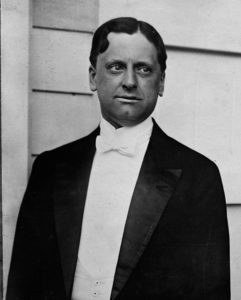
Circa 1917: Roland Sletor Morris. Following his Sept. 20th, 1917 reception in Philadelphia, Morris soon proceeded to Japan. Source: Library of Congress /Bain News Service.


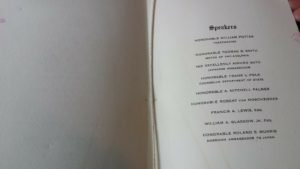
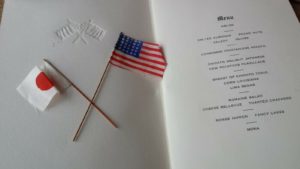
The interior of the Program/Menu to the reception is presented below.

This diplomatic event and the prominent individuals who attended it, offers a window to several significant international issues of that day.


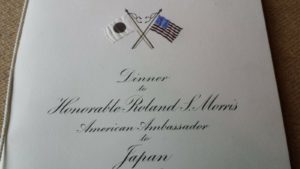
Dinner to Honorable Roland S. Morris

American Ambassador to Japan

on Thursday evening September 20th, 1917

The Bellevue-Stratford [Hotel], Philadelphia


Speakers

–Honorable William Potter (ex-Minister to Italy)

Toastmaster

–Honorable Thomas B. Smith (November 2, 1869–April 17, 1949) served as a member of the Pennsylvania House of Representatives and was the 82nd Mayor of Philadelphia from 1916 until 1920.

–His Excellency Aimaro Sato (aka Yoshimaro Satō (佐藤 愛麿, April 22, 1857 – January 12, 1934) was the Japanese Ambassador to the United States from 1916 to 1918.

–Honorable Frank Lyon Polk Frank Lyon Polk (September 13, 1871 – February 7, 1943) was a prominent United States lawyer and diplomat, who was also a name partner of the law firm today known as Davis Polk & Wardwell. At the time of this reception he held the position of Counselor Department of State

–Honorable Alexander Mitchell Palmer (May 4, 1872 – May 11, 1936), was United States Attorney General from 1919 to 1921. He is best known for overseeing the Palmer Raids during the Red Scare (U.S. efforts against communists in America) of 1919–20. Palmer selected J. Edgar Hoover to his position in newly formed federal intelligence organization that would become the F.B.I.

–Honorable Robert von Moschzisker (March 6, 1870 – November 21, 1939) a Justice of the Supreme Court of Pennsylvania from 1909 to 1921 and Chief Justice from 1921 to 1930.

–Francis A. Lewis, Esq.

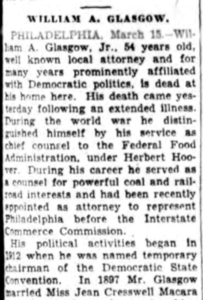
–William A. Glasgow, Jr., Esq. (April 29, 1865 – March 14, 1930) [Note 8]                  

–Honorable Roland S. Morris

American Ambassador to Japan


The reception for Morris took place at the Bellevue-Stratford Hotel, a landmark building at 200 S. Broad Street at the corner of Walnut Street in Center City, Philadelphia, Pennsylvania.


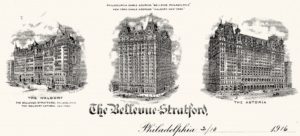
Engraved 1916 letterhead of the Bellevue-Stratford Hotel, Philadelphia, PA, with vignettes of both that hotel, as well as those of the Waldorf and Astoria Hotels in New York all of which were then operating under the management of George Boldt. Source courtesy of: “The Cooper Collection of U.S. Hotel History” [1]


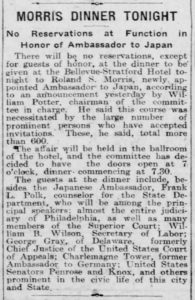
The below news article describes this festive diplomatic ballroom event, with 600 attendees, including many members Philadelphia’s judiciary, two U.S. senators, a fellow U.S. ambassador, and many other prominent supporters of the civic life in this city and State.

The Philadelphia Inquirer, Philadelphia, Pennsylvania, Sept. 20th, 1917, Thu • Page 10


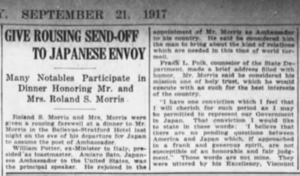
Below is another news article that described the Sept. 20th diplomatic event:

Evening Public Ledger, Philadelphia, Pennsylvania, Sept. 21, 1917, Friday • Page 9


At the event His Excellency Aimaro Sato Japanese Ambassador to the United States, stated that, “He rejoiced in the appointment of Mr. Morris as Ambassador to his country. He said he considered him the man to bring about the kind of relations which are needed in this time of world turmoil.”

Ambassador Morris stated, “I believe there are no pending questions between America and Japan which, if approached in a frank and generous spirit, are not susceptible of an honorable and fair judgement.” Those are not. They were uttered by his Excellency, Viscount Ishii.


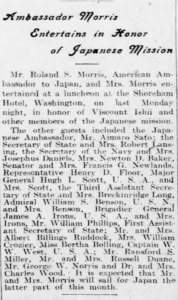
Eleven days earlier, Ambassador Morris and his wife entertained Viscount Ishii and his peace mission. During 1917-1918, Ishii and his delegation travelled the U.S., attempting to negotiate a compromise with the U.S. to ease U.S. Japan tensions. See below news article:

The Philadelphia Inquirer, Philadelphia, Pennsylvania, Sept. 9th, 1917, Sunday • Page 64


The result of Ishii’s visit was the Lansing: Ishii Agreement a diplomatic note signed between the U.S. and Japan on November 2, 1917 linked to their disputes with regards to China. In the published text of the Agreement, signed by U.S. Secretary of State Robert Lansing and Japanese special envoy Ishii Kikujirō, both parties pledged to uphold the Open Door Policy in China, with respect to its territorial and administrative integrity. However, the U.S. acknowledged that Japan had “special interests” in China due to its geographic proximity, especially in those areas of China adjacent to Japanese territory, which was in full alignment to the Open Door Policy. [2]

In a secret protocol attached to the public Agreement, both parties agreed not to take advantage of the special opportunities presented by World War I to seek special rights or privileges in China at the expense of other nations allied in the war effort against Germany.

Note: An upcoming blog post on this website will focus on the Lansing: Ishii Agreement


Some general biographical information about Roland Sletor Morris (March 11, 1874 – November 23, 1945): Morris was a U.S. diplomat and politician. He served as U.S. Ambassador to Japan from 1917 to 1921, and is perhaps best remembered for his special missions to Siberia in 1918 and 1919. He was one of the founding partners of the law firm of Duane Morris, in Philadelphia. For additional biographical info about Ambassador Morris see notes: [3] [4] [5] [6] Morris’ official papers are in the Library of Congress.


Some pivotal issues of the day during Morris’s time as Ambassador to Japan, which affected U.S., European, Russian, Chinese and Japanese relations:

-The Bolshevik Revolution of 1917 combined with destruction of World War One destabilized mainly Europe and Russia, and in its aftermath, created uncertainties as to who would now take the leadership roles in Asia. Would the prior now weakened European colonial powers retain their positions, and to what degree would the rise Japanese influence impact the situation? [7]

-Japan had been an active ally of the democracies in WWI, and she felt she deserved to be treated as an equal to the European powers and the U.S. Despite her support in WWI, she felt dishonored when she saw racism shown against Japanese Americans living in the U.S. She viewed the great instability and civil war in Russia, and felt she was justified to have a larger presence in China, so as to contain the Russian Bolshevik movement from moving into China.

-The U.S. took the stance that the best way for China to resist moving towards communism, was for China’s territory to remain intact. The U.S. accepted that prior colonial powers could continue to hold significant influence in China, but that China not be divided up by those nations. Instead, the U.S. promoted the Open Door Policy with the hope China would move towards democracy. There was idealism and optimism to this approach, which could not stand up to the future destabilizing rise of communism and fascism leading to World War Two.


                  AMBASSADOR MORRIS ARRIVES IN JAPAN


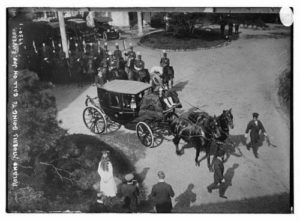
Circa 1918: U.S. Ambassador Roland Sletor Morris going to call on Japanese Emperor Taisho. Source: George Grantham Bain Collection (Library of Congress).


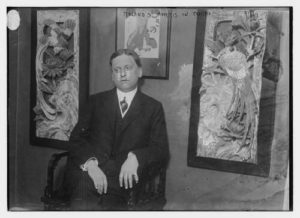
Circa 1918: Roland S. Morris in Tokyo, seated in front of artwork.

Source: George Grantham Bain Collection (Library of Congress).


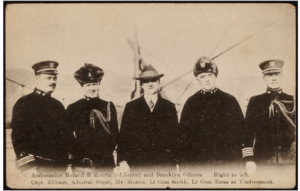
Ambassador Roland S. Morris accompanied by U.S. naval officers of the U.S.S. Brooklyn (ACR-3) – Right to left, Captain Althaus, Admiral Roger, Ambassador Morris, Lt. Commander Smith, and Lt. Commander Estes at Vladivostok, Russia. Circa 1918 to 1919.


Postcard: Springfield College Archives and Special Collections

Courtesy of: Cliff Smith YMCA Postcard Collection


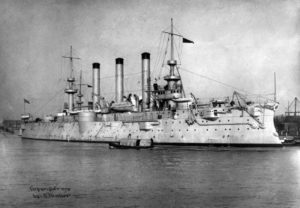
U.S.S. Brooklyn (ACR-3) at anchor, c. 1898.

United States Navy

Built: 1893–1896

In commission:     1896–1921

Namesake:  City of Brooklyn, New York


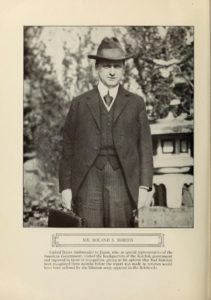
Portrait photo of Roland Sletor Morris

Book source: The World’s Work, 1919: https://archive.org/stream/worldswork38gard#page/566/mode/2up

Ambassador Morris was in Japan, taking a supportive role for the White Russians who are resisting the Bolshevik takeover of the important port city of Vladivostok.


The historical novel The Emperor and the Spy dramatically presents the exciting events surrounding this period of history in Vladivostok, and how a regional war almost erupted, but was prevented in 1922 by an American military intelligence agent Captain Sidney Mashbir.


Available in Print, EBook, and Audiobook:

Here are links to the book.

Barnes & Nobles link

Amazon Link


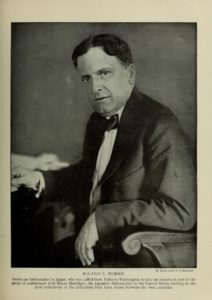
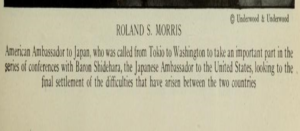
1921 Ambassador Roland S. Morris is called back from Japan to Washington, D.C. to negotiate with Japanese Ambassador to the U.S. Baron Shidehara. In 1921, Baron Shidehara accompanied Prince Iyesato Tokugawa, who headed Japanese delegation to the Washington Naval Arms Conference in the U.S. capital – Where they met with the leaders of many other nations to work out a naval arms limitation treaty, which was signed in 1922.

Book source for the photo: The World’s Work, 1921: https://archive.org/stream/worldswork41gard#page/318/mode/2up

Author: Underwood & Underwood


The Art of Peace illustrated biography highlights the diplomatic engagements between leaders of the U.S. and Japan during the first four decades of the twentieth century, in their support of democracy and their creative pursuit of goodwill, in spite of the turbulent times they lived. So influential was Prince Tokugawa and his Japanese supporters, that it would only be after Tokugawa’s passing in 1940, that Japan was pressured to ally with the Axis Powers in WWII.


Link to the Introduction:

THE ART OF PEACE


NOTES

[1] Constructed in 1904 and expanded to its present size in 1912, Bellevue-Stratford Hotel has continued as a well-known institution for more than a century and is still widely known by that original, historic name. In 1988 the building was converted to a mixed-use development. It has been known since then as The Bellevue. The hotel portion is currently managed by Hyatt as The Bellevue Hotel.]

[2] Tuchman, Stilwell and the American Experience in China, 1911–1945, page 48

[3] Biography and History from: Princeton University Library Finding Aids: Morris, Roland S. (Roland Sletor), 1874-1945.

“Roland S. (Sletor) Morris was a leader of the Democratic Party in Pennsylvania and was the ambassador to Japan from 1917-1921…born in Olympia, Washington on March 11, 1874 to Thomas Burnside Morris and Sarah Arndt Sletor. Morris attended the Lawrenceville School before entering Princeton University in September 1892. He graduated in June 1896, and went to the University of Pennsylvania Law School from 1896-1899, graduating cum laude. After receiving his law degree, Morris practiced law in Philadelphia at the firm of Duane, Morris and Heckscher. Morris was also politically active; he was the Chairman of the Democratic State Finance Committee in 1908 and from 1913-1916; additionally, he was a delegate or delegate at large to the Democratic National Convention in 1904, 1908, 1912, 1920, and 1928. President Woodrow Wilson appointed him as Ambassador to Japan from 1917-1921, and sent him on a special mission to Siberia from 1918-1919. Morris was a professor of international law at the University of Pennsylvania beginning in 1924, President of the American Philosophical Society, a trustee of both Princeton University and Temple University, and a Regent of the Smithsonian Institute.”

[4] In 1934, Morris lost the Pennsylvania Democratic U.S. Senate primary to Joseph Guffey, who was subsequently elected. Source: “Pennsylvania Oracle”. Time Magazine. 1934-05-28.

[5] Morris was one of the founding partners in 1904, of the law firm Duane, Morris, Heckscher and Roberts that is currently known as Duane Morris, which has offices in the United States, London, Singapore, Viet Nam, Oman, Myanmar, Shanghai and Taiwan. Morris also served as the Chancellor of the Philadelphia Bar Association, 1933 to 1935.  Source: The Duane Morris firm website.

[6] Morris was one of the reception hosts at the 1934 Japan Society of New York City Annual Gala Dinner event honoring the visit of Prince Iyesato Tokugawa. A blog post for that event is included on this website. Source: TheEmperorAndTheSpy.com blog

[7] The Russian Revolution began during the First World War. The revolution erupted in the context of Russia’s major military losses during that War, which resulted in much of the Russian Army being ready to mutiny. The situation climaxed with the October Revolution in 1917, a Bolshevik-led armed insurrection by workers and soldiers in Petrograd that successfully overthrew the Provisional Government, transferring all its authority to the Soviets.

The Russian Revolution was a period of political and social revolution across the territory of the Russian Empire, commencing with the abolition of the monarchy in 1917, and concluding in 1923 after the Bolshevik establishment of the Soviet Union, resulting in the end of the Civil War. They also established Soviet power in the newly independent republics of Armenia, Azerbaijan, Belarus, Georgia and Ukraine, and brought these jurisdictions into unification under the Union of Soviet Socialist Republics (USSR) in 1922. Victorious, they reconstituted themselves as the Communist Party.

[8] William A. Glasgow, Jr., Esq. (April 29, 1865 – March 14, 1930) was one of the speakers at the Ambassador Morris dinner event.                        Source: Ancestry.com. Since there is no Wikipedia page, the below obituary announcement is included to honor his memory.

Filed Under: Tokugawa Archives Tagged With: Admiral Roger, Aimaro Sato, Alexander Mitchell Palmer, Ambassador Aimaro Sato, Ambassador Morris, Ambassador Satō, Baron Eiichi Shibusawa, Baron Shibusawa, Baron Shibusawa Eiichi, Baron Shidehara, Bellevue-Stratford Hotel, Bolsheviks, Capt. Althaus, Captain Althaus, Chinese History, Colonel Mashbir, Colonel Sidney Mashbir, Communism, Diplomacy, Duane Morris, Duane Morris Law Firm, Eiichi Shibusawa, Emperor Taisho, Esq., Francis A. Lewis, Frank Lyon Polk, Historical biography, History of Communism, Honorable Thomas B. Smith, Honorable William Potter, in Philadelphia, International Friendship, International Relations, J. Edgar Hoover, Japan China relations, Japan History, Japan U.S. Relations, Jr., Lansing: Ishii Agreement, law firm of Duane Morris, Lt. Commander Estes, Lt. Commander Smith, Mayor of Philadelphia Thomas B. Smith, Mayor Thomas B. Smith, Prince Iyesato Tokugawa, Prince Tokugawa, Prince Tokugawa Iesato, Robert von Moschzisker, Roland S. Morris, Roland Sletor Morris, Russian History, Shibusawa Eiichi, Stan S. Katz, Stan S. Katz blog, The Art of Peace, The Art of Peace biography, The Emperor and the Spy, TheEmperorAndTheSpy.com, U.S. Japan relations, U.S.-Japan History, U.S.S. Brooklyn, U.S.S. Brooklyn (ACR-3), Viscount Ishii, Vladivostok, Washington Naval Arms Conference, William A. Glasgow, William Potter, William Potter (ex-Minister to Italy), World War One, World War Two, Yoshimaro Satō, 佐藤 愛麿

Copyright © 2026 Stan S. Katz