Stan. S. Katz

Author of The Emperor and the Spy

  • Home
  • Author
  • Books
  • Reviews
  • Educators
  • News
  • Audiobook & Timeline
  • Mashbir Archives
  • Tokugawa Archives
  • Contact
Follow Stan on FacebookFollow Stan on TwitterFollow Stan on GoodreadsFollow Stan on RSS

Sign Up for Future Blogs Linked to Colonel Mashbir and Japanese History

Read the Intro Posts

INTRODUCTION TO THE ART OF PEACE

WELCOME!

Recent Posts

  • San Diego Jewish Journal Holocaust Remembrance Edition May 2016 highlights the historical novel, The Emperor and the Spy and the outstanding achievements of Colonel Sidney Mashbir.
  • The Emperor and the Spy, was one of two books highlighted during academic/diplomatic event sponsored by the Prime Minister’s Office of Japan and hosted by San Diego World Affairs Council
  • Osher Lifelong Education Institute – UCSD Presentation. Remarkable story, the alliance between a patriotic U.S. Intelligence Agent, Colonel Sidney Mashbir, and a humanitarian Japanese International Statesman, Prince Iyesato Tokugawa, who heroically delayed and attempted to prevent WWII in the Pacific.
  • Tokugawa & Komatsu, Forgotten Heroes – Until his passing in 1940, Prince Iyesato Tokugawa held back WWII in the Pacific – Tokugawa’s diplomatic legacy lived on after WWII ended, when his protégé, Takashi Komatsu, guided the US and Japan to again become friends and allies.
  • Have you ever wondered how US and Japan re-established their friendship and alliance following the trauma of WWII? Here’s a new biography that honors an amazing Japanese American statesman, Takashi Komatsu, who guided this major achievement.

Archives

The 1909 Shibusawa Delegation visits Upstate, New York – U.S. and Japanese leaders come together in friendship over a Century Ago

February 15, 2020 by Stan S. Katz Leave a Comment

The Shibusawa 1909 Delegation is welcomed by the City of Ithaca.
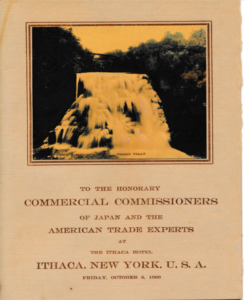


Front cover to a celebratory Event Program/Dinner Menu (six page brochure) honoring the visit of Baron Eiichi Shibusawa & his wife, and his accompanying Japanese goodwill/business delegation.       

                       The description reads:

“To The Honorary COMMERCIAL COMMISSIONERS of Japan and the American Trade Experts at the Ithaca Hotel, Ithaca, New York. U.S.A. Friday, October 8, 1909” – (Photo of beautiful Ithaca Falls.)
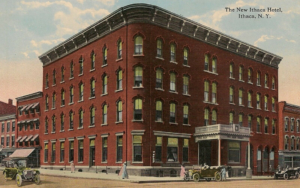


1909 Postcard of The Ithaca Hotel, where the event occurred.


Background History on Baron Shibusawa and his 1909 delegation:

Baron Shibusawa is known as the “Father of Japanese capitalism” and frequently referred to as the “Japanese J. P. Morgan.” An industrialist and entrepreneur, he was responsible for introducing Western-style capitalism to Japan during the Emperor Meiji period (1868-1912). With financial interests in railroads, steel, printing, gas, electric, mining, fishing, and oil, Shibusawa quickly became Japan’s wealthiest man. During his long life, Shibusawa helped launch over 500 companies, and was responsible for modernizing Japan’s economic and banking systems, including the introduction of paper notes. At one time, he was the director of seventy companies, however, he resisted direct ownership/control of most of the companies he helped launch, preferring an advisory role instead, giving more freedom for these new companies to determine their own strategies for growth.

Shibusawa founded the Japanese Chamber of Commerce and Industry and the First National Bank of Japan – and for two decades, he was the chairman of the Tokyo Chamber of Commerce. His priorities went beyond pure profit, when referring to his business ventures, he called it stakeholder capitalism (rather than traditional capitalism). He felt strongly that the growth of a nation, economically and otherwise, depended on the involvement of many stakeholders. While profit was still a significant goal, he often integrated ethical beliefs, and even Confucianism, into his management practices. Beyond his business interests, he utilized his own funds to establish over 600 organizations aimed at social welfare, including hospitals, universities, and disaster relief programs among others.

At the start of the twentieth century, U.S. – Japanese relations reached a new stage, with Japan emerging as an economic powerhouse in the Pacific, combined with its growing military. To ease potential tensions between the two countries and also increase business/financial relations between their nations, a delegation of U.S. businessmen were invited to visit Japan in 1908. This invitation was sent to representatives of the Associated Chambers of Commerce of the Pacific Coast. This invitation came from the chambers of commerce of six major cities of Japan: Tokyo, Yokohama, Osaka, Kyoto, Kobe, and Nagoya. Their invitation was accepted, and approximately sixty U.S. representatives made a tour of Japan, where they were received with generous and even lavish hospitality, not only by the people, but also by the imperial government. Prince Iyesato Tokugawa and Baron Eiichi Shibusawa were central figures in receiving this U.S. delegation.

-In appreciation for the fine cordiality shown to the U.S. delegation during their 1908 visit to Japan, an invitation in 1909 was now sent to the Japanese to tour the U.S. This invitation came from the Associated Chambers of Commerce of the Pacific Coast, whose membership included the chambers of commerce of eight principle cities: San Francisco, Los Angeles, San Diego and Oakland in California, and Seattle, Tacoma, Portland, and Spokane in the Northwest.

Based on this pleasant invitation, in 1909, Baron Shibusawa headed a Japanese delegation to the U.S., which included many of Japan’s most prominent business leaders and notables. They sailed from Yokohama, on August 19, on the American steamship Minnesota, and arrived first in Seattle, Washington, on Wednesday, Sept. 1st. They left Seattle on Sept. 6th, and began their journey visiting 53 cities from the West coast to Boston, and returning from New York back to Los Angeles and then to San Francisco.

Of the fifty-eight members in this Japanese delegation, six were women (five of them the wives of the commissioners), thirteen private secretaries, and thirty-nine commissioners. They would travel 11, 000 miles thru-out the U.S. before returning home. This delegation included nine members of the Japanese parliament, two of the largest banking houses were represented by Baron Shibusawa, and the bank of Mitsui & Co. represented by Kenzo Iwahara, Managing Director. There were six other bankers in the group, and also representatives of nearly every line of industry and commerce, including the ownership and management of electric railways, shipbuilding, manufacturing of silk and cotton, exporting and importing, and stock market brokerage – The professions of law and medicine were also represented, as well as some well-known Japanese educators, authors, and newspaper writers.

Their main goals were to develop friendship between the two nations while encouraging bilateral trade and commerce. This sentiment was repeatedly expressed by Shibusawa and other commission members, as well as by their American hosts. The delegation made the news across the United States, during the course of their three month journey. They traveled in a specially outfitted ‘Million Dollar Train,’ provided by the American industrial community. Their meetings included many chambers of commerce. There were also tours of factories, power plants, fire departments, port facilities, mines, farms, schools, universities, libraries, theaters, churches, hospitals, and many other facilities.
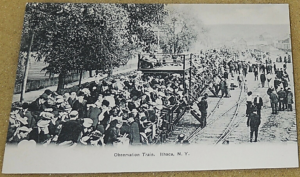


1909 – Ithaca, New York – Raised observation platform with a crowd gathered awaiting a Train’s arrival – This postcard gives a sense of the welcoming reception given for the Japanese Delegation.
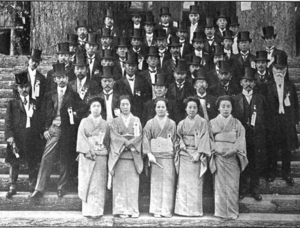


November 1909 photo from The Coast magazine (Seattle, Washington).

Baron and Baroness Shibusawa (front center), with the other Japanese delegates and their wives, pose at the Forestry Building at the Alaska-Yukon-Pacific Exposition. The delegation included bankers, presidents of the chambers of commerce from the largest cities in Japan, businessmen who were members of the Japanese Diet (Japanese Congress), and several Japanese consuls general, who were stationed in the United States. Delegates included representatives of the Tokyo Stock Exchange, lawyers, publishers, journalists, as well as a university professor and a physician. (Note: The Alaska-Yukon-Pacific Exposition was a world’s fair held in Seattle, Washington, publicizing the development of the Pacific Northwest. The fairgrounds became the campus of the University of Washington.) The Japanese delegation’s trip was arranged by Asahi, one of the largest newspapers in Japan (which is currently known as The Asahi Shimbun (朝日新聞).

At the train station in the City of Ithaca, a large reception was given for their honored Japanese visitors – This greeting party included the city’s current Mayor and nine former Mayors. Also attending were five former Presidents of the Village of Ithaca, as well as representatives of Cornell University, including Dean Charles H. Hull, members of his staff, along with eight Cornell professors. Also there to respectfully receive them were the student president and members of the Japanese Club of Cornell. The Ithaca Business Men’s Association, along with many others attended, as displayed in the Menu/Program.

To make the visitors’ experience in the U.S. more enjoyable, six members of the Associated Chambers of Commerce volunteered to accompany their Japanese friends/business colleagues, to assist in managing the events along their journey. Those six individuals are also highlighted within the Menu/Program.

In addition to the above, the U.S. government recognized the international significance of this Japanese visit and sent three U.S. representatives to accompany and be of assistance during their travels.

During their time in the U.S., they were greeted by many distinguished American leaders including President William Howard Taft, whom Baron Shibusawa and Prince Tokugawa had already befriended years earlier, when Taft had served as minister of war, under President Theodore Roosevelt.

Shibusawa and his delegation were also greeted by the inventor Thomas Alva Edison of General Electric, and James Jerome Hill of Great Northern Railway. When their continental journey ended, they left San Francisco on November 30, traveling to Honolulu, Hawaii, then arriving in Japan on December 17, 1909. With them, they carried fresh information on a wide range of industries, as well as many new cultural insights.

The stated goals of the Japanese delegation were:

-To increase and extend trade relations between the U.S. and Japan

-Improve personal acquaintances and friendly relations between representatives of both nations.

*It is significant to note that the U.S. Chamber of Commerce was founded in 1912, just three years after the 1909 visit of the Shibusawa delegation – It is most likely that this highly publicized Japanese business visit served as a catalyst connecting chambers of commerce across America into becoming a national organization. President Taft was one of the U.S. leaders that Shibusawa met with during his visit, and Taft is recognized as one of those who encouraged the establishment of the U.S. Chamber of Commerce, to support and enhance the economy of the United States.
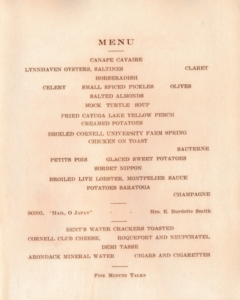


A lavish meal, followed by Five Minute Talks – This illustration and the four that follow are part of the Event Program/Dinner Menu brochure presented earlier.
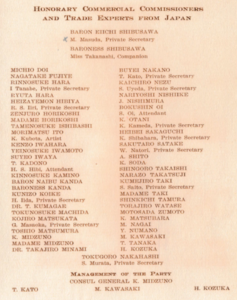


Japanese Delegates, along with those who managed the Party. This list is also presented with additional information in Note [1]
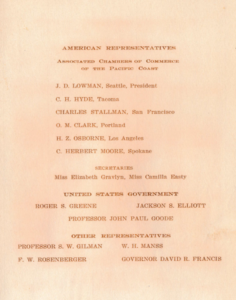


American Representatives attending the event. This list is also presented with additional information in Note [2]
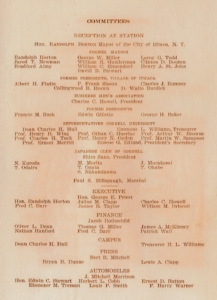


Committee Members – This list of notable citizens of Ithaca, is also presented with additional information in the Notes [3]
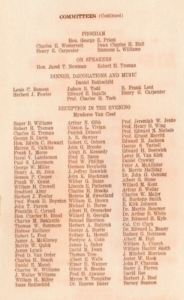


Committee Members (continued) the notable civic and business leaders of the Ithaca community, who put the Program together, were Speakers, arranged the Dinner, Decorations, and Music, and were part of the Evening Reception. *See Note [4] for more info about the two prominent speakers Robert H. Treman and Jared T. Newman
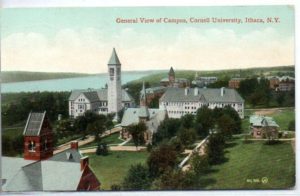


View of Cornell University – Ithaca, N.Y. – 1909 Postcard


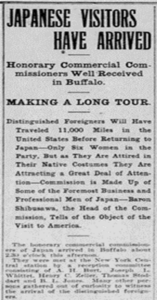
Below is the top segment of a newspaper article that gave an overview of the Japanese delegates’ three month tour and also highlighted the hospitality they had received in the city of Buffalo, New York, three days prior to their reception in Ithaca. [The Buffalo Commercial – 05 Oct. 1909, Tue • Page 1]


– The Shibusawa Eiichi Memorial Foundation / Museum (located in Japan) honors and preserves the legacy of Baron Shibusawa and his allies –  Their website is: https://www.shibusawa.or.jp/english/museum/                                                                      


The Honorary COMMERCIAL COMMISSIONERS of Japan felt so appreciative for the fine treatment they had received during their visit, that when they returned to Japan, they sent back a gift to the U.S.A..

It was given to a representative of Northwestern New York State, F. W. Rosenberger, Esq., a member of the City of Buffalo, New York Chamber of Commerce. He was also one of the U.S. representatives who attended the above event in Ithaca, New York. It is a Japanese silver two handled presentation cup on a square pedestal inscribed in Japanese on the base on one side, and in English on the other side, as shown in the below photos.

Decorated with Japanese dragon emblems around the top rim and an American eagle symbol in the circular area between them.

The English inscription reads:

Presented to F W Rosenberger, Esq. by the honorary commercial commissioners of Japan to U.S.A. 1909.

Marked Tamonten Tokio and signed in Japanese.

Meiji period.  Height 5 1/2″ Length 8″. Weight 28.25 troy oz.

This silver trophy was sent as a return gift from “The Honorary Commercial Commissioners of Japan to the U.S.A” (渡米実業団) to the people who took care of them.

The Japanese writing on the base of the above silver gift lists the names of many of the Japanese visitors who toured the U.S.A.

Further information about this gift is available in Note 5 in the Notes Section at the end of this blog post.


*The historical content for this article was discovered while researching for an illustrated biography.

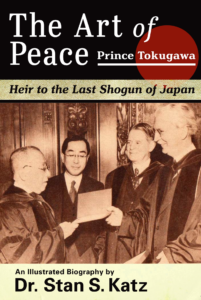
This biography comes in two versions: The Art of Diplomacy and The Art of Peace. Both highlight the Japanese international statesmen Prince Iyesato Tokugawa (aka Prince Tokugawa Iesato) and his allies, such as Baron Eiichi Shibusawa – These true humanitarians devoted their lives to creatively promoting peaceful international relations, a prosperous global economy, and democracy – Two decades of historical research was combined with the discovery of hundreds of rare illustrations, to reveal many significant unknown events that shaped the destinies of the United States and Japan.
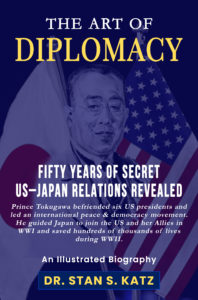


PRINT & KINDLE EDITION



DIGITAL EBOOK EDITION [includes an additional 100 pages of historical notes to assist researchers]


NOTES FOR THIS BLOG POST

Note 1 –

List of the 1909 Japanese Delegates:

Baron Eiichi Shibusawa

M. Masuda, Private Secretary

Baroness Shibusawa

Miss Takanashi, Companion (niece of Baron and Baroness Shibusawa)

Michio Doi

Nagatake Fujiye

Rinnosuke Hara

I. Tanabe, Private Secretary

Ryuta Hara

Heizayemon Hibiya

R. S. Iiri, Private Secretary

Zenjuro Horikoshi

Madame Horikoshi

Tamenosuke Ishibashi

Morimatsu Ito

K. Kubota, Artist

Kenzo Iwahara

Yeinosuke Iwamoto

Suyeo Iwaya

T. Kadono

H. S. Hibi, Attendant

Kinnosuke Kamino

Baron Naibu Kanda

Baroness Kanda

Kunizo Koike

H. Iida, Private Secretary

Dr. T. Kumagae

Tokunosuke Machida

Kojiro Matsukata

G. Masaoka, Private Secretary

Toshio Matsumura

K. Midzuno Consul General

Madame Midzuno

Dr. Takajiro Minami

Buyei Nakano

T. Kato, Private Secretary

Kaichiro Nezu

S. Uyeda, Private Secretary

Nariyoshi Nishiike

J. Nishimura

Bokushin Oi

S. Oi. Attendant

K. Otani

K. Kameda, Private Secretary

Heibei Sakaguchi

K. Shibahara, Private Secretary

Sakutaro Satake

W. Natori, Private Secretary

A. Shito

K. Soda

Shingoro Takaishi

Narazo Takatsuji

Kumejiro Taki

S. Saito, Private Secretary

Madame Taki

Shinkichi Tamura

Torajiro Watase

Motosada Zumoto – also accompanied Baron Shibusawa when he returned to the U.S. in 1915, and a banquet was held to honor him. This 1915 diplomatic event attended by former Presidents Theodore Roosevelt & William Howard Taft – A PHOTO of that diplomatic gathering is presented as part of another Blog post on TheEmperorAndTheSpy.com) – M. Zumoto served as the translator and secretary for Baron Shibusawa –  He was also a part owner and editor of The Japan Times – Japan’s largest and oldest English-language daily newspaper, currently  published by The Japan Times, Ltd. (株式会社ジャパンタイムズ) of Tokyo. In addition, M. Zumoto was the Director of the Oriental Information Agency of New York.

K. Matsubara

M. Nagai

Y. Numano

M. Kawasaki

T. Tanaka

H. Kozuka

Tokugoro Nakahashi

S. Murata, Private Secretary


Names of those who managed the 1909 event in Ithaca, New York

Consul General K. Midzuno (Consul General Midzuno also in a 1915 photo when Baron Shibusawa visited the U.S. again and a banquet was held to honor him, which was attended by former President Theodore Roosevelt and William Howard Taft). A PHOTOGRAPH of that event is presented as a Blog post on the website: TheEmperorAndTheSpy.com). Consul General Midzuno is one of the Japanese officials linked to the Japanese gifting of the cherry blossom trees to the U.S. Capital in 1910 and 1912.

T. Kato

M. Kawasaki

H. Kozuka


Note 2 –

American Representatives at the 1909 Ithaca event

Associated Chambers of Commerce of the Pacific Coast

J. D. Lowman, Seattle, President

C. H. Hyde, Tacoma

Charles Stallman, San Francisco

O. M. Clark, Portland

H. Z. Osborne, Los Angeles

C. Herbert Moore, Spokane


Secretaries

Miss Elizabeth Gavlyn,

Miss Camilla Easty


U.S. Government

Roger S. Greene – State Department

Jackson S. Elliott – from Washington, D.C., representing Associated Press for the U.S. Dept. of Commerce and Labor

Professor John Paul Goode – University of Chicago


Other U.S. Representatives

Professor S. W. Gilman – from the University of Wisconsin, representing the cities of Minneapolis and St. Paul, Milwaukee, and Duluth.

F. W. Rosenberger – from the city of Buffalo, he represented the Northwestern New York.

W. H. Manes – of the Chicago Association of Commerce, represents the cities of Chicago, Des Moines, and Omaha.

Governor David Rowland Francis (October 1, 1850 – January 15, 1927) was an American politician and diplomat. He served in various positions including Mayor of St. Louis, the 27th Governor of Missouri, and United States Secretary of the Interior. He was the U.S. Ambassador to Russia between 1916 and 1917, during the Russian Revolution of 1917. He was a Wilsonian Democrat. After graduating from University, David R. Francis became a successful businessman in St. Louis and served as the president of a grain merchant’s exchange. The St. Louis Mining and Stock Exchange was formed in St. Louis in the fall of 1880 with Francis as a founding member. Source: Wikipedia.


Note 3–

Below is a transcription of the names of the Committee Members for the 1909 event:

Reception at Train Station

Honorable Randolph Horton Mayor of the City of Ithaca, N.Y.

Former Mayors:

Jared T. Newman

Bradford Almy

George W. Miller

William R. Gunderman

William C. Elmendorf

David B. Stewart

Leroy G. Todd

Clinton D. Bouton

Henry A. St. John


Former Presidents of the Village of Ithaca:

Albert H. Platts

P. Frank Sisson

Charles J. Rumsey

Collingwood B. Brown

D. Waite Burdick


Business Men’s Association:

Charles C. Howell, President

Former Presidents:

Francis M. Bush

Edwin Gillette

George H. Baker


Representatives of Cornell University:

Dean Charles H. Hull

Emmons L. Williams, Treasurer

Professor Henry H. Wing

Professor Othan C. Guerlac

Professor Arthur W. Browne

Professor Charles H. Tuck

Professor Charles H. Tuck

Professor Henry N. Ogden

Professor Martin W. Sampson

Professor Ernest Merritt

Roscoe G. Edlund, President’s Secretary

Japanese Club of Cornell:

Shiro Sano, President

N. Kuroda

T. Odaira

M. Morita

T. Ogata

S. Nakamigawa

J. Murakami

T. Okabe


Marshal: Paul S. Millspaugh


Executive:

Honorable George E. Priest

Honorable Randolph Horton

Julius M. Clapp

James B. Taylor

Charles C. Howell

William M. Driscoll


Finance

Jacob Rothschild

Oliver L. Dean

Nathan Hanford

Thomas G. Miller

Fred C. Barr

James A. McKinney

Patrick Wall


Cornell University Campus:

Dean Charles H. Hull

Treasurer E. L. Williams


Press:

Bert R. Mitchell

Bryan B Dunne

Lewis A. Clapp


Automobiles to pick up visitors:

J. Mitchell Morrison

Honorable Edwin C. Stewart

Herbert L. Cobb Earnest D. Button

Ebenezer M. Treman

Louis P. Smith

F. Harry Warner

Ernest D. Button


Note 4- Robert Henry Treman (1858-1937) was one of the two speakers at the 1909 event honoring the visit of the Shibusawa Delegation.

Based on the author of this article’s enthusiasm for nature and his prior visits to beautiful upstate New York, here is some additional information about Robert Henry Treman, who was an amazing environmentalist and nature lover: Treman was born into an influential Ithaca family in 1858.  He attended local schools and Cornell University and joined the family hardware business in Ithaca in 1878.  During his association it grew from a small local business to a large corporation. His family also owned an iron foundry, and they had controlling interests in the Tompkins County Bank, the Ithaca Gas Light Company, and the Ithaca Water Works.  The Treman family acquired land around Buttermilk Falls and other creeks in case they needed to tap the water for their company.  In 1891 he was elected director of a local bank and in 1932 became Chairman of what was eventually known as the Tompkins County Trust Company.  He was also a director of the Federal Reserve Bank of New York from 1913 to 1931.

In 1891, Treman also became a trustee of Cornell University, a post he held for 45 years.  He worked with fellow trustee Henry Sackett to improve the Cascadilla and Fall Creek glens near the Cornell campus.  This period after the Civil War was a time of increasing awareness of the America’s natural environment.  The Trustees of Reservations was established in Massachusetts in 1891 to protect the natural environment in that state.  California quickly followed suit. By the 1920s the American Scenic and Historic Preservation Society had become prominent.  A movement to establish state parks grew up, encouraged by the increased interest in automobile touring.

About 1915, as Treman was bringing friends to visit the Enfield gorge — a well-known Ithaca scenic destination — he noted the decline in the hamlet of Enfield Falls.  Remembering his family association from his childhood days, he made arrangements to buy the mill as well as the miller’s house.  He closed the mill, which was still operating, temporarily.  During World War I, Treman and his wife Laura continued to buy properties in the area.  In 1920, when most of the property in the hamlet of Enfield Falls had been acquired, Robert and Laura donated the land to New York State to establish a state park to be called Enfield Glen Reservation.  Treman was chairman of the Enfield Falls Reservation Commission from 1920 to 1924.  He also donated land, which had been acquired as a possible water source for the city of Ithaca, along Buttermilk Creek to create another park in 1923.  He then continued to serve as Chairman of the Finger Lakes Commission, which also oversaw other parks in the area, from 1924 until his death in 1937.

[Source of the above biographical info: The Friends of Robert H. Treman State Park, chartered thru the State Education Department of the State of New York.  Its purpose is to conduct educational and history-related programs, services, and activities in keeping with the nature of the park, to assist in fund raising activities, the purchase of objects, equipment, and supplies for the benefit of the park, and to support this park for the benefit of the local community, the residents of the State of New York, and the general public.]


– Jared Treman Newman – the other listed speaker at the 1909 event honoring the visit of the Shibusawa Delegation – Jared Treman Newman was an Ithaca, New York attorney, 1893-1896, and Mayor, 1907-1908; Cornell University Trustee, 1895-1903 and 1907-1933; and a bank official. Cornell University Class of 1875.


NOTE 5

Further details about the silver gift given by the Honorary Commercial Commissioners are as follows: Its photo appears on the gravure page of the following book, and the circumstances are described on page 627 of the following book.

渡米實業團誌 | WorldCat.org

https://search.worldcat.org/en/title/1020991311

渡米實業圃誌 – Tobei Jitsugyōdan – Google ブックス

https://books.google.co.jp/books?id=HBOlWY_1Q30C


Parts of this book is cited in “Shibusawa Eiichi Denki Shiryo,” which states that Rosenberger was a member of the Buffalo Chamber of Commerce and served as the Northwest New York State representative when accepting the Honorary Commercial Commissioners of Japan.

第32巻(DK320013k)本文|デジタル版『渋沢栄一伝記資料』|渋沢栄一|公益財団法人渋沢栄一記念財団

https://eiichi.shibusawa.or.jp/denkishiryo/digital/main/index.php?DK320013k_text#DK320013k-0005


紐育州西北部代表者(バッファロー商業会議所会員)

エフ・ダブリュー・ローゼンバァガー殿


Filed Under: Tokugawa Archives Tagged With: Alaska-Yukon-Pacific Exposition, Associated Chambers of Commerce of the Pacific Coast, Baron Eiichi Shibusawa, Baron Shibusawa, Baron Shibusawa Eiichi, C. Herbert Moore, Charles Stallman, City of Ithaca History, Consul-General K. Midzuno, David R. Francis, David Rowland Francis, Diplomacy, Eiichi Shibusawa, Eiichi Shibusawa 1909 Delegation, Governor David Rowland Francis, H. Z. Osborne, Historical biography, History of Cornell University, History of U.S. Chamber of Commerce, International Friendship, J. D. Lowman, Jackson S. Elliott, James Jerome Hill, Japan History, Japan U.S. Relations, Japanese Club of Cornell, Jared T. Newman, K. Midzuno, M. Zumoto, Motosada Zumoto, O. M. Clark, President Theodore Roosevelt, Prince Iyesato Tokugawa, Prince Tokugawa, Prince Tokugawa Iesato, Professor John Paul Goode, Remove term: Shibusawa Eiichi Memorial Foundation Shibusawa Eiichi Memorial Museum, Robert H. Treman, Roger S. Greene, Seattle Chamber of Commerce, Shibusawa Eiichi, Shibusawa Eiichi Memorial Foundation, Shibusawa Eiichi Memorial Foundation / Museum, Stan S. Katz, Stan S. Katz blog, The Art of Peace, The Art of Peace biography, The Ithaca Hotel, Theodore Roosevelt, Thomas Alva Edison, U.S. Chamber of Commerce, U.S. Chamber of Commerce History, U.S. Japan relations, U.S.-Japan History, US Japan relations, William Howard Taft

A Time Capsule to Cornell University from over a Century Ago. Looking for suggestions and assistance to bring its fascinating contents to life through a documentary film, an illustrated book, and classroom curriculum.

February 13, 2020 by Stan S. Katz Leave a Comment

This Photo/Memory Album Presents a Intimate View of Student Life during the early 1900s.

By Dr. Stan S. Katz    –    February 14th, 2021


Most of the blog posts that you’ll find on this website are linked to historical relations between the U.S. and Japan. However, on occasion another interesting historical topic is discovered that sparks the imagination and inspires the sharing of its story with others.

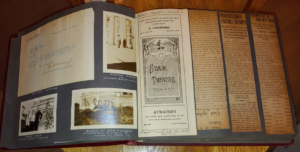
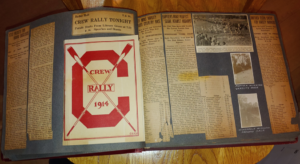
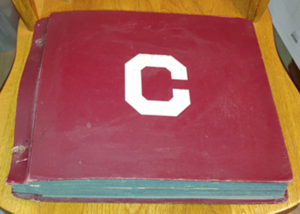
This Cornell University project began a dozen years ago in 2008, while exploring the Del Mar Antique Fair in southern California, when this maroon-colored, very old photo album/scrapbook with the white letter “C” printed on its cover caught my eye. The seller didn’t know much of the history linked to it, other than that it was connected to Cornell University, and that at least thirty individuals that morning had immersed themselves while examining its fascinating contents.

Having once been an antiquarian bookstore owner, this description grabbed my attention. After just a few minutes of scanning the amazing variety of items in the album, I knew that many other folks would enjoy this time capsule to university life from the distant past – So I purchased the album, thinking that one day I’d figure out how best to share this engaging material.

The album had been owned by a Cornell student, Melvin Lorrel Nichols (1894-1981), who majored in Chemistry, which coincidentally, was also my major at Brooklyn College (Class of 1973). However, Melvin graduated from Cornell almost a half century earlier, attending as an undergrad from 1914-1918. And it is specifically those four years that his album depicts. Melvin would later become a significant member of the Cornell Chemistry Dept. teaching staff for almost four decades.


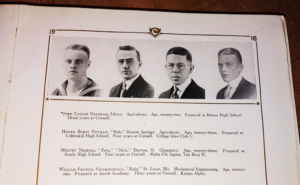
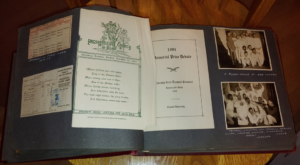
Top section of a university yearbook page from “The Cornellian and Class Book 1918”. It presents several members of the graduating class, including Melvin Nichols third from the left. Melvin’s nicknames were “Pete” and “Nick”.


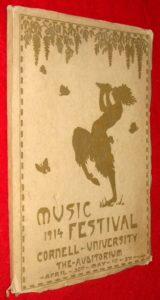
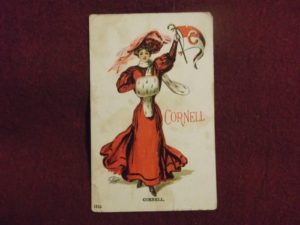
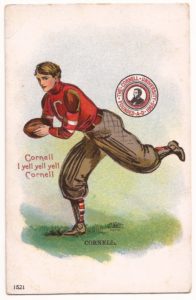
Below are some ephemera from the period: a 1914 musical event and some colorful 1916 postcards.


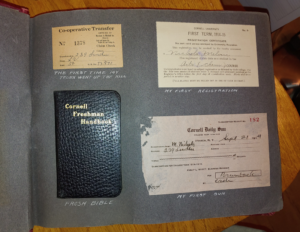
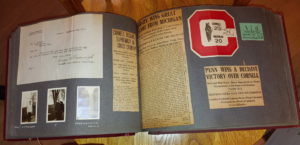
From his earliest days, Melvin saved diverse mementos of his time spent at Cornell. Above is the first page of the large album (10.25 x 13 inches, and 3 inches thick). Please note a future presentation of this material for a eBook or documentary film would scan and highlight each of these historical items to a higher image resolution than what is available for this blog post presentation.


Below is an enlarged section from the above album page:


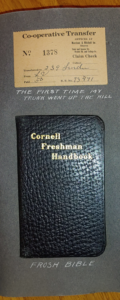
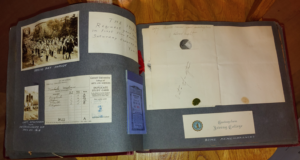
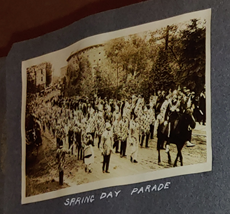
Both sides of the thirty-four pages of this album are filled with rare historical materials – Melvin was amazingly meticulous, his album displays interesting ephemera from all four of his student years, with many photos of him with his friends/fellow students. There is also a wide array of letters, student event pamphlets, colorful period postcards, newspaper clippings of intermural sport events, along with the original tickets to some of those games, and news clippings for other Cornell related topics. The illustration to the left displays his receipt for transporting his trunk up the hill during his first day at the school.

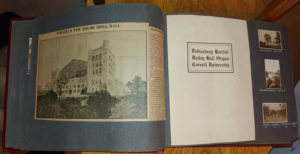
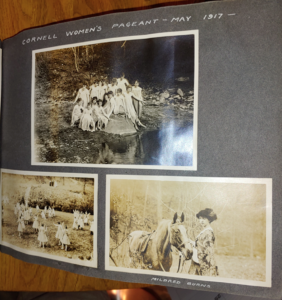
There is also the Cornell Freshman Handbook that he describes as the “Frosh Bible”, which contains 168 pages filled with the relevant topics that incoming students needed know about their school’s academic activities, fraternity and sorority related info, and a directory to city services to meet their needs, giving insights to life in the City of Ithaca during that period. The album also presents photos of fanciful university pageants, celebrations, and public events.

And with those years being impacted by World War One, some of Melvin’s photos are linked to the ROTC. As a senior, Melvin was temporarily drafted into the military. Despite the tragic backdrop of war, this album instead gives a sense of a pleasant & meaningful university experience being had, with Melvin most appreciative to have been able to attend Cornell with the financial support of student grants from the university.


Below is an enlarged photo from the prior illustration:


This album goes beyond exclusively revealing university life at Cornell, it also intimately presents what student life was probably like at hundreds of other fine universities during the early nineteen hundreds, prior to our current high tech computerized age, filled with its smart cell phones, Facebook, and social networking which has in many ways changed how we relate to one another. Early presidents of Cornell strove to create a sense of community among the students and faculty; they wanted their surroundings to have natural and poetic beauty, while also honoring the impressive stately architectural designs from the past – It was their intention that this would inspire students to feel better about themselves and the world they lived.

One of the goals of this blog post/illustrated article is to introduce this unique view of the past to others, perhaps leading to potential future joint historical/educational/entertainment projects. Whether it be as an illustrated eBook, an online museum exhibit, the source for a documentary on Cornell’s history, or perhaps, even an animated film that brings these photos and documents to life. Those who might interest in these creative pursuits such as historians, Cornell’s Alumni Association, those in media, such as film, and others, are invited to discuss the possibilities through the below email contacts. These email addresses are linked to an historical biography and novel titled: The Art of Peace & The Emperor and the Spy written by the author of this article. Those books also began with the acquisition of a rare collection historical documents.

[email protected]

[email protected]

-Besides the Album’s wonderful 250 items to draw from, there’s an additional one hundred antique items linked to Cornell history that have been collected, which could contribute to a colorful reminiscent sense of that period. These include Cornell’s illustrated yearbook, “The Cornellian and Class Book 1918”.


Additional biographical details about Melvin Lorrel Nichols, the creator of the 1914-1918 Cornell Album:

Born: November 30, 1894 in city of Dayton, Ohio.

Died: March 29th, 1981 in California.

Melvin Lorrel “Pete” Nichols was a chemistry professor and author.


Early life:

Nichols was the son of Joseph Wiseman Nichols, a cabinetmaker, and Sarah Rebecca Heidelbaugh. He was the youngest of six children. [Source: Geneology.com]


Personal life:

Melvin married Mary N. Bancroft in 1926. They had one daughter, Sarah, “Sally”.


Career:

Nichols was awarded his PhD from Cornell University in 1922. His thesis was “Dinitrosoresorcinol as a reagent for the quantitative determination of cobalt in the presence of nickel and other metals of the third group”.

He was awarded a Guggenheim Fellowship in Chemistry in 1929. (See Note 1)

Nichols was on the faculty at Cornell University from 1923-1962, rising to become Emeritus Professor of Chemistry.

“Pete” Nichols’ wrote two textbooks on analytical chemistry:        Gas Analysis, co-authored with L.M. Dennis, and a Laboratory Manual of Analytical Chemistry.

In 1950, Pete Nichols agreed to become Executive Director of Cornell’s Chemistry Department, a new position which involved supervision of the support facilities and the non-academic staff of what had become a large and complex establishment. He held this position until his retirement in 1962.

A letter of Tribute to Melvin Lorrel Nichols was written by fellow members of the Cornell faculty. (Note 2)


OVERVIEW OF THIS MEMORY ALBUM

1-It is engaging and entertaining, with a backdrop of nostalgia.

2-This relic is in many ways a commemorative to a young man and future imminent professor.

3-It is a testimonial, offering a unique window to student life at a fine university over a century ago, to the friendships and the various on and off campus activities of that time.

4-It depicts the academic and social values that were thought necessary to be passed on to future generations, representing a Window to the past.

5-It must be emphasized that this Cornell album assembled and protected hundreds of historical items called ephemera that would have otherwise been lost forever. The below definition of ephemera comes from The Ephemera Society of America:

“Precious primary source information . . . that is what the ephemera world considers its bits and bobs of vintage (and current), usually paper items. Much of it was likely expected, back in its day, to be briefly useful then discarded. Today such items which have survived the vagaries of time often reveal things we might not otherwise ever learn. A story last year in the New York Times reported the stunning information that NASA—unthinkably—had somehow managed to lose the original tapes of Mankind’s first landing on the moon! Surely this monumentally important video document was expected to be carefully coddled and treasured forever. And yet even something as priceless as that somehow proved ephemeral. As it happens, derivative copies do exist, so that particular record has not totally disappeared. But it could have. If information as important as that could be so easily lost for eternity, imagine how much lesser—yet culturally relevant—historical information has indeed been lost with the passage of time. Each collected piece of surviving paper Americana serves up information, and some of it available nowhere else on earth. One person’s trash is another person’s treasure.

“In a nutshell, to collectors “ephemera” are vintage printed or written items which originally served some specific purpose and were not expected to be retained or preserved, but which are now cherished. A few decades ago much of it was called “Paper Americana”, though ephemera is not necessarily American. Or even paper: these days the field has been expanded to include such things as tobacco tins, photographs, radio premiums, textile swatches, vinyl record albums, items made of celluloid or wood. Also included are various items which were indeed likely to have been saved, such as wedding invitations, marriage certificates, passports, birth certificates, wills, deeds, divorce papers, stock certificates, promissory notes, and many other vintage documents…

“Maurice Rickards, author of the definitive Encyclopedia of Ephemera and a founder of The Ephemera Society in England, dubbed such items “the minor transient documents of everyday life.” That organization says that—produced to meet the needs of the day—“such items reflect the moods and mores of past times in a way that more formal records cannot.” Besides being enjoyable to find and collect, vintage ephemera is valuable primary source information which offers unique windows into cultures past.”

(Note 3) presents more information about The Ephemera Society of America.


This Album might contribute to Classroom Curriculum:

Classroom Discussion Questions:

A-What does a well-rounded university education mean? As an individual and as a society, what makes us who we are culturally and academically, what are those values?

B-This album might serve as a springboard for classroom discussions about how the world has changed and in what ways have things remained the same?

C-Are there lessons that can be learned from that period a century ago, that might well serve us in our modern world?

D-As a related research project, there could be interviews of current university students, alumni, and faculty to hear their response to the album, giving an intergenerational insights to the interpretation of its contents.

E- In our time of rapidly advancing technology, filled with uncertainties regarding the future, this album invites students to compare life then and now, to recognize our roots, the values of our ancestors, and the foundation of who we are. Does this album perhaps serve as a compass/roadmap to cherished values of our society from long ago?

F-The album could augment the presentation of related historical material, such as the events of World War One. How did that conflict impact student life and the ways students saw themselves? Has the role of intra-mural sports in university life changed? The possibilities continues as the project unveils new insights into the album’s contents.

G-Are there universal values? Where are we going as a society and as a world? What might we be losing or gaining in the process of moving forward? The album is a sociological study into human nature, then and now.


NOTES


Note 1 – In 1929, Professor Melvin Lorrel Nichols was honored by receiving a Guggenheim Fellowship. That award is intended for individuals who have already demonstrated exceptional capacity for productive scholarship or exceptional creative ability.

Fellowships are awarded through two annual competitions: one open to citizens and permanent residents of the United States and Canada, and the other open to citizens and permanent residents of Latin America and the Caribbean. Candidates must apply to the Guggenheim Foundation in order to be considered in either of these competitions.

The Foundation receives approximately 3,000 applications each year. Although no one who applies is guaranteed success in the competition, there is no prescreening: all applications are reviewed. Approximately 175 Fellowships are awarded each year.

During the rigorous selection process, applicants will first be pooled with others working in the same field, and examined by experts in that field: the work of artists will be reviewed by artists, that of scientists by scientists, that of historians by historians, and so on. The Foundation has a network of several hundred advisers, who either meet at the Foundation offices to look at applicants’ work, or receive application materials to read offsite. These advisers, all of whom are themselves former Guggenheim Fellows, then submit reports critiquing and ranking the applications in their respective fields. Their recommendations are then forwarded to and weighed by a Committee of Selection, which then determines the number of awards to be made in each area. Occasionally, no application in a given area is considered strong enough to merit a Fellowship.

The Committee of Selection then forwards its recommendations to the Board of Trustees for final approval. The successful candidates in the United States and Canada competition are announced in early April; those in the Latin America and Caribbean competition, in early June. The Guggenheim Fellowship organization guarantees that their advisers and Committee of Selection members, as well as those who submit letters of reference, absolute confidentiality. Therefore, under no circumstances will the reasons for the rejection of an application be provided.

Source for Note 1: The John Simon Guggenheim Memorial Foundation website: https://www.gf.org/about/fellowship/

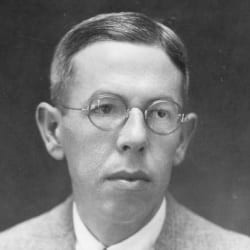
That organization’s website presents the below photo and technical details linked to Professor Nichols being honored with a Guggenheim Fellowship:


MELVIN L. NICHOLS

Fellow: Awarded 1929

Field of Study: Chemistry

Competition: U.S. & Canada

Born: 11-30-1894

Died: 03-29-1981


As published in the Foundation’s Report for 1929–30:

Nichols, Melvin Lorrel:  Appointed to make a study of the adsorption of anions by barium sulphate and a study of the conductivity of alkylated ammonia salts in non-aqueous solvents, in certain German and Austrian laboratories; tenure, twelve months from July 15, 1929.

Born November 30, 1894, at Dayton, Ohio.

Education: Cornell University, B. Chem., 1918, Ph. D., 1922.

Instructor in Analytical Chemistry, 1918–22, Assistant Professor, 1922—, Cornell University.

Publications: “Gas Analysis,” 1929. Articles and reviews in Journal of the American Chemical Society, Industrial and Engineering Chemistry, Journal of Physical Chemistry.


Note 2 – Cornell University Faculty Memorial Statement

Source: http://ecommons.library.cornell.edu/handle/1813/17813


Melvin L. Nichols

November 30, 1894 — March 29, 1981

Melvin L. “Pete” Nichols, emeritus professor of chemistry, who died March 29, 1981, at the age of eighty-six, enjoyed a career that almost perfectly characterizes a true-blue Cornellian. He was, in fact, a member of that very small group of our faculty that had been personally acquainted with every Cornell president. As Melvin Nichols, he left his home town of Dayton, Ohio, in 1914 to enter Cornell as a freshman. He remained in Ithaca, known to his many friends as Pete, until 1978, when, in failing health, he moved to California to be close to his only daughter, Sally. After receiving his Bachelor of Chemistry degree in 1918, he was appointed an instructor in chemistry at Cornell and simultaneously embarked on a graduate study program under Professor Orndorf, majoring in organic chemistry. He was awarded a Doctor of Philosophy degree in 1922 and was promptly appointed assistant professor in chemistry. He remained on the chemistry faculty until his retirement in 1962.

Nichols’s field of teaching and research was analytical chemistry, and for many years he was unofficial head of the analytical teaching group of the Chemistry Department. He wrote two textbooks on analytical chemistry, Gas Analysis, coauthored with L. M. Dennis, and Laboratory Manual of Analytical Chemistry. In 1950, Nichols agreed to become executive director of Cornell’s Chemistry Department, a new position which involved supervision of the support facilities and the nonacademic staff of what had become a large and complex establishment. He held this position until his retirement in 1962.

The forty-eight years of Pete Nichols’s life as a student and teacher at Cornell were years of great change for Cornell chemistry. The science itself became more physical and more theoretical. Applied fields such as agricultural chemistry, sanitary chemistry, and chemical microscopy, which had once been central at Cornell, were spun off or phased out. Industrial chemistry was transformed into chemical engineering and moved into the College of Engineering for its separate and independent development. There was a disastrous fire in 1916 which destroyed Morse Hall, the chemistry building; fortunately, a splendid new Baker Laboratory building opened in 1922. That chemistry at Cornell survived these changes and indeed grew stronger and more effective over the years was due in large measure to the successful adjustments and continuing contributions of Pete Nichols and other faculty members of his generation. Cornell is in their debt.

In 1926 Nichols married Mary Bancroft, the attractive and lively-minded daughter of one of Cornell’s eminent chemistry professors, Wilder D. Bancroft. When newcomers to Cornell first learned of this marriage, they were prone to mutter something about “marrying the boss’s daughter,” and were chagrined to learn that the true situation had been almost the exact opposite. Nichols was a coworker and protégé of the other strong-willed Cornell chemist of the time, L. M. Dennis, and Dennis and Bancroft had a long-established and well developed dislike of each other. Hence, to Dennis, a Nichols involvement with a Bancroft was akin to joining up with the enemy. It is a tribute to his tact and his persistence that Pete Nichols rode out the storm and kept his Cornell position.

Mary Nichols died suddenly in 1967, and Pete Nichols lived on alone in Ithaca, actively involved with his wide circle of friends. He will be missed by his Ithaca friends and colleagues as well as by the hundreds of Cornell students that he taught.

Albert W. Laubengayer,

William T. Miller,

Franklin A. Long

Cornell


Note 3 – History of the Ephemera Society of America from their website:

A small band of collectors interested in promoting the collecting, study, and preservation of ephemera established the Ephemera Society of America (ESA) in 1980, to serve as a link between and among collectors, archivists, researchers and dealers, and to encourage interest in all aspects of vintage paper. Five years earlier, in 1975, Maurice Rickards and his associates in England had established The Ephemera Society of the United Kingdom., and similar organizations have arisen in Canada, Austria, and Australia.

Shortly after ESA was formed, it was granted non-profit tax-exempt status as an educational organization. The society embarked upon a publishing program to educate its members and the general public about the world of ephemera. Issue #1 of our Ephemera News newsletter came out in the summer of 1981, and this regular newsletter continues its unbroken publication run to the present time. Printed as ink-on-paper until mid-2011, it is now entitled eNews and sent electronically each month to every member. ENews delivers news, details on conferences and other activities, a calendar of upcoming shows and events, auction notes, new book notices, links to stories of interest, announcements and other content of interest to ephemerists.

ESA publishes The Ephemera Journal, a highly regarded print publication devoted solely to illustrated scholarly articles on many different topics. Journal authors have included faculty and staff from a long list of distinguished institutions including the American Antiquarian Society, Winterthur, the Huntington Library, the Library Company of Philadelphia, Colonial Williamsburg, the Clements Library, Brown University and many other distinguished organizations. Many fine articles have come from independent scholars and collectors. https://www.ephemerasociety.org/


About the Author:

Stan S. Katz wrote the historical novel The Emperor and the Spy about an adventurous, high ranking U.S. intelligence agent Colonel Sidney Mashbir. He also authored the illustrated biography The Art of Peace about Prince Tokugawa Iesato, heir to the last Shogun of Japan. But when that dynasty ended, Prince Tokugawa instead became an international statesman who promoted good relations between U.S. and Japan.

Stan’s journey into historical writing began while he was the owner of two antiquarian bookstores. It was through these bookstores that he acquired the secret personal papers Colonel Mashbir. During the 1920s and ‘30s prior to WWII, Mashbir allied with many influential, peace loving Japanese leaders in an attempt maintain goodwill between their nations. Two of Mashbir’s closest Japanese allies were Prince Tokugawa Iesato and Baron Shibusawa Eiichi. Regrettably, WWII could not be prevented.

During his long military career, Mashbir served closely with General John Joseph Pershing during WWI, and Admiral Joseph King and General Douglas MacArthur during WWII. As one of MacArthur’s closest intelligence advisors, Mashbir took a pivotal role in shortening WWII in the Pacific. And during the post-war Occupation of Japan, he guided the U.S. and Japan to once again become allies. Colonel Mashbir’s primary source collection of historical documents unveiled significant unknown U.S. Japan relations during the first half of the twentieth century.

The website TheEmperorAndTheSpy.com presents many blog posts containing important rare and never before available photos and written documents linked to U.S. Japan history…One of these blog posts highlights a 1909 visit by Baron Shibusawa to Ithaca, New York, where the president of Cornell University, along with many Cornell professors, the mayor of the Ithaca, and other prominent individuals assembled to greet their honored guest from Japan. Baron Shibusawa Eiichi is remembered as a great humanitarian who promoted friendship between the East and the West, and is known as the Father of Modern Japanese Capitalism.

Based on Katz’s curiosity for international relations, for many years he’s been a member of and on the board of directors for the San Diego World Affairs Council, which is a local chapter the World Affairs Councils of America. Through this fine non-profit, non-partisan international affairs educational forum, he’s attended many fascinating presentations and met ambassadors, consul generals, and other political, economic, academic, and military representatives from around the globe. You’re invited to visit their websites to learn more about these organizations.


Filed Under: Tokugawa Archives Tagged With: Albert W. Laubengayer, Antique university album, Baron Eiichi Shibusawa, Baron Shibusawa, Baron Shibusawa Eiichi, Colonel Sidney Mashbir, Cornell University, DrStanKatz.com, Ephemera Society of America, Franklin A. Long, Guggenheim Fellowship, Historical documentary film, History of Cornell University, Melvin Lorrel Nichols, Melvin Nichols, Memory Album from Cornell University, President Theodore Roosevelt, Prince Iyesato Tokugawa, Prince Tokugawa, Prince Tokugawa Iesato, Shibusawa Eiichi, Stan S. Katz, Stan S. Katz blog, The Art of Peace, The Art of Peace biography, The Emperor and the Spy, TheEmperorAndTheSpy.com, Theodore Roosevelt, U.S. Japan relations, U.S.-Japan History, University Album, US Japan relations, William T. Miller, World War One

Copyright © 2026 Stan S. Katz