Stan. S. Katz

Author of The Emperor and the Spy

  • Home
  • Author
  • Books
  • Reviews
  • Educators
  • News
  • Audiobook & Timeline
  • Mashbir Archives
  • Tokugawa Archives
  • Contact
Follow Stan on FacebookFollow Stan on TwitterFollow Stan on GoodreadsFollow Stan on RSS

Sign Up for Future Blogs Linked to Colonel Mashbir and Japanese History

Read the Intro Posts

INTRODUCTION TO THE ART OF PEACE

WELCOME!

Recent Posts

  • San Diego Jewish Journal Holocaust Remembrance Edition May 2016 highlights the historical novel, The Emperor and the Spy and the outstanding achievements of Colonel Sidney Mashbir.
  • The Emperor and the Spy, was one of two books highlighted during academic/diplomatic event sponsored by the Prime Minister’s Office of Japan and hosted by San Diego World Affairs Council
  • Osher Lifelong Education Institute – UCSD Presentation. Remarkable story, the alliance between a patriotic U.S. Intelligence Agent, Colonel Sidney Mashbir, and a humanitarian Japanese International Statesman, Prince Iyesato Tokugawa, who heroically delayed and attempted to prevent WWII in the Pacific.
  • Tokugawa & Komatsu, Forgotten Heroes – Until his passing in 1940, Prince Iyesato Tokugawa held back WWII in the Pacific – Tokugawa’s diplomatic legacy lived on after WWII ended, when his protégé, Takashi Komatsu, guided the US and Japan to again become friends and allies.
  • Have you ever wondered how US and Japan re-established their friendship and alliance following the trauma of WWII? Here’s a new biography that honors an amazing Japanese American statesman, Takashi Komatsu, who guided this major achievement.

Archives

1920 – An Important Event Encouraging Good US / Japan Relations. Recently discovered Photo – Frank A. Vanderlip, a leading US business figure and president of the Japan Society of New York City meets with Shibusawa Eiichi and representatives of Mitsui & Co., and other Japanese leaders.

February 16, 2020 by Stan S. Katz 6 Comments


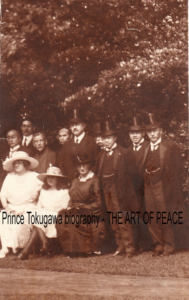
Above  is an original 1920 photo (far right segment) of the larger photo shown just below. It presents an exciting moment in international business relations, an early U.S. Japan trade/economic alliance being formed, while at the same strengthening U.S. Japan political and cultural relations. This gathering took place at the home of Baron Shibusawa (seated front row, seventh from the left in the below photo).
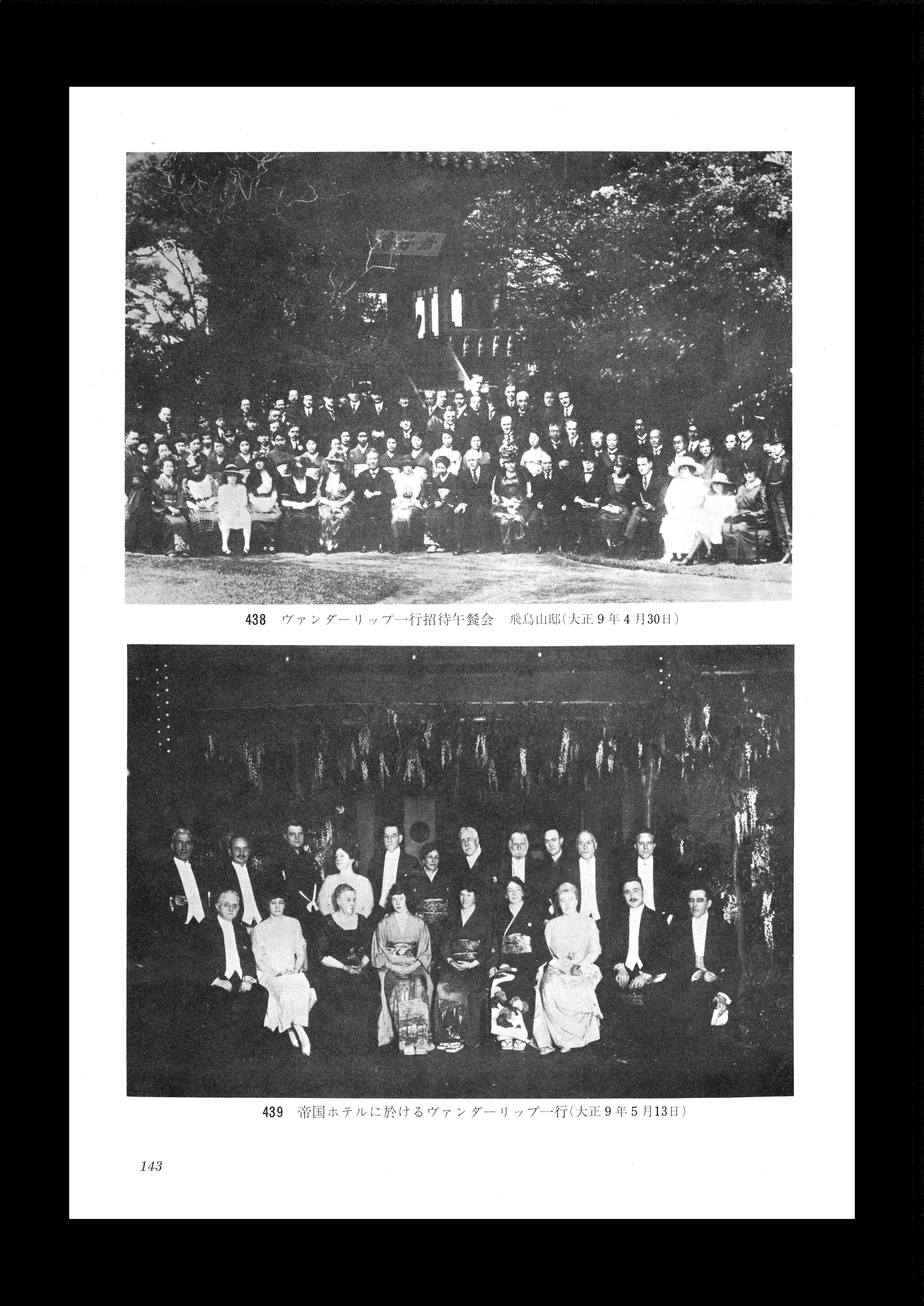
 

The successful American banker and journalist Frank A. Vanderlip (seated 10th from the left in the upper black and white photo, and standing 7th from the left in the lower black and white photo.

Vanderlip headed this U.S. business delegation to Japan, where he was met by Baron Shibusawa Eiichi and other Japanese business and governmental leaders. Vanderlip was the former Assistant Secretary of the U.S. Treasury from 1897 to 1901 and major contributor to the future creation of the U.S. Federal Reserve System. Baron Shibusawa is known as the Father of the Japanese Modern Capitalistic Economy, who among his many accomplishments launched Japan’s first national bank. In 1909, Vanderlip became the president of National City Bank which held more capital than any other bank in the U.S.

The above 1920 photo was taken following a special dinner hosted by Shibusawa Eiichi for Mr. Vanderlip and his family, along with their accompanying U.S. delegation. Several of individuals in the above photos have been identified. The remaining Japanese individuals will hopefully be identified in the future and this article will be updated.


The invited American guests of the day are as follows

Mr. Frank A. Vanderlip and Mrs. Vanderlip, and their daughter(s). (Mr. Vanderlip is standing 5th from the right in the bottom black and white photo, shown above.)

Mr. Harry E. Benedict – nationally known executive and economist,

Mr. Henry W. Taft and Mrs. Taft – Henry Waters Taft (May 27, 1859 – August 11, 1945) was an American lawyer and author. He was the son of Alphonso and brother of President William Howard Taft. A renowned antitrust lawyer, he was a name partner at Cadwalader, Wickersham & Taft.

Mr. Jacob G. Shurman and Mrs. Shurman –  Jacob Gould Schurman (May 2, 1854 – August 12, 1942) was a Canadian-born American educator and diplomat, who served as President of Cornell University and United States Ambassador to Germany.

Mr. Darwin Kingsley and Mrs. Kingsley – Darwin P. Kingsley ~ PRESIDENT NEW YORK LIFE INSURANCE CO – 1906-1930

Mr. Julian Street and Mrs. Street, and daughter

Mr. Seymour L. Cromwell and Mrs. Cromwell – President of the New York Stock Exchange

Mr. Lewis L. Clark and Mrs. Clark, and daughter

Mr. Lyman Judson Gage (June 28, 1836 – January 26, 1927) was an American financier and Presidential Cabinet officer.

Mr. George Eastman – George Eastman (July 12, 1854 – March 14, 1932) was an American entrepreneur who founded the Eastman Kodak Company and helped to bring the photographic use of roll film into the mainstream. He was a major philanthropist, establishing the Eastman School of Music, Rochester Philharmonic Orchestra, and schools of dentistry and medicine at the University of Rochester and in London Eastman Dental Hospital; contributing to the Rochester Institute of Technology (RIT) and the construction of several buildings at the second campus of Massachusetts Institute of Technology (MIT) on the Charles River. In addition, he made major donations to Tuskegee University and Hampton University, historically black universities in the South. With interests in improving health, he provided funds for clinics in London and other European cities to serve low-income residents. NOTE: The author of this blog post lived in Rochester for 10 years and got the chance to see many of the above fine institutions that George Eastman created. (Eastman is seated far left in the lower black and white photo, shown above.)

Mr. J. Lionberger Davis and Mrs. Davis – J. Lionberger Davis (John Lionberger) was born in St. Louis, Missouri in 1878. He was a lawyer and banker; he graduated from Princeton in 1900, and studied law at Harvard and Washington University. He was founder and chairman of the Real Estate Mortgage Trust Company and the Security National Bank Savings and Trust Company in St. Louis, Missouri. During World War I, Davis served as managing director of the Alien Property Custodian from 1917-1919. He was an active Democrat and personal friend of Presidents Woodrow Wilson and Franklin Roosevelt. He died in 1973. Lionberger was an avid collector of fine art. Much of his art collection was gifted to various art museums around the country.

Mr. Edward Mulligan – might have been a banker.

Mr. Harry Serenbetz

Mr. Ballantine and Mrs. (details unknown); (spelling Valentine?)

Mr. Bors (details unknown)

*Note: Some of the information in the blog post was kindly provided by an individual who is included in the Comments Section at the end of this Blog Post.


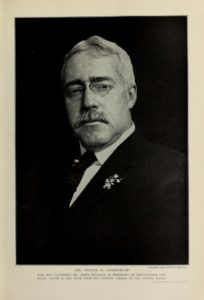
Frank A. Vanderlip (November 17, 1864 – June 30, 1937)

Below is a 1909 photo of Frank A. Vanderlip – Source: Wikipedia, from the book: The World’s Work, 1909, by the Brown Brothers.


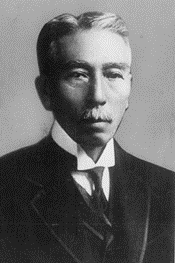
Baron Shibusawa Eiichi (渋沢 栄, March 16, 1840 – November 11, 1931, aka Eiichi Shibusawa) was a Japanese industrialist who spearheaded the introduction of Western capitalism into Japan after the Meiji Restoration of 1868. 


Photo date unknown – Source: Wikipedia


Baron Takuma Dan (團 琢磨, September 7, 1858 – March 5, 1932) is on the far right of the 1908 photo of the original photo segment . He was a graduate of Massachusetts Institute of Technology and was married to the younger sister of statesman Kaneko Kentarō. Dan was a successful Japanese businessman who became Director-General of Mitsui & Co., Ltd. (三井物産, Mitsui Bussan) which is currently one of the largest sogo shosha (general trading companies) in Japan. It is part of the Mitsui Group, and its business sectors include energy, machinery, chemicals, food, textile, logistics, finance, and more. The company was established in 1876 with 16 members including the founder, Takashi Masuda.  

Takuma Dan – photo date unknown: Source Wikipedia


Baron Takamine Mitsui (三井 高棟, 8 February 1857 – 9 February 1948) is on the far left in the original photo segment.

In 1919, Takamine Mitsui was considered for the position of Japan’s new ambassador to the United States. At the time, he was the richest man in Japan and the head of the successful, centuries old, Mitsui family. He had worldwide commercial and financial interests and was described in the Press of his own country as the ‘Japanese Rockefeller’.
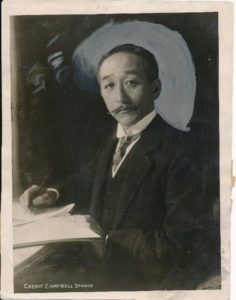


Baron Takamine Mitsui – Source: press photo circa 1919
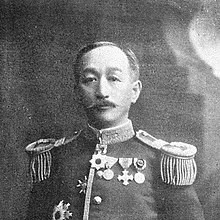


Baron Takamine Mitsui

日本語: 三井高棟

Photo date: October 1913

Source  Japanese book “Kazoku Gaho (Pictorial Peerage of the Empire of Japan)” published by Kazoku Gaho Sha.

日本語: 華族画報社「華族画報」より。


No reference photo could be found for Masao Shibusawa, son of Baron Shibusawa.

The below photo is from the 1920 original photo segment which shows what the author of this blog FIRST believed to be Masao Shibusawa. Verification from historians would be appreciated in confirming this information. During the 1920s, Masao Shibusawa was President of Tokyo Ishikawajima, a shipbuilding and engineering firm that also manufactured of cars, trucks, and small buses. This company would be part of the early history of domestic car manufacturing in Japan, leading to the company Isuzu. Source: The New Domestic Automakers in the United States and Canada: History, By A.J. Jacobs, Publisher: Lexington Books, 2016

Below photo: At first, incorrectly, the below individuals were assumed to be Baron Shibusawa left, with his son Masao Shibusawa right. It is not yet clear who they are.

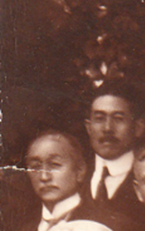


The above photo is a section of the original 1920 photo segment: Left: Baron Mitsui, the right photo might be: Taka Kawada
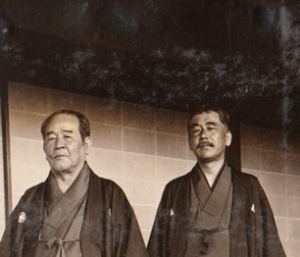


The above 1917 reference photo presents: Baron Shibusawa Eiichi and Taka-Kawada: two of the Greatest Financiers in Japan. The photo was taken on the porch of Baron Shibusawa’s home. Shibusawa was known as the Father of Modern Banking and Economics in Japan (seen as the J. P. Morgan of Japan.) Above information: ”Journal of the American Asiatic Association” volume 17, March 1917-Dec. 1917: the article is titled: Japan’s Prosperity The New Wealth and Its Measure of New Reserve Power written by S. Joseph Reed, Jr. (The article relates to Japan’s economy and to the shipbuilding industry.) Photo source: archives of the author of this blog post.


ADDITIONAL DETAILS ABOUT THE 1920 original PHOTO segment:

This rare photo was discovered six years ago by the author of this blog post, while doing research for an illustrated biography on Prince Tokugawa Iesato (aka Prince Iyesato Tokugawa 1863-1940), titled: The Art of Peace. The biography highlights the significant political, economic, and social welfare contributions of Prince Tokugawa Iesato  and Baron Shibusawa Eiichi who often allied with one another to achieve Japan’s domestic and international goals. It offers a new perspective on U.S. Japan relations, during the first half of the 20th Century.

At first, it was largely a mystery as to who the individuals were and what the date of this photo was as well, and what was the event that brought these individuals together? This was not a press photo, which generally has description printed on the back. Research into newspaper archives found only one article that mentioned a large U.S. business delegation visiting Japan in Dec. 18, 1908, but this article didn’t list even one name of the U.S. delegates. This article did however state that the U.S. delegation was met by leading Japanese, but none of those Japanese were identified.

It appeared that this photo was most likely taken as a personal memory of Frank A. Vanderlip and his business delegation’s visit to Japan.

As part of the research, an inquiry was made with the Shibusawa Eiichi Memorial Foundation and Museum, an organization that honors the legacy and values of Baron Shibusawa and his allies. This organization was started over 120 years ago and is based in Asukayama Park in Oji, Tokyo, on the site of the former Shibusawa residence. The head of their library resources section kindly confirmed they didn’t know that Frank A. Vanderlip, along with his family, and his U.S. business delegation might have visited Japan in 1908 and that he might had met with Baron Shibusawa and other Japanese business leaders. Since that time, new information was provided that revealed that this meeting of East and West occurred in 1920, not 1908.

Here is the link to the Shibusawa organization’s website: https://www.shibusawa.or.jp/english/


The 1920 photo is 10 inches by 3.5 inches in size.

The reverse side of this significant, but age weathered photo is shown below.

Written in ink are the words:

“DINNER BY

BARON SHIBUSAWA

TO VANDERLIP MISSION“
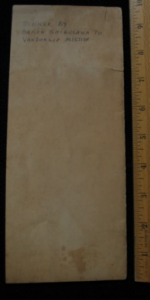


If there had been a meeting between a Vanderlip business delegation and Japanese economic leaders in 1908, the reason for the limited press coverage for this meeting might well be that the participants wished privacy as they discussed urgent U.S. economic issues and the unstable and potentially adversarial political relations between the U.S. and Japan.

On the economic front this meeting was quite urgent, because of a recent, major economic downturn in the U.S., called The Panic of 1907, also known as the 1907 Bankers’ Panic, linked to the collapse of the U.S. Stock Market. Based on this U.S. economic crisis, a 1908 US business delegation visited Japan most likely had the goal of working together with their Japanese allies to bring back a stable and prosperous U.S. economy by increasing U.S. Japan trade & through the Japanese extending financial backing thru loans to the U.S. – These supportive measures would simultaneously improve the economy of Japan, and hopefully strengthen U.S. Japan political and cultural relations.

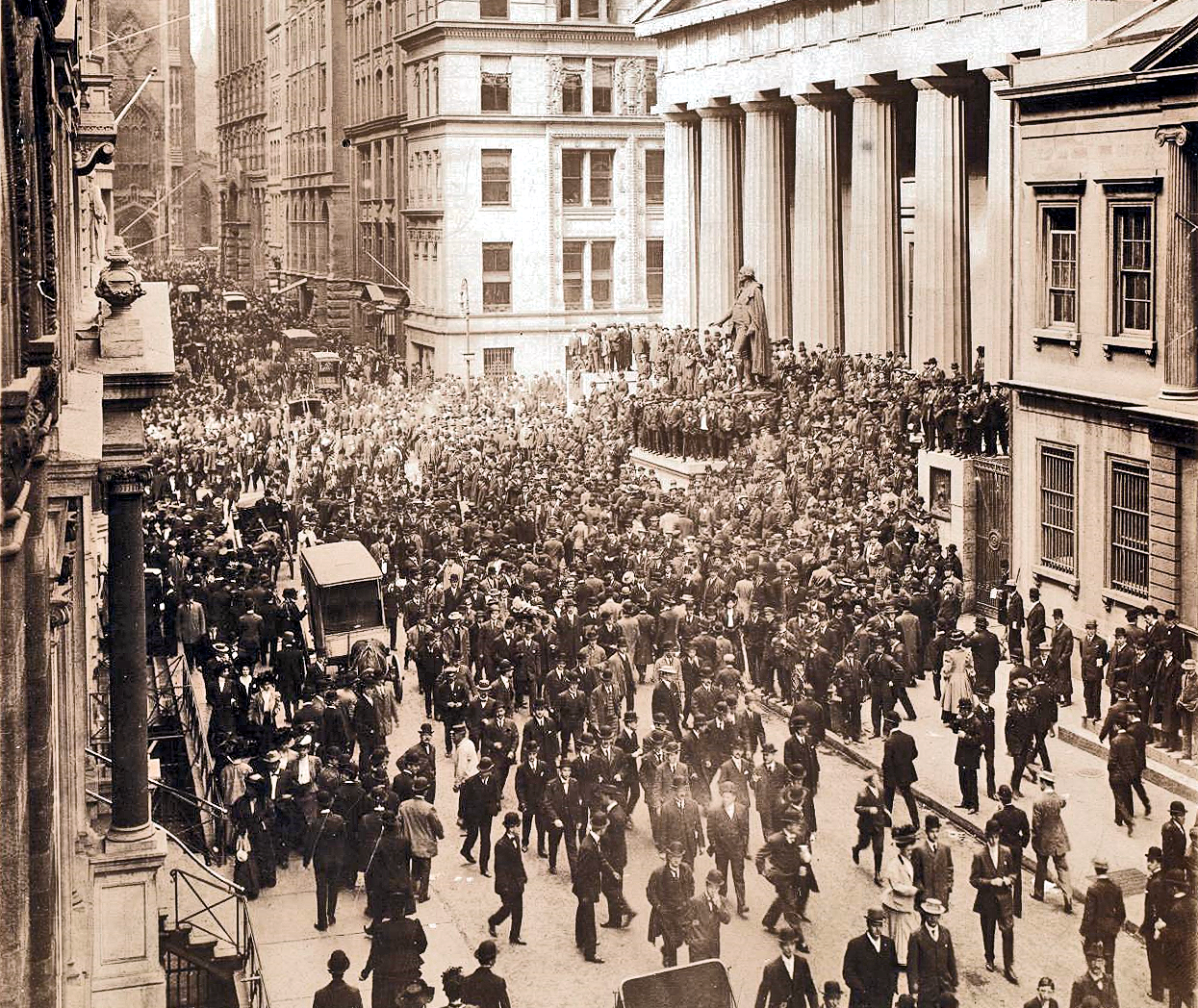
The below photo presents Wall Street during the Bank and Stock Market Crash which was called the 1907 Bankers’ Panic. Anxious crowds gathered around Federal Hall, one of the first of two historic buildings located at 26 Wall Street in the Financial District of Manhattan, New York City. The original, a Federal style structure completed in 1703, served as New York’s first City Hall. Notice the statue of George Washington in front of the building. Source of photo: Wikipedia
 

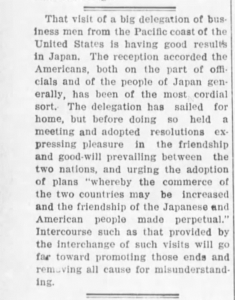
Below is the newspaper article believed to be linked to the Vanderlip/U.S. 1908 business delegation visit to Japan:

Courtland Journal (Courtland, Kansas)

December 18, 1908, Friday, Page 2

This news article did not have a title, but appeared in a column with the heading:

“THE COMET”

A. Hoyt Publisher, Courtland, Kansas

Below is a transcription of the December 18, 1908 Courtland Journal article, followed by the scanned newspaper article:

“That visit of a big delegation of businessmen from the Pacific coast of the United States is having good results in Japan. The reception accorded the Americans, both on the part of officials and of the people of Japan generally, has been of the most cordial sort. The delegations has sailed for home, but before doing so held a meeting and adopted resolutions expressing pleasure in the friendship and good-will prevailing between the two nations, and urging the adopting of plans “whereby the commerce of the two countries may be increased and the friendship of the Japanese and American people made perpetual.” Intercourse such as that provided by the interchange of such visits will go far toward promoting those ends and removing all cause for misunderstanding.”



The following year, 1909, Shibusawa headed a Japanese business/goodwill delegation to the United States, that included 40 of Japan’s most prominent business leaders and notables. They came at the invitation of the Seattle Chamber of Commerce and the Associated Chambers of Commerce of the Pacific Coast. The Japanese delegates and their companions traveled from Pacific to Atlanta, and back again, touring and being welcomed in over fifty U.S. cities. The newspaper: The Buffalo Commercial – 05 Oct. 1909, Tue • Page 1 – gives some general details about Shibusawa and his Japanese delegation’s three month journey and states that that visit was in reciprocation for the fine hospitality given to the U.S. delegates during their 1908 visit. However, no mention is made that the 1908 visit had been headed by Frank A. Vanderlip, nor was there mention made that any photos had been taken of the Japanese and the U.S. representatives coming together in 1908. 


With the goal of identifying all of the individuals in the below 1920 Photo, below are enlarged segments of that photo with the individuals given ID numbers. Those who are already recognized are named. Hopefully, historians or family members who visit will be able to assist in identifying those who haven’t yet been recognized. This information can be sent thru the comment section of this blog post. Thank you.
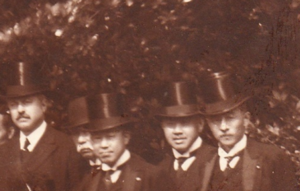


From: Right to left

1- Might be: Baron Takuma Dan (團 琢磨, September 7, 1858 – March 5, 1932)

2- Might be Baron Shibusawa’s son, Masao Shibusawa.

3- Might be Baron Shibusawa’s son, Masao Shibusawa.

4- Unknown gentlemen with white mustache

5- Unknown gentlemen in top hat
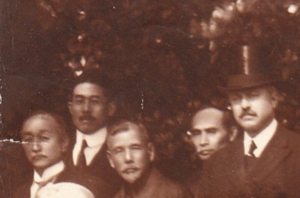


From: Right to left

5- Unknown gentlemen

6- Unknown gentlemen

7- Unknown gentlemen

8- Might be: Taka Kawada (taller with black tie)

9- Baron Takamine Mitsui (三井 高棟, 8 February 1857 – 9 February 1948)
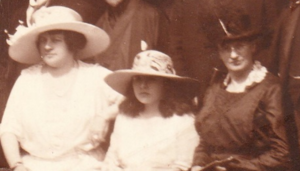


From: Right to left

10- Might be: Daughter of Frank A. Vanderlip

11- Might be: Daughter of Frank A. Vanderlip

12- Might be companion for the Vanderlip children.


In 1909, in reciprocation for a 1908 U.S. business/goodwill delegation’s visit to Japan, Baron Shibusawa Eiichi, accompanied by his Japanese business/goodwill delegation toured the United States. During their visit, the Japanese were greeted by the Vanderlip family and top representatives of American Industry, such as General Electric and Westinghouse.

In the following year, 1910, Prince Tokugawa Iesato visited the U.S., to further strengthen the growing friendship between their two nations. Prince Tokugawa’s 1910 goodwill visit was strongly linked to the 1912 gifting of the Cherry Blossom Trees to the U.S. Capital, whose commemoration is now celebrated annually as the National Cherry Blossom Festival.

The Art of Peace biography presents Prince Tokugawa and his Japanese allies who creatively supported democracy and peace. For thirty years (1903-1933), Prince Tokugawa served as President of Japan’s upper house of congress, the House of Peers.          

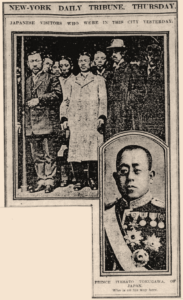
The below May 5, 1910 – The New York Daily Tribune newspaper article announces the coming arrival of Prince Tokugawa to New York City, after his and his delegation’s visit to Washington D.C. During this visit, Prince Tokugawa met with President William Howard Taft and many other U.S. governmental leaders.


As for Frank A. Vanderlip, in 1910 his services were required for secret business gatherings where press coverage was kept to a minimum, when Vanderlip came together with other U.S. financial experts on Dr. Jekyll Island, to plan out the creation of initial framework for the U.S. Federal Reserve System, a system which would play an important role in stabilizing the U.S. economy by overseeing the U.S. currency supply, to avoid similar events such as ‘The Panic of 1907’.

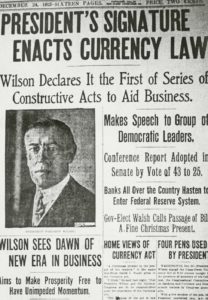
The below December 24, 1913 newspaper article highlights President Woodrow Wilson’s new currency laws as part of the establishment the U.S. Federal Reserve System. Source of illustration: Wikipedia


In 1915, Baron Shibusawa Eiichi again visited the U.S. on a diplomatic goodwill/business visit.
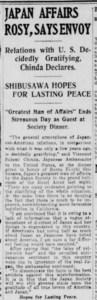


New-York Tribune (New York City), Dec. 3rd, 1915, Friday, Page 9.

To honor Baron Shibusawa’s visit, on December 2, 1915 a dinner event was hosted by the Japan Society of New York City at the grand ballroom of the Hotel Astor. At this gathering, Viscount Sutemi Chinda the Japanese Ambassador to the U.S. spoke of the growing positive relations between the U.S and Japan. There were 360 guests who attended this dinner and dance.

During his 1915 visit, Baron Shibusawa met with President Woodrow Wilson.

Another significant event linked to honoring Baron Shibusawa’s 1915 visit was held at a well-known restaurant in New York City, called Sherry’s. Among the 65 attendees who attended this banquet were former Presidents Theodore Roosevelt and William Howard Taft – A rare, perhaps one of a kind photo of this 1915 event is presented in another Blog post on this website.


Note: Upcoming blog posts will present other significant historical photos that require further identification of the individuals and of the events depicted – Historians/educators/researchers are invited to share their insights so as to bring greater clarity to these mysterious pieces of history. Your contributions will be acknowledged – To receive these future blog posts, you’re invited sign up at the top right.

BELOW IS A LINK TO A NEWSPAPER ARTICLE THAT COVERED THE 1920 MEETING BETWEEN THE VANDERLIP BUSINESS DELEGATION AND SHIBUSWA EIICHI, AND HIS JAPANESE COLLEAGES.

https://www.newspapers.com/image/208940552/?terms=shibusawa%20meets%20with%20frank%20vanderlip&match=1

In 1920 Frank A. Vanderlip became the president of the Japan Society of New York City.

The below information comes from the Japan Society website: https://www.japansociety.org/page/about/brief_history

“Japan Society of New York, established in 1907, was one of the pioneers of cultural exchange in the early 20th century. Begun in a time when few Americans knew anything about Japan, it quickly reached a wider audience than the few learned societies that focused on Asia at the time. Japan Society not only hosted leading Japanese visitors to the United States, it sponsored the first important exhibitions of Japanese art, published important books on Japan written by American experts, and promoted the study of Japan in American schools and universities by distributing learning materials and providing funds for prizes at the collegiate level. Throughout the 1910s and 1920s, it became the leading forum for Japanese to encounter their American counterparts abroad.

As political and racial tensions worsened between Japan and the United States in the 1920s and 1930s, the Society steadfastly refused to take a political stance, preferring education to advocacy. Nonetheless, Japan Society worked with other internationalist groups, such as the Carnegie Endowment for International Peace or the America-Japan Society of Tokyo, to increase contact between Americans and Japanese at all levels. The Society’s Annual Dinner became a venue for leading Japanese statesmen to give major addresses on the state of the U.S.-Japan relationship.”

Japan Society recognized Prince Tokugawa as their guest of honor at their 1934 Annual Dinner Celebration.

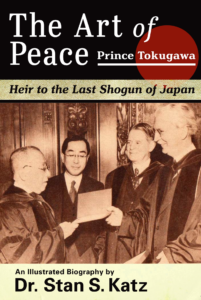
During Prince Tokugawa’s 1934 visit to the U.S., he was also greatly acknowledged by a prestigious university – The cover of the below biography highlights Prince Tokugawa receiving an Honorary Doctor of Laws Degree from the president of the University of Southern California, for his contributions to education, international goodwill, and philanthropy. 
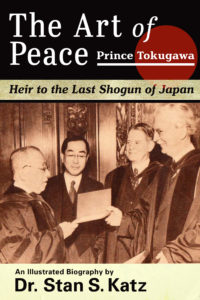


THE ART OF PEACE highlights Prince Tokugawa and Baron Shibusawa, along with their Japanese and non-Japanese allies as they creatively promoted democracy and international goodwill during the first few decades of the twentieth century, an exciting, but often turbulent period of history.

THE ART OF PEACE comes in two versions: a general reader edition and an ‘expanded’ edition which has an additional 100 pages of historical notes and a comprehensive index to assist researchers.

AVAILABLE THRU AMAZON LINKS BELOW:

General Reader Edition

Expanded Edition


Bibliographical Sources for this blog post:

  1. Courtland Journal (Courtland, Kansas) December 18, 1908, under a column with the heading: “THE COMET”, H. A. Hoyt Publisher” [Technical research details: Please note: It was difficult to discover this newspaper article online, in that no names of the participants were given by the U.S. press. So to find it, required entering the Search words: “Business delegation visits Japan” and the date period “1907-1908” on archival websites. If instead the search words for name of the newspaper “Courtland Journal” with the publication date “December 18, 1908” were used, no successful search results occurred.]
  2. TheEmperorAndTheSpy.com.
  3. Katz, Stan S. (2019). The Art of Peace, California: Horizon Productions. ISBN 978-0-9903349-2-7
  4. “COMMERCIAL EMISSARIES FROM MIKADO’S LAND ARE GIVEN WELCOME”. “The Butte Miner” (Butte, Montana) page 10. September 15, 1909.
  5. “TO MEET PRESIDENT – TAFT WILL MEET JAPANESE EMISSARIES AT MINNEAPOLIS – Baron Shibusawa Has Message From Emperor to Present to Chief Executive”. The Butte Miner (Butte, Montana). September 15, 1909.
  6. “”JAPANESE VISITORS WHO WERE IN THE CITY YESTERDAY” (Prince Iyesato Tokugawa leads a Japanese goodwill delegation to Washington, D.C. and then to New York City, as part of the gifting of the Cherry Blossom Trees to the United States)”. The New-York Daily Tribune. May 5, 1910.
  7. “JAPAN AFFAIRS ROSY, SAYS ENVOY” Relations with U.S. Decidedly Gratifying, Chinda Declares. Shibusawa Hopes for Lasting Peace. “Greatest Man of Affairs” Ends Strenuous Day as Guest at (Japan) Society Dinner: New-York Tribune, New York, New York, December 3rd, 1915, page 9.
  8. “WILSON MEETS SHIBUSAWA. Welcomes Japanese Financier, Who Also Pays Visit to Lansing.” New York Times, published Dec. 7, 1915

If you enjoyed this illustrated article – Click the Like Tab at the top of the page and consider sharing it with your friends – Thank you.
 

Filed Under: Tokugawa Archives Tagged With: 1907 Bankers' Panic, Baron Dan Takuma, Baron Eiichi Shibusawa, Baron Mitsui, Baron Mitsui Takamine, Baron Shibusawa, Baron Shibusawa Eiichi, Baron Takamine Mitsui, Baron Takuma Dan, Dan Takuma, Darwin Kingsley, Diplomacy, Director-General of Mitsui & Co., Edward Mulligan, Eiichi Shibusawa, Father of the Modern Japanese Economy, First formal U.S. Japan trade/economic alliance, First modern day U.S. Japan trade/economic alliance, First U.S. Business delegation to go to Japan, First U.S. Japan business alliance, Frank A. Vanderlip, Frank Vanderlip, George Eastman, Harry E. Benedict, Harry Serenbetz, Henry Taft, Historical biography, History of Isuzu, History of National City Bank, History of National City Bank of New York, History of the Cherry Blossom Festival in Washington D.C., History of the Japan Society of Manhattan, History of the National Cherry Blossom Festival, History of the United States Chamber of Commerce, History of U.S. Chamber of Commerce, Honorary Doctor of Laws Degree from the University of Southern California, Honorary Doctor of Laws Degree from USC, https://www.shibusawa.or.jp/english/, International Friendship, J. Lionberger Davis, J. P. Morgan of Japan, Jacob Gould Schurman, Japan History, Japan Society, Japan Society 1934 Annual Dinner Celebration, Japan Society of Manhattan, Japan Society of New York City, Julian Street, Lewis L. Clark, Ltd., Lyman Gage, Lyman Judson Gage, Masao Shibusawa, Mitsui & Co., Mitsui Group, Mitsui Takamine, Narcissa Cox Vanderlip, President Taft, President Theodore Roosevelt, President William Howar, President William Howard Taft, President Wilson, President Woodrow Wilson, Prince Iyesato Tokugawa, Prince Tokugawa, Prince Tokugawa Iesato, Prince Tokugawa’s 1934 visit to the U.S., Seymour L. Cromwell, Shibusawa Eiichi, Shibusawa Eiichi Memorial Foundation, Shibusawa Eiichi Memorial Foundation and Museum, Shibusawa Eiichi Memorial Museum, Stan S. Katz, Stan S. Katz blog, Taka Kawada, Takamine Mitsui, Takashi Masuda, Takuma Dan, The Art of Peace, The Art of Peace biography, The Japan Society, The Japan Society of New York City, The Panic of 1907, TheEmperorAndTheSpy.com, Theodore Roosevelt, Tokyo Ishikawajima, U.S. Chamber of Commerce, U.S. Federal Reserve System, U.S. Japan relations, U.S.-Japan History, United States Chamber of Commerce, United States Chamber of Commerce History, US Japan relations, Vanderlip, William Howard Taft, Woodrow Wilson, 三井 高棟, 三井物産, 團 琢磨, 渋沢 栄

The 1909 Shibusawa Delegation visits Upstate, New York – U.S. and Japanese leaders come together in friendship over a Century Ago

February 15, 2020 by Stan S. Katz Leave a Comment

The Shibusawa 1909 Delegation is welcomed by the City of Ithaca.


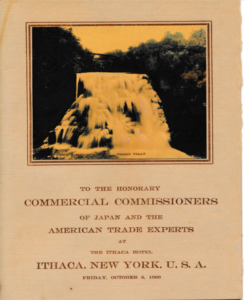
Front cover to a celebratory Event Program/Dinner Menu (six page brochure) honoring the visit of Baron Eiichi Shibusawa & his wife, and his accompanying Japanese goodwill/business delegation.       

                       The description reads:

“To The Honorary COMMERCIAL COMMISSIONERS of Japan and the American Trade Experts at the Ithaca Hotel, Ithaca, New York. U.S.A. Friday, October 8, 1909” – (Photo of beautiful Ithaca Falls.)


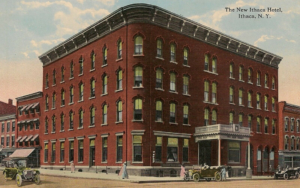
1909 Postcard of The Ithaca Hotel, where the event occurred.


Background History on Baron Shibusawa and his 1909 delegation:

Baron Shibusawa is known as the “Father of Japanese capitalism” and frequently referred to as the “Japanese J. P. Morgan.” An industrialist and entrepreneur, he was responsible for introducing Western-style capitalism to Japan during the Emperor Meiji period (1868-1912). With financial interests in railroads, steel, printing, gas, electric, mining, fishing, and oil, Shibusawa quickly became Japan’s wealthiest man. During his long life, Shibusawa helped launch over 500 companies, and was responsible for modernizing Japan’s economic and banking systems, including the introduction of paper notes. At one time, he was the director of seventy companies, however, he resisted direct ownership/control of most of the companies he helped launch, preferring an advisory role instead, giving more freedom for these new companies to determine their own strategies for growth.

Shibusawa founded the Japanese Chamber of Commerce and Industry and the First National Bank of Japan – and for two decades, he was the chairman of the Tokyo Chamber of Commerce. His priorities went beyond pure profit, when referring to his business ventures, he called it stakeholder capitalism (rather than traditional capitalism). He felt strongly that the growth of a nation, economically and otherwise, depended on the involvement of many stakeholders. While profit was still a significant goal, he often integrated ethical beliefs, and even Confucianism, into his management practices. Beyond his business interests, he utilized his own funds to establish over 600 organizations aimed at social welfare, including hospitals, universities, and disaster relief programs among others.

At the start of the twentieth century, U.S. – Japanese relations reached a new stage, with Japan emerging as an economic powerhouse in the Pacific, combined with its growing military. To ease potential tensions between the two countries and also increase business/financial relations between their nations, a delegation of U.S. businessmen were invited to visit Japan in 1908. This invitation was sent to representatives of the Associated Chambers of Commerce of the Pacific Coast. This invitation came from the chambers of commerce of six major cities of Japan: Tokyo, Yokohama, Osaka, Kyoto, Kobe, and Nagoya. Their invitation was accepted, and approximately sixty U.S. representatives made a tour of Japan, where they were received with generous and even lavish hospitality, not only by the people, but also by the imperial government. Prince Iyesato Tokugawa and Baron Eiichi Shibusawa were central figures in receiving this U.S. delegation.

-In appreciation for the fine cordiality shown to the U.S. delegation during their 1908 visit to Japan, an invitation in 1909 was now sent to the Japanese to tour the U.S. This invitation came from the Associated Chambers of Commerce of the Pacific Coast, whose membership included the chambers of commerce of eight principle cities: San Francisco, Los Angeles, San Diego and Oakland in California, and Seattle, Tacoma, Portland, and Spokane in the Northwest.

Based on this pleasant invitation, in 1909, Baron Shibusawa headed a Japanese delegation to the U.S., which included many of Japan’s most prominent business leaders and notables. They sailed from Yokohama, on August 19, on the American steamship Minnesota, and arrived first in Seattle, Washington, on Wednesday, Sept. 1st. They left Seattle on Sept. 6th, and began their journey visiting 53 cities from the West coast to Boston, and returning from New York back to Los Angeles and then to San Francisco.

Of the fifty-eight members in this Japanese delegation, six were women (five of them the wives of the commissioners), thirteen private secretaries, and thirty-nine commissioners. They would travel 11, 000 miles thru-out the U.S. before returning home. This delegation included nine members of the Japanese parliament, two of the largest banking houses were represented by Baron Shibusawa, and the bank of Mitsui & Co. represented by Kenzo Iwahara, Managing Director. There were six other bankers in the group, and also representatives of nearly every line of industry and commerce, including the ownership and management of electric railways, shipbuilding, manufacturing of silk and cotton, exporting and importing, and stock market brokerage – The professions of law and medicine were also represented, as well as some well-known Japanese educators, authors, and newspaper writers.

Their main goals were to develop friendship between the two nations while encouraging bilateral trade and commerce. This sentiment was repeatedly expressed by Shibusawa and other commission members, as well as by their American hosts. The delegation made the news across the United States, during the course of their three month journey. They traveled in a specially outfitted ‘Million Dollar Train,’ provided by the American industrial community. Their meetings included many chambers of commerce. There were also tours of factories, power plants, fire departments, port facilities, mines, farms, schools, universities, libraries, theaters, churches, hospitals, and many other facilities.


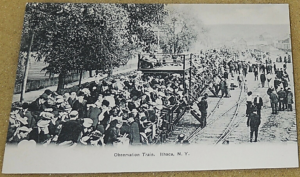
1909 – Ithaca, New York – Raised observation platform with a crowd gathered awaiting a Train’s arrival – This postcard gives a sense of the welcoming reception given for the Japanese Delegation.


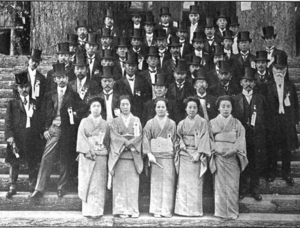
November 1909 photo from The Coast magazine (Seattle, Washington).

Baron and Baroness Shibusawa (front center), with the other Japanese delegates and their wives, pose at the Forestry Building at the Alaska-Yukon-Pacific Exposition. The delegation included bankers, presidents of the chambers of commerce from the largest cities in Japan, businessmen who were members of the Japanese Diet (Japanese Congress), and several Japanese consuls general, who were stationed in the United States. Delegates included representatives of the Tokyo Stock Exchange, lawyers, publishers, journalists, as well as a university professor and a physician. (Note: The Alaska-Yukon-Pacific Exposition was a world’s fair held in Seattle, Washington, publicizing the development of the Pacific Northwest. The fairgrounds became the campus of the University of Washington.) The Japanese delegation’s trip was arranged by Asahi, one of the largest newspapers in Japan (which is currently known as The Asahi Shimbun (朝日新聞).

At the train station in the City of Ithaca, a large reception was given for their honored Japanese visitors – This greeting party included the city’s current Mayor and nine former Mayors. Also attending were five former Presidents of the Village of Ithaca, as well as representatives of Cornell University, including Dean Charles H. Hull, members of his staff, along with eight Cornell professors. Also there to respectfully receive them were the student president and members of the Japanese Club of Cornell. The Ithaca Business Men’s Association, along with many others attended, as displayed in the Menu/Program.

To make the visitors’ experience in the U.S. more enjoyable, six members of the Associated Chambers of Commerce volunteered to accompany their Japanese friends/business colleagues, to assist in managing the events along their journey. Those six individuals are also highlighted within the Menu/Program.

In addition to the above, the U.S. government recognized the international significance of this Japanese visit and sent three U.S. representatives to accompany and be of assistance during their travels.

During their time in the U.S., they were greeted by many distinguished American leaders including President William Howard Taft, whom Baron Shibusawa and Prince Tokugawa had already befriended years earlier, when Taft had served as minister of war, under President Theodore Roosevelt.

Shibusawa and his delegation were also greeted by the inventor Thomas Alva Edison of General Electric, and James Jerome Hill of Great Northern Railway. When their continental journey ended, they left San Francisco on November 30, traveling to Honolulu, Hawaii, then arriving in Japan on December 17, 1909. With them, they carried fresh information on a wide range of industries, as well as many new cultural insights.

The stated goals of the Japanese delegation were:

-To increase and extend trade relations between the U.S. and Japan

-Improve personal acquaintances and friendly relations between representatives of both nations.

*It is significant to note that the U.S. Chamber of Commerce was founded in 1912, just three years after the 1909 visit of the Shibusawa delegation – It is most likely that this highly publicized Japanese business visit served as a catalyst connecting chambers of commerce across America into becoming a national organization. President Taft was one of the U.S. leaders that Shibusawa met with during his visit, and Taft is recognized as one of those who encouraged the establishment of the U.S. Chamber of Commerce, to support and enhance the economy of the United States.


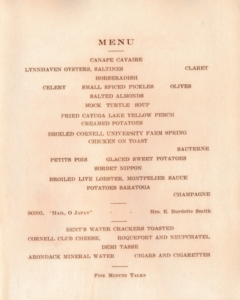
A lavish meal, followed by Five Minute Talks – This illustration and the four that follow are part of the Event Program/Dinner Menu brochure presented earlier.


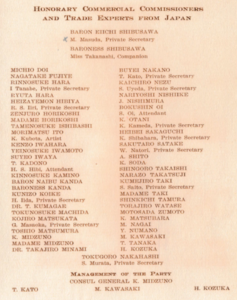
Japanese Delegates, along with those who managed the Party. This list is also presented with additional information in Note [1]


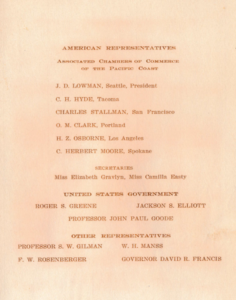
American Representatives attending the event. This list is also presented with additional information in Note [2]


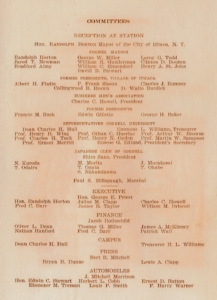
Committee Members – This list of notable citizens of Ithaca, is also presented with additional information in the Notes [3]


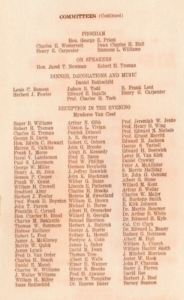
Committee Members (continued) the notable civic and business leaders of the Ithaca community, who put the Program together, were Speakers, arranged the Dinner, Decorations, and Music, and were part of the Evening Reception. *See Note [4] for more info about the two prominent speakers Robert H. Treman and Jared T. Newman


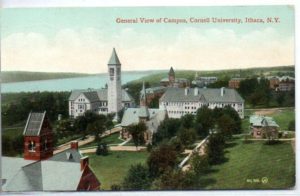
View of Cornell University – Ithaca, N.Y. – 1909 Postcard


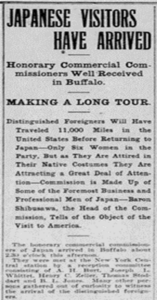
Below is the top segment of a newspaper article that gave an overview of the Japanese delegates’ three month tour and also highlighted the hospitality they had received in the city of Buffalo, New York, three days prior to their reception in Ithaca. [The Buffalo Commercial – 05 Oct. 1909, Tue • Page 1]


– The Shibusawa Eiichi Memorial Foundation / Museum (located in Japan) honors and preserves the legacy of Baron Shibusawa and his allies –  Their website is: https://www.shibusawa.or.jp/english/museum/                                                                      


The Honorary COMMERCIAL COMMISSIONERS of Japan felt so appreciative for the fine treatment they had received during their visit, that when they returned to Japan, they sent back a gift to the U.S.A..

It was given to a representative of Northwestern New York State, F. W. Rosenberger, Esq., a member of the City of Buffalo, New York Chamber of Commerce. He was also one of the U.S. representatives who attended the above event in Ithaca, New York. It is a Japanese silver two handled presentation cup on a square pedestal inscribed in Japanese on the base on one side, and in English on the other side, as shown in the below photos.

Decorated with Japanese dragon emblems around the top rim and an American eagle symbol in the circular area between them.

The English inscription reads:

Presented to F W Rosenberger, Esq. by the honorary commercial commissioners of Japan to U.S.A. 1909.

Marked Tamonten Tokio and signed in Japanese.

Meiji period.  Height 5 1/2″ Length 8″. Weight 28.25 troy oz.

This silver trophy was sent as a return gift from “The Honorary Commercial Commissioners of Japan to the U.S.A” (渡米実業団) to the people who took care of them.

The Japanese writing on the base of the above silver gift lists the names of many of the Japanese visitors who toured the U.S.A.

Further information about this gift is available in Note 5 in the Notes Section at the end of this blog post.


*The historical content for this article was discovered while researching for an illustrated biography.

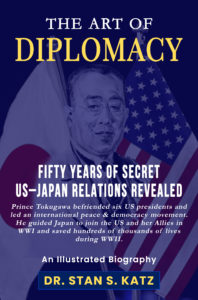
This biography comes in two versions: The Art of Diplomacy and The Art of Peace. Both highlight the Japanese international statesmen Prince Iyesato Tokugawa (aka Prince Tokugawa Iesato) and his allies, such as Baron Eiichi Shibusawa – These true humanitarians devoted their lives to creatively promoting peaceful international relations, a prosperous global economy, and democracy – Two decades of historical research was combined with the discovery of hundreds of rare illustrations, to reveal many significant unknown events that shaped the destinies of the United States and Japan.


PRINT & KINDLE EDITION


DIGITAL EBOOK EDITION [includes an additional 100 pages of historical notes to assist researchers]


NOTES FOR THIS BLOG POST

Note 1 –

List of the 1909 Japanese Delegates:

Baron Eiichi Shibusawa

M. Masuda, Private Secretary

Baroness Shibusawa

Miss Takanashi, Companion (niece of Baron and Baroness Shibusawa)

Michio Doi

Nagatake Fujiye

Rinnosuke Hara

I. Tanabe, Private Secretary

Ryuta Hara

Heizayemon Hibiya

R. S. Iiri, Private Secretary

Zenjuro Horikoshi

Madame Horikoshi

Tamenosuke Ishibashi

Morimatsu Ito

K. Kubota, Artist

Kenzo Iwahara

Yeinosuke Iwamoto

Suyeo Iwaya

T. Kadono

H. S. Hibi, Attendant

Kinnosuke Kamino

Baron Naibu Kanda

Baroness Kanda

Kunizo Koike

H. Iida, Private Secretary

Dr. T. Kumagae

Tokunosuke Machida

Kojiro Matsukata

G. Masaoka, Private Secretary

Toshio Matsumura

K. Midzuno Consul General

Madame Midzuno

Dr. Takajiro Minami

Buyei Nakano

T. Kato, Private Secretary

Kaichiro Nezu

S. Uyeda, Private Secretary

Nariyoshi Nishiike

J. Nishimura

Bokushin Oi

S. Oi. Attendant

K. Otani

K. Kameda, Private Secretary

Heibei Sakaguchi

K. Shibahara, Private Secretary

Sakutaro Satake

W. Natori, Private Secretary

A. Shito

K. Soda

Shingoro Takaishi

Narazo Takatsuji

Kumejiro Taki

S. Saito, Private Secretary

Madame Taki

Shinkichi Tamura

Torajiro Watase

Motosada Zumoto – also accompanied Baron Shibusawa when he returned to the U.S. in 1915, and a banquet was held to honor him. This 1915 diplomatic event attended by former Presidents Theodore Roosevelt & William Howard Taft – A PHOTO of that diplomatic gathering is presented as part of another Blog post on TheEmperorAndTheSpy.com) – M. Zumoto served as the translator and secretary for Baron Shibusawa –  He was also a part owner and editor of The Japan Times – Japan’s largest and oldest English-language daily newspaper, currently  published by The Japan Times, Ltd. (株式会社ジャパンタイムズ) of Tokyo. In addition, M. Zumoto was the Director of the Oriental Information Agency of New York.

K. Matsubara

M. Nagai

Y. Numano

M. Kawasaki

T. Tanaka

H. Kozuka

Tokugoro Nakahashi

S. Murata, Private Secretary


Names of those who managed the 1909 event in Ithaca, New York

Consul General K. Midzuno (Consul General Midzuno also in a 1915 photo when Baron Shibusawa visited the U.S. again and a banquet was held to honor him, which was attended by former President Theodore Roosevelt and William Howard Taft). A PHOTOGRAPH of that event is presented as a Blog post on the website: TheEmperorAndTheSpy.com). Consul General Midzuno is one of the Japanese officials linked to the Japanese gifting of the cherry blossom trees to the U.S. Capital in 1910 and 1912.

T. Kato

M. Kawasaki

H. Kozuka


Note 2 –

American Representatives at the 1909 Ithaca event

Associated Chambers of Commerce of the Pacific Coast

J. D. Lowman, Seattle, President

C. H. Hyde, Tacoma

Charles Stallman, San Francisco

O. M. Clark, Portland

H. Z. Osborne, Los Angeles

C. Herbert Moore, Spokane


Secretaries

Miss Elizabeth Gavlyn,

Miss Camilla Easty


U.S. Government

Roger S. Greene – State Department

Jackson S. Elliott – from Washington, D.C., representing Associated Press for the U.S. Dept. of Commerce and Labor

Professor John Paul Goode – University of Chicago


Other U.S. Representatives

Professor S. W. Gilman – from the University of Wisconsin, representing the cities of Minneapolis and St. Paul, Milwaukee, and Duluth.

F. W. Rosenberger – from the city of Buffalo, he represented the Northwestern New York.

W. H. Manes – of the Chicago Association of Commerce, represents the cities of Chicago, Des Moines, and Omaha.

Governor David Rowland Francis (October 1, 1850 – January 15, 1927) was an American politician and diplomat. He served in various positions including Mayor of St. Louis, the 27th Governor of Missouri, and United States Secretary of the Interior. He was the U.S. Ambassador to Russia between 1916 and 1917, during the Russian Revolution of 1917. He was a Wilsonian Democrat. After graduating from University, David R. Francis became a successful businessman in St. Louis and served as the president of a grain merchant’s exchange. The St. Louis Mining and Stock Exchange was formed in St. Louis in the fall of 1880 with Francis as a founding member. Source: Wikipedia.


Note 3–

Below is a transcription of the names of the Committee Members for the 1909 event:

Reception at Train Station

Honorable Randolph Horton Mayor of the City of Ithaca, N.Y.

Former Mayors:

Jared T. Newman

Bradford Almy

George W. Miller

William R. Gunderman

William C. Elmendorf

David B. Stewart

Leroy G. Todd

Clinton D. Bouton

Henry A. St. John


Former Presidents of the Village of Ithaca:

Albert H. Platts

P. Frank Sisson

Charles J. Rumsey

Collingwood B. Brown

D. Waite Burdick


Business Men’s Association:

Charles C. Howell, President

Former Presidents:

Francis M. Bush

Edwin Gillette

George H. Baker


Representatives of Cornell University:

Dean Charles H. Hull

Emmons L. Williams, Treasurer

Professor Henry H. Wing

Professor Othan C. Guerlac

Professor Arthur W. Browne

Professor Charles H. Tuck

Professor Charles H. Tuck

Professor Henry N. Ogden

Professor Martin W. Sampson

Professor Ernest Merritt

Roscoe G. Edlund, President’s Secretary

Japanese Club of Cornell:

Shiro Sano, President

N. Kuroda

T. Odaira

M. Morita

T. Ogata

S. Nakamigawa

J. Murakami

T. Okabe


Marshal: Paul S. Millspaugh


Executive:

Honorable George E. Priest

Honorable Randolph Horton

Julius M. Clapp

James B. Taylor

Charles C. Howell

William M. Driscoll


Finance

Jacob Rothschild

Oliver L. Dean

Nathan Hanford

Thomas G. Miller

Fred C. Barr

James A. McKinney

Patrick Wall


Cornell University Campus:

Dean Charles H. Hull

Treasurer E. L. Williams


Press:

Bert R. Mitchell

Bryan B Dunne

Lewis A. Clapp


Automobiles to pick up visitors:

J. Mitchell Morrison

Honorable Edwin C. Stewart

Herbert L. Cobb Earnest D. Button

Ebenezer M. Treman

Louis P. Smith

F. Harry Warner

Ernest D. Button


Note 4- Robert Henry Treman (1858-1937) was one of the two speakers at the 1909 event honoring the visit of the Shibusawa Delegation.

Based on the author of this article’s enthusiasm for nature and his prior visits to beautiful upstate New York, here is some additional information about Robert Henry Treman, who was an amazing environmentalist and nature lover: Treman was born into an influential Ithaca family in 1858.  He attended local schools and Cornell University and joined the family hardware business in Ithaca in 1878.  During his association it grew from a small local business to a large corporation. His family also owned an iron foundry, and they had controlling interests in the Tompkins County Bank, the Ithaca Gas Light Company, and the Ithaca Water Works.  The Treman family acquired land around Buttermilk Falls and other creeks in case they needed to tap the water for their company.  In 1891 he was elected director of a local bank and in 1932 became Chairman of what was eventually known as the Tompkins County Trust Company.  He was also a director of the Federal Reserve Bank of New York from 1913 to 1931.

In 1891, Treman also became a trustee of Cornell University, a post he held for 45 years.  He worked with fellow trustee Henry Sackett to improve the Cascadilla and Fall Creek glens near the Cornell campus.  This period after the Civil War was a time of increasing awareness of the America’s natural environment.  The Trustees of Reservations was established in Massachusetts in 1891 to protect the natural environment in that state.  California quickly followed suit. By the 1920s the American Scenic and Historic Preservation Society had become prominent.  A movement to establish state parks grew up, encouraged by the increased interest in automobile touring.

About 1915, as Treman was bringing friends to visit the Enfield gorge — a well-known Ithaca scenic destination — he noted the decline in the hamlet of Enfield Falls.  Remembering his family association from his childhood days, he made arrangements to buy the mill as well as the miller’s house.  He closed the mill, which was still operating, temporarily.  During World War I, Treman and his wife Laura continued to buy properties in the area.  In 1920, when most of the property in the hamlet of Enfield Falls had been acquired, Robert and Laura donated the land to New York State to establish a state park to be called Enfield Glen Reservation.  Treman was chairman of the Enfield Falls Reservation Commission from 1920 to 1924.  He also donated land, which had been acquired as a possible water source for the city of Ithaca, along Buttermilk Creek to create another park in 1923.  He then continued to serve as Chairman of the Finger Lakes Commission, which also oversaw other parks in the area, from 1924 until his death in 1937.

[Source of the above biographical info: The Friends of Robert H. Treman State Park, chartered thru the State Education Department of the State of New York.  Its purpose is to conduct educational and history-related programs, services, and activities in keeping with the nature of the park, to assist in fund raising activities, the purchase of objects, equipment, and supplies for the benefit of the park, and to support this park for the benefit of the local community, the residents of the State of New York, and the general public.]


– Jared Treman Newman – the other listed speaker at the 1909 event honoring the visit of the Shibusawa Delegation – Jared Treman Newman was an Ithaca, New York attorney, 1893-1896, and Mayor, 1907-1908; Cornell University Trustee, 1895-1903 and 1907-1933; and a bank official. Cornell University Class of 1875.


NOTE 5

Further details about the silver gift given by the Honorary Commercial Commissioners are as follows: Its photo appears on the gravure page of the following book, and the circumstances are described on page 627 of the following book.

渡米實業團誌 | WorldCat.org

https://search.worldcat.org/en/title/1020991311

渡米實業圃誌 – Tobei Jitsugyōdan – Google ブックス

https://books.google.co.jp/books?id=HBOlWY_1Q30C


Parts of this book is cited in “Shibusawa Eiichi Denki Shiryo,” which states that Rosenberger was a member of the Buffalo Chamber of Commerce and served as the Northwest New York State representative when accepting the Honorary Commercial Commissioners of Japan.

第32巻(DK320013k)本文|デジタル版『渋沢栄一伝記資料』|渋沢栄一|公益財団法人渋沢栄一記念財団

https://eiichi.shibusawa.or.jp/denkishiryo/digital/main/index.php?DK320013k_text#DK320013k-0005


紐育州西北部代表者(バッファロー商業会議所会員)

エフ・ダブリュー・ローゼンバァガー殿


Filed Under: Tokugawa Archives Tagged With: Alaska-Yukon-Pacific Exposition, Associated Chambers of Commerce of the Pacific Coast, Baron Eiichi Shibusawa, Baron Shibusawa, Baron Shibusawa Eiichi, C. Herbert Moore, Charles Stallman, City of Ithaca History, Consul-General K. Midzuno, David R. Francis, David Rowland Francis, Diplomacy, Eiichi Shibusawa, Eiichi Shibusawa 1909 Delegation, Governor David Rowland Francis, H. Z. Osborne, Historical biography, History of Cornell University, History of U.S. Chamber of Commerce, International Friendship, J. D. Lowman, Jackson S. Elliott, James Jerome Hill, Japan History, Japan U.S. Relations, Japanese Club of Cornell, Jared T. Newman, K. Midzuno, M. Zumoto, Motosada Zumoto, O. M. Clark, President Theodore Roosevelt, Prince Iyesato Tokugawa, Prince Tokugawa, Prince Tokugawa Iesato, Professor John Paul Goode, Remove term: Shibusawa Eiichi Memorial Foundation Shibusawa Eiichi Memorial Museum, Robert H. Treman, Roger S. Greene, Seattle Chamber of Commerce, Shibusawa Eiichi, Shibusawa Eiichi Memorial Foundation, Shibusawa Eiichi Memorial Foundation / Museum, Stan S. Katz, Stan S. Katz blog, The Art of Peace, The Art of Peace biography, The Ithaca Hotel, Theodore Roosevelt, Thomas Alva Edison, U.S. Chamber of Commerce, U.S. Chamber of Commerce History, U.S. Japan relations, U.S.-Japan History, US Japan relations, William Howard Taft

Copyright © 2026 Stan S. Katz