Stan. S. Katz

Author of The Emperor and the Spy

  • Home
  • Author
  • Books
  • Reviews
  • Educators
  • News
  • Audiobook & Timeline
  • Mashbir Archives
  • Tokugawa Archives
  • Contact
Follow Stan on FacebookFollow Stan on TwitterFollow Stan on GoodreadsFollow Stan on RSS

Sign Up for Future Blogs Linked to Colonel Mashbir and Japanese History

Read the Intro Posts

INTRODUCTION TO THE ART OF PEACE

WELCOME!

Recent Posts

  • San Diego Jewish Journal Holocaust Remembrance Edition May 2016 highlights the historical novel, The Emperor and the Spy and the outstanding achievements of Colonel Sidney Mashbir.
  • The Emperor and the Spy, was one of two books highlighted during academic/diplomatic event sponsored by the Prime Minister’s Office of Japan and hosted by San Diego World Affairs Council
  • Osher Lifelong Education Institute – UCSD Presentation. Remarkable story, the alliance between a patriotic U.S. Intelligence Agent, Colonel Sidney Mashbir, and a humanitarian Japanese International Statesman, Prince Iyesato Tokugawa, who heroically delayed and attempted to prevent WWII in the Pacific.
  • Tokugawa & Komatsu, Forgotten Heroes – Until his passing in 1940, Prince Iyesato Tokugawa held back WWII in the Pacific – Tokugawa’s diplomatic legacy lived on after WWII ended, when his protégé, Takashi Komatsu, guided the US and Japan to again become friends and allies.
  • Have you ever wondered how US and Japan re-established their friendship and alliance following the trauma of WWII? Here’s a new biography that honors an amazing Japanese American statesman, Takashi Komatsu, who guided this major achievement.

Archives

The Emperor and the Spy, was one of two books highlighted during academic/diplomatic event sponsored by the Prime Minister’s Office of Japan and hosted by San Diego World Affairs Council

May 28, 2025 by Stan S. Katz Leave a Comment

On June 22nd, 2016 the Prime Minister’s Office of Japan sent a delegation of historians, diplomats, military experts, and professors from Japan to America on a goodwill diplomatic/educational tour. They held panel discussions on the rise of international tensions in the Southeast Asian Pacific region, issues involved and possible solutions. The event took place on the campus of the University of San Diego, at the Joan Kroc Institute of Peace and Justice . . . The historical novel, The Emperor and the Spy, honors many Japanese leaders who attempted to prevent World War Two in the Pacific. The author of this novel was invited to do a book signing at this gathering. A copy of the novel was inscribed by the author to Prime Minister Shinzo Abe. This copy was given to Kenko Sone the head of the visiting Japanese delegation. Kenko Sone also held the position of Director of Global Communications for the Office of the Prime Minister. Kenko Sone kindly offered to present the inscribed gifted copy to Prime Minister Shinzo Abe upon his return to Japan. Kenko Sone is currently the Consul General to the Consulate-General of Japan in Los Angeles.

Further description of the above event is given below:

East Asian Geopolitical Realignment, 1930’s and the Present

Hosted by San Diego World Affairs Council

Date and time

Wednesday, June 22, 2016 · 3:15 – 7:30pm PDT

Location

Joan B. Kroc Institute for Peace and Justice, University of San Diego

San Diego, CA 92110

Description

The San Diego World Affairs Council is proud to announce a special event to discuss East Asian geopolitical realignment and regional power shifts in the 1930’s and the present.

The book Fifteen Lectures on Showa Japan: Road to the Pacific War in Recent Historiography structures Panel 2 and is available for discounted sale below and at the event through the sponsorship of the Japan Library.

AGENDA:

Registration: 3:15 PM

Introductions: 3:40 PM

Panel 1: The Role of Japan and its Allies/Regional Partners in Maintaining Peace and Stability in Asia (3:50 – 5:20 PM)

This panel session will examine how Washington, Seoul, Hanoi and other regional partners can work together to maintain regional stability as an increasingly assertive China is rapidly expanding its sphere of influence. While the US bilateral alliances with Japan and South Korea remain vital cornerstones of security in Northeast Asia, China’s challenge to the status quo could escalate tensions and may lead to a crisis in the region. With this as a backdrop, these three experts will provide insights as to how Asian countries are reacting to recent developments in the geopolitical landscape – namely, the South China Sea issue and North Korean nuclear development/missile testing. They will offer their views about how tensions can be diffused to avert a military conflict in the region and create a more stable and secure East Asia.


Moderator:

Tosh Minohara (Kobe University)


Panelists:

Donald K. Emmerson (Stanford University)


Kan Kimura (Kobe University)


Chisako Masuo (Kyushu University)


Panel 2: Road to the Pacific War in Recent Historiography (5:30 – 6:30 PM)

This panel discussion will celebrate the publication of the book ‘Fifteen Lectures on Showa Japan: Road to the Pacific War in Recent Historiography’. Two Japanese authors whose essays are featured in the book will analyze the events that led to war between the United States and Japan 75 years ago from multiple angles, such as international relations, military balance, Japanese domestic politics and Japanese foreign policy. Professor Doak will moderate the discussion and give an international perspective to this historical analysis


Moderator:

Kevin M. Doak (Georgetown University)


Panelists:

Haruo Tohmatsu (National Defense Academy of Japan)


Kota Watanabe (Teikyo University)


Public Reception – Garden of the Sky (6:30 – 7:30 PM)

Hors d’oeuvres and soft drinks


During the event we’ll also promote the sale of 2 topically-relevant books:

Fifteen Lectures on Showa Japan: Road to the Pacific War in Recent Historiography
Edited by Tsutsui Kiyotada
Translated by Noda Makito and Paul Narum
***the basis for Panel 2***
sponsored by Japan Library

The Emperor and The Spy: The Secret Alliance to Prevent WWII
by Stan S. Katz
An historical novel based on the brilliant life, exciting exploits and personal papers of American Colonel Sidney Mashbir, who, as a spy, secretly allied with top leaders in Japan, including members of the Japanese Royal Family, in an heroic attempt to prevent conflict between their nations and the outbreak of World War II. On May 18, 2016 an article on Mr. Katz and his book appeared in the San Diego Union Tribune. Mr. Katz will be on hand to sign copies of his book.

Our event is the cusp of the Society for Historians of American Foreign Relations conference at the University of San Diego (June 23 – 25, 2016).

Organized by

San Diego World Affairs Council

Credit is due to various volunteers from the San Diego World Affairs Council (SDWAC).

Here are two of those who helped organize the event: David Edick Jr. President of  SDWAC and U.S. Ambassador Reno L. Harnish III


Filed Under: Mashbir Archives Tagged With: Chisako Masuo (Kyushu University), David Edick Jr., David Edick Jr. President of  SDWAC, Donald K. Emmerson (Stanford University), East Asian Geopolitical Realignment 1930's and the Present, Fifteen Lectures on Showa Japan: Road to the Pacific War in Recent Historiography, Haruo Tohmatsu (National Defense Academy of Japan), Japan Library, Joan B. Kroc Institute for Peace and Justice, Kan Kimura (Kobe University), Kenko Sone, Kenko Sone Director of Global Communications, Kevin M. Doak (Georgetown University), Kota Watanabe (Teikyo University), Noda Makito and Paul Narum, Prime Minister Shinzo Abe, Prime Minister's Office of Japan, Prince Tokugawa, Prince Tokugawa Archives, Prince Tokugawa Iesato, Reno L. Harnish III, San Diego World Affairs Council, Shinzo Abe, Society for Historians of American Foreign Relations, Stan S. Katz, Stan S. Katz archives, Stan S. Katz blog, The Emperor and the Spy, The Emperor and The Spy: The Secret Alliance to Prevent WWII, Tosh Minohara (Kobe University), Tsutsui Kiyotada, U.S. Ambassador Reno Harnish III, U.S. Ambassador Reno L. Harnish III, US bilateral alliances with Japan and South Korea

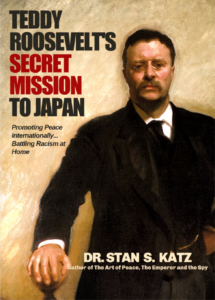
An Exciting Upcoming Biography: Teddy Roosevelt’s Secret Mission to Japan

January 31, 2021 by Stan S. Katz Leave a Comment


INTRODUCTION

The people we choose to honor, shape and inspire our future

Theodore Roosevelt (October 27, 1858 – January 6, 1919) a Man of and ahead of his Time.

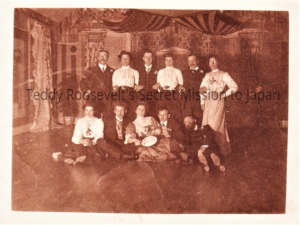
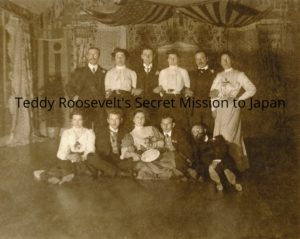
Launching the creation of this exciting biography was the surprising acquisition of a one-of-a-kind, antique group photo which appeared to include Theodore Roosevelt, taken during a secret visit to Japan in 1909. And if it was Theodore, why had he gone there? The U.S. and Japanese flags attached to the ceiling above the eleven individuals in the photo gave the impression of a diplomatic event. Once you’ve read this biography, you’ll likely agree that Theodore, accompanied by his wife, Edith, their daughter, Alice, and their son, Kermit, along with seven other companions did take part in this most covert operation in U.S. Presidential History.

The research on the below mysterious 1909 photo revealed important new insights about Theodore Roosevelt, both the man and the creative international negotiator – This story will entertain the general public & supply historians with fascinating material for further investigation.


This 1909 Photo was acquired while researching for the author’s historical novel, The Emperor and the Spy, and the illustrated biographies: The Art of Peace and The Art of Diplomacy. These books highlight US Japanese relations. The novel presents a high level U.S. intelligence agent, Colonel Sidney Mashbir (1891-1973), who during the 1920’s and ’30’s formed strong alliances with Japanese leaders, together striving to maintain goodwill between their nations. The biographies spotlight the inspiring Japanese statesmen, Prince Iyesato Tokugawa (1863-1940) and Baron Eiichi Shibusawa (1840-1931), who closely engaged with eight U.S. presidents and other world leaders in the pursuit of peace, democracy, and mutually beneficial business and cultural exchange. Theodore Roosevelt, along with his presidential successor, William Howard Taft, developed a personal friendship and political alliance with Tokugawa and Shibusawa during the first decades of the 20th Century. A largely untold story.

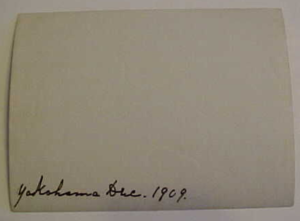
Illustrated above is the back of the mysterious group photo, with the words written in pen:

“Yokohama Dec. 1909.”

The photo measures 4.25″ x 3.25″

*It is worthy of note that in 1905, Alice Roosevelt and William Howard Taft (the then Secretary of War under T.R.), along with a large U.S. political entourage visited Japan and Asia in general. For unknown reasons, Alice required that most the photos of that journey not be shared with the general public until over a century later. When they were made available, they were utilized for an online Smithsonian Museum Exhibit titled: Alice in Asia: The 1905 Taft Mission to Asia. It appears that secrecy was required for T.R. to achieve his diplomatic goals with the Japan in 1909. And for that reason, they delayed sharing Alice’s 1905 photos with the public until the far distant future.

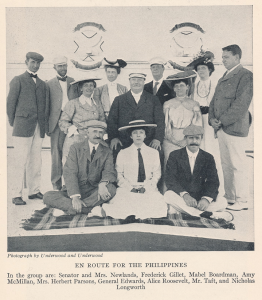
The below 1905 photo illustration is from Alice Roosevelt’s autobiography, Crowded Hours. It shows her and her shipmate companions – The Photo is included in the Smithsonian Museum Exhibit: Alice in Asia: The 1905 Taft Mission to Asia – It is an interesting coincidence that in the above 1909 Photo, Alice is seated cross-legged on the ground in front of her father, while in the below 1905 Photo, she is now seated cross-legged at the feet of William Howard Taft.


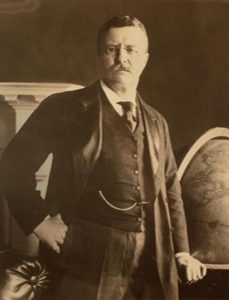
Known-photo-of-T.R.-circa-1908

Frequently referred to by his initials T.R. or Teddy Roosevelt, he is one of our most admired and even beloved presidents. Displayed below is circa 1908 Portrait photo of T.R. standing next to a World Globe. Besides being a national statesman, he wished to be recognized as a leader with a global perspective and international influence. Like most powerful presidential leaders, there were successes and controversies linked to his domestic policies and foreign engagements. These topics are explored, using hundreds of illustrations.

On a personal note: from an early age, I’ve had a deep appreciation for Theodore for various reasons, including his sheer determination to overcome his limitations as an unhealthy child, and instead live a robust, adventurous, and accomplished life.

T.R. served as the 26th president of the United States from 1901 to 1909. And before that from March to September 1901, he served under President William McKinley as the 25th vice president. Prior to those highest level national offices, T.R. also held the position as the 33rd governor of the influential State of New York from 1899 to 1900, emerging as a dominant political leader and a driving force for antitrust legislation supporting Progressive policies in the early 20th century. T.R. also wore the hat of a conservationist, naturalist, and writer. And he is respectfully depicted on Mount Rushmore, alongside George Washington, Thomas Jefferson, and Abraham Lincoln.

A great deal of new historical material was discovered that highlighted Theodore Roosevelt’s strong desire to improve the lives of Black Americans. T.R. strongly looked up to President Abraham Lincoln and his struggle to eliminate slavery. This biography highlights inspiring actions on the part of T.R. to improve Black / White race relations. Based on earlier writings and research linked to eliminating racism, the author of this biography was in 2023 nominated for the Dr. Martin Luther King Community Service Award, by the City of Oceanside, California and a Chapter of the NAACP.

T.R. looked out for the average citizen and wasn’t afraid to face off with powerful corporations in order to defend America’s natural environment. Accompanied by the naturalist, John Muir, they once embarked on a three-night camping trip exploring the most beautiful and pristine areas of Yosemite. This inspired Theodore to realize that many of America’s most beautiful areas needed protection – So he established the U.S. National Park Service which watches over this precious legacy. And during his 1909 Smithsonian Museum African Safari adventure, he used his influence to inspire the creation of the great game parks of East Africa that continue to this day.

Teddy Roosevelt’s Secret Mission to Japan

Like a Sherlock Holmes mystery, unravelling clues and finding hidden meanings, recognizing the collaborators in their 1909 mission to Japan, and those dangerous forces who stood in their way – Supporting the veracity of this extraordinary story are “Highly Top Secret” classified Japanese diplomatic letters recently unearthed from the National Archives of Japan from over a century ago. These 1908-1909 correspondences strategized how best to encourage T.R. to pay a friendly visit to Japan during his term in office or after his presidency, just as the dark storm clouds of  World War One were rapidly approaching.

It appears that it was towards the conclusion of his African Safari, and before embarking on his European Peace Tour that T.R. and members of his family and their companions secretly visited Japan. The recent impressive military victory of the Japanese over the Russians in the Russo-Japanese War of 1904-1905, added importance to the US and Japan maintaining good relations. T.R.’s leadership role in bringing that conflict to an end resulted in him receiving a Nobel Peace Prize in 1906 – So US / Japan relations was a topic very close to his heart.

The amazing search capabilities of the internet assisted in the retrieval of historical newspapers/magazines and in the acquisition of long forgotten personal and official primary source materials. Included in this biography is a 1908 photo of T.R. secretly accompanied by Andrew Carnegie, attending a Memorial Ceremony for Abraham Lincoln – Carnegie wished to meet with T.R. prior to T.R.’s departure on his African Safari Adventure and European Peace Mission, which Carnegie funded.

There is also a rare 1910 photo of T.R. being met by his much younger cousin, F.D.R., upon T.R.’s return from Africa and Europe.

Another fascinating photo only recently discovered presents the then former Presidents Theodore Roosevelt and William Howard Taft  in 1915, secretly attending a diplomatic banquet in N.Y.C. honoring the visit of  the Japanese statesmen, Baron Shibusawa. There was a pattern of secrecy when it came to U.S. / Japan political relations.

This biography highlights T.R.’s alliances with the world’s most influential international political leaders, the wealthiest individuals, as well as European and Japanese nobility. Strategic statecraft lessons are revealed in this fascinating story, providing significant perspectives on matters that continue to influence U.S. Asian relations to this day.


Color enhanced version of the original 1909 photo.


The book is Dedicated to these organizations

World Affairs Councils of America (WACA) – a national, non-profit, non-partisan, educational/political affairs association whose goal is international cooperation and understanding. The author is on the board of directors of the San Diego World Affairs Council, a local chapter. On a yearly basis, WACA and her many chapters across the U.S. organize exciting local and national high school competitions called Academic World Quest, where students display their knowledge of significant world events.

Rotary International promotes good-will projects in local communities and internationally. Their motto, “Service Above Self.”

Japan Society of New York City has a long history of supporting good relations between U.S. and Japan.

America-Japan Society headquartered in Tokyo, celebrated its 100th Year Anniversary in 2017. They promote peace and stability for Japan-U.S. relations, as well as for the world, encouraging educational and cultural exchange.

Shibusawa Eiichi Memorial Foundation and Museum located in Japan. Baron Shibusawa Eiichi and Prince Tokugawa Iesato were friends and allies with President Theodore Roosevelt and with other U.S. presidents in the promotion of goodwill between their nations.

National Association of Japan-America Societies (NAJAS), a private, non-profit, non-partisan organization that offers educational, cultural, and business programs about Japan and U.S./Japan relations. Located in 32 cities in the U.S., their mission to strengthen cooperation and understanding between Japan and the U.S.

*Appreciation is also given to other organizations promoting inter-racial goodwill within the U.S. and internationally.


TABLE OF CONTENTS

Chapter One                                                                          1

-Early Research to Identify the Individuals in the 1909 photo

-Overview of U.S. Japan relations mid-1800s thru early 1900s

-T.R. combats Racism against Japanese Americans


Chapter Two                                                                        31

-Economic Instability and an International Arms Race


Chapter Three                                                                     48

-Six of the Eleven Individuals in the Mystery Photo are identified

– T.R.’s exciting 1909-1910 Smithsonian African Expedition


Chapter Four                                                                      73

-Theories as to why Teddy Roosevelt might have Secretly Visited Japan in late 1909


Chapter Five                                                                       89

-Theodore Roosevelt Advances the Rights and Respect of Black Americans


Chapter Six                                                                       109

-Logistics as to how T.R. & his companions might have covertly travelled to Japan?

–The Cornelius Vanderbilt Family connection.                                                                                                                                                                                                                                      

Chapter Seven                                                                   127

-Andrew Carnegie and the Beginnings of an International Peace Movement, Supported by T.R. & influential Japanese statesmen.

–Was History Repeating Itself? Was T.R.’s 1909 visit to Japan with his family, similar to that of former President Grant, a half-century earlier?


Chapter Eight                                                                   146     

-‘Highly Classified Secrets’ at THE NATIONAL ARCHIVES OF JAPAN offers a potential key to the mysterious 1909 visit to Japan.                                                                                                                                                                                                                                   

Chapter Nine                                                                  172           

-T.R.’s fascinating 1909-1910 WORLD TOUR INCLUDES EGYPT AND EUROPE.                                                                                                                                                                                                                        

Chapter Ten                                                                    194     

-With WORLD WAR I closing in, a strong U.S. Japan Alliance was more Important than Ever.                                                                                                                                                                                                                                 

CLOSING REMARKS                                                        210

ACKNOWLEDGEMENT                                                   219

NOTES SECTION                                                              220

Additional Research Resources                                      265

Index                                                                                   267


Praise for Author’s Prior Books

The Emperor and the Spy historical novel

‘’I have learned a lot about Colonel Mashbir and his real friendship with Prince Tokugawa which was a pleasant surprise for me. Your stories about Japanese-American Military Intelligence Service have also done a great justice to so many unsung heroes.”  Kazuo Kodama, former Japanese Ambassador to the United Nations


“I realize how difficult it is to weave fact and fiction but you did a masterful job. I have often wondered about the closing of WW II and how Japan got its new system of governance.” J. L. Ruthenberg, Lieutenant Colonel, USMC, Retired


“A fascinating story . . . a fine book,”

Lisa Wolff, past Managing Editor of Simon & Shuster


BARNES & NOBLE chose this novel to honor Veterans Day Weekend with a Book signing at their Oceanside, California Store.


“Novelist brings spy out of the shadows. Looking forward to the movie.”

Pam Kragen, SAN DIEGO UNION TRIBUNE


“The Emperor and the Spy…I couldn’t put it down.”

Hilliard Harper, Retired Naval Reserve Commander and former Writer for the Los Angeles Times


“My mother is a history expert. She taught history to high schoolers. She read your book in a day over the weekend and is now rereading it. These are her comments: It’s a fun read, page turner, shows tremendous research, historical novels don’t get better than that, intelligently written book, informative, conversations enlightening, she learned a lot…In sum, she said this is an outstanding book. Congratulations!”

Dave Edick Jr., President of San Diego World Affairs Council & President of San Diego International Sister Cities Association


“The book is fast-paced yet thoroughly researched. I compare the depth and factual detail of Katz’s writing with those of Wilbur Smith and Dick Francis. You’ll appreciate the weaving of concurrent events, and the nuances only an expert in the field can convey. Like Frederick Forsyth’s books, the international intrigue with imminent national security threats keep one in suspense . . . Katz’s narrative subtly demonstrates the pivot points around which the arc of history may have been so very different… It’s deliciously epic.”

Rita Lim Wilby PhD., Rotarian and Chairman of Programming at San Diego World Affairs Council


“Thank you for having interest in Japanese History. Looking forward to your new book! [The biography of Prince Tokugawa]

Kenko Sone Director of Global Communications for Shinzō Abe Prime Minister of Japan


The Art of Peace & The Art of Diplomacy illustrated biographies

“The importance of preventing war is rarely given recognition through literature and in accounts of history.  It can be every bit as exciting as glorified accounts of war and certainly a better approach.” Professor Claire Langham, former President of the East-West Center of Southern California


“We look forward to adding The Art of Peace to the School’s library collection. Your goal to reach high school and college students with this information is an ambitious – but important – goal. Best wishes with your project.”

Suzette Heiman, Director of Planning and Communications Missouri School of Journalism at University of Missouri


“We appreciate your kindness and all the work you have done to promote understanding of Shibusawa Eiichi and US-Japan relations as a whole. I wish you all the best in your current and future endeavors. With gratitude,”  Toru Shigehara: Head Librarian/Information Resources Center, Shibusawa Eiichi Memorial Foundation and Museum located in Japan


Include your Contact info on TheEmperorAndTheSpy.com website to be notified when the Theodore Roosevelt Biography is published.

You’re also invited to Like the Facebook Author Page: https://www.facebook.com/TheEmperorAndTheSpy/


Filed Under: Tokugawa Archives Tagged With: Abraham Lincoln, Abraham Lincoln Birthplace Memorial, Alice in Asia The 1905 Taft Mission to Asia, Alice Longworth Roosevelt, Alice Roosevelt, Alice Roosevelt autobiography, Andrew Carnegie, Baron Eiichi Shibusawa, Baron Shibusawa, Colonel Theodore Roosevelt, Cornelius Vanderbilt, Crowded Hours, Edith Roosevelt, Eiichi Shibusawa, Emperor Meiji, Hilliard Harper, Iyesato Tokugawa, Kazuo Kodama, Kenko Sone Director of Global Communications, Kermit Roosevelt, Pam Kragen, President Taft, President Theodore Roosevelt, President William Howard Taft, Prince Iyesato Tokugawa, Professor Claire Langham, Secret Diplomacy, Secret Presidential missions, Shibusawa Eiichi Memorial Foundation and Museum, Smithsonian exhibit on Japan, Stan S. Katz, Stan S. Katz archives, Stan S. Katz blog, Taft and Japan, Teddy Roosevelt, Teddy Roosevelt's Secret Mission to Japan, The Art of Peace, The Art of Peace biography, The Emperor and the Spy, THE NATIONAL ARCHIVES OF JAPAN, Theodore Roosevelt, Theodore Roosevelt and Andrew Carnegie, Theodore Roosevelt and F.D.R., Theodore Roosevelt and Franklin Delano Roosevelt, U.S. Japan, U.S. Japan Diplomacy, U.S. Japan relations, Unknown History about Theodore Roosevelt, Unknown stories about Theodore Roosevelt, William Howard Taft

Copyright © 2026 Stan S. Katz