Stan. S. Katz

Author of The Emperor and the Spy

  • Home
  • Author
  • Books
  • Reviews
  • Educators
  • News
  • Audiobook & Timeline
  • Mashbir Archives
  • Tokugawa Archives
  • Contact
Follow Stan on FacebookFollow Stan on TwitterFollow Stan on GoodreadsFollow Stan on RSS

Sign Up for Future Blogs Linked to Colonel Mashbir and Japanese History

Read the Intro Posts

INTRODUCTION TO THE ART OF PEACE

WELCOME!

Recent Posts

  • San Diego Jewish Journal Holocaust Remembrance Edition May 2016 highlights the historical novel, The Emperor and the Spy and the outstanding achievements of Colonel Sidney Mashbir.
  • The Emperor and the Spy, was one of two books highlighted during academic/diplomatic event sponsored by the Prime Minister’s Office of Japan and hosted by San Diego World Affairs Council
  • Osher Lifelong Education Institute – UCSD Presentation. Remarkable story, the alliance between a patriotic U.S. Intelligence Agent, Colonel Sidney Mashbir, and a humanitarian Japanese International Statesman, Prince Iyesato Tokugawa, who heroically delayed and attempted to prevent WWII in the Pacific.
  • Tokugawa & Komatsu, Forgotten Heroes – Until his passing in 1940, Prince Iyesato Tokugawa held back WWII in the Pacific – Tokugawa’s diplomatic legacy lived on after WWII ended, when his protégé, Takashi Komatsu, guided the US and Japan to again become friends and allies.
  • Have you ever wondered how US and Japan re-established their friendship and alliance following the trauma of WWII? Here’s a new biography that honors an amazing Japanese American statesman, Takashi Komatsu, who guided this major achievement.

Archives

President Theodore Roosevelt and Prince Iyesato Tokugawa worked together to improve U.S. Japan relations and combat anti-Asian Racism in America.

November 1, 2019 by Stan S. Katz Leave a Comment

The early 1900s were at times challenging in terms of U.S. Japan engagement:

This October 23rd, 1907 Puck magazine cover shows President Theodore Roosevelt defending the nation of Japan from attack. Roosevelt is wearing a military uniform with the Japanese Imperial seal on his hat. He holds a rifle and confronts two rolled-up U.S. newspapers labeled the ‘Sun‘ and ‘World‘ who are also holding rifles and confronting Roosevelt – The background shows the flag of the Japanese Imperial Army.
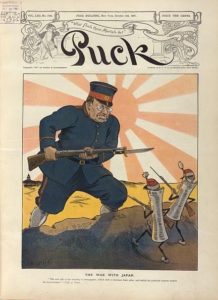
In the magazine caption, Roosevelt stated that the war talk predicting a future conflict between the U.S. and Japan was based entirely on these incendiary newspapers, which sought to increase their sales, and for that reason, these newspapers had attacked Roosevelt’s representative Minister William Howard Taft, who Roosevelt had again sent to Tokyo to promote improved communications between their two nations. Roosevelt felt things were actually going well diplomatically between the U.S. and Japan and he appreciated the growing friendship between them. However, these news publications were instigating conflict by stating there was an aggressive competition as to which nation would be most powerful in the Pacific. These U.S. newspapers and others promoted a racist/anti-Asian agenda, which negatively influenced American public opinion. Roosevelt felt that relations between the U.S. and Japan were good and were even strengthening based on the interaction of representatives to one another’s nations.

During the early 1900s, President Theodore Roosevelt twice sent his Minister Taft to visit Japan accompanied by a delegation of U.S. congressmen. Taft and his delegation were received and honored at diplomatic events thrown by Prince Tokugawa and Baron Shibusawa, and supported by many other distinguished Japanese representatives. During his goodwill visit to Japan in 1905, the future President Taft was accompanied by President Theodore Roosevelt’s oldest daughter Alice. Taft and Alice were treated graciously during their time in Japan, and even met with the Japanese Emperor Meiji. 


Seeing the heated racism in the U.S. against Asians living there, Prince Tokugawa took a stand in his own nation against this narrow minded and cruel approach to treating one another. To combat racism, Prince Tokugawa during the 1920’s established Essay Writing Contests in all Japanese public schools and public universities, where students expressed in their own words what Abraham Lincoln’s noble principles of human equality stood for.
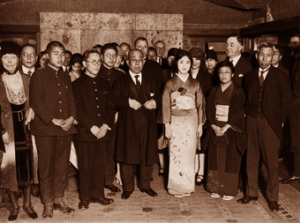
This photo highlights a February 19, 1929 Award presentation to the winners of the Third Lincoln Essay Contest which was held at the Imperial Hotel, Tokyo.
Prince Iyesato Tokugawa was the President of the America-Japan Society which sponsored the event.

In photo: Prince Tokugawa (front center) and Count Aisuke Kabayama (at far right). This photo is courtesy of the America-Japan Society: this fine organization located in Japan, was founded in 1917 and continues to this day to promote amity and mutual understanding between the Japanese and American people. Prince Tokugawa was its 2nd president from 1924 until his passing in 1940.

To learn more, here is the internet link to the America-Japan Society:    http://ajstokyo.org/en-home/


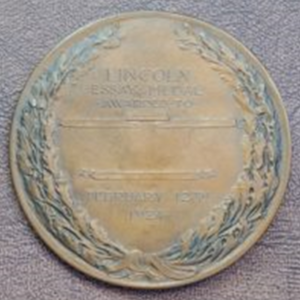
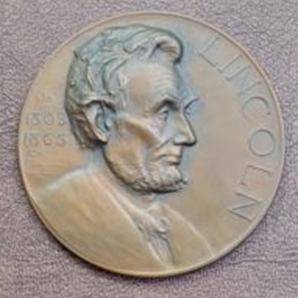
The winners of these essay contests were awarded an impressive Abraham Lincoln Commemorative Coin in recognition of their accomplishment.

Presented below is the front and back of one such commemorative award, which was 3 inches in diameter. This commemorative medallion included a velvet lined presentation case to display the award. 


Hope you enjoyed your visit.

You’re invited to Sign up for future blog posts & Please consider sharing this post with your friends who appreciate history.


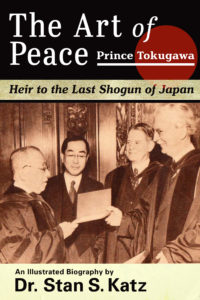
Through narrative and hundreds of illustrations, THE ART OF PEACE  presents a new historical perspective on U.S. Japan relations.


AVAILABLE THRU AMAZON:
General Reader Edition

Expanded Edition

Filed Under: Tokugawa Archives Tagged With: Abraham Lincoln, Aisuke Kabayama, America-Japan Society, Anti-Asian Racism, Diplomacy of Peace, Historical biography, History of Racism, Honoring Abraham Lincoln, Horizon Productions, Imperial Hotel, Japan U.S. Relations, Lincoln Essay Contest, Lincoln Essay Contests, President Lincoln, President Roosevelt, President Theodore Roosevelt, Prince Iyesato Tokugawa, Prince Tokugawa Iesato, Prince Tokugawa Iesato Archives, Puck Magazine, Stan S. Katz, Stan S. Katz blog, The Art of Peace, The Art of Peace biography, TheEmperorAndTheSpy.com, Theodore Roosevelt, U.S. Japan relations, US Japa, US Japan relations, William Howard Taft, Yellow Peril

Dec. 23, 1929 – J. Edgar Hoover oversees the protection detail for the visiting Japanese Naval Delegation in Washington, D.C. – U.S. Secretary of State Stimson and the Japanese Ambassador Debuchi greet the visitors and escort them to the White House to meet with President Hoover

July 8, 2019 by Stan S. Katz Leave a Comment

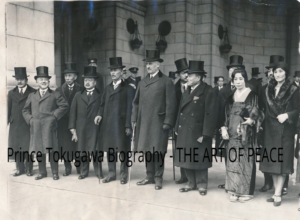
Dec. 23, 1929 – A rare photo of J. Edgar Hoover as he oversees the protection detail for the visiting Japanese Naval Delegation in Washington, D.C. The Japanese delegation were were on their way to attend negotiations in Europe for the ratification of the 1930 London Naval Treaty (officially the Treaty for the Limitation and Reduction of Naval Armament). The delegation was greeted at the Washington Union (Train) Station by U.S. Secretary of State Henry L. Stimson and the Japanese Ambassador Katsuji Debuchi; the delegation then visited the White House to meet with President Herbert Hoover.


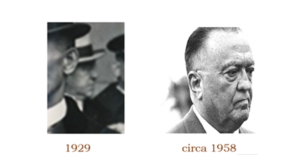
December 23, 1929 – This photo offers rare candid view of J. Edgar Hoover, who is wearing the straw hat in the background and standing near a policeman. This photo is a sectional view of the larger group photo. This sectional view allowed the enlargement necessary to clearly view J. Edgar Hoover. This photo presents a unique glimpse of Hoover during a Bureau of Investigation (prior name of the FBI) field operation, when he wasn’t posing for the camera.

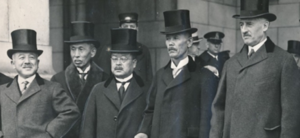
This photo highlights the arriving Japanese Naval Delegation in Washington, D.C., prior to the delegation being received by President Herbert Hoover at the White House. We see U. S. Secretary of State Henry L. Stimson (1867 – 1950) at the far right, with Japanese Ambassador to the U.S. Katsuji Debuchi  at the far left. They are greeting the arriving Japanese Naval Delegation at the Washington Union (Train) Station. The delegation was passing thru the U.S. on their way to Europe for the negotiations that would ratify the 1930 London Naval Arms (limitation) Conference. The 1930 The London Naval Treaty (officially the Treaty for the Limitation and Reduction of Naval Armament) was an agreement between Great Britain, Japan, France, Italy and the United States, signed on 22 April 1930. Seeking to address a loophole in the formidable 1922 Washington Naval Treaty (that created tonnage limits for each nation’s surface warships), it regulated submarine warfare and limited naval shipbuilding. Ratifications were exchanged in London on 27 October 1930, and the treaty went into effect on the same day.

One of the significant benefits of this treaty, beyond attempting to maintain peace, was that the Great Depression had just begun in late 1929, and the treaty encouraged less funds be spent in an international Arms Race, when that money could better be used for urgently needed social support programs during the economic downturn.


Above is the larger version of the December 23, 1929 photo as the Japanese Naval Delegation arrive in Washington, D.C., on their way to the 1930 London Naval Conference.

Front row, Left to right: Admiral Seizō Sakonji; Japanese Ambassador Katsuji Debuchi; , T. Kawasaki, Reijiro Wakatsuki chief of delegates; U.S. Secretary of State Stimson: Hirosi Saito, Madame Takarabe, and Madame Debuchi. Back row right side: Takeshi Takarabe, assistant chief delegate (wearing glasses and standing behind his wife).


The individual in the background wearing a straw hat, adjacent to the policeman is J. Edgar Hoover (see below photo enlargements):


John Edgar Hoover (January 1, 1895 – May 2, 1972) was the first Director of the Federal Bureau of Investigation (FBI) of the United States and an American law enforcement administrator. He was first appointed as the director of the Bureau of Investigation – the FBI’s predecessor – in 1924 and was instrumental in founding the FBI in 1935, where he remained director for another 37 years until his death in 1972 at the age of 77.

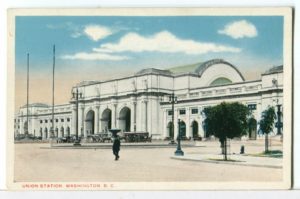
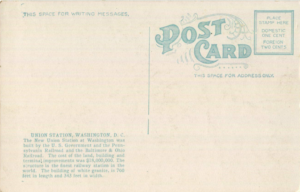
The Dec. 23, 1929 group photo was taken in front of the south main entrance to the Washington Union Station. Below is a circa 1929 postcard of the train station. The descriptive reverse side of the postcard is also displayed below:


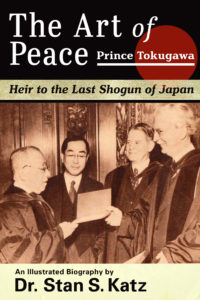
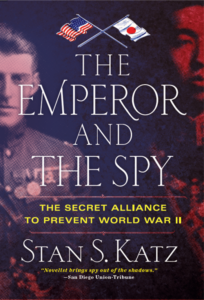
It was a surprising discovery noticing that J. Edgar Hoover appeared in the Dec. 23rd, 1929 photo. The photo was acquired while doing research for the historical novel The Emperor and the Spy: The Secret Alliance to Prevent WWII, and the illustrated biography The Art of Peace by Stan S. Katz.

The Emperor and the Spy focuses on the life of a high level U.S. intelligence agent Colonel Sidney Mashbir who befriended and allied with Japanese leaders, including members of the Japanese royal family during the 1920s and 1930s, in a valiant attempt to maintain goodwill between their nations.

The Art of Peace biography is in many ways a nonfictional sequel to the novel and highlights the pivotal behind the scenes events in U.S. Japan relations during the first half of the twentieth century. The book highlights one of Colonel Mashbir’s closest and most influential Japanese allies Prince Iyesato Tokugawa (1863-1940).

For further information visit the website TheEmperorAndTheSpy.com


Link to the Introduction of THE ART OF PEACE


Link to Introduction for THE EMPEROR AND THE SPY


Filed Under: Tokugawa Archives Tagged With: 1915 U.S. Japan relations, 1930 London Naval Treaty, Admiral Seizō Sakonji, Aisuke Kabayama, Ambassador Katsuji Debuchi, Count Aisuke Kabayama, F.B.I., Federal Bureau of Investigation, Henry L. Stimson, Herbert Hoover, Hirosi Saito, J. Edgar Hoover, Japanese Ambassador Katsuji Debuchi, Katsuji Debuchi, London Naval Treaty, Madame Debuchi, Madame Takarabe, President Herbert Hoover, President Hoover, Prince Iyesato Tokugawa, Prince Tokugawa Iesato, Reijiro Wakatsuki, Secretary of State Henry L. Stimson, Seizō Sakonji, Stan S. Katz, Stan S. Katz blog, T. Kawasaki, Takeshi Takarabe, The Art of Peace, The Art of Peace biography, The Emperor and the Spy, TheEmperorAndTheSpy.com, Tokugawa Iesato, U.S. Japan Diplomacy, U.S. Secretary of State Henry L. Stimson

Copyright © 2026 Stan S. Katz