Stan. S. Katz

Author of The Emperor and the Spy

  • Home
  • Author
  • Books
  • Reviews
  • Educators
  • News
  • Audiobook & Timeline
  • Mashbir Archives
  • Tokugawa Archives
  • Contact
Follow Stan on FacebookFollow Stan on TwitterFollow Stan on GoodreadsFollow Stan on RSS

Sign Up for Future Blogs Linked to Colonel Mashbir and Japanese History

Read the Intro Posts

INTRODUCTION TO THE ART OF PEACE

WELCOME!

Recent Posts

  • San Diego Jewish Journal Holocaust Remembrance Edition May 2016 highlights the historical novel, The Emperor and the Spy and the outstanding achievements of Colonel Sidney Mashbir.
  • The Emperor and the Spy, was one of two books highlighted during academic/diplomatic event sponsored by the Prime Minister’s Office of Japan and hosted by San Diego World Affairs Council
  • Osher Lifelong Education Institute – UCSD Presentation. Remarkable story, the alliance between a patriotic U.S. Intelligence Agent, Colonel Sidney Mashbir, and a humanitarian Japanese International Statesman, Prince Iyesato Tokugawa, who heroically delayed and attempted to prevent WWII in the Pacific.
  • Tokugawa & Komatsu, Forgotten Heroes – Until his passing in 1940, Prince Iyesato Tokugawa held back WWII in the Pacific – Tokugawa’s diplomatic legacy lived on after WWII ended, when his protégé, Takashi Komatsu, guided the US and Japan to again become friends and allies.
  • Have you ever wondered how US and Japan re-established their friendship and alliance following the trauma of WWII? Here’s a new biography that honors an amazing Japanese American statesman, Takashi Komatsu, who guided this major achievement.

Archives

Friendship & Alliance between Presidents Theodore Roosevelt & William Howard Taft with the Japanese leaders Baron Shibusawa & Prince Tokugawa and a Tour of the Japanese Friendship Garden San Diego

December 9, 2019 by Stan S. Katz 1 Comment

The Spirit of International Goodwill 
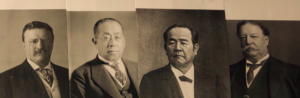


President Roosevelt – Prince Tokugawa – Baron Shibusawa – President Taft

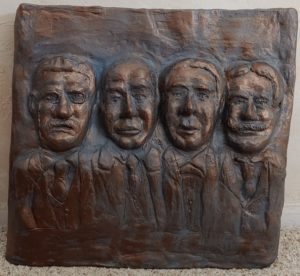
During the first decades of the 1900s, these four accomplished statesmen allied together to promote amity between their nations.

This relief sculpture has been accented with metallic paint to look like a bronze – If the Japanese Friendship Garden in Balboa Park, San Diego welcomes this gift, it will be cast in bronze and be presented as a token of goodwill from the San Diego World Affairs Council (a chapter of the World Affairs Councils of America) and perhaps also from the San Diego Diplomacy Council & the East West Center – Fine organizations that support international cooperation for a more peaceful and democratic world.

TheEmperorAndTheSpy.com website presents additional blog posts revealing the strong alliance between them.

The inspiration for this sculpture arose while the author of this blog was researching for the biography The Art of Peace, which highlights the friendship and political alliance between these four leaders. It includes hundreds of illustrations, including many rare photos, offering a new perspective on U.S. Japan relations during the first half of the twentieth century, and illustrates that nations come together thru their mutual appreciation of one another’s arts and culture – To further enhance the friendship between the U.S. and Japan today a gift of a bronze sculpture was created by the author of this article to honor these four fine diplomats, who worked shoulder to shoulder in the pursuit of peace.

Below is the clay version of the sculpture
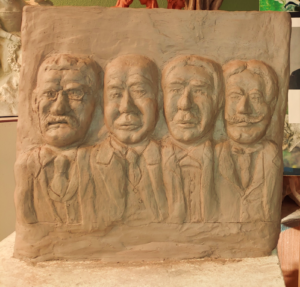
President Theodore Roosevelt (1858 – 1919) 

In office as president from September 14, 1901 – March 4, 1909.

Received the Nobel Peace Prize in 1906 for guiding the arbitration that ended the Russo-Japanese War of 1904-1905.  


Prince Tokugawa Iesato aka Prince Iyesato Tokugawa (1863-1940)         

President of Japan’s upper house of congress The House of Peers for thirty years from 1903-1933. He was also the President of the Japanese Red Cross Society and headed many other significant Japanese organizations. Prince Tokugawa took a pivotal guiding role in both the Japanese gifting of the Cherry Blossom Trees to Washington, D.C. in 1912 and in this gesture of international goodwill becoming the official National Cherry Blossom Festival beginning in 1935, an event celebrated annually by hundreds of thousands of U.S. citizens and visitors from around the world. 


Baron Shibusawa Eiichi aka Baron Eiichi Shibusawa (1840-1931)     

Known as the ‘Father of Japan’s modern economic system,‘ Shibusawa helped launch hundreds of business ventures as well as social service organizations, including universities, hospitals, social welfare and international relations/relief organizations. 

Baron Shibusawa was twice nominated for a Nobel Peace Prize for the years 1926 and 1927.


President William Howard Taft (1857 – 1930)

In office as president March 4, 1909 – March 4, 1913

President Taft and his wife First Lady Helen Herron Taft were the official U.S. recipients the Japanese Gift of Cherry Blossom Trees in 1912. 

Eight years after his presidency, Taft became the first U.S. President to later become the Chief Justice of the United States Supreme Court from July 11, 1921 – February 3, 1930.


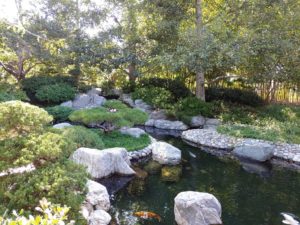
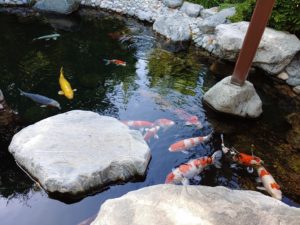
You are now invited to take a brief tour of the beautiful Japanese Friendship Garden.

 

Here is the link to the Japanese Friendship Garden Official Website: http://www.niwa.org/

Their mission statement: to develop a traditional Japanese garden as a center to educate, engage, and inspire people of diverse backgrounds about Japanese culture and community legacy.
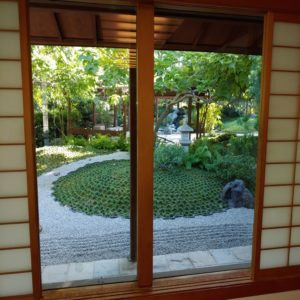
 

An outside view from inside of one of the tranquil buildings in the garden.

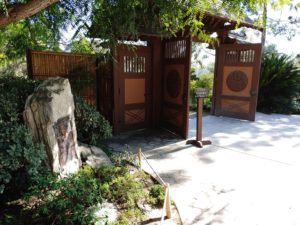
Photos taken by the author of this blog on August 2019
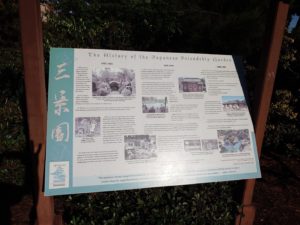


Near the entrance to the Japanese Friendship Garden is a presentation board displaying the history of this beautiful place, whose roots go back to the 1915-1916 Pan-American Exposition, where there was a popular Japanese Teahouse that was enjoyed by many visitors. Over the following century, the hospitality theme of that teahouse has evolved into the current Japanese Friendship Garden. Much of the impressive architecture that today comprises the expansive Balboa Park in San Diego, were part of that exposition.
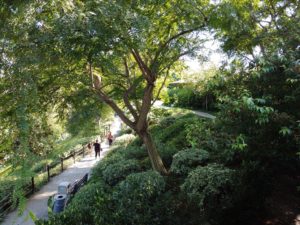
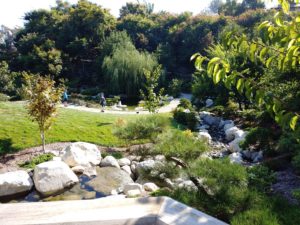


Charles C. Dail Memorial Gate (above)

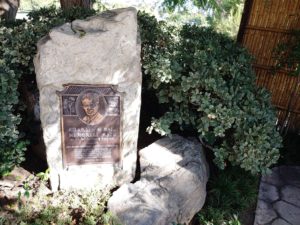
Close-up view (below) of the Bronze plaque near the gate honoring Charles C. Dail, who was the Mayor of San Diego from 1953-1963 and the Founder of the San Diego – Yokohama Sister Cities Program.
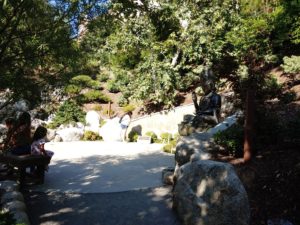


Above: in the distance, a mother reads a statue’s dedication plaque, while her daughter (seated to the left) appreciatively looks at the lovely Buddhist statue in the shadows, which is called ‘The Goddess of Mercy and Compassion’ – To learn more about this sculpture from the 1700s, the dedication plaque describes its fascinating history.


Hope you enjoyed your visit to the Japanese Friendship Garden. 
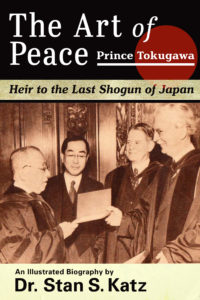


THE ART OF PEACE book cover presents Prince Tokugawa receiving an Honorary Doctor of Laws Degree from the University of Southern California. The president of the university Dr. Rufus B. von Kleinsmid hands the degree to Prince Tokugawa on March 19th, 1934. This presentation took place during a special luncheon given in Los Angeles, hosted by George I. Cochran, the president of USC’s Board of Trustees. Prince Iyesato Tokugawa was accompanied by his son Iyemasa, the newly appointed Minister to Canada.

Left to right in photo: Prince Iyesato Tokugawa; Iyemasa Tokugawa; George I. Cochran; Dr. Rufus B. von Kleinsmid.

In accepting the honor, Tokugawa respectfully said,

“He wished to receive it in the name of the Japanese people as a whole rather than as a personal distinction.”

During Prince Tokugawa’s 1934 visit to Los Angeles, The Los Angeles Times stated that a banquet dinner in his honor was hosted by the Japan America Society of Los Angeles. The Japan America Society of Los Angeles is now known as the Japan America Society of Southern California, its goal

“Building Japan-America Relationships Since 1909“

In 1909, during the first year of The Japan America Society of Los Angeles, they had also welcomed and hosted Baron Eiichi Shibusawa and fifty members of his goodwill/trade delegation.


THE ART OF PEACE biography highlights U.S. – Japan relations during the first half of the twentieth century.

The friendship and alliance between Prince Tokugawa, Baron Shibusawa and President Roosevelt and President Taft is presented as part of this history.

EBook Available thru Amazon in two Versions:

Expanded Edition


The General Reader Edition of PRINCE TOKUGAWA’S BIOGRAPHY IS TITLED:

THE ART OF DIPLOMACY
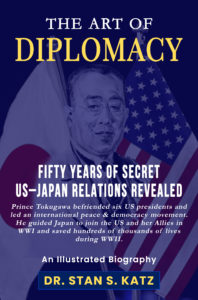


AVAILABLE IN PRINT AND KINDLE EBOOK


Filed Under: Tokugawa Archives Tagged With: Ambassador Katsuji Debuchi, Balboa Park, Baron Eiichi Shibusawa, Baron Shibusawa, Baron Shibusawa Eiichi, Chinese History, Colonel Mashbir, Colonel Mashbir Archives, Colonel Sidney Mashbir, Diplomacy, Eiichi Shibusawa, General Douglas MacArthur, Gift for Japanese Friendship Garden, Gift of Sculpture, Historical biography, History of Japanese Friendship Garden, History of the Cherry Blossom Festival in Washington D.C., History of the National Cherry Blossom Festival, History of USC, Holocaust, International Friendship, International Relations, Iyemasa Tokugawa, Japan China relations, Japan History, Japan U.S. Relations, Japanese Friendship Garden, Japanese Friendship Garden in Balboa Park, President Theodore Roosevelt, Prince Iyesato Tokugawa, Prince Tokugawa, Prince Tokugawa Archives, Prince Tokugawa Iesato, Prince Tokugawa Iesato Archives, San Diego, Shibusawa Eiichi, Stan S. Katz, Stan S. Katz blog, The Art of Peace, The Art of Peace biography, TheEmperorAndTheSpy.com, Theodore Roosevelt, U.S. Japan relations, U.S.-Japan History, US Japan relations, William Howard Taft, World War One, World War Two

President Theodore Roosevelt and Prince Iyesato Tokugawa worked together to improve U.S. Japan relations and combat anti-Asian Racism in America.

November 1, 2019 by Stan S. Katz Leave a Comment

The early 1900s were at times challenging in terms of U.S. Japan engagement:

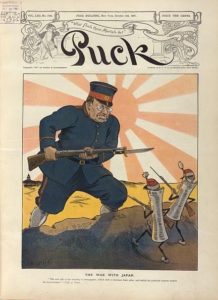
This October 23rd, 1907 Puck magazine cover shows President Theodore Roosevelt defending the nation of Japan from attack. Roosevelt is wearing a military uniform with the Japanese Imperial seal on his hat. He holds a rifle and confronts two rolled-up U.S. newspapers labeled the ‘Sun‘ and ‘World‘ who are also holding rifles and confronting Roosevelt – The background shows the flag of the Japanese Imperial Army.

In the magazine caption, Roosevelt stated that the war talk predicting a future conflict between the U.S. and Japan was based entirely on these incendiary newspapers, which sought to increase their sales, and for that reason, these newspapers had attacked Roosevelt’s representative Minister William Howard Taft, who Roosevelt had again sent to Tokyo to promote improved communications between their two nations. Roosevelt felt things were actually going well diplomatically between the U.S. and Japan and he appreciated the growing friendship between them. However, these news publications were instigating conflict by stating there was an aggressive competition as to which nation would be most powerful in the Pacific. These U.S. newspapers and others promoted a racist/anti-Asian agenda, which negatively influenced American public opinion. Roosevelt felt that relations between the U.S. and Japan were good and were even strengthening based on the interaction of representatives to one another’s nations.

During the early 1900s, President Theodore Roosevelt twice sent his Minister Taft to visit Japan accompanied by a delegation of U.S. congressmen. Taft and his delegation were received and honored at diplomatic events thrown by Prince Tokugawa and Baron Shibusawa, and supported by many other distinguished Japanese representatives. During his goodwill visit to Japan in 1905, the future President Taft was accompanied by President Theodore Roosevelt’s oldest daughter Alice. Taft and Alice were treated graciously during their time in Japan, and even met with the Japanese Emperor Meiji. 


Seeing the heated racism in the U.S. against Asians living there, Prince Tokugawa took a stand in his own nation against this narrow minded and cruel approach to treating one another. To combat racism, Prince Tokugawa during the 1920’s established Essay Writing Contests in all Japanese public schools and public universities, where students expressed in their own words what Abraham Lincoln’s noble principles of human equality stood for.

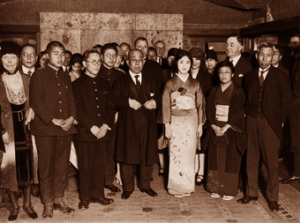
This photo highlights a February 19, 1929 Award presentation to the winners of the Third Lincoln Essay Contest which was held at the Imperial Hotel, Tokyo.
Prince Iyesato Tokugawa was the President of the America-Japan Society which sponsored the event.

In photo: Prince Tokugawa (front center) and Count Aisuke Kabayama (at far right). This photo is courtesy of the America-Japan Society: this fine organization located in Japan, was founded in 1917 and continues to this day to promote amity and mutual understanding between the Japanese and American people. Prince Tokugawa was its 2nd president from 1924 until his passing in 1940.

To learn more, here is the internet link to the America-Japan Society:    http://ajstokyo.org/en-home/


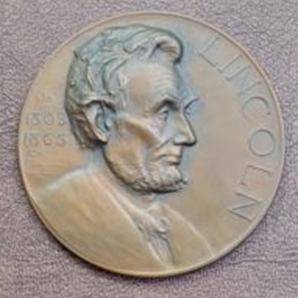
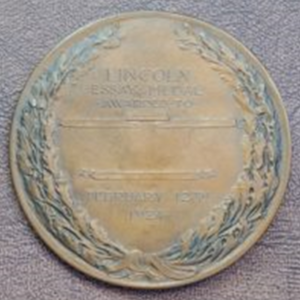
The winners of these essay contests were awarded an impressive Abraham Lincoln Commemorative Coin in recognition of their accomplishment.

Presented below is the front and back of one such commemorative award, which was 3 inches in diameter. This commemorative medallion included a velvet lined presentation case to display the award. 


Hope you enjoyed your visit.

You’re invited to Sign up for future blog posts & Please consider sharing this post with your friends who appreciate history.


Through narrative and hundreds of illustrations, THE ART OF PEACE  presents a new historical perspective on U.S. Japan relations.


AVAILABLE THRU AMAZON:

General Reader Edition

Expanded Edition

Filed Under: Tokugawa Archives Tagged With: Abraham Lincoln, Aisuke Kabayama, America-Japan Society, Anti-Asian Racism, Diplomacy of Peace, Historical biography, History of Racism, Honoring Abraham Lincoln, Horizon Productions, Imperial Hotel, Japan U.S. Relations, Lincoln Essay Contest, Lincoln Essay Contests, President Lincoln, President Roosevelt, President Theodore Roosevelt, Prince Iyesato Tokugawa, Prince Tokugawa Iesato, Prince Tokugawa Iesato Archives, Puck Magazine, Stan S. Katz, Stan S. Katz blog, The Art of Peace, The Art of Peace biography, TheEmperorAndTheSpy.com, Theodore Roosevelt, U.S. Japan relations, US Japa, US Japan relations, William Howard Taft, Yellow Peril

  • « Previous Page
  • 1
  • 2

Copyright © 2026 Stan S. Katz