Stan. S. Katz

Author of The Emperor and the Spy

  • Home
  • Author
  • Books
  • Reviews
  • Educators
  • News
  • Audiobook & Timeline
  • Mashbir Archives
  • Tokugawa Archives
  • Contact
Follow Stan on FacebookFollow Stan on TwitterFollow Stan on GoodreadsFollow Stan on RSS

Sign Up for Future Blogs Linked to Colonel Mashbir and Japanese History

Read the Intro Posts

INTRODUCTION TO THE ART OF PEACE

WELCOME!

Recent Posts

  • San Diego Jewish Journal Holocaust Remembrance Edition May 2016 highlights the historical novel, The Emperor and the Spy and the outstanding achievements of Colonel Sidney Mashbir.
  • The Emperor and the Spy, was one of two books highlighted during academic/diplomatic event sponsored by the Prime Minister’s Office of Japan and hosted by San Diego World Affairs Council
  • Osher Lifelong Education Institute – UCSD Presentation. Remarkable story, the alliance between a patriotic U.S. Intelligence Agent, Colonel Sidney Mashbir, and a humanitarian Japanese International Statesman, Prince Iyesato Tokugawa, who heroically delayed and attempted to prevent WWII in the Pacific.
  • Tokugawa & Komatsu, Forgotten Heroes – Until his passing in 1940, Prince Iyesato Tokugawa held back WWII in the Pacific – Tokugawa’s diplomatic legacy lived on after WWII ended, when his protégé, Takashi Komatsu, guided the US and Japan to again become friends and allies.
  • Have you ever wondered how US and Japan re-established their friendship and alliance following the trauma of WWII? Here’s a new biography that honors an amazing Japanese American statesman, Takashi Komatsu, who guided this major achievement.

Archives

Tokugawa & Komatsu, Forgotten Heroes – Until his passing in 1940, Prince Iyesato Tokugawa held back WWII in the Pacific – Tokugawa’s diplomatic legacy lived on after WWII ended, when his protégé, Takashi Komatsu, guided the US and Japan to again become friends and allies.

November 12, 2024 by Stan S. Katz Leave a Comment

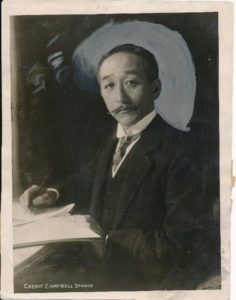
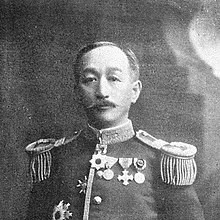
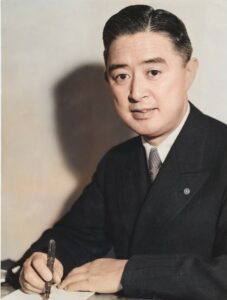
                             Prince Iyesato Tokugawa (1863-1940)      Takashi Komatsu (1887-1965)

Prince Tokugawa was the Heir to the last Shogun, a dynasty that had ruled Japan for 260 years. He served as President of Japan’s Upper House of Congress, was President of the Japanese Medical Association. And held many other leadership positions, shaping international and domestic policies of Japan. Based on his humanitarian accomplishments, US newspapers called him The Prince of Peace. It was only after his passing in 1940, that Japan was pressured by militants to enter WWII against the Allies.

Announcing an important new biographical work released in late 2024:

The Cherry Blossom Weeps for Me:  A Quest for the Dawn of Peace, by James Mikel Wilson.

This illustrated biography highlights the untold story of how Prince Tokugawa’s outstanding legacy lived on through his impressive protégé, the Japanese American statesman, Takashi Komatsu. Komatsu relit the torch of friendship and alliance between the US and Japan following WWII. Working with influential American leaders such as General MacArthur, John D. Rockefeller III, and Secretary of State Henry Kissinger, as well as many others.

Print and Kindle Edition


When the author, James Mikel Wilson, first contacted me several years ago, it was a pleasant surprise. Wilson had read the The Emperor and the Spy, I’d written and was familiar with the illustrated Prince Tokugawa biographies that followed: The Art of Peace and The Art of Diplomacy. Those biographies described Komatsu during the years proceeding WWII. However, Wilson felt Komatsu deserved a biography to reveal how significant Komatsu was during the decades following WWII in re-kindling the strong friendship and alliance between the US and Japan.

“The Cherry Tree Weeps For Me” gives an intimate view of US / Japanese relations during the first 70 years of the 20th Century, beginning the journey through the eyes of twelve old, Komatsu. Who immigrated alone to America to seek his fortune. He would become a vital bridge between the East and West, meeting with Prime Ministers, Generals, US Presidents, and Secretaries of State. While maintaining his integrity and humility. This biography is also a testimonial to Monmouth University in Illinois, which Takashi Komatsu and the James Wilson attended. The book highlights many other alumni from that fine learning institution who took heroic and humanitarian roles linked to international relations – You’ll likely find yourself becoming a friend of Takashi Komatsu, seeing his life devoted to the highest values of humanity: joy, peace, love, and mutual respect.

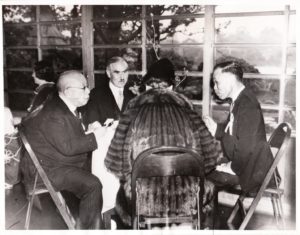
Circa 1935: Takashi Komatsu takes the place for Prince Tokugawa, who was unable to attend the above diplomatic event. Source: America-Japan Society Press Photo [color enhanced].

Below is a description from the back of the above Photo.

American “Embassy Day” held in Tokyo to Honor New American Consul General and Secretaries. Takashi Komatsu, pinch-hitting for Prince Tokugawa as toastmaster at a recent luncheon of the America-Japan Society held in the Imperial Hotel. This event honored the Consul General and Mrs. George A. Makinson (of San Francisco), first Secretary of the Embassy and Mrs. Stuart E. Grummon (of Newark, N.J.), and Second Secretary and Mrs. W.T. Turner (from Emory, Georgia). Mr. Komatsu [standing], and to his right: Mrs. Makinson (with fur), Mr. Grummon and Mrs. Turner: and to his left: Mrs. Grummon and Consul General Makinson (baldish).

Mr. John L. Curtis, Far Eastern manager of the National City Bank of New York, said he was glad to return to Tokyo, his second home, after a summer in New England. Non-Embassy guests present included Mr. John Moorris, chief of the Far East bureau of the United Press, from Shanghai: Mr. Archibald T. Steele, of the Far East Bureau of the Chicago Daily News; and Captain Maxwell representing the Chicago Tribune, en route from the United States to Berlin via Siberia.


In many ways, The Cherry Tree Weeps for Me, is a sequel to the below books.


Mashbir was a brilliant US intelligence agent. During the 1920 and ‘30s, he allied with Prince Tokugawa, promoting amity between their nations. It was only after Tokugawa’s passing that militants pushed Japan into war. 
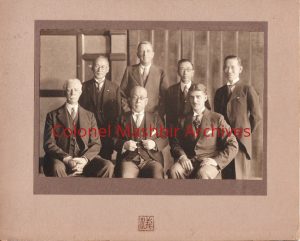
April, 1937: Imperial Hotel, Tokyo, following a Pan Pacific Club luncheon hosted by Prince Iyesato Tokugawa to honor Colonel Sidney Mashbir’s return visit to Japan. Tokugawa is seated adjacent to his American friend and ally, Mashbir. Accompanying them are several of Tokugawa’s other Japanese and American advisers. There was a rising militant movement in Japan and Mashbir was on a dangerous undercover mission. During Mashbir’s visit, Tokugawa heroically placed his own life in danger by sharing top secret intelligence information with Mashbir to bring back to the U.S. that might have preserved peace between their nations. However, their efforts were undermined. The novel The Emperor and the Spy highlights this untold story.

  • Despite their best efforts, WWII could not be stopped….Colonel Mashbir was then recruited by General Douglas MacArthur to command a top-secret intelligence organization ATIS (Allied Translator and Interpreter Section). ATIS grew to almost 5,000 members, and significantly shaped the successful Allied battle strategy in the Pacific, dramatically shortening the war. ATIS was mainly composed of thousands of first generation Japanese Americans (Nisei) who patriotically volunteered to serve under Mashbir’s command, translating and interpreting strategic military documents coming in from the Pacific battlefields. While also interrogating Japanese prisoners of war. And many also heroically went into the battlefield to serve at the front lines. Based on their major contributions, Colonel Mashbir felt the injustice of Presidential Executive Order 9066 that resulted in the illegal imprisonment of  loyal Japanese. Approximately 112,000 persons were sent  to “relocation centers” that would be their home for the duration of the war. Nearly 70,000 of the evacuees were American citizens. There were no charges of disloyalty against any of these citizens. Nor was there any means they could appeal their loss of property and personal liberty. 
  • Colonel Mashbir swore that once the war was over, he would devote himself to letting the world know of the major contributions made by patriotic Japanese Americans who had served under his command in ATIS.
  • Colonel Mashbir took a major role in ending WWII and orchestrated the Japanese Surrender Signing Ceremony. Thereby avoiding a major destructive battle on mainland Japan.
  • Mashbir arranged for General MacArthur and Emperor Hirohito to meet, to plan the rebuilding of Japan and the rekindling of US / Japan friendship. Mashbir served as the translator and facilitator.


 Back cover: The Emperor and the Spy

Published 2015, 2017, 2019

Available in Print, Kindle, and Audiobook


Here are biographies that highlight the fascinating life of Prince Iyesato Tokugawa.

  Published 2019

KINDLE EDITION

DESCRIPTION OF BOOK COVER PHOTO:

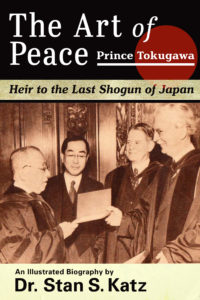
When WWII ended, for various geopolitical reasons there was an urgent agenda in place to leave behind the details of the period leading up to that tragic conflict. And instead, the goal was to expediently reestablish Japan and the U.S. as friends and allies. This resulted in much of the significant peaceful Japanese diplomatic engagement during the prior decades to that war being lost, forgotten, or destroyed – For instance, the above book cover photo comes from what might well be the last remaining crumbling copy of a 1934 Japanese magazine. It presents Prince Tokugawa receiving an Honorary Doctor of Laws Degree from the University of Southern California. The president of the university Dr. Rufus B. von Kleinsmid hands the certificate to Prince Tokugawa. (Left to right in photo: Prince Iyesato Tokugawa; Iyemasa Tokugawa; George I. Cochran; Dr. Rufus B. von Kleinsmid.)

This presentation took place during a special luncheon given March 19, 1934 in Los Angeles, hosted by George I. Cochran, the president of the school’s Board of Trustees. Prince Iyesato Tokugawa was accompanied by his son Iyemasa, the newly appointed Japanese Minister to Canada.

The Los Angeles Times stated that this honorary degree was given to Prince Tokugawa “in recognition of distinguished service in international statesmanship,” and for his “support of many philanthropic and educational movements.”

In accepting the honor, Tokugawa respectfully responded, 

“He wished to receive it in the name of the Japanese people as a whole rather than as a personal distinction.” 

The Los Angeles Times stated that a banquet dinner was to be hosted by the Japan-America Society of Los Angeles to honor Prince Tokugawa’s visit. The Governor of California and the former Mayor of Los Angeles planned to attend.

Surprisingly, the University of Southern California currently has no record of this event having taken place. 

And it’s an intriguing coincidence that during the following year, 1935, President Franklin D. Roosevelt was also awarded an Honorary Doctor of Laws Degree from USC, on October 1, 1935. Prince Tokugawa and President FDR knew each other well. During Tokugawa’s 1934 visit to the U.S. the  two men met and discussed ways in which they could maintain amity between their nations. Prince Tokugawa invited FDR to visit Japan with hope that a face to face meeting between US and Japanese leaders including the Japanese Royal Family might strengthen their friendship and understanding.

*The publication of THE ART OF PEACE was brought to the attention of the leadership of USC, revealing significant forgotten history about their school from over 85 years earlier – It is exciting that not long afterwards, USC awarded honorary degrees to former USC Nisei (first generation Japanese-American) students who had not been allowed to continue their education at USC following their release from internment camps. In which they had been unfairly imprisoned during WWII – Many of these former students were deceased, so their honorary degrees were conferred to their families. There is a USC Annenberg Media article about this college degree presentation titled: “President Folt conferred honorary degrees to the families of 33 former Nisei students.” Written by Clara Preve-Durrieu, April 06, 2022. Thus correcting an injustice from the distant past.


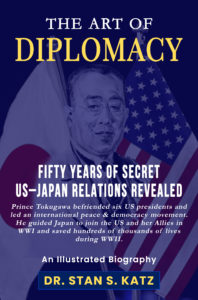
The ART OF PEACE was republished in a General Reader Edition titled: THE ART OF DIPLOMACY.

(Note:  THE ART OF PEACE  has an additional 100 pages of historical notes to assist researchers.)

Print and Kindle Edition


Our times need inspiring role models in the art of peaceful and respectful international diplomacy – It would improve international relations in Asia to recognize Prince Tokugawa’s major humanitarian achievements as President of the Red Cross Society of Japan, promoting the creation of demilitarized safe zones in China. These havens helped protect the lives of hundreds of thousands of Chinese civilians during the years leading up to and during WWII. They also served as refuge for tens of thousands of European Jews fleeing the Holocaust. 

During 1921-1922, Prince Tokugawa headed the Japanese Delegation to the Washington Naval Arms Limitation Conference, hoping to maintain peace.

To combat racism, during the 1920s and ’30s, Prince Tokugawa incorporated Lincoln Essay Contests into all Japan’s public schools and universities. Giving awards to students who wrote the best essays honoring the humanitarian principles of Abraham Lincoln.  

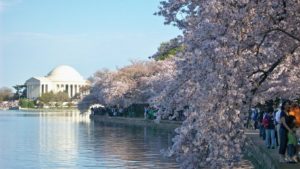
Prince Tokugawa took a guiding role in 1912 Japanese gifting of Cherry Trees to Washington, D.C. evolving into the National Cherry Blossom Festival, Our capital’s largest annual international goodwill celebration. This achievement has also surprisingly not yet been recognized.

The timing is right to bring deserved international attention to these outstanding statesmen: Prince Tokugawa and Takashi Komatsu.


Reader Praise for:
The Emperor and the Spy

The Art of Peace

The Art of Diplomacy

The Cherry Tree Weeps For Me


Filed Under: Tokugawa Archives Tagged With: 1934 USC Bestows Honorary Doctor of Laws Degree on Prince Tokugawa, Abraham Lincoln, Abraham Lincoln and Japan, Abraham Lincoln Commemorative Medal, Ambassador Grew, Ambassador Grew and Prince Tokugawa, Ambassador Joseph C. Grew, Ambassador Joseph Grew, American “Embassy Day” held in Tokyo, Anti-Asian Racism, Archibald T. Steele, Baron Eiichi Shibusawa, Baron Shibusawa, Baron Shibusawa Eiichi, Captain Maxwell representing the Chicago Tribune, Carol L. Folt, chief of the Far East bureau of the United Press, Clara Preve-Durrieu, Colonel Mashbir, Colonel Sidney Forrester Mashbir, Colonel Sidney Mashbir, Consul General George A. Makinson, Dr. Rufus B. von Kleinsmid, Eiichi Shibusawa, Far Eastern manager of the National City Bank of New York, FDR, Frank A. Vanderlip, Frank Vanderlip, General Douglas MacArthur, General MacArthur, George A. Makinson, George I. Cochran, Heir to the Last Shogun, Heir to the last Tokugawa Shogun, Henry Kissinger, Henry Kissinger and Japan, History of Racism, History of the University of Southern California, History of University of Southern California, History of USC, Honorary Doctor of Laws Degree from USC, Honoring Abraham Lincoln, Iesato Tokugawa, Iyemasa Tokugawa, Jacquinot Safe Zone, James Mikel Wilson, Japanese Internment Camps, Japanese Racism at USC, John D. Rockefeller III, John L. Curtis, John Moorris, Komatsu and Tokugawa, Komatsu Takashi, Lincoln Essay Contest, Lincoln Essay Contests, Monmouth University, Monmouth University History, of the Far East Bureau of the Chicago Daily News, president abraham, President Abraham Lincoln, President Folt conferred honorary degrees to the families of 33 former Nisei students, President Franklin D. Roosevelt, Prince Iyemasa Tokugawa, Prince Tokugawa Iesato, Prince Tokugawa Iesato Archives, Racism at USC, Shanghai Safe Zone, Shogunate, Stan S. Katz, Stan S. Katz archives, Stan S. Katz blog, Stuart E. Grummon, Takashi Komatsu, Takashi Komatsu and Prince Tokugawa, Takashi Komatsu businessman, Takashi Komatsu diplomat, Takashi Komatsu industrialist, Takashi Komatsu international statesman, The art of diplomacy, The Art of Diplomacy biography, The Art of Peace, The Art of Peace biography, The Cherry Blossom Weeps for Me, The Cherry Blossom Weeps for Me:  A Quest for the Dawn of Peace, Tokugawa and Grew, Tokugawa and Komatsu, Tokugawa Iesato, US Japan relations, USC and Japan, USC Annenberg Media, USC Bestows Honorary Doctor of Laws Degree, USC Bestows Honorary Doctor of Laws Degree on Prince Tokugawa, USC History, USC President Folt, W.T. Turner

Prince Tokugawa’s Pivotal Role in Establishing the National Cherry Blossom Festival in Washington, DC.

May 2, 2020 by Stan S. Katz Leave a Comment


Prince Iyesato Tokugawa guided the Japanese gifting of the cherry blossom trees to the U.S. Capital in 1910 and 1912 into becoming an international token of goodwill which is now officially known as the annual National Cherry Blossom Festival – His behind the scenes role in accomplishing this diplomatic success was discovered while researching for the illustrated biography on Prince Tokugawa, titled: THE ART OF PEACE.

[Note: Prince Tokugawa (1863-1940) while traveling outside of Japan went by the name Prince Iyesato Tokugawa, while in Japan, he was known as Prince Tokugawa Iesato.]

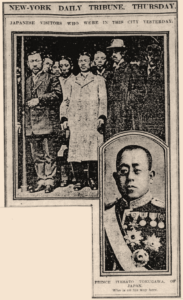
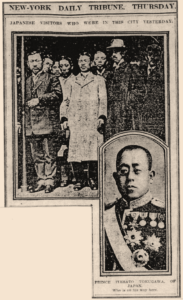
The above May 5, 1910 New York Daily Tribune announced the coming arrival of Prince Iyesato Tokugawa to New York City, following his visit to Washington, D.C. Scheduled to coincide with the arrival of Prince Tokugawa, was the recent arrival of a delegation of sixty Japanese. Prince Tokugawa and his delegation had spent time together in the U.S. Capital, prior to visiting New York City. Several of the Japanese delegation are shown in the newspaper photos. The individual standing between the gentlemen in the long white coat and the individual in the white hat is  Yukio Ozaki Mayor of Japan’s capital city of Tokyo, who is the Japanese official most remembered linked to the gifting of the cherry blossom trees to the U.S. capital city of Washington, D.C. This recognition being given to Mayor Ozaki is based on Prince Tokugawa’s humility and wisdom, he preferred this gift be seen symbolically coming from the nation of Japan, rather than highlight his own role in bringing it about.


(Left) Sectional view from The New York Daily Tribune 1910 photo, Mayor Ozaki is in the center. (Right photo for comparison) Circa 1920 photo of Mayor Ozaki.

The goodwill delegation accompanying Prince Tokugawa included bankers, physicians, lawyers, merchants, sociologists and newspaper men, who were on a world tour. Besides America, their itinerary included France, Germany, Switzerland, and Russian Siberia. They desired to familiarize themselves with the outside world, and also encourage the outside world to have a better understanding of Japan.

During his 1910 visit, Prince Tokugawa met and dined with President Taft at the White House. Prince Tokugawa and two visiting members of the Imperial family were also honored with a luncheon by the Japan Society of Manhattan. A hundred guests were present, with the President of the Society, Lindsay Russell, presiding. At that event, Prince Tokugawa expressed his appreciation of the Japan Society, which was founded just three years earlier in 1907 and continues to this day to promote good U.S. Japan relations . . . That evening, a special dinner was held by the Japan Society for Mayor Yukio Ozaki. This gave Prince Tokugawa an opportunity to introduce Yukio Ozaki to leading members of the Japanese-American community and to the general American public as part of promoting the Japanese gift of cherry blossom trees.

Though, Prince Tokugawa held the powerful position of President of Japan’s upper house of congress The House of Peers, when asked by reporters why he had come to America in 1910, as was his style, he humbly declared he was there in no official capacity – However, he expressed his interest in the comparative study of the governmental systems of other modern nations. He visited the U.S. Congress twice to see her political process in action. To better understand the U.S. legal system, Tokugawa viewed a corporate lawsuit trial.

On a lighter note, while in New York City, Prince Tokugawa was greatly amused when he visited Madison Square Garden and saw a Wild West Show, with cowboys straining to hang onto bucking mustangs! – As for sports, Tokugawa had become an avid baseball fan well before his 1910 visit. He beamed as he told U.S. reporters about the excitingly competitive intercollegiate baseball games he’d seen in Japan between the University of Wisconsin and the Tokio College team. Tokugawa expressed the hope that many more games would be arranged between American and Japanese college teams, and that he wished to see baseball become the national game of Japan. Tokugawa sincerely believed that nations that shared a love for such a fine sport, would likely remain good allies. Two decades later, Prince Tokugawa arranged for the American All-Star Team to visit Japan to play ball.

The Japanese initially gifted two thousand cherry blossom trees in 1910. Regrettably, those trees were diseased and had to be destroyed. To remedy this unexpected setback and further build upon this goodwill gesture, in 1912 the Japanese sent an even greater number, three thousand and twenty cherry blossom trees of twelve varieties. President Taft and his wife would be the official U.S. representatives receiving this gift.

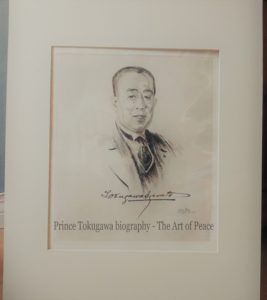
In terms of the evolution of the Cherry Blossom Festival, from 1913 – 1920: workmen continued planting the Japanese cherry blossom trees around the Washington, D.C. Tidal Basin and in East Potomac Park. However, no events occurred to commemorate the gift, that is, until 1922, when the first annual gatherings began. – What is significant is that during 1921-1922, Prince Tokugawa returned to the U.S. to ally with the current President Warren Harding during the Washington Naval Arms (Limitation) Conference, the first truly international conference held in the U.S. Capital. Prince Tokugawa headed the Japanese delegation – It was during this successful conference, that Prince Tokugawa most likely also found time to encourage the Japanese cherry blossom gift into becoming an annual celebration. Below is a signed portrait etching of Prince Tokugawa, drawn during that 1921-1922 conference.


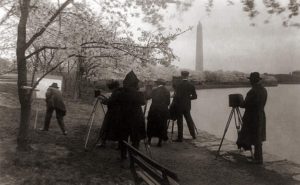
1920s: a painter & several photographers are at the Tidal Basin facing the Washington Monument, attempting to capture the beauty of the cherry trees in bloom. Photo: Library of Congress.


During 1930 and during 1933-1934, Prince Tokugawa again travelled across the U.S. – During that last visit, he further promoted the goodwill of the 1912 Japanese gift. Prince Tokugawa was a luncheon guest of his friends Colonel Theodore Roosevelt Jr. (son of deceased President) and his mother Mrs. Theodore Roosevelt. This was followed by a more formal luncheon given in Prince Tokugawa’s honor by President Franklin Delano Roosevelt. The impressive guest list at this event included: the Chief Justice of the Supreme Court; the Secretaries of State, Treasury, and Interior; several Congressman, the Under Secretary of State (and former U.S. Ambassador to Belgium and Canada); the Surgeon General, and the Chairman of the American Red Cross John Barton Payne. [Source: “Formal Luncheon Given By President Roosevelt Entertains for the Head of the Japanese Red Cross, Prince Iyesato Tokugawa.” The New York Times, March 2, 1934.]

It is significant to recognize that Prince Tokugawa was in Washington, D.C. during March 1934, the month preceding the “first formal festival” commemorating the 1912 Japanese gift of cherry trees – On April 19th, 1934: The District of Columbia Commissioners sponsored a three-day Cherry Blossom Festival.

The following year, 1935, the National Cherry Blossom Festival ‘Officially’ became an annual event in the U.S. Capital.

Prince Tokugawa had accomplished his mission, helping launch this important international goodwill event. He would likely have wished to attend the 1934 inauguration ceremony, but his schedule required him to be on the West Coast to receive an Honorary Doctor of Laws Degree from the University of Southern California (USC). The book cover for the biography THE ART OF PEACE  presents him receiving this degree from the president of USC, for his support of foreign student exchange programs & for his international philanthropic contributions.


“THE ART OF PEACE“ IS AVAILABLE AS A DIGITAL EBOOK


PRINCE TOKUGAWA’S BIOGRAPHY IS ALSO AVAILABLE IN A PRINT and KINDLE EDITION


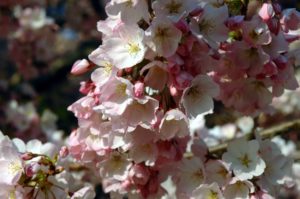
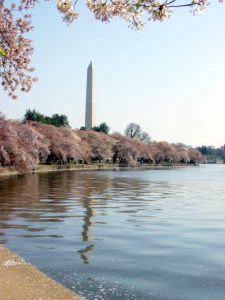
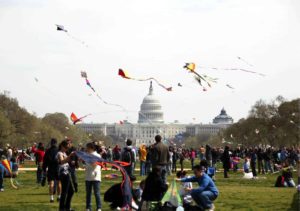
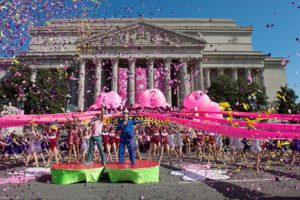
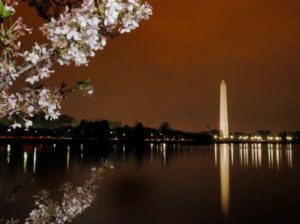
Below are several additional historical photos and some recent ones linked to the Cherry Blossom Festival:


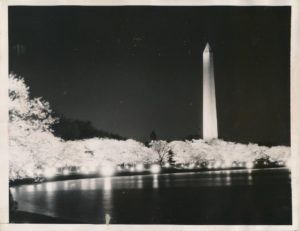
April 16, 1934 press photo describes a Cherry Tree Spectacle that brought 100,000 visitors to Washington, D.C., over the weekend to witness the beautiful cherry trees in bloom. This was in preparation for the Cherry Blossom Festival to be held the following week. Some of these trees were further beautified with electric lighting.


March 18, 1937 press photo gives further insight into Prince Tokugawa’s important role in the establishment of the National Cherry Blossom Festival: The Garden Club of America wanted to thank Prince Tokugawa and Japan for the hospitality shown to their garden club members from across the U.S., during their 1935 visit, when they toured the most beautiful of Japan’s gardens, as well as her historical sites. The garden club also wished to commemorate the 25th Anniversary of the Japanese gifting of the cherry blossom trees to the U.S. in 1912. When they reciprocated in 1937, with a gift of 4,650 flowering trees and plants, who better to receive this gift to Japan, than Prince Tokugawa. As it had been him, who introduced the then Mayor of Tokyo to the U.S. leaders in Washington, D.C. in 1910, as part of launching that goodwill gesture.

In the above photo, Prince Tokugawa is now accompanied by the current Mayor of Tokyo, Torataro Ushitsuka. Together, they represented Japan in receiving these gifted trees and plants from the Garden Club of America. They were joined by the current U.S. Ambassador Joseph Clark Grew and his wife, who represented the United States. Photo shows the official group at tea, after having attended the gifting ceremony held at Kiyozumi Park, Tokyo.

Left to right: Prince Tokugawa, Ambassador Grew, Mayor Ushitsuka, and Mrs. Grew, with her back to the camera.


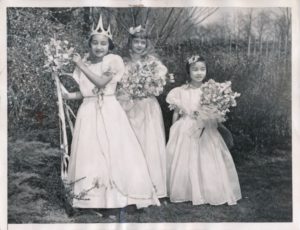
“The Queen of the 1937 National Cherry Blossom Festival” Washington, D.C.

25th Anniversary Celebration commemorating the 1912 Japanese gift, Sakiko Saito (left) age 10, is ceremonially crowned Queen of this goodwill event. Sakiko is accompanied by her entourage: her sister, Masako Saito (right) age 8, and Barbara Caldwell (center) age 10, who is the Maid of Honor representing the U.S. Sakiko and Masako are the daughters of the Japanese Ambassador to the U.S. Hirosi Saito. Source press photo.


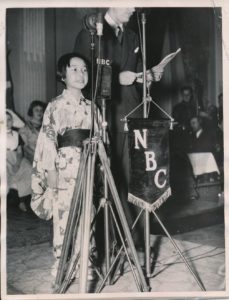
The 1930s were a difficult time in terms of the world economic depression, with powerful forces pushing the world towards war. To counter this, nation-bridging efforts were promoted by Prince Tokugawa and his allies. The above December 21st, 1936 press photo presents Japanese Ambassador Saito’s younger daughter Masako (7 years old), along with other foreign diplomats’ children (dressed in their nations’ traditional clothing) sending Merry Christmas greetings by radio broadcast to youngsters around the world. This was the fourth annual broadcast of its kind.


Prince Tokugawa felt that life was precious and meant to be celebrated!

Tokugawa and his allies would be delighted to see the goodwill event they launched many years ago, continues to bring joy to so many today, contributing to better understanding between nations – Perhaps one day, Prince Tokugawa’s memory will be be honored as part of this wonderful celebration.


The above photo and those that follow are provided courtesy of The National Cherry Blossom Festival, Inc. a not-for-profit organization whose mission is:

“Dedicated to promoting the beauty of nature and international friendship through year-round programs, events, and educational initiatives that enhance our environment, showcase arts and culture, and build community spirit.”


Filed Under: Tokugawa Archives Tagged With: Baron Eiichi Shibusawa, Baron Shibusawa, Baron Shibusawa Eiichi, Cherry Blossom Festival, Diplomacy, Historical biography, History of the Cherry Blossom Festival in Washington D.C., History of the National Cherry Blossom Festival, History of the University of Southern California, History of USC, Honorary Doctor of Laws Degree from the University of Southern California, Honorary Doctor of Laws Degree from USC, International Friendship, International Relations, Iyemasa Tokugawa, Japan History, Japan U.S. Relations, National Cherry Blossom Festival, President Taft, President Theodore Roosevelt, President William Howard Taft, Prince Iyesato Tokugawa, Prince Iyesato Tokugawa Archives, Prince Tokugawa Archives, Prince Tokugawa Iesato, Prince Tokugawa Iesato Archives, Shibusawa Archives, Stan S. Katz, Stan S. Katz blog, The Art of Peace, The Art of Peace biography, TheEmperorAndTheSpy.com, Theodore Roosevelt, U.S. Japan relations, U.S.-Japan History, US Japan relations, William Howard Taft, World War One, World War Two, Yukio Ozaki, Yukio Ozaki Mayor of Tokyo

1920 – An Important Event Encouraging Good US / Japan Relations. Recently discovered Photo – Frank A. Vanderlip, a leading US business figure and president of the Japan Society of New York City meets with Shibusawa Eiichi and representatives of Mitsui & Co., and other Japanese leaders.

February 16, 2020 by Stan S. Katz 6 Comments


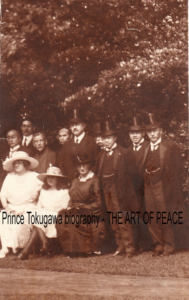
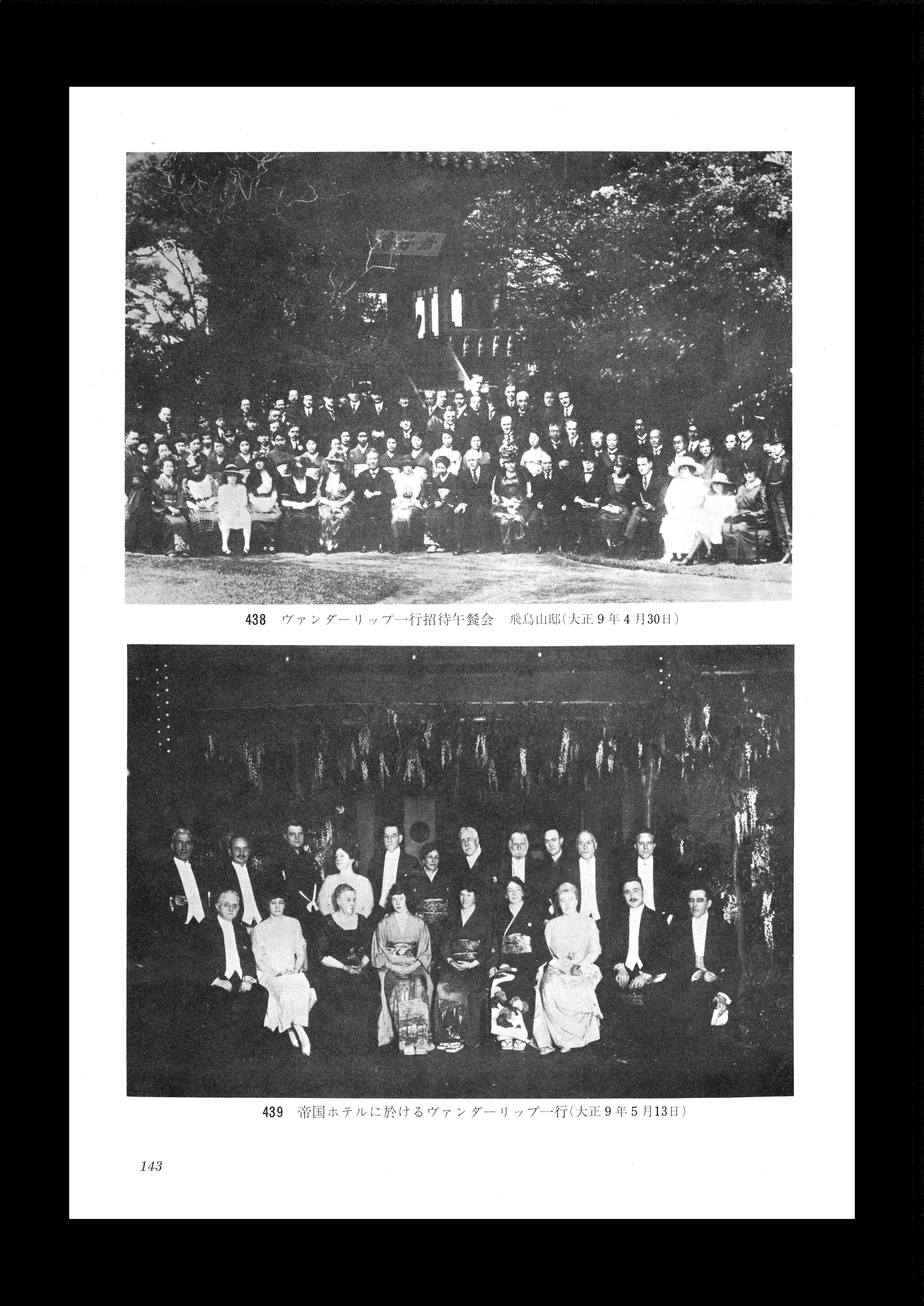
Above  is an original 1920 photo (far right segment) of the larger photo shown just below. It presents an exciting moment in international business relations, an early U.S. Japan trade/economic alliance being formed, while at the same strengthening U.S. Japan political and cultural relations. This gathering took place at the home of Baron Shibusawa (seated front row, seventh from the left in the below photo).


The successful American banker and journalist Frank A. Vanderlip (seated 10th from the left in the upper black and white photo, and standing 7th from the left in the lower black and white photo.

Vanderlip headed this U.S. business delegation to Japan, where he was met by Baron Shibusawa Eiichi and other Japanese business and governmental leaders. Vanderlip was the former Assistant Secretary of the U.S. Treasury from 1897 to 1901 and major contributor to the future creation of the U.S. Federal Reserve System. Baron Shibusawa is known as the Father of the Japanese Modern Capitalistic Economy, who among his many accomplishments launched Japan’s first national bank. In 1909, Vanderlip became the president of National City Bank which held more capital than any other bank in the U.S.

The above 1920 photo was taken following a special dinner hosted by Shibusawa Eiichi for Mr. Vanderlip and his family, along with their accompanying U.S. delegation. Several of individuals in the above photos have been identified. The remaining Japanese individuals will hopefully be identified in the future and this article will be updated.


The invited American guests of the day are as follows

Mr. Frank A. Vanderlip and Mrs. Vanderlip, and their daughter(s). (Mr. Vanderlip is standing 5th from the right in the bottom black and white photo, shown above.)

Mr. Harry E. Benedict – nationally known executive and economist,

Mr. Henry W. Taft and Mrs. Taft – Henry Waters Taft (May 27, 1859 – August 11, 1945) was an American lawyer and author. He was the son of Alphonso and brother of President William Howard Taft. A renowned antitrust lawyer, he was a name partner at Cadwalader, Wickersham & Taft.

Mr. Jacob G. Shurman and Mrs. Shurman –  Jacob Gould Schurman (May 2, 1854 – August 12, 1942) was a Canadian-born American educator and diplomat, who served as President of Cornell University and United States Ambassador to Germany.

Mr. Darwin Kingsley and Mrs. Kingsley – Darwin P. Kingsley ~ PRESIDENT NEW YORK LIFE INSURANCE CO – 1906-1930

Mr. Julian Street and Mrs. Street, and daughter

Mr. Seymour L. Cromwell and Mrs. Cromwell – President of the New York Stock Exchange

Mr. Lewis L. Clark and Mrs. Clark, and daughter

Mr. Lyman Judson Gage (June 28, 1836 – January 26, 1927) was an American financier and Presidential Cabinet officer.

Mr. George Eastman – George Eastman (July 12, 1854 – March 14, 1932) was an American entrepreneur who founded the Eastman Kodak Company and helped to bring the photographic use of roll film into the mainstream. He was a major philanthropist, establishing the Eastman School of Music, Rochester Philharmonic Orchestra, and schools of dentistry and medicine at the University of Rochester and in London Eastman Dental Hospital; contributing to the Rochester Institute of Technology (RIT) and the construction of several buildings at the second campus of Massachusetts Institute of Technology (MIT) on the Charles River. In addition, he made major donations to Tuskegee University and Hampton University, historically black universities in the South. With interests in improving health, he provided funds for clinics in London and other European cities to serve low-income residents. NOTE: The author of this blog post lived in Rochester for 10 years and got the chance to see many of the above fine institutions that George Eastman created. (Eastman is seated far left in the lower black and white photo, shown above.)

Mr. J. Lionberger Davis and Mrs. Davis – J. Lionberger Davis (John Lionberger) was born in St. Louis, Missouri in 1878. He was a lawyer and banker; he graduated from Princeton in 1900, and studied law at Harvard and Washington University. He was founder and chairman of the Real Estate Mortgage Trust Company and the Security National Bank Savings and Trust Company in St. Louis, Missouri. During World War I, Davis served as managing director of the Alien Property Custodian from 1917-1919. He was an active Democrat and personal friend of Presidents Woodrow Wilson and Franklin Roosevelt. He died in 1973. Lionberger was an avid collector of fine art. Much of his art collection was gifted to various art museums around the country.

Mr. Edward Mulligan – might have been a banker.

Mr. Harry Serenbetz

Mr. Ballantine and Mrs. (details unknown); (spelling Valentine?)

Mr. Bors (details unknown)

*Note: Some of the information in the blog post was kindly provided by an individual who is included in the Comments Section at the end of this Blog Post.


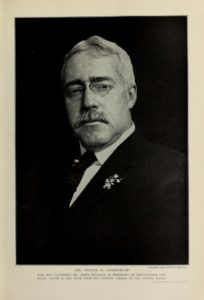
Frank A. Vanderlip (November 17, 1864 – June 30, 1937)

Below is a 1909 photo of Frank A. Vanderlip – Source: Wikipedia, from the book: The World’s Work, 1909, by the Brown Brothers.


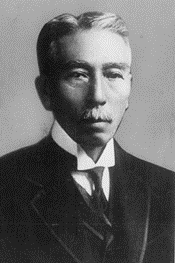
Baron Shibusawa Eiichi (渋沢 栄, March 16, 1840 – November 11, 1931, aka Eiichi Shibusawa) was a Japanese industrialist who spearheaded the introduction of Western capitalism into Japan after the Meiji Restoration of 1868. 


Photo date unknown – Source: Wikipedia


Baron Takuma Dan (團 琢磨, September 7, 1858 – March 5, 1932) is on the far right of the 1908 photo of the original photo segment . He was a graduate of Massachusetts Institute of Technology and was married to the younger sister of statesman Kaneko Kentarō. Dan was a successful Japanese businessman who became Director-General of Mitsui & Co., Ltd. (三井物産, Mitsui Bussan) which is currently one of the largest sogo shosha (general trading companies) in Japan. It is part of the Mitsui Group, and its business sectors include energy, machinery, chemicals, food, textile, logistics, finance, and more. The company was established in 1876 with 16 members including the founder, Takashi Masuda.  

Takuma Dan – photo date unknown: Source Wikipedia


Baron Takamine Mitsui (三井 高棟, 8 February 1857 – 9 February 1948) is on the far left in the original photo segment.

In 1919, Takamine Mitsui was considered for the position of Japan’s new ambassador to the United States. At the time, he was the richest man in Japan and the head of the successful, centuries old, Mitsui family. He had worldwide commercial and financial interests and was described in the Press of his own country as the ‘Japanese Rockefeller’.


Baron Takamine Mitsui – Source: press photo circa 1919


Baron Takamine Mitsui

日本語: 三井高棟

Photo date: October 1913

Source  Japanese book “Kazoku Gaho (Pictorial Peerage of the Empire of Japan)” published by Kazoku Gaho Sha.

日本語: 華族画報社「華族画報」より。


No reference photo could be found for Masao Shibusawa, son of Baron Shibusawa.

The below photo is from the 1920 original photo segment which shows what the author of this blog FIRST believed to be Masao Shibusawa. Verification from historians would be appreciated in confirming this information. During the 1920s, Masao Shibusawa was President of Tokyo Ishikawajima, a shipbuilding and engineering firm that also manufactured of cars, trucks, and small buses. This company would be part of the early history of domestic car manufacturing in Japan, leading to the company Isuzu. Source: The New Domestic Automakers in the United States and Canada: History, By A.J. Jacobs, Publisher: Lexington Books, 2016

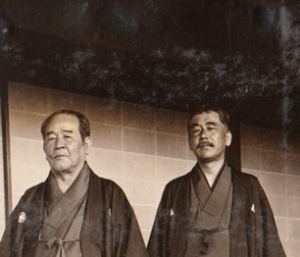
Below photo: At first, incorrectly, the below individuals were assumed to be Baron Shibusawa left, with his son Masao Shibusawa right. It is not yet clear who they are.


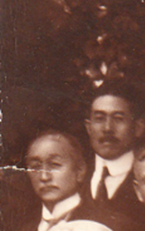
The above photo is a section of the original 1920 photo segment: Left: Baron Mitsui, the right photo might be: Taka Kawada


The above 1917 reference photo presents: Baron Shibusawa Eiichi and Taka-Kawada: two of the Greatest Financiers in Japan. The photo was taken on the porch of Baron Shibusawa’s home. Shibusawa was known as the Father of Modern Banking and Economics in Japan (seen as the J. P. Morgan of Japan.) Above information: ”Journal of the American Asiatic Association” volume 17, March 1917-Dec. 1917: the article is titled: Japan’s Prosperity The New Wealth and Its Measure of New Reserve Power written by S. Joseph Reed, Jr. (The article relates to Japan’s economy and to the shipbuilding industry.) Photo source: archives of the author of this blog post.


ADDITIONAL DETAILS ABOUT THE 1920 original PHOTO segment:

This rare photo was discovered six years ago by the author of this blog post, while doing research for an illustrated biography on Prince Tokugawa Iesato (aka Prince Iyesato Tokugawa 1863-1940), titled: The Art of Peace. The biography highlights the significant political, economic, and social welfare contributions of Prince Tokugawa Iesato  and Baron Shibusawa Eiichi who often allied with one another to achieve Japan’s domestic and international goals. It offers a new perspective on U.S. Japan relations, during the first half of the 20th Century.

At first, it was largely a mystery as to who the individuals were and what the date of this photo was as well, and what was the event that brought these individuals together? This was not a press photo, which generally has description printed on the back. Research into newspaper archives found only one article that mentioned a large U.S. business delegation visiting Japan in Dec. 18, 1908, but this article didn’t list even one name of the U.S. delegates. This article did however state that the U.S. delegation was met by leading Japanese, but none of those Japanese were identified.

It appeared that this photo was most likely taken as a personal memory of Frank A. Vanderlip and his business delegation’s visit to Japan.

As part of the research, an inquiry was made with the Shibusawa Eiichi Memorial Foundation and Museum, an organization that honors the legacy and values of Baron Shibusawa and his allies. This organization was started over 120 years ago and is based in Asukayama Park in Oji, Tokyo, on the site of the former Shibusawa residence. The head of their library resources section kindly confirmed they didn’t know that Frank A. Vanderlip, along with his family, and his U.S. business delegation might have visited Japan in 1908 and that he might had met with Baron Shibusawa and other Japanese business leaders. Since that time, new information was provided that revealed that this meeting of East and West occurred in 1920, not 1908.

Here is the link to the Shibusawa organization’s website: https://www.shibusawa.or.jp/english/


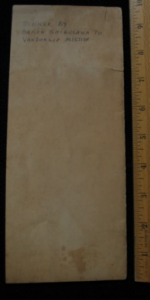
The 1920 photo is 10 inches by 3.5 inches in size.

The reverse side of this significant, but age weathered photo is shown below.

Written in ink are the words:

“DINNER BY

BARON SHIBUSAWA

TO VANDERLIP MISSION“


If there had been a meeting between a Vanderlip business delegation and Japanese economic leaders in 1908, the reason for the limited press coverage for this meeting might well be that the participants wished privacy as they discussed urgent U.S. economic issues and the unstable and potentially adversarial political relations between the U.S. and Japan.

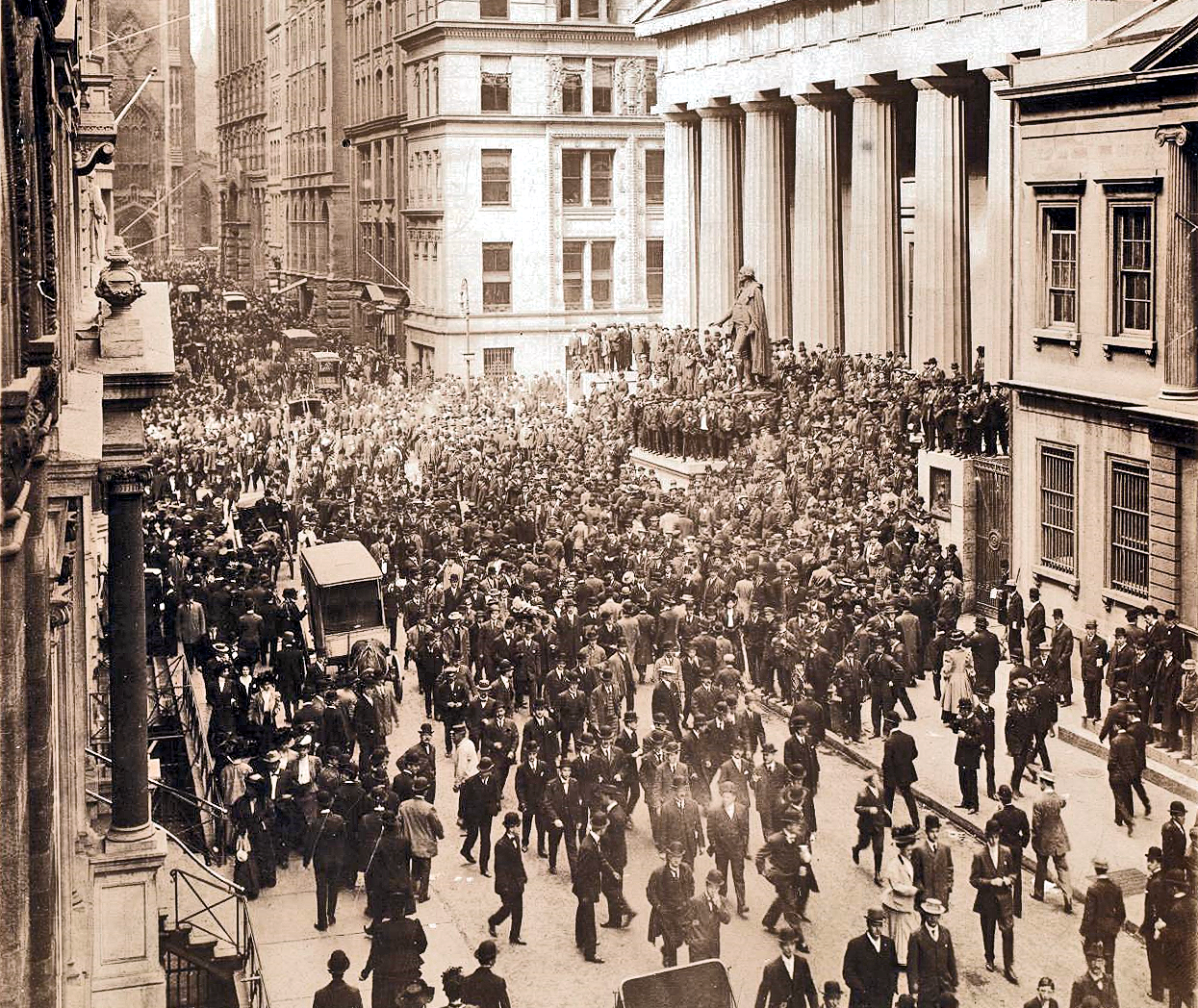
On the economic front this meeting was quite urgent, because of a recent, major economic downturn in the U.S., called The Panic of 1907, also known as the 1907 Bankers’ Panic, linked to the collapse of the U.S. Stock Market. Based on this U.S. economic crisis, a 1908 US business delegation visited Japan most likely had the goal of working together with their Japanese allies to bring back a stable and prosperous U.S. economy by increasing U.S. Japan trade & through the Japanese extending financial backing thru loans to the U.S. – These supportive measures would simultaneously improve the economy of Japan, and hopefully strengthen U.S. Japan political and cultural relations.

The below photo presents Wall Street during the Bank and Stock Market Crash which was called the 1907 Bankers’ Panic. Anxious crowds gathered around Federal Hall, one of the first of two historic buildings located at 26 Wall Street in the Financial District of Manhattan, New York City. The original, a Federal style structure completed in 1703, served as New York’s first City Hall. Notice the statue of George Washington in front of the building. Source of photo: Wikipedia


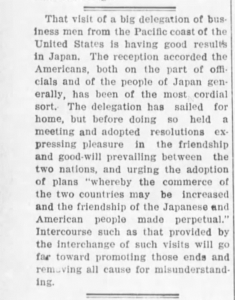
Below is the newspaper article believed to be linked to the Vanderlip/U.S. 1908 business delegation visit to Japan:

Courtland Journal (Courtland, Kansas)

December 18, 1908, Friday, Page 2

This news article did not have a title, but appeared in a column with the heading:

“THE COMET”

A. Hoyt Publisher, Courtland, Kansas

Below is a transcription of the December 18, 1908 Courtland Journal article, followed by the scanned newspaper article:

“That visit of a big delegation of businessmen from the Pacific coast of the United States is having good results in Japan. The reception accorded the Americans, both on the part of officials and of the people of Japan generally, has been of the most cordial sort. The delegations has sailed for home, but before doing so held a meeting and adopted resolutions expressing pleasure in the friendship and good-will prevailing between the two nations, and urging the adopting of plans “whereby the commerce of the two countries may be increased and the friendship of the Japanese and American people made perpetual.” Intercourse such as that provided by the interchange of such visits will go far toward promoting those ends and removing all cause for misunderstanding.”


The following year, 1909, Shibusawa headed a Japanese business/goodwill delegation to the United States, that included 40 of Japan’s most prominent business leaders and notables. They came at the invitation of the Seattle Chamber of Commerce and the Associated Chambers of Commerce of the Pacific Coast. The Japanese delegates and their companions traveled from Pacific to Atlanta, and back again, touring and being welcomed in over fifty U.S. cities. The newspaper: The Buffalo Commercial – 05 Oct. 1909, Tue • Page 1 – gives some general details about Shibusawa and his Japanese delegation’s three month journey and states that that visit was in reciprocation for the fine hospitality given to the U.S. delegates during their 1908 visit. However, no mention is made that the 1908 visit had been headed by Frank A. Vanderlip, nor was there mention made that any photos had been taken of the Japanese and the U.S. representatives coming together in 1908. 


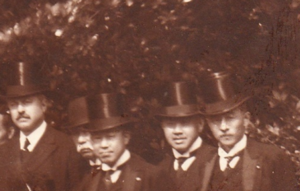
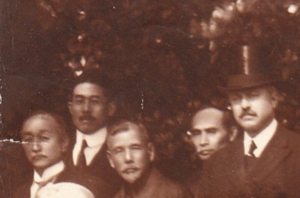
With the goal of identifying all of the individuals in the below 1920 Photo, below are enlarged segments of that photo with the individuals given ID numbers. Those who are already recognized are named. Hopefully, historians or family members who visit will be able to assist in identifying those who haven’t yet been recognized. This information can be sent thru the comment section of this blog post. Thank you.


From: Right to left

1- Might be: Baron Takuma Dan (團 琢磨, September 7, 1858 – March 5, 1932)

2- Might be Baron Shibusawa’s son, Masao Shibusawa.

3- Might be Baron Shibusawa’s son, Masao Shibusawa.

4- Unknown gentlemen with white mustache

5- Unknown gentlemen in top hat


From: Right to left

5- Unknown gentlemen

6- Unknown gentlemen

7- Unknown gentlemen

8- Might be: Taka Kawada (taller with black tie)

9- Baron Takamine Mitsui (三井 高棟, 8 February 1857 – 9 February 1948)


From: Right to left

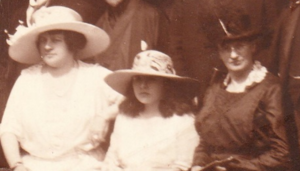
10- Might be: Daughter of Frank A. Vanderlip

11- Might be: Daughter of Frank A. Vanderlip

12- Might be companion for the Vanderlip children.


In 1909, in reciprocation for a 1908 U.S. business/goodwill delegation’s visit to Japan, Baron Shibusawa Eiichi, accompanied by his Japanese business/goodwill delegation toured the United States. During their visit, the Japanese were greeted by the Vanderlip family and top representatives of American Industry, such as General Electric and Westinghouse.

In the following year, 1910, Prince Tokugawa Iesato visited the U.S., to further strengthen the growing friendship between their two nations. Prince Tokugawa’s 1910 goodwill visit was strongly linked to the 1912 gifting of the Cherry Blossom Trees to the U.S. Capital, whose commemoration is now celebrated annually as the National Cherry Blossom Festival.

The Art of Peace biography presents Prince Tokugawa and his Japanese allies who creatively supported democracy and peace. For thirty years (1903-1933), Prince Tokugawa served as President of Japan’s upper house of congress, the House of Peers.          

The below May 5, 1910 – The New York Daily Tribune newspaper article announces the coming arrival of Prince Tokugawa to New York City, after his and his delegation’s visit to Washington D.C. During this visit, Prince Tokugawa met with President William Howard Taft and many other U.S. governmental leaders.


As for Frank A. Vanderlip, in 1910 his services were required for secret business gatherings where press coverage was kept to a minimum, when Vanderlip came together with other U.S. financial experts on Dr. Jekyll Island, to plan out the creation of initial framework for the U.S. Federal Reserve System, a system which would play an important role in stabilizing the U.S. economy by overseeing the U.S. currency supply, to avoid similar events such as ‘The Panic of 1907’.

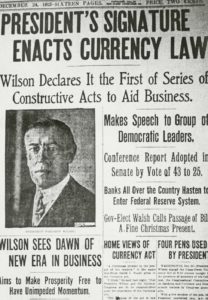
The below December 24, 1913 newspaper article highlights President Woodrow Wilson’s new currency laws as part of the establishment the U.S. Federal Reserve System. Source of illustration: Wikipedia


In 1915, Baron Shibusawa Eiichi again visited the U.S. on a diplomatic goodwill/business visit.


New-York Tribune (New York City), Dec. 3rd, 1915, Friday, Page 9.

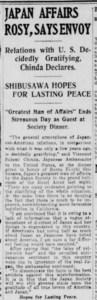
To honor Baron Shibusawa’s visit, on December 2, 1915 a dinner event was hosted by the Japan Society of New York City at the grand ballroom of the Hotel Astor. At this gathering, Viscount Sutemi Chinda the Japanese Ambassador to the U.S. spoke of the growing positive relations between the U.S and Japan. There were 360 guests who attended this dinner and dance.

During his 1915 visit, Baron Shibusawa met with President Woodrow Wilson.

Another significant event linked to honoring Baron Shibusawa’s 1915 visit was held at a well-known restaurant in New York City, called Sherry’s. Among the 65 attendees who attended this banquet were former Presidents Theodore Roosevelt and William Howard Taft – A rare, perhaps one of a kind photo of this 1915 event is presented in another Blog post on this website.


Note: Upcoming blog posts will present other significant historical photos that require further identification of the individuals and of the events depicted – Historians/educators/researchers are invited to share their insights so as to bring greater clarity to these mysterious pieces of history. Your contributions will be acknowledged – To receive these future blog posts, you’re invited sign up at the top right.

BELOW IS A LINK TO A NEWSPAPER ARTICLE THAT COVERED THE 1920 MEETING BETWEEN THE VANDERLIP BUSINESS DELEGATION AND SHIBUSWA EIICHI, AND HIS JAPANESE COLLEAGES.

https://www.newspapers.com/image/208940552/?terms=shibusawa%20meets%20with%20frank%20vanderlip&match=1

In 1920 Frank A. Vanderlip became the president of the Japan Society of New York City.

The below information comes from the Japan Society website: https://www.japansociety.org/page/about/brief_history

“Japan Society of New York, established in 1907, was one of the pioneers of cultural exchange in the early 20th century. Begun in a time when few Americans knew anything about Japan, it quickly reached a wider audience than the few learned societies that focused on Asia at the time. Japan Society not only hosted leading Japanese visitors to the United States, it sponsored the first important exhibitions of Japanese art, published important books on Japan written by American experts, and promoted the study of Japan in American schools and universities by distributing learning materials and providing funds for prizes at the collegiate level. Throughout the 1910s and 1920s, it became the leading forum for Japanese to encounter their American counterparts abroad.

As political and racial tensions worsened between Japan and the United States in the 1920s and 1930s, the Society steadfastly refused to take a political stance, preferring education to advocacy. Nonetheless, Japan Society worked with other internationalist groups, such as the Carnegie Endowment for International Peace or the America-Japan Society of Tokyo, to increase contact between Americans and Japanese at all levels. The Society’s Annual Dinner became a venue for leading Japanese statesmen to give major addresses on the state of the U.S.-Japan relationship.”

Japan Society recognized Prince Tokugawa as their guest of honor at their 1934 Annual Dinner Celebration.

During Prince Tokugawa’s 1934 visit to the U.S., he was also greatly acknowledged by a prestigious university – The cover of the below biography highlights Prince Tokugawa receiving an Honorary Doctor of Laws Degree from the president of the University of Southern California, for his contributions to education, international goodwill, and philanthropy. 


THE ART OF PEACE highlights Prince Tokugawa and Baron Shibusawa, along with their Japanese and non-Japanese allies as they creatively promoted democracy and international goodwill during the first few decades of the twentieth century, an exciting, but often turbulent period of history.

THE ART OF PEACE comes in two versions: a general reader edition and an ‘expanded’ edition which has an additional 100 pages of historical notes and a comprehensive index to assist researchers.

AVAILABLE THRU AMAZON LINKS BELOW:

General Reader Edition

Expanded Edition


Bibliographical Sources for this blog post:

  1. Courtland Journal (Courtland, Kansas) December 18, 1908, under a column with the heading: “THE COMET”, H. A. Hoyt Publisher” [Technical research details: Please note: It was difficult to discover this newspaper article online, in that no names of the participants were given by the U.S. press. So to find it, required entering the Search words: “Business delegation visits Japan” and the date period “1907-1908” on archival websites. If instead the search words for name of the newspaper “Courtland Journal” with the publication date “December 18, 1908” were used, no successful search results occurred.]
  2. TheEmperorAndTheSpy.com.
  3. Katz, Stan S. (2019). The Art of Peace, California: Horizon Productions. ISBN 978-0-9903349-2-7
  4. “COMMERCIAL EMISSARIES FROM MIKADO’S LAND ARE GIVEN WELCOME”. “The Butte Miner” (Butte, Montana) page 10. September 15, 1909.
  5. “TO MEET PRESIDENT – TAFT WILL MEET JAPANESE EMISSARIES AT MINNEAPOLIS – Baron Shibusawa Has Message From Emperor to Present to Chief Executive”. The Butte Miner (Butte, Montana). September 15, 1909.
  6. “”JAPANESE VISITORS WHO WERE IN THE CITY YESTERDAY” (Prince Iyesato Tokugawa leads a Japanese goodwill delegation to Washington, D.C. and then to New York City, as part of the gifting of the Cherry Blossom Trees to the United States)”. The New-York Daily Tribune. May 5, 1910.
  7. “JAPAN AFFAIRS ROSY, SAYS ENVOY” Relations with U.S. Decidedly Gratifying, Chinda Declares. Shibusawa Hopes for Lasting Peace. “Greatest Man of Affairs” Ends Strenuous Day as Guest at (Japan) Society Dinner: New-York Tribune, New York, New York, December 3rd, 1915, page 9.
  8. “WILSON MEETS SHIBUSAWA. Welcomes Japanese Financier, Who Also Pays Visit to Lansing.” New York Times, published Dec. 7, 1915

If you enjoyed this illustrated article – Click the Like Tab at the top of the page and consider sharing it with your friends – Thank you.


Filed Under: Tokugawa Archives Tagged With: 1907 Bankers' Panic, Baron Dan Takuma, Baron Eiichi Shibusawa, Baron Mitsui, Baron Mitsui Takamine, Baron Shibusawa, Baron Shibusawa Eiichi, Baron Takamine Mitsui, Baron Takuma Dan, Dan Takuma, Darwin Kingsley, Diplomacy, Director-General of Mitsui & Co., Edward Mulligan, Eiichi Shibusawa, Father of the Modern Japanese Economy, First formal U.S. Japan trade/economic alliance, First modern day U.S. Japan trade/economic alliance, First U.S. Business delegation to go to Japan, First U.S. Japan business alliance, Frank A. Vanderlip, Frank Vanderlip, George Eastman, Harry E. Benedict, Harry Serenbetz, Henry Taft, Historical biography, History of Isuzu, History of National City Bank, History of National City Bank of New York, History of the Cherry Blossom Festival in Washington D.C., History of the Japan Society of Manhattan, History of the National Cherry Blossom Festival, History of the United States Chamber of Commerce, History of U.S. Chamber of Commerce, Honorary Doctor of Laws Degree from the University of Southern California, Honorary Doctor of Laws Degree from USC, https://www.shibusawa.or.jp/english/, International Friendship, J. Lionberger Davis, J. P. Morgan of Japan, Jacob Gould Schurman, Japan History, Japan Society, Japan Society 1934 Annual Dinner Celebration, Japan Society of Manhattan, Japan Society of New York City, Julian Street, Lewis L. Clark, Ltd., Lyman Gage, Lyman Judson Gage, Masao Shibusawa, Mitsui & Co., Mitsui Group, Mitsui Takamine, Narcissa Cox Vanderlip, President Taft, President Theodore Roosevelt, President William Howar, President William Howard Taft, President Wilson, President Woodrow Wilson, Prince Iyesato Tokugawa, Prince Tokugawa, Prince Tokugawa Iesato, Prince Tokugawa’s 1934 visit to the U.S., Seymour L. Cromwell, Shibusawa Eiichi, Shibusawa Eiichi Memorial Foundation, Shibusawa Eiichi Memorial Foundation and Museum, Shibusawa Eiichi Memorial Museum, Stan S. Katz, Stan S. Katz blog, Taka Kawada, Takamine Mitsui, Takashi Masuda, Takuma Dan, The Art of Peace, The Art of Peace biography, The Japan Society, The Japan Society of New York City, The Panic of 1907, TheEmperorAndTheSpy.com, Theodore Roosevelt, Tokyo Ishikawajima, U.S. Chamber of Commerce, U.S. Federal Reserve System, U.S. Japan relations, U.S.-Japan History, United States Chamber of Commerce, United States Chamber of Commerce History, US Japan relations, Vanderlip, William Howard Taft, Woodrow Wilson, 三井 高棟, 三井物産, 團 琢磨, 渋沢 栄

Copyright © 2026 Stan S. Katz