Stan. S. Katz

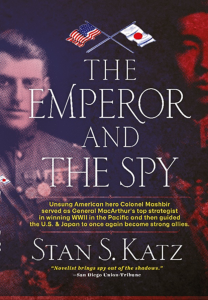
Author of The Emperor and the Spy

  • Home
  • Author
  • Books
  • Reviews
  • Educators
  • News
  • Audiobook & Timeline
  • Mashbir Archives
  • Tokugawa Archives
  • Contact
Follow Stan on FacebookFollow Stan on TwitterFollow Stan on GoodreadsFollow Stan on RSS

Sign Up for Future Blogs Linked to Colonel Mashbir and Japanese History

Read the Intro Posts

INTRODUCTION TO THE ART OF PEACE

WELCOME!

Recent Posts

  • San Diego Jewish Journal Holocaust Remembrance Edition May 2016 highlights the historical novel, The Emperor and the Spy and the outstanding achievements of Colonel Sidney Mashbir.
  • The Emperor and the Spy, was one of two books highlighted during academic/diplomatic event sponsored by the Prime Minister’s Office of Japan and hosted by San Diego World Affairs Council
  • Osher Lifelong Education Institute – UCSD Presentation. Remarkable story, the alliance between a patriotic U.S. Intelligence Agent, Colonel Sidney Mashbir, and a humanitarian Japanese International Statesman, Prince Iyesato Tokugawa, who heroically delayed and attempted to prevent WWII in the Pacific.
  • Tokugawa & Komatsu, Forgotten Heroes – Until his passing in 1940, Prince Iyesato Tokugawa held back WWII in the Pacific – Tokugawa’s diplomatic legacy lived on after WWII ended, when his protégé, Takashi Komatsu, guided the US and Japan to again become friends and allies.
  • Have you ever wondered how US and Japan re-established their friendship and alliance following the trauma of WWII? Here’s a new biography that honors an amazing Japanese American statesman, Takashi Komatsu, who guided this major achievement.

Archives

San Diego Jewish Journal Holocaust Remembrance Edition May 2016 highlights the historical novel, The Emperor and the Spy and the outstanding achievements of Colonel Sidney Mashbir.

May 29, 2025 by Stan S. Katz Leave a Comment

The first page of article has a photo of General Douglas MacArthur.

It was gifted to Colonel Sidney Mashbir and has an inscription from MacArthur to Mashbir.

This inscription gives a sense of the magnitude of Mashbir’s contributions to the Allies’ Victory in Pacific during WWII.

The inscription reads:

To Mashbir

With admiration and cordial regard from his old comrade-in-arms.

Douglas MacArthur

Tokyo – 1945


The Antiquarian and the Creative Writing

by Natalie Jacobs April 29, 2016

Sixteen years ago, Stan Katz had never written a book. The longtime owner of several antiquarian bookstores, Katz knew a lot about books, and had an extensive collection of classics. But he never considered writing one himself, until he heard the story of Colonel Sidney Mashbir.

It was 1999 when someone came into one of Katz’s bookstores with a box of photos and documents.

“I didn’t have any idea what I was really looking at other than it looked really interesting,” he says from his home office in Oceanside.

Katz could immediately gather that the documents were related to intelligence before and during World War II.

“My mom was an Auschwitz survivor and so was her sister. I’ve long had an interest in WWII and what was going on and how it came to be. And then all of a sudden I had the papers of a spy who was very integral in winning WWII, I found out.”

And so began Stan Katz’s investigation into the life and work of Colonel Mashbir, a little-known historical figure from a dense and complicated time period. To help decipher the personal letters and photos from the box he acquired that day in his bookstore, Katz purchased Mashbir’s autobiography, itself an antiquarian rarity (Mashbir’s son later gave Katz the rights to it).

That he had no experience with creative writing didn’t stop Katz from exploring possible ways to use this information, which he immediately felt touched on an important and untold story about a great but mostly forgotten man. Katz spent about a year working on a screenplay, but it didn’t have the “fullness” Katz was looking for. So he settled on an historical novel. But why fictionalize the story if it is so compelling?

“First of all,” he says, “when it comes to spies, you never know the whole story. What happened was, over and over again, I was told by [Mashbir’s] son, by others, that history, in a lot of people’s mind, is boring, it doesn’t engage people.”

To Katz, this was primarily a spy story.

“I would come up with an action-packed espionage novel that’s 70 percent nonfictional in nature, 30 percent fictionalized.”

Katz says he tried to remain true to history even in the fictionalized parts, which required research into people and events that branched off from Mashbir himself. Take, for example, Charles Lindbergh.

“Whether he spoke to Mashbir or not at certain points,” Katz says, “wasn’t as significant as [the fact that Lindbergh] was leading an isolationist movement in America to prevent us from going into WWII. You’ll understand that Henry Ford and Charles Lindbergh were leading a massive effort to keep us out of WWII, regardless of what the Jews were going through.”

So instead of a screenplay, in order to explore the depth of not only this figure Mashbir but also the complications of the WWII era, Katz wrote a 500-page novel called “The Emperor and the Spy, The Secret Alliance to End WWII.” The editing process alone took five years.

Sidney Mashbir was Jewish, and very early on in the book, Katz has Mashbir confront that Jewish identity. He’s young and in the Arizona guard, about to embark on a mission to bring the Mexican revolutionary Poncho Villa to a meeting with General John J. Pershing. One of his colleagues says, “Mashbir, is that Jewish?” Mashbir brushes it off, ignoring the question.

“His grandfather was very Jewish Orthodox,” Katz explains. “He forced Mashbir’s mother to move from Tucson where there weren’t that many Jews at the time [late 1800s], to New York to marry a Jewish Russian immigrant. They married, they have a very unhappy marriage. They go back to the Southwest, they try to make it work but Mashbir sees this constant conflict between his Jewish parents and his grandfather who is Orthodox.

“I have to interpret this,” Katz concludes, from his interviews with Mashbir’s son and other genealogical research.

“He got into the military first in 1904. How were Jews treated in our country? How were they seen? Most wouldn’t even be broadcasting that they’re Jewish.”

After a series of military starts and stops, in 1942 General Douglas MacArthur tapped Mashbir to lead the Allied Translator and Interpreter Section (ATIS) within the Southwest Pacific Area. This was a group of nearly 5,000 intelligence agents working to investigate Japanese war crimes.

Katz pulls out a narrow pamphlet filled with names. It’s a list of all the Japanese enemies identified by ATIS; Mashbir’s personal copy.

Katz discovered that Mashbir’s greatest ally in the Japanese government was Emperor Hirohito’s right-hand man, Prince Iyesato Tokugawa.

“There was an intimacy between Mashbir and Tokugawa,” Katz says, holding up a greeting card sent to Mashbir from Tokugawa, and flipping to a photo of the two at a “prestigious luncheon” in Japan.

“[Mashbir] said Prince Tokugawa was so important that if he hadn’t died, the Japanese would not have allied with the Axis Powers. [Mashbir] said that in his autobiography.”

Katz makes the connection that three months after Tokugawa died, in June of 1940, Japan allied with Germany.

“What Mashbir and the war in the Pacific taught was there was a rising fanaticism who felt they were superior to other races and other creeds and they were going to take over by force. The story depicts how the counter effort was – here are individuals, statesmen, who are trying to use cultural, art, science, music interchange, student exchanges, all these different means to create bridges between people so as to prevent conflict and not let militant extremists, close-minded, narrow-minded people, take over.”

For Katz, the fact that Mashbir himself was ultimately unsuccessful in that effort does not diminish his legacy or the importance of diplomacy.

“Mashbir’s insight into the Japanese culture was such that he was able to guide General MacArthur and other leaders, when the war ended, how best to treat occupied Japan and how best to lead it so that it could become the democratic country that we could be allies with.

“We went into a country like Iraq,” Katz says, bringing the argument to present day, “without really understanding the culture, the leadership, how to move forward, and the country fell apart into civil war. The same thing could have happened in Japan.”

Since publishing “The Emperor and the Spy,” Katz has also completed a 300-page online timeline, which chronicles Mashbir and many of the people he came in contact with throughout his life. That document includes rarely seen photographs of Japanese leaders and members of the U.S. military and general society, from documents that Katz has added to his personal collection throughout the years. One of his goals for the book is to see it used in high school and college courses.

“One of these days, it will be used in teaching a very strong message about why the state of Israel happened, how the Holocaust preceded, and about an American Jewish spy who had major impacts in us winning a war. I think he’ll be a household name.”

Katz’s next book project will be a biography on Prince Tokugawa.

Colonel Sidney Mashbir is buried at Fort Rosecrans in Point Loma. Details on the fictionalized account of his life can be found online at TheEmperorAndTheSpy.com


The second page of article shown below may be hard to read.

For easier reading, the above Transcription was given.


Front cover: May 2016 San Diego Jewish Journal Holocaust Remembrance Edition


BELOW is a Letter to the Publisher of San Diego Jewish Journal, Mark Moss. This letter led to the above magazine article being written.

Dear Dr. Mark Moss,

I hope all is well.

It’s been years since we last met. We have some mutual friends. We spoke to one another at a couple of festive gatherings. Just like yourself, I’m a Dentist whose career went in a very different direction.

Last time we spoke, I mentioned an historical novel I was working on, that had strong connections to Jewish History. You kindly offered to include an announcement or an article linked to the release of this book in the San Diego Jewish Journal.

After sixteen years of writing and research this novel and a website linked to it, are finally completed.

Below are some of the details of this project:

-The title of the novel is, The Emperor and the Spy. It is quite unique, in that it was inspired by my acquisition of the secret personal papers, official documents, and photographs of an American Military Intelligence Officer.

This novel has a strong Jewish theme for various reasons:

1- I’m Jewish and my mother was an Auschwitz survivor.

2- The novel depicts the events leading up to and during the Holocaust, and emphasizes the need for the creation of the State of Israel.

3- The main protagonist in the novel is an unsung hero, an Intelligence agent of Jewish heritage, named Colonel Sidney Mashbir. This master spy allied with top Japanese leaders during the 1920s and 1930s, including members of the Japanese Royal Family. They valiantly attempted to prevent hostilities in Asia, and prevent conflict between their two nations and the outbreak of WWII.

4-Regrettably, when WWII erupted, this intelligence agent of Jewish Heritage, took a major role in defeating the Axis Powers in the Pacific Theater of War. The significant role he took in winning that war will bring pride to the Jewish community, as well as recognition and respect from the general American Public. Colonel Mashbir and the large intelligence organization, ATIS (Allied Translator and Interpreter Section), that he commanded shortened that war by two years!

5- It was surprisingly to discover that one of the peace-loving Japanese leaders who allied with this spy (who is prominently highlighted in the novel), took a pivotal role in the creation of demilitarized “safe zones” in China, that helped save the lives of tens of thousands of Jewish refugees fleeing the Holocaust. These “safe zones” also provided haven to hundreds of thousands of Chinese civilians during the years leading up to and during WWII.  This Japanese statesman, Prince Iyesato Tokugawa, an unsung humanitarian hero, put his life in great danger resisting the militarists in his own country and elsewhere, who wanted war.

6- An extensively documented 125 page Application in the name of Prince Iyesato Tokugawa has been created. This application is going to be sent to the commemorative organization in Israel, Yad Vashem. The goal being, that this Japanese statesman receive the honorary recognition of Righteous Among the Nations. This information will also be sent to other humanitarian organizations such as the U.N. to acknowledge this amazing individual.

You’re invited to explore the website, TheEmperorAndTheSpy.com to learn more. This website displays many of the historical documents that inspired the novel.

Please let me know how we might proceed to bring out this story in the San Diego Jewish Journal, honoring unsung heroes from the past.

Thank you so much for your time and attention,

Stan S. Katz

P.S.

Attached to this Letter is the following:

The National Veterans’ Organization, JAVA (Japanese American Veterans Association), reviewed my website’s historical materials and read the novel. They wished to show their support by highlighting the Release of the novel and the website on Page 17 of their 2016 Summer Quarterly Newsletter. That article is included with this email.


Filed Under: Mashbir Archives Tagged With: Colonel Mashbir, Colonel Sidney Forrester Mashbir, Colonel Sidney Mashbir, Dr. Stan Katz, Holocaust, Holocaust History, Japan and the Holocaust, Jews fleeing Holocaust, Mark Moss, Natalie Jacobs, Prince Iyesato Tokugawa, Prince Iyesato Tokugawa Archives, Prince Tokugawa, Prince Tokugawa Iesato, Publisher of San Diego Jewish Journal, San Diego Jewish Journal, Sidney Mashbir, Stan S. Katz, Stan S. Katz archives, Stan S. Katz blog, The Antiquarian and the Creative Writing, US Japan relations

For Highlighting the Legacy of Great Leaders who Strove for Peace & Democracy and Fought Against Racism, Author/Historian Dr. Stan S. Katz was nominated for the Dr. Martin Luther King, Jr., Community Service Award

February 13, 2023 by Stan S. Katz 6 Comments

Dear Friends,

Here is an illustrated article which honors the memories of significant Black, Asian, and Caucasian historical figures who creatively and peacefully utilized the intercultural exchange of art, music, education, and diplomacy as well as working through the political and legal systems to improve race relations – International disrespect and racism has often been a catalyst towards conflict. By gaining new insights from history, we discover better answers for dealing with our challenging issues of today.

Over the past twenty years, I’ve written historical works which honor significant, but often forgotten individuals who devoted their lives to promoting peace, democracy, and strove to confront racism. Based largely on this, in combination with volunteer activities and membership in public affairs organizations, such as the San Diego World Affairs Council, I was nominated for the Dr. Martin Luther King, Jr. Community Service Award. The below article highlights the Award Ceremony and Prayer Breakfast honoring the memory of MLK, and gives an introduction to the historical work I’ve written, including some rare photos discovered during my research.

Dr. Martin Luther King, Jr. Community Service Award for 2023

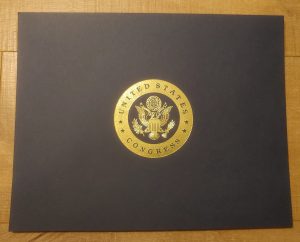
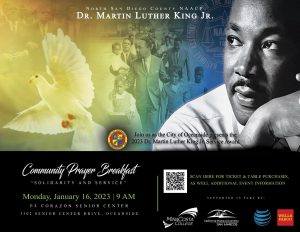
Above is the Front Cover of the Event Booklet distributed at this Community Prayer Breakfast and Award Event. It contains short bios of the nominees for the award, and includes descriptions of the speakers and honors various organizations that supported this inspiring gathering.

Sponsored by City of Oceanside and North San Diego County NAACP

Award Ceremony took place on MLK Day, January 16th, 2023.

This article was written by Dr. Stan S. Katz, who felt gratitude and was emotionally touched to be one of the nominees.


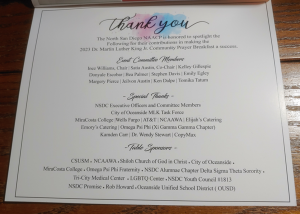
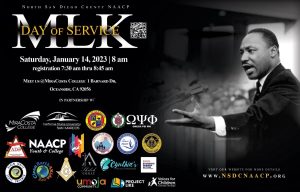
Below is the Back Cover of the Event Booklet – During the weekend prior to the above event, members of the North San Diego County NAACP working in partnership with other community organizations, held a DAY OF SERVICE to honor the memory of Dr. King – Volunteers came together to to help those in need in our community.


US Congressman Mike Levin gives a stirring speech, describing how he once personally accompanied US Congressman John Lewis (1940 – 2020) over the Edmund Pettus Bridge in Selma, Alabama. This was done in commemoration for that important historical event in the movement towards a more inclusive democracy and equal treatment of the races. Levin stated this important moment helped shape his social values to improve the treatment of all of our nation’s citizens. John Lewis  was often called the conscience of the congress.

Uplifting speeches were also given by Senator Catherine Blakespear, District 38, California State Legislature, and Mayor Esther Sanchez of the City of Oceanside.


The Dr. Martin Luther King, Jr. Community Service Award is an annual award given to a resident of the City of Oceanside or member of the U.S. Armed Forces stationed at Marine Corps Base (MCB) Camp Pendleton. The award is given to a resident who exemplifies the ideals and teachings of Dr. Martin Luther King, Jr. who worked to advance civil rights, equal education, labor, and voter rights and who fought racial inequality through non-violence and civil disobedience. The Community Service Award began thirty years ago as a way to recognize persons in the community who have given time and energy through volunteerism to improve community life, develop positive relations in the community, and enhance the lives of individuals. The award has no restrictions as to race, ethnicity, gender, or type of service and is open to any resident of Oceanside or MCB Camp Pendleton. The North San Diego County Chapter of the NAACP partners with the City of Oceanside in presenting this Community Award.

All nominees for the 2023 Dr. Martin Luther King, Jr. Community Service Award receive the following:

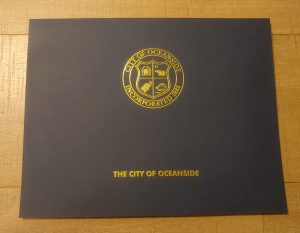
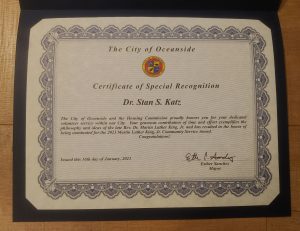
– A Certificate of Special Recognition from the City of Oceanside, issued January 16th, 2023 from Esther Sanchez Mayor

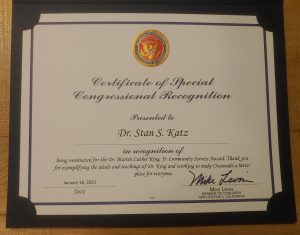
– A Certificate of Special Congressional Recognition from Mike Levin, Member of the U.S. Congress 49th District, California, issued January 16th, 2023

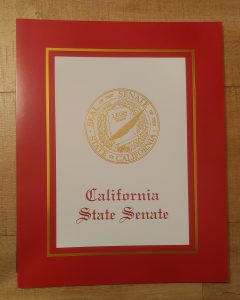
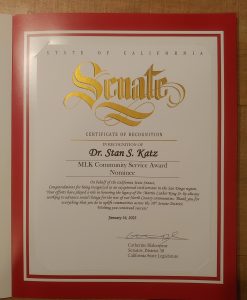
– A Certificate of Recognition on behalf of the California State Senate, from Catherine Blakespear Senator, District 38, issued January 16th, 2023


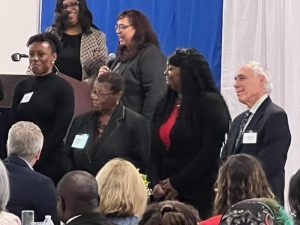
Upon the stage, behind the podium, in the brown jacket is Inez Williams, Events Chairman for the North San Diego County NAACP – Holding the microphone is Mayor Esther Sanchez of the City of Oceanside – In front of them are four of the five nominees for the 2023 Dr. Martin Luther King, Jr. Community Service Award. Mrs. Karen Williams Graham was one of the nominees, but is out of the frame of the above photo. The four nominees present in the above photo from left to right: Captain Lakyra Pharms; Eleanor Juanita Evans; Satia O. Austin; and Dr. Stan S. Katz.


Satia O. Austin receives the Dr. King Community Service Award.

Then Mayor Esther Sanchez presents the proclamation for Dr. King Day of Service and Community Breakfast Weekend, with special acknowledgement to NSDC NAACP, MiraCosta College Service Learning and Beatriz “Bea” Palmer.


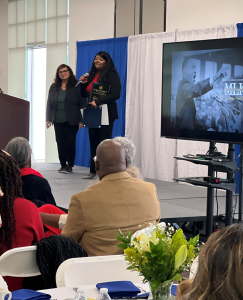
Satia O. Austin, after winning the Dr. Martin Luther King, Jr. 2023 Community Service Award, gives an acceptance speech describing her passion to help others in our community. A most inspiring woman.


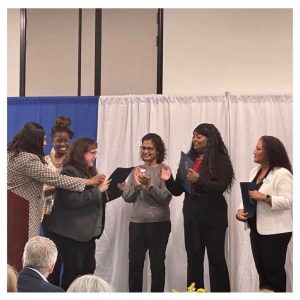
All of the Dr. Martin Luther King, Jr. Community Service Award nominees received Certificates of Recognition from US Congressman Mike Levin, California State Senator Catherine Blakespear, and Oceanside Mayor Esther Sanchez.


Over the past twenty years, I’ve done historical research and written books honor great individuals who promoted peace and democracy, and sought to eliminate racism. Below are books I’ve written linked to these goals. My nomination for the MLK Community Service Award from the City of Oceanside and the NSDC NAACP was based on these books and research, as well as community volunteer service I’ve given over many years.

This historical novel reveals the thrilling adventures of a brilliant US Army Intelligence Agent, Colonel Sidney Mashbir (1891-1973). Mashbir’s fascinating career in espionage began in the American Southwest during the early 1900’s, maintaining stability along the U.S.- Mexico border during the Mexican Revolution.

During the 1920s, Mashbir moved to Japan and became a Japanese linguist. Throughout that decade and through the 1930s, he befriended some of the most influential Japanese leaders. And together, at great personal risk, they heroically resisted militarists pushing towards war. Instead, Mashbir and his Japanese allies creatively supported goodwill between the US and Japan, delaying and almost preventing WWII in the Pacific – However, that conflict could not be avoided.

The novel highlights the great contributions that Japanese Americans gave to their adopted nation during the war, despite the discrimination and injustices they faced in the United States prior to, and then greatly magnified during those war years. When 120,000 mainly Japanese American US citizens were incarcerated in internment camps, when they had done nothing wrong. Often with the loss of their possessions and the major disruption of their personal, educational, vocational lives. It was a dark moment in US History.

As for Colonel Sidney Mashbir, with the outbreak of war, he became General MacArthur’s top military strategy advisor in winning that conflict. And once it was over, he helped guide the US and Japan to once again become strong allies.

Mashbir often worked with his Navy buddy, the future Rear Admiral and Deputy Chief of Naval Intelligence, Ellis Zacharias (1890 – 1961). These good friends were early pioneers in the creation of the CIA.

To learn more, you’re invited to visit: TheEmperorAndTheSpy.com


-Colonel Mashbir’s most influential Japanese ally and close friend was Prince Iesato Tokugawa – aka Iyesato Tokugawa (1863-1940). Tokugawa was the leading advocate of Japan’s international peace and democracy movement during the first four decades of the 20th Century.

For 30 of those years, he served as President of Japan’s upper house of congress, the House of Peers. I felt privileged to have the opportunity to write about this unsung hero and humanitarian, who deserved a biography highlighting his fascinating life and outstanding accomplishments.

During the 1920s and 1930s Prince Tokugawa incorporated Lincoln Essay Contests into all Japanese Public Schools and Colleges to Fight Racism and Honor the Values of President Lincoln. Recognition was given to the students who best described those values.

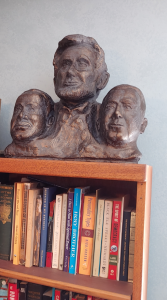
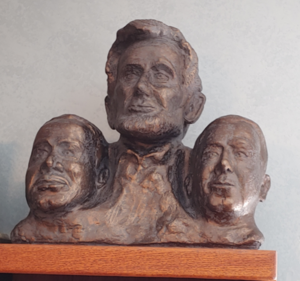
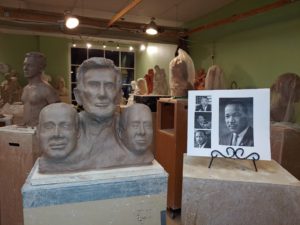
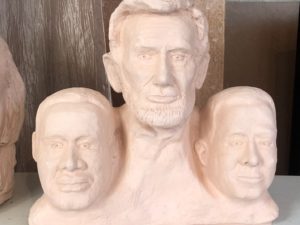
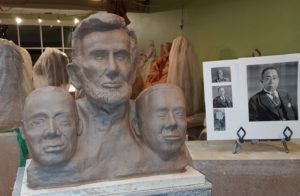
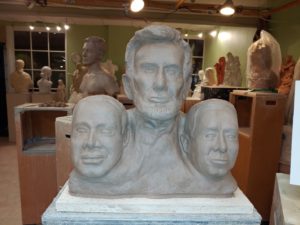
I created the below sculpture in order to capture and honor the essence of three significant Men of Peace, who promoted Human Dignity and Racial Equality,

President Abraham Lincoln (February 12, 1809 – April 15, 1865)

Dr. Martin Luther King, Jr. (January 15, 1929 – April 4, 1968)

Prince Iyesato Tokugawa (徳川 家達, August 24, 1863 – June 5, 1940)


Tokugawa loved his own Japanese culture. He also came to love the peoples and cultures of the West. This was despite the anti-Asian and anti-Black racism he often saw during his travels across the US. Prince Tokugawa, like Dr. King, recognized the common brotherhood of humanity.

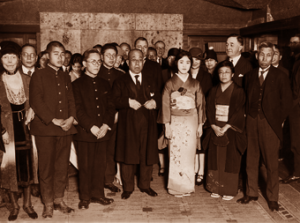
Photo: February 19, 1929 Award Presentation for the student winners of the Third Lincoln Essay Contest which was held at the Imperial Hotel, Tokyo. Prince Tokugawa was the President of the America-Japan Society which sponsored the event.

Prince Tokugawa (front center) and Count Aisuke Kabayama (at far right). This illustration is courtesy of the America-Japan Society. This fine organization, located in Japan, was founded in 1917 and continues to this day to promote amity and mutual understanding between the Japanese and American people. Prince Tokugawa was its 2nd president from 1924 until his passing in 1940. To learn more, here is the internet link to the America-Japan Society:    http://ajstokyo.org/en-home/


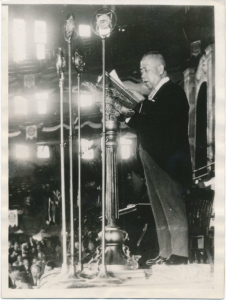
In 1930, Tokugawa was selected as the Keynote Speaker at the 25th Anniversary Celebration for Rotary International held in Chicago. There, he presented a speech encouraging peaceful international relations to 15,000 fellow Rotarians gathered from around the world.

The New York Times, June 27, 1930, press photo: “Japanese Prince Addresses Rotarian Convention: In an address of international importance, before 15,000 Rotarians assembled in Chicago for their Silver Anniversary Jubilee.” The following are two excerpts his inspiring speech, which was titled ‘National Aspirations.’

“Japan’s foremost aspiration is to cultivate the arts of peace and live at peace with her neighbors, near or distant, great or small.”

“Peace is a continuous process. Like liberty, peace demands “eternal vigilance” as its price. To the goal of peace, there can be no short cut.”


Prince Tokugawa was to be the Heir to the last powerful ruling Shogun. However, when that 265 year old dynasty ended in 1868, he instead took to the world stage as an international statesman. As a Renaissance man and adept diplomat, he creatively shared his passion for the arts, music, culture, science, athletic sports, and nature to establish bridges of friendship and understanding between the East and the West, while also promoting mutual respect within Asia. He is a fine role model for our current leaders dealing with the urgent issues of today that require international cooperation to solve.

Tokugawa supported higher education and a greater voice for women in public affairs. And despite his major influence, he maintained his humility. Often working behind the scenes, remaining unrecognized for many of his important achievements. Colonel Mashbir described Tokugawa as the true hidden power behind the Japanese Imperial Throne, and that he was so influential, that it was only after his passing in 1940, that militants were able to push Japan towards war with the Allies.

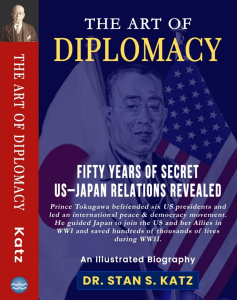
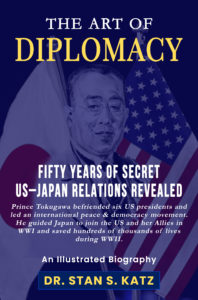
Two versions of the Prince Tokugawa’s biography were written: The Art of Diplomacy & The Art of Peace.

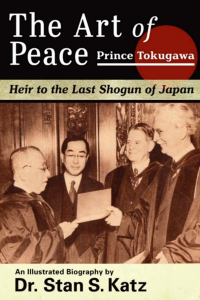
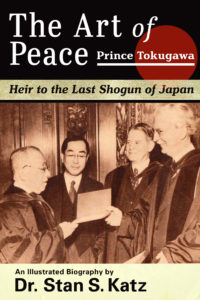
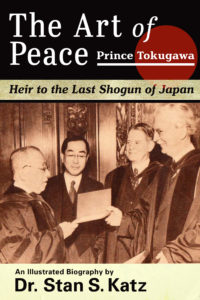
The Art of Peace book cover displays a 1934 photo of Tokugawa receiving an Honorary Doctor of Law Degree from the President of the University of Southern California for his lifelong philanthropic & academic contributions and for his promotion of respectful East / West relations. Tokugawa’s son is also in the photo, as is the President of USC’s Board of Directors. The following year, USC presented the same honorary award to President FDR.


To encourage respect between Japan and China, Prince Tokugawa and his influential Japanese industrialist ally & friend, Baron Shibusawa, incorporated Chinese literature courses into Japan’s colleges with hopes it would encourage better inter-cultural understanding and prevent conflict.


However, WWII could be delayed, but not prevented. So as to save innocent civilian lives, Prince Tokugawa, as President of the Red Cross Society of Japan, served as Chairman of the 1934 International Red Cross Conference held in Tokyo – During that significant global gathering, they approved the establishment of demilitarized “safe zones” in war-torn China, which prior to, and during WWII, provided refuge for tens of thousands of European Jews fleeing the Holocaust and also offered safety for hundreds of thousands of Chinese civilians.

  • One would hope that recognition of this major Japanese humanitarian achievement might help improve current strained relations between China and Japan, leading to greater regional stability, cooperation, and amity.


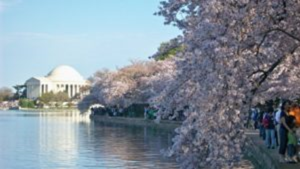
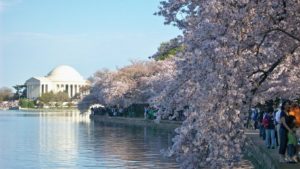
And to establish an ongoing legacy of U.S. – Japan friendship, Prince Tokugawa guided the Japanese gifting of cherry blossom trees to the U.S. in 1912, into becoming the National Cherry Blossom Festival in 1935. This delightful yearly celebration continues to this day in Washington, D.C., and is one of our nation’s largest and most popular international goodwill events.


The Legacy of Prince Tokugawa’s Respect for Human Equality linked to President Abraham Lincoln Lives On

Prince Tokugawa went beyond judging others by their race, creed, or color, as revealed by his sponsorship of Lincoln Essay Contests in all Japanese public schools and universities during the 1920s and ’30s. He would be delighted to know of the continued friendship between the U.S. and Japan, and that future Japanese and U.S. leaders would join together to recognize the importance of President Lincoln’s universal message. Perhaps, someday, Essay Contests will be sponsored in schools of the U.S., Japan, and other nations, honoring the fine values of Iesato Tokugawa.

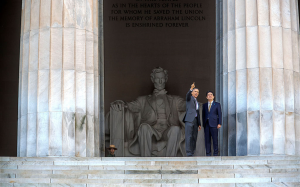
April 27, 2015: U.S. President Barack Obama and Prime Minister of Japan Shinzo Abe tour the Lincoln Memorial. They are looking towards the Washington Monument on the National Mall in Washington, D.C. Prime Minister Abe was in Washington, D.C. for meetings with President Obama. Abe also attended a state dinner in his honor at the White House the following night. A U.S. administration official described the above photo as follows:
“This is an opportunity before the formal events tomorrow to spend time together one-on-one at a place of historical significance for the United States, as this month marks both the 150th anniversary of the Civil War’s end as well as President Lincoln’s passing…”

The above photo and description of the diplomatic meeting between President Obama and Prime Minister Abe, comes from the conclusion of the Prince Tokugawa biography. The goal of my books is that they bring inspiring leaders from the past, back to life, igniting an interest, even a passion for history. To be enjoyed by the general public and shared in academic curriculum.


MORE INFORMATION ABOUT THE DR. MARTIN LUTHER KING, JR. EVENT

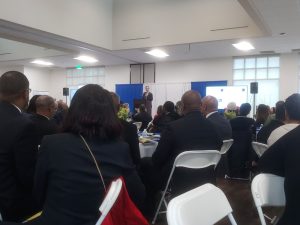
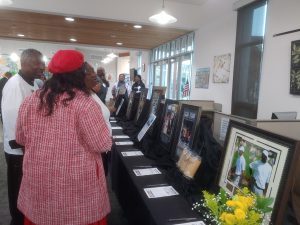
It was inspiring seeing the 300 attendees to the Dr. King Community Prayer Breakfast. Many of these individuals are active in organizations that work to create a more positive and inclusive community where we look out for one another with friendship and respect. In the below photo, Silent Auction items are on display – Proceeds going to support the many fine services given by the North San Diego County Chapter of the NAACP.

During this gathering:

Two talented high school teenagers were recognized as part of this wonderful event. One sang an emotionally connecting song, another contributed artwork for the Silent Auction Fundraiser for the NSDC NAACP.

There was also an impressive 7 year old girl who expressively danced on the front stage as uplifting music was played, the audience came to their feet in applause.

The breakfast was delicious and the company friendly and welcoming to one another.

Representatives of Mira Costa College, also the Captain and several City of Oceanside police officers were in attendance. Other City of Oceanside officials and other San Diego community groups were also represented.

A Reverend gave a meaningful prayer of appreciation before a delightful breakfast was served.


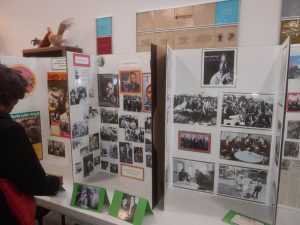
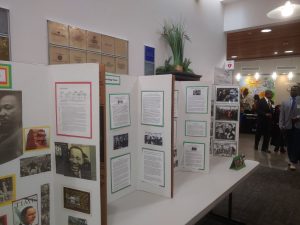
Gary Rossell (shown below), and his wife Carolyn, are founders of the Rossell African-American History Awareness Museum. They regularly travel around the county to bring their beautifully illustrated and inspiring exhibits to public social justice commemorative events, such as this Dr. Martin Luther King, Jr. community gathering.


Carolyn Rossell (above, her side view to the camera), along with her husband, Gary, created this wonderfully inspiring educational exhibit.

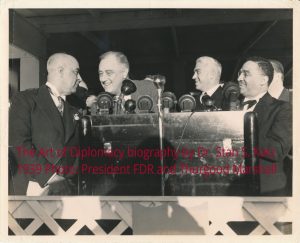
I showed Gary and Carolyn Rossell the rare 1939 photo below. This Photo was discovered and identified while doing historical research that honors the legacy of Thurgood Marshall (Marshall is at far right in photo).

Gary and Carolyn expressed great interest in utilizing this unique piece of history as part of an upcoming exhibit to honor the accomplishments of Thurgood Marshall, our nation’s first Black US Supreme Court Judge.

Marshall took a major role in gaining equal rights for all citizens in our nation and was a driving force in the growth of the NAACP. In the above photo, the 31 year attorney Marshall allies with President FDR to advance the treatment of Black Workers. Marshall was then on the Legal staff of the NAACP. The following year, 1940, he was selected Chief of the NAACP Legal Defense and Educational Fund, which was created to mount a legal assault against segregation. Marshall became one of our nation’s leading judicial voices. He argued 32 cases before the U.S. Supreme Court, winning 29.

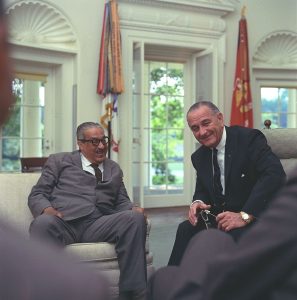
June 13th, 1967: Thurgood Marshall meets in friendship and mutual respect with President Lyndon B. Johnson in the Oval Office of the White House on the day that Marshall was nominated by Johnson to serve on the Supreme Court. Photo courtesy of the LBJ Museum & Library


Acknowledgments

  • It was a pleasure to meet Joe Farmer, who was seated at my same table. In 2009, he was the recipient of the Dr. Martin Luther King, Jr. Community Service Award. During his 40 years of service at Camp Pendleton, he oversaw upkeep and maintenance. In addition, he served as Commissioner of Housing for the City of Oceanside.
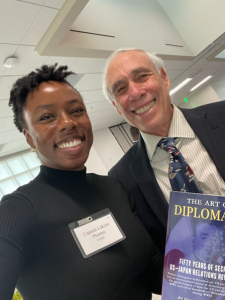
  • Also seated at our table was US Marine Captain Lakyra Pharms (shown below), one of the five nominees for the 2023 award.

During the event, I gifted a copy of the illustrated biography, The Art of Diplomacy to Captain Lakyra Pharms. Lakyra suggested we take a photo, and above is results. Lakyra’s significant community achievements, as that of the other nominees are included in the Event booklet shown at the top of this article, which was distributed at the event. Lakyra mentioned the future possibility of going towards a career in the diplomatic service.

Several of the above photos of the MLK Community Service Award nominees were kindly provided by Joseph Farmer, the 2009 Recipient of the Dr. Martin Luther King, Jr. Community Service Award.

Thanks also go to Bea Palmer, an active member of the NAACP, who helped bring about this MLK commemorative event. Bea Palmer is Vice-President – Board of Directors of “Operation HOPE” – North County San Diego, whose mission is to provide a safe environment for both families with children and single women who are experiencing homelessness and to help support them as they rebuild their lives and regain HOPE.” Bea Palmer is also actively involved at MiraCosta College, encouraging bright young students to engage with and improve their community.

Below is a link to learn more about Bea Palmer and the MiraCosta College Service Learning program mentioned above:   https://hub.miracosta.edu/meet/profile.aspx?id=65

I also had the pleasure of meeting Margery Pierce, who took an active part in setting up this MLK event. She was the Director of Neighborhood Services for the City of Oceanside.

Appreciation goes out to the representatives of the North San Diego County NAACP for supporting this community event. “The NAACP’s mission is to achieve equity, political rights, and social inclusion by advancing policies and practices that expand human and civil rights, eliminate discrimination, and accelerate the well-being, education, and economic security of Black people and all persons of color.”

There were many other individuals and organizations who took a significant role in making this wonderful event come to life. Gratitude goes out to all of them! The following illustration was the last page of the booklet that was distributed at this gathering. It highlights many of those who generously supported this event.


Filed Under: Tokugawa Archives Tagged With: Anti-Asian Racism, Anti-Black Racism, Beatriz “Bea” Palmer, Black History, Black History Month, Black Supreme Court Judge, Captain Lakyra Pharms, Carolyn Rossell, Colonel Mashbir, Colonel Mashbir Archives, Diplomacy of Peace, Dr. Katz, Dr. King Community Prayer Breakfast, Dr. Martin Luther King, Dr. Martin Luther King Jr. Community Service Award, Eleanor Juanita Evans, Emperor Hirohito, FDR, Gary Rossell, History of the NAACP, Japan History, Jean Rossell, Joseph Farmer, Margery Pierce, Mayor Esther Sanchez, MiraCosta College, MiraCosta College Service Learning, MLK Day, Mrs. Karen Williams Graham, NSDC NAACP, Oceanside, Operation HOPE” - North County San Diego, Peace Diplomacy, President Lyndon B. Johnson, Prince Iyemasa Tokugawa, Prince Iyesato Tokugawa, Prince Iyesato Tokugawa Archives, Prince Tokugawa, Representative John Lewis, Representative Mike Levin, Rossell African-American History Awareness Museum, Satia O. Austin, Senator Catherine Blakespear, Stan S. Katz, Stan S. Katz archives, Stan S. Katz blog, Stan S. Katz nominated for Dr. Martin Luther King Jr. Community Service Award, Takashi Komatsu, The art of diplomacy, The Art of Diplomacy biography, The Art of Peace, The Art of Peace biography, The Emperor and the Spy, Thurgood Marshall, U.S.-Japan History, US Congressman Mike Levin, US Supreme Court

Prince Tokugawa during the 1920s and 1930s incorporated Lincoln Essay Writing Contests into all Japanese Public Schools and Colleges to Combat Racism while Honoring the Humanitarian Values of President Abraham Lincoln.

February 8, 2021 by Stan S. Katz Leave a Comment


This bronze sculpture honors three great individuals.

Men of Peace who promoted Human Dignity and Racial Equality.

President Abraham Lincoln (February 12, 1809 – April 15, 1865)

Dr. Martin Luther King Jr. (January 15, 1929 – April 4, 1968)

Prince Iyesato Tokugawa (徳川 家達, August 24, 1863 – June 5, 1940)


Martin Luther King Jr. is well known as an American Christian minister and activist who became the most visible spokesperson and leader in the Civil Rights Movement from 1955 until his assassination in 1968. On October 14, 1964, King won the Nobel Peace Prize for combating racial inequality through nonviolent means, inspired by his Christian beliefs and the nonviolent activism of Mahatma Gandhi.

Prince Iyesato Tokugawa (aka Tokugawa Iesato) was born during the American Civil War and would come to admire the values of Abraham Lincoln. During the early 1860s, Iyesato’s adopted father Shogun Tokugawa Iemochi received a personal letter from President Abraham Lincoln encouraging a close friendship between the United States and Japan. Ironically, Iyesato’s life would have similarities to that of Abraham Lincoln, both national leaders who went through a moral, constitutional, and political crisis leading to a civil war in their nations.

The years leading up to WWII saw a growing militarist and fascist movement taking over Japan, disrupting the democratically elected and peace loving Japanese congress. This Japanese militarists’ goal was to expand territorially into neighboring nations. Prince Tokugawa working his allies, including Shibusawa Eiichi, incorporated the study of Chinese literature classics into Japanese schools to encourage respect for the culture of their neighbor and thus promote good relations between these two countries. Tokugawa also shared Japanese cultural treasures through a impressive art exhibition sent to the United States as a means of bridging these two nations. 

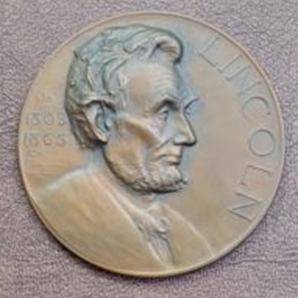
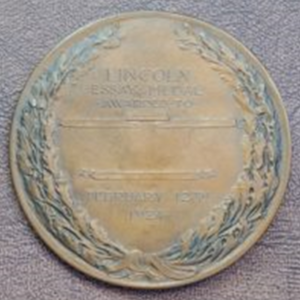
Historically, racism against Asians in the United States goes back to the mid-1800s into the first few decades of the 1900s. In response to this, Prince Tokugawa wished to guide Japan to take a more enlightened path. During the 1920s, Tokugawa incorporated Lincoln Essay Contests into all of Japan’s public schools and public universities. Large bronze commemorative medallions with the face of Abraham Lincoln upon them were awarded to the students who best expressed the noble values of Abraham Lincoln and his struggle to end slavery and racism.


This photo highlights the February 19, 1929 Award presentation to the student winners of the Third Lincoln Essay Contest which was held at the Imperial Hotel, Tokyo. Prince Tokugawa was the President of the America-Japan Society which sponsored the event.

In photo: Prince Tokugawa (front center) and Count Aisuke Kabayama (at far right). This photo is courtesy of the America-Japan Society. This fine organization, located in Japan, was founded in 1917 and continues to this day to promote amity and mutual understanding between the Japanese and American people. Prince Tokugawa was its 2nd president from 1924 until his passing in 1940. To learn more, here is the internet link to the America-Japan Society:    http://ajstokyo.org/en-home/


The winners of these essay contests were awarded an impressive Abraham Lincoln Commemorative Medallion in recognition of their accomplishment.

Below is the front and back of the academic award, which was 3 inches in diameter. The award included a blue velvet lined display case. 


1930 Original Press Photo: Former US Ambassador to Japan Charles MacVeagh with Lincoln Essay contest winners, Japan. 

Back of the Photo states:                                              

“Winners of the Lincoln Essay contest under auspices of the Lincoln Centenary Assoc. and the Japanese-American Society photographed with American Ambassador when they receive prizes – Tokyo – left to right at the Imperial Hotel Miss Yuki Chiba, 1st prize; Ambassador Charles MacVeagh; Ichiro Kawasaki, 2nd prize and Tokuji Hasegawa, third prize. (Japan)”

Photo measures 8.5 x 6.5inches. Photo is dated 10-17-1930.  


TO LEARN MORE ABOUT PRINCE TOKUGAWA

Below are two versions of his illustrated biography:


AVAILABLE AS A DIGITAL EBOOK 

This expanded digital edition is largely identical to “THE ART OF DIPLOMACY”  but has an additional 100 pages of historical notes to assist researchers.


Description of the above book cover photo: 

Prince Iyesato Tokugawa receives an Honorary Doctor of Laws Degree from the University of Southern California (USC). Dr. Rufus B. von Kleinsmid President of the university bestows this degree.

This presentation took place during a special luncheon given March 19th, 1934 in Los Angeles that was hosted by George I. Cochran, President of the Board of Trustees of USC. Prince Tokugawa was accompanied by his son Iyemasa, the newly appointed Minister to Canada.

Left to right in photo: Prince Iyesato Tokugawa; Iyemasa Tokugawa; George I. Cochran; Dr. Rufus B. von Kleinsmid.


The Los Angeles Times stated that this honorary degree was given to Prince Iyesato Tokugawa:

“In recognition of distinguished service in international statesmanship,” and for his “support of many philanthropic and educational movements.”

In accepting the honor, Tokugawa respectfully said,

“He wished to receive this honor in the name of the Japanese people as a whole rather than as a personal distinction.”

The Los Angeles Times also said that a banquet dinner was to be hosted by the Japan-America Society of Los Angeles, to honor Prince Tokugawa’s visit. The Governor of California and the former Mayor of Los Angeles planned to attend.


AVAILABLE IN PRINT AND KINDLE EBOOK EDITIONS


FOR THOSE WHO WISH TO LEARN MORE ABOUT THE CREATION PROCESS FOR SCULPTURES

Presented below are some of the steps involved for the bronze sculpture presented earlier.

-Photos of these fine statesmen were first gathered which presented them from various angles to assist in gaining a three dimensional perspective.

-Blocks of clay are then sculpted (carved) into a general representation.

President Abraham Lincoln (February 12, 1809 – April 15, 1865)

Dr. Martin Luther King Jr. (January 15, 1929 – April 4, 1968)

Prince Iyesato Tokugawa (徳川 家達, August 24, 1863 – June 5, 1940)


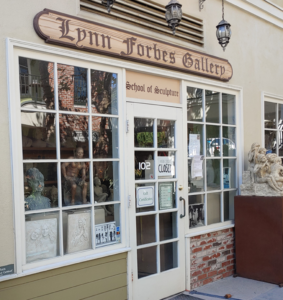
This sculpture was created by the author of this blog post at the Lynn Forbes Sculpture Studio in the city of Carlsbad, California 2020. The above sculpture photo was taken inside that fine studio, whose exterior is shown in the below photo.


-Once the piece is completed, the clay is allowed to dry at room temperature for six weeks.

-Then it is baked at a high temperature which further hardens the material and turns the clay to a pinkish color.

Dr. Martin Luther King Jr. and Prince Iyesato Tokugawa symbolically stand on the shoulders of President Abraham Lincoln, continuing and promoting his legacy against racism.

These great individuals all put their lives on the line promoting their humanitarian beliefs.


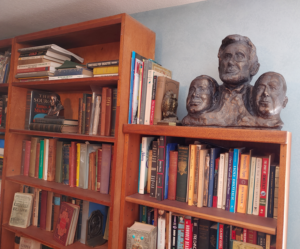
A Bronze patina finish can be applied to the sculpture and the finished work can now remain as a hardened clay sculpture or it can be cast as bronze sculpture.


The above photo presents the statue in the author’s office.

A limited edition of this statue will be gifted to various organizations that promote positive international relations and social justice. 


Filed Under: Tokugawa Archives Tagged With: Abraham Lincoln, Abraham Lincoln and Japan, Abraham Lincoln Commemorative Medal, Baron Eiichi Shibusawa, Baron Shibusawa, Baron Shibusawa Eiichi, Charles MacVeagh, Chinese History, Diplomacy, Dr. Martin Luther King, Eiichi Shibusawa, History of the Cherry Blossom Festival in Washington D.C., Honoring Abraham Lincoln, Ichiro Kawasaki, International Friendship, Japan History, Japan U.S. Relations, Japanese-American Society, Lincoln Centenary Association, Lincoln Essay Contest, Martin Luther King, Miss Yuki Chiba, President Abraham Lincoln, prince iyesato tok, Prince Iyesato Tokugawa, Prince Iyesato Tokugawa Archives, Prince Tokugawa, Prince Tokugawa Archives, Prince Tokugawa Iesato, Prince Tokugawa Iesato Archives, Stan S. Katz, Stan S. Katz blog, Statue, Statue of Abraham Lincoln, Statue of Dr. Martin Luther King, Statue of Prince Tokugawa, The Art of Peace, The Art of Peace biography, TheEmperorAndTheSpy.com, Tokuji Hasegawa, U.S. Japan relations, U.S.-Japan History, US Ambassador Charles MacVeagh, US Ambassador to Japan Charles MacVeagh, US Japan relations, World War Two, 徳川 家達, 渋沢 栄

Prince Tokugawa’s Pivotal Role in Establishing the National Cherry Blossom Festival in Washington, DC.

May 2, 2020 by Stan S. Katz Leave a Comment


Prince Iyesato Tokugawa guided the Japanese gifting of the cherry blossom trees to the U.S. Capital in 1910 and 1912 into becoming an international token of goodwill which is now officially known as the annual National Cherry Blossom Festival – His behind the scenes role in accomplishing this diplomatic success was discovered while researching for the illustrated biography on Prince Tokugawa, titled: THE ART OF PEACE.

[Note: Prince Tokugawa (1863-1940) while traveling outside of Japan went by the name Prince Iyesato Tokugawa, while in Japan, he was known as Prince Tokugawa Iesato.]

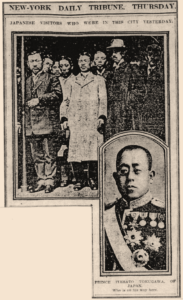
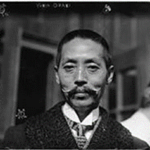
The above May 5, 1910 New York Daily Tribune announced the coming arrival of Prince Iyesato Tokugawa to New York City, following his visit to Washington, D.C. Scheduled to coincide with the arrival of Prince Tokugawa, was the recent arrival of a delegation of sixty Japanese. Prince Tokugawa and his delegation had spent time together in the U.S. Capital, prior to visiting New York City. Several of the Japanese delegation are shown in the newspaper photos. The individual standing between the gentlemen in the long white coat and the individual in the white hat is  Yukio Ozaki Mayor of Japan’s capital city of Tokyo, who is the Japanese official most remembered linked to the gifting of the cherry blossom trees to the U.S. capital city of Washington, D.C. This recognition being given to Mayor Ozaki is based on Prince Tokugawa’s humility and wisdom, he preferred this gift be seen symbolically coming from the nation of Japan, rather than highlight his own role in bringing it about.


(Left) Sectional view from The New York Daily Tribune 1910 photo, Mayor Ozaki is in the center. (Right photo for comparison) Circa 1920 photo of Mayor Ozaki.

The goodwill delegation accompanying Prince Tokugawa included bankers, physicians, lawyers, merchants, sociologists and newspaper men, who were on a world tour. Besides America, their itinerary included France, Germany, Switzerland, and Russian Siberia. They desired to familiarize themselves with the outside world, and also encourage the outside world to have a better understanding of Japan.

During his 1910 visit, Prince Tokugawa met and dined with President Taft at the White House. Prince Tokugawa and two visiting members of the Imperial family were also honored with a luncheon by the Japan Society of Manhattan. A hundred guests were present, with the President of the Society, Lindsay Russell, presiding. At that event, Prince Tokugawa expressed his appreciation of the Japan Society, which was founded just three years earlier in 1907 and continues to this day to promote good U.S. Japan relations . . . That evening, a special dinner was held by the Japan Society for Mayor Yukio Ozaki. This gave Prince Tokugawa an opportunity to introduce Yukio Ozaki to leading members of the Japanese-American community and to the general American public as part of promoting the Japanese gift of cherry blossom trees.

Though, Prince Tokugawa held the powerful position of President of Japan’s upper house of congress The House of Peers, when asked by reporters why he had come to America in 1910, as was his style, he humbly declared he was there in no official capacity – However, he expressed his interest in the comparative study of the governmental systems of other modern nations. He visited the U.S. Congress twice to see her political process in action. To better understand the U.S. legal system, Tokugawa viewed a corporate lawsuit trial.

On a lighter note, while in New York City, Prince Tokugawa was greatly amused when he visited Madison Square Garden and saw a Wild West Show, with cowboys straining to hang onto bucking mustangs! – As for sports, Tokugawa had become an avid baseball fan well before his 1910 visit. He beamed as he told U.S. reporters about the excitingly competitive intercollegiate baseball games he’d seen in Japan between the University of Wisconsin and the Tokio College team. Tokugawa expressed the hope that many more games would be arranged between American and Japanese college teams, and that he wished to see baseball become the national game of Japan. Tokugawa sincerely believed that nations that shared a love for such a fine sport, would likely remain good allies. Two decades later, Prince Tokugawa arranged for the American All-Star Team to visit Japan to play ball.

The Japanese initially gifted two thousand cherry blossom trees in 1910. Regrettably, those trees were diseased and had to be destroyed. To remedy this unexpected setback and further build upon this goodwill gesture, in 1912 the Japanese sent an even greater number, three thousand and twenty cherry blossom trees of twelve varieties. President Taft and his wife would be the official U.S. representatives receiving this gift.

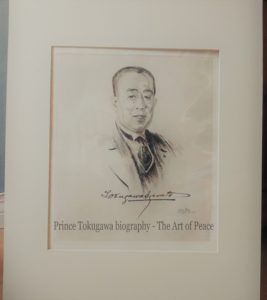
In terms of the evolution of the Cherry Blossom Festival, from 1913 – 1920: workmen continued planting the Japanese cherry blossom trees around the Washington, D.C. Tidal Basin and in East Potomac Park. However, no events occurred to commemorate the gift, that is, until 1922, when the first annual gatherings began. – What is significant is that during 1921-1922, Prince Tokugawa returned to the U.S. to ally with the current President Warren Harding during the Washington Naval Arms (Limitation) Conference, the first truly international conference held in the U.S. Capital. Prince Tokugawa headed the Japanese delegation – It was during this successful conference, that Prince Tokugawa most likely also found time to encourage the Japanese cherry blossom gift into becoming an annual celebration. Below is a signed portrait etching of Prince Tokugawa, drawn during that 1921-1922 conference.


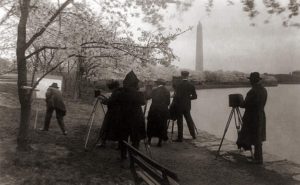
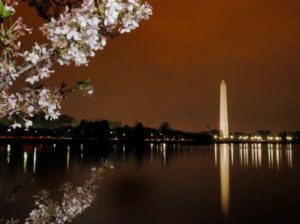
1920s: a painter & several photographers are at the Tidal Basin facing the Washington Monument, attempting to capture the beauty of the cherry trees in bloom. Photo: Library of Congress.


During 1930 and during 1933-1934, Prince Tokugawa again travelled across the U.S. – During that last visit, he further promoted the goodwill of the 1912 Japanese gift. Prince Tokugawa was a luncheon guest of his friends Colonel Theodore Roosevelt Jr. (son of deceased President) and his mother Mrs. Theodore Roosevelt. This was followed by a more formal luncheon given in Prince Tokugawa’s honor by President Franklin Delano Roosevelt. The impressive guest list at this event included: the Chief Justice of the Supreme Court; the Secretaries of State, Treasury, and Interior; several Congressman, the Under Secretary of State (and former U.S. Ambassador to Belgium and Canada); the Surgeon General, and the Chairman of the American Red Cross John Barton Payne. [Source: “Formal Luncheon Given By President Roosevelt Entertains for the Head of the Japanese Red Cross, Prince Iyesato Tokugawa.” The New York Times, March 2, 1934.]

It is significant to recognize that Prince Tokugawa was in Washington, D.C. during March 1934, the month preceding the “first formal festival” commemorating the 1912 Japanese gift of cherry trees – On April 19th, 1934: The District of Columbia Commissioners sponsored a three-day Cherry Blossom Festival.

The following year, 1935, the National Cherry Blossom Festival ‘Officially’ became an annual event in the U.S. Capital.

Prince Tokugawa had accomplished his mission, helping launch this important international goodwill event. He would likely have wished to attend the 1934 inauguration ceremony, but his schedule required him to be on the West Coast to receive an Honorary Doctor of Laws Degree from the University of Southern California (USC). The book cover for the biography THE ART OF PEACE  presents him receiving this degree from the president of USC, for his support of foreign student exchange programs & for his international philanthropic contributions.


“THE ART OF PEACE“ IS AVAILABLE AS A DIGITAL EBOOK


PRINCE TOKUGAWA’S BIOGRAPHY IS ALSO AVAILABLE IN A PRINT and KINDLE EDITION


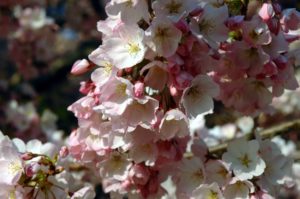
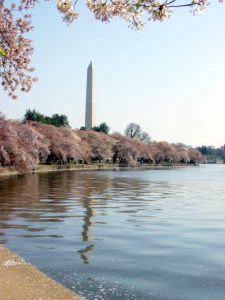
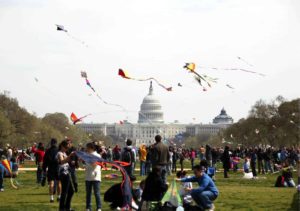
Below are several additional historical photos and some recent ones linked to the Cherry Blossom Festival:


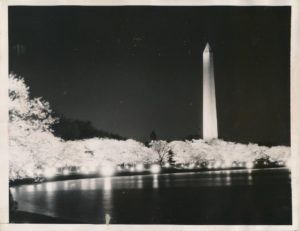
April 16, 1934 press photo describes a Cherry Tree Spectacle that brought 100,000 visitors to Washington, D.C., over the weekend to witness the beautiful cherry trees in bloom. This was in preparation for the Cherry Blossom Festival to be held the following week. Some of these trees were further beautified with electric lighting.


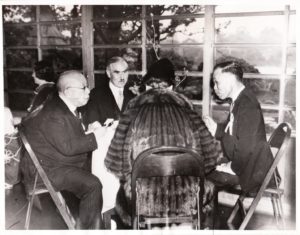
March 18, 1937 press photo gives further insight into Prince Tokugawa’s important role in the establishment of the National Cherry Blossom Festival: The Garden Club of America wanted to thank Prince Tokugawa and Japan for the hospitality shown to their garden club members from across the U.S., during their 1935 visit, when they toured the most beautiful of Japan’s gardens, as well as her historical sites. The garden club also wished to commemorate the 25th Anniversary of the Japanese gifting of the cherry blossom trees to the U.S. in 1912. When they reciprocated in 1937, with a gift of 4,650 flowering trees and plants, who better to receive this gift to Japan, than Prince Tokugawa. As it had been him, who introduced the then Mayor of Tokyo to the U.S. leaders in Washington, D.C. in 1910, as part of launching that goodwill gesture.

In the above photo, Prince Tokugawa is now accompanied by the current Mayor of Tokyo, Torataro Ushitsuka. Together, they represented Japan in receiving these gifted trees and plants from the Garden Club of America. They were joined by the current U.S. Ambassador Joseph Clark Grew and his wife, who represented the United States. Photo shows the official group at tea, after having attended the gifting ceremony held at Kiyozumi Park, Tokyo.

Left to right: Prince Tokugawa, Ambassador Grew, Mayor Ushitsuka, and Mrs. Grew, with her back to the camera.


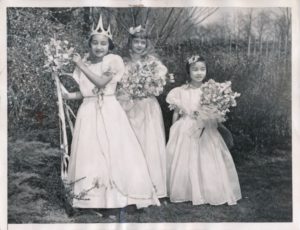
“The Queen of the 1937 National Cherry Blossom Festival” Washington, D.C.

25th Anniversary Celebration commemorating the 1912 Japanese gift, Sakiko Saito (left) age 10, is ceremonially crowned Queen of this goodwill event. Sakiko is accompanied by her entourage: her sister, Masako Saito (right) age 8, and Barbara Caldwell (center) age 10, who is the Maid of Honor representing the U.S. Sakiko and Masako are the daughters of the Japanese Ambassador to the U.S. Hirosi Saito. Source press photo.


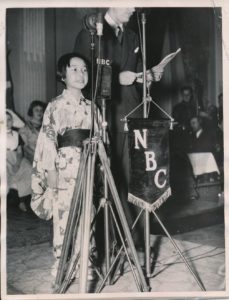
The 1930s were a difficult time in terms of the world economic depression, with powerful forces pushing the world towards war. To counter this, nation-bridging efforts were promoted by Prince Tokugawa and his allies. The above December 21st, 1936 press photo presents Japanese Ambassador Saito’s younger daughter Masako (7 years old), along with other foreign diplomats’ children (dressed in their nations’ traditional clothing) sending Merry Christmas greetings by radio broadcast to youngsters around the world. This was the fourth annual broadcast of its kind.


Prince Tokugawa felt that life was precious and meant to be celebrated!

Tokugawa and his allies would be delighted to see the goodwill event they launched many years ago, continues to bring joy to so many today, contributing to better understanding between nations – Perhaps one day, Prince Tokugawa’s memory will be be honored as part of this wonderful celebration.


The above photo and those that follow are provided courtesy of The National Cherry Blossom Festival, Inc. a not-for-profit organization whose mission is:

“Dedicated to promoting the beauty of nature and international friendship through year-round programs, events, and educational initiatives that enhance our environment, showcase arts and culture, and build community spirit.”


Filed Under: Tokugawa Archives Tagged With: Baron Eiichi Shibusawa, Baron Shibusawa, Baron Shibusawa Eiichi, Cherry Blossom Festival, Diplomacy, Historical biography, History of the Cherry Blossom Festival in Washington D.C., History of the National Cherry Blossom Festival, History of the University of Southern California, History of USC, Honorary Doctor of Laws Degree from the University of Southern California, Honorary Doctor of Laws Degree from USC, International Friendship, International Relations, Iyemasa Tokugawa, Japan History, Japan U.S. Relations, National Cherry Blossom Festival, President Taft, President Theodore Roosevelt, President William Howard Taft, Prince Iyesato Tokugawa, Prince Iyesato Tokugawa Archives, Prince Tokugawa Archives, Prince Tokugawa Iesato, Prince Tokugawa Iesato Archives, Shibusawa Archives, Stan S. Katz, Stan S. Katz blog, The Art of Peace, The Art of Peace biography, TheEmperorAndTheSpy.com, Theodore Roosevelt, U.S. Japan relations, U.S.-Japan History, US Japan relations, William Howard Taft, World War One, World War Two, Yukio Ozaki, Yukio Ozaki Mayor of Tokyo

Welcome!

April 13, 2020 by Stan S. Katz Leave a Comment


The illustrated Blog posts on this website focus on U.S. Japan relations and Japanese history.

Katz was a Specialist in Rare Books and Ephemera when he acquired the personal papers of a Master Spy, Colonel Sidney Forrester Mashbir (1891-1973). These fascinating materials, combined with his passion for history and many years of research resulted in the exciting historical novel THE EMPEROR AND THE SPY, followed by a sequel, an illustrated biography titled: THE ART OF PEACE.

The Emperor and the Spy highlights the adventurous life of Colonel Mashbir and reveals his alliance during the 1920s and 1930s with many Japanese leaders, including members of the Japanese Royal Family. These influential Japanese included Prince Tokugawa Iesato (1863-1940) President of Japan’s upper house of congress for thirty years & Baron Shibusawa Eiichi, who is known as the Father of the Modern Japanese Economy. These fine Japanese statesmen blended international diplomacy, art and cultural exchange, as well as business and commerce to bring nations together in friendship. 

Colonel Mashbir in his personal writings emphasized:

Prince Tokugawa was the true hidden power behind the Imperial Throne & was so politically influential in supporting democracy and peace, it was only after his death in 1940, that Japan was pressured into joining the Axis Powers in WWII.

In the process of rapidly moving forward towards reconciliation between the U.S. and Japan following that tragic conflict, much of the history of the first four decades of the 1900s were lost or forgotten, with little recognition given to heroic efforts by many Japanese and non-Japanese who strove to prevent that war. Many readers of The Emperor and the Spy wanted to know more about the impressive individuals depicted in the novel and the period they lived, leading to the Prince Tokugawa biography: The Art of Peace. 


Praise for The Art of Peace

“Your new biography is the perfect follow on to your historical novel The Emperor and the Spy about Colonel Mashbir, a  superlative history that was a fun read, yet it was also eye opening to the story behind the scenes in that critical time of history between the west and Japan.  Here is all that anyone who is a serious student of conflict and history of Japan could possibly want.  The illustrated version of pure history makes this biography as fun to read as a novel. I enjoyed every chapter.  Just as a footnote, I loved the way you ended the book with President Obama’s and Japanese Prime Minister Abe’s speeches – Those words are exactly how all our minds should work in building relationships between peoples that are of different cultures.  I am richer in knowledge about all the amazing heretofore unknown to me heroes that you portrayed, especially Prince Tokugawa.

Paul Ringwood U.S. Navy Commander (retired)


“I am very pleased to learn that you have now published ”The Emperor and the Spy”…‘’I have learned a lot about Colonel Mashbir and his real friendship with Prince Iesato Tokugawa which was a pleasant surprise for me.” “I wish you all the best & best of luck on your new book on ‘’Tokugawa Iesato.”

Kazuo Kodama, former Ambassador of Japan to the United Nations / current Ambassador of Japan to the European Union


“This is a really interesting and understudied topic.”

Professor Benjamin Uchiyama, Ph.D. History, University of Southern California


“The importance of preventing war is rarely given recognition through literature and in accounts of history.  It can be every bit as exciting as glorified accounts of war and certainly a better approach.”

Professor Claire Langham, former President of the East-West Center of Southern California Chapter, an organization which promotes positive relations among the people and nations of the United States, Asia, and the Pacific through cooperative study, research, and dialogue.


“We appreciate your kindness and all the work you have done to promote understanding of Shibusawa Eiichi and US-Japan relations as a whole. I wish you all the best in your current and future endeavors.”

With gratitude, Toru Shigehara

Head Librarian/Information Resources Center

Shibusawa Eiichi Memorial Foundation


In 2021, the general reader digital edition of THE ART OF PEACE was revised, retitled, and newly published as THE ART OF DIPLOMACY to better represent the broad spectrum of Prince Tokugawa’s achievements.

AVAILABLE IN PRINT AND KINDLE EBOOK EDITION


Filed Under: Tokugawa Archives Tagged With: 25th Anniversary of Rotary International, Allied Translator Interpreter Section, Ambassador Grew, Ambassador Katsuji Debuchi, Ambassador of Japan to the United Nations, America-Japan Society, Armenian Genocide, Arms Limitation, ATIS, Baron Eiichi Shibusawa, Baron Shibusawa, Baron Shibusawa Eiichi, Chinese History, Chiune Sugihara, Colonel Mashbir, Colonel Mashbir Archives, Colonel Sidney Mashbir, Commodore Perry, Communism, Crown Prince Hirohito, Democracy, Diplomacy, Director of Planning and Communications for: The Missouri School of Journalism at University of Missouri, East-West Center of Southern California, Eiichi Shibusawa, Emperor Akihito, Emperor Hirohito, Garden Club of America, Garden Club of America Visits Japan 1935, General Douglas MacArthur, General MacArthur, History of the Cherry Blossom Festival in Washington D.C., History of the Garden Club of America, History of the National Cherry Blossom Festival, History of University of Southern California, Holocaust, International Friendship, International Relations, Iyemasa Tokugawa, Japan China relations, Japan U.S. Relations, Japan-America Society, Kazuo Kodama, Kazuo Kodama Ambassador of Japan to the European Union, Mashbir Archives, National Cherry Blossom Festival, Paul Ringwood U.S. Navy Commander, Ph.D. History, President Barack Obama, President Warren Harding, Prince Iemasa Tokugawa, Prince Iyemasa Tokugawa, Prince Iyesato Tokugawa Archives, Prince Takamatsu, Prince Tokugawa Archives, Prince Tokugawa Iesato Archives, Prince Tokugawa Yoshihisa, Princess Takamatsu, Professor Benjamin Uchiyama, Professor Claire Langham, Rotary History, Rotary International History, ROTC History, Safe Zones, Safes Zones, Saving Jewish Lives in WWII, Shanghai Ghetto, Shanghai Safe Zone, Shibusawa Archives, Shibusawa Eiichi, Shibusawa Eiichi Memorial Foundation and Museum, Shogun Yoshinobu, Stan S. Katz, Suzette Heiman, The Art of Peace, The Art of Peace biography, The Emperor and the Spy, Tokugawa Iemasa, Tokugawa Iyemasa, Tokugawa Shogun Dynasty, Tokugawa Shogun History, Toru Shigehara Head Librarian/Information Resources Center Shibusawa Eiichi Memorial Foundation, U.S. Japan relations, U.S.-Japan History, University of Southern California, World War One, World War Two

Copyright © 2026 Stan S. Katz