Stan. S. Katz

Author of The Emperor and the Spy

  • Home
  • Author
  • Books
  • Reviews
  • Educators
  • News
  • Audiobook & Timeline
  • Mashbir Archives
  • Tokugawa Archives
  • Contact
Follow Stan on FacebookFollow Stan on TwitterFollow Stan on GoodreadsFollow Stan on RSS

Sign Up for Future Blogs Linked to Colonel Mashbir and Japanese History

Read the Intro Posts

INTRODUCTION TO THE ART OF PEACE

WELCOME!

Recent Posts

  • San Diego Jewish Journal Holocaust Remembrance Edition May 2016 highlights the historical novel, The Emperor and the Spy and the outstanding achievements of Colonel Sidney Mashbir.
  • The Emperor and the Spy, was one of two books highlighted during academic/diplomatic event sponsored by the Prime Minister’s Office of Japan and hosted by San Diego World Affairs Council
  • Osher Lifelong Education Institute – UCSD Presentation. Remarkable story, the alliance between a patriotic U.S. Intelligence Agent, Colonel Sidney Mashbir, and a humanitarian Japanese International Statesman, Prince Iyesato Tokugawa, who heroically delayed and attempted to prevent WWII in the Pacific.
  • Tokugawa & Komatsu, Forgotten Heroes – Until his passing in 1940, Prince Iyesato Tokugawa held back WWII in the Pacific – Tokugawa’s diplomatic legacy lived on after WWII ended, when his protégé, Takashi Komatsu, guided the US and Japan to again become friends and allies.
  • Have you ever wondered how US and Japan re-established their friendship and alliance following the trauma of WWII? Here’s a new biography that honors an amazing Japanese American statesman, Takashi Komatsu, who guided this major achievement.

Archives

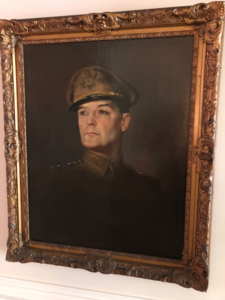
Colonel Sidney Mashbir’s widow Alice gifted her husband’s portrait of General MacArthur to his good friends Marine Captain William Warren and Marine Colonel Robert F. Warren…Robert and William shared their personal experiences with their friend Sidney.

April 11, 2020 by Stan S. Katz 1 Comment


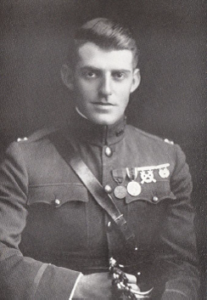
Having studied and written about Colonel Sidney Mashbir, it was my good fortune when Robert Warren and his son William Warren contacted me in 2018 to discuss their close friendship with Colonel Mashbir many years earlier.

William and Robert generously shared various historical materials linked to Colonel Mashbir (1891-1973). This blog post will present a number of those items, as well as Robert and William’s recollections of Colonel Mashbir. Also included is biographic material about Robert and William Warren, who being younger than Mashbir, were inspired and influenced by Colonel Mashbir’s heroic dedication to our nation.

-The oil painting illustration of General Douglas MacArthur shown above is courtesy of the William Warren.


Further details about the General MacArthur oil painting.

Below is an email sent by William (aka Bill) dated April 17, 2018, giving more info about the history of the painting and why it was gifted to him.

“Stan, here are photographs of the portrait of General MacArthur.  I have provided three views, one where I stood back in order to give you an idea of the relative size of it.

According to Alice Mashbir, she thought that Sid would have wanted me to have this portrait as it was one of his most loved things.  The portrait hung over his mantle at his house in Emerald Bay (Laguna Beach).  Also according to Alice, Sid acquired this portrait from an art store in New York (City I think) and it was a big secret about what he may have paid for it.  It was apparently commissioned by General MacArthur’s wife.  The story goes that when she discovered an infidelity she threw champagne at the portrait.  That may be true since one can clearly see very faint dribbles of something.

The artist of the portrait was Julian Lamar.  I am not sure when it was painted.  A bit about Julian Lamar:

Born Julian Kitchen Lamar Miller in Augusta, Georgia, he shortened his name to Lamar in 1922 to honor his mother’s family and to make his name more memorable as an artist. Although he began painting as a child, his family encouraged him to attend the United States Military Academy, from which he graduated in 1918. After the Armistice, he resigned his commission to concentrate on his career as an artist. Lamar lived for a while in Chicago, then moved to New York in 1920.

He maintained an active studio in New York, but traveled extensively to paint his subjects in their native surroundings. He painted many prominent figures, including Prime Minister Winston Churchill; President Franklin D. Roosevelt; Franklin H. Martin, President, American College of Surgeons; and Governor Frank Dixon, Alabama. He was also an accomplished landscape painter.

You can Google him…there is a lot of information about him on the web.

Enjoy Stan.  I will forward documents this afternoon.

Bill Warren”
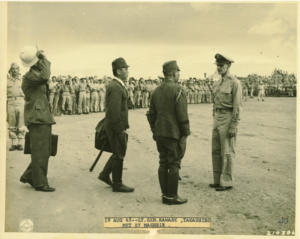


August 19, 1945, Lt. General Kawabe, Takashiro met by Mashbir.                Source of photo: courtesy of William Warren.                                      

Besides taking a decisive role in the winning of WWII, Colonel Mashbir also helped orchestrate the Japanese Surrender Signing Ceremony, officially ending the conflict. In the above photo, Mashbir receives the Japanese Surrender Signing Arrangement committee in Manila, Philippines. They would work together to organize the details for the surrender.

The term V-J Day represents both the initial announcement of Japan’s surrender on the afternoon of August 15, 1945 in Japan, and because of time zone differences, August 14, 1945 when it was announced in the United States and the rest of the Americas and Eastern Pacific Islands. V-J Day is also represented as September 2, 1945, when the actual signing of the surrender document occurred, officially ending World War II.


A Gift to Colonel Mashbir from General MacArthur

The Photo inscription reveals Mashbir’s significant role in winning World War Two.
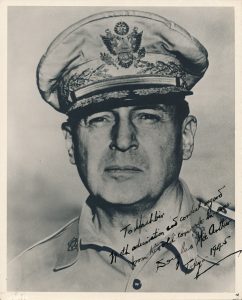


“To Mashbir”


“With admiration and cordial regard from his old comrade-in-arms.”


“Douglas MacArthur”


“Tokyo – 1945”   


Twenty seven years later, in 1972, the below inscribed portrait photo of Colonel Mashbir was respectfully gifted to his good friend Robert Warren, who Mashbir addressed as:

“Colonel Bob Warren, a gallant Marine”.
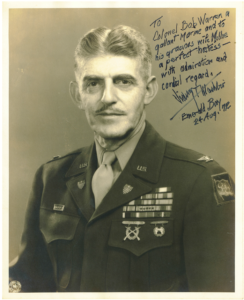


Robert’s son, William, has added the below description linked to this photo.

“Here is a photo of Sid with an inscription to my Dad and Mother (Millie).  Mother passed away in January 2010, but she, my Dad, Sid and Alice became good friends over the years.  This photo is dated 1972.  There are two photos of my Dad that I thought you might like to have, one was his official USMC photo taken in 1969 I think and the other where he is posed on the jet was taken, I think, in 1965 (see below).  He was then a Lt. Colonel and was the Commanding Officer of the Marine Attack Squadron, VMA-331 based in Beaufort, SC.  The squadron flew the Douglas A-4 Skyhawk.  A side note, one of the previous Commanding Officers of VMA-331 was Lt. Colonel Don Conroy who was the “Great Santini” character in Pat Conroy’s novel of the same name.” 


­­­­­­­­­­­­­­­­______________________________


Presented below is further Information about Colonel Mashbir and other topics gathered during an interview with Colonel Robert F. Warren – May 18, 2018.

Colonel Robert F. Warren proudly mentioned that his son William had been an infantry platoon leader in Viet Nam, and that the survival rate for that position averaged only 4-6 months. Thank God he made it back.

Robert stated he spent many hours with Mashbir and recalled that Mashbir was angry with General Willoughby, who was General MacArthur’s chief of staff GHQ during WWII. Robert said that Mashbir would mockingly imitate Willoughby’s accent. Mashbir’s anger stemmed from his feeling that Willoughby had often prevented Mashbir from directly delivering urgent strategic information to MacArthur, and that Willoughby regularly took credit for many of Mashbir’s ideas.

Below are a number of other comments Colonel Warren made related to Colonel Mashbir.

-When Mashbir returned to the Imperial Hotel after surviving the Great Kanto Earthquake of 1923, the Hotel Manager Inmaru (sp?) responded as if, “He couldn’t be more surprised if he’d seen the Buddha step out of Hell.”

-Robert clarified a matter linked to the historical novel about Colonel Mashbir, titled The Emperor and the Spy. Robert said that Mashbir’s good friend James Moriarty (Marine) was sent to China first, then to Japan.

-Sidney Mashbir’s son Forrester (his older son) became the manager of entertainment at the Sands Hotel/Casino in Las Vegas.

-Robert met Don Mashbir (Sidney’s younger son) and Don’s wife Rosa.

-Sid told Don that Sid didn’t want heroics to keep him alive when he got near the end.

-Sidney Mashbir’s home was in Emerald Bay, in Laguna Beach, which has beautiful views.

-Sid came to Robert’s military retirement party.

-Sid started the Pan-Pacific Club of Tokyo. Robert said, “Sid had a strong positive feeling for the whole nation of Japan.”

-Robert stated, “Sid had respect for the top levels of the Japanese hierarchy who were against war; they were almost prisoners of the military or they were eliminated altogether.”

-When Mashbir was leaving Japan, he laid on the floor of the ship, so as not to see Mt. Fuji, because he was superstitious that if you do not wish to return to Japan, you should not look back at that magnificent mountain view.


William Warren wrote the below letter:

“I have just ordered two copies of your book [The Emperor and the Spy], one for my father and one for myself. Both of us had the pleasure of calling Colonel Mashbir our friend. I personally spent many, many hours with Colonel Mashbir at his home in Laguna Beach. He and his second wife, Alice were host to me on many, many weekends when I was a young Lieutenant in the US Marine Corps. Sid also invited me to the Army and Navy Club in Washington DC where I believe he was a charter member. He was a most amazing man and one of my all-time heroes!! After Sid’s death, Alice sent me the original oil painting of General MacArthur that was one of his prized possessions. This portrait hung over the mantel in his Laguna Beach home. Alice told me that Sid would have wanted me to have this portrait and that I was to forever keep this in my family, never giving it to a museum or selling it. That portrait still hangs in my home today. Alice also gave me a copy of Sid’s book, “I was an American Spy” and she endorsed the book for me.

I have not yet read your book, but would love to keep in touch with you. Thank you for honoring this great man.

(William) Bill Warren, 9026 Mossy Hill Lane, Indian Land, SC 29707.”
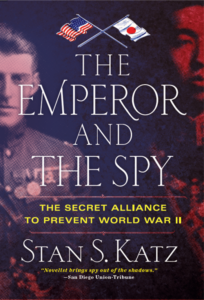


Presented below are William Warren’s comments after reading this novel:

“Review of “The Emperor and the Spy”

“A true story of intrigue, history and a little known American hero.”

By Bill Warren on May 27, 2018

“I had the good fortune to have met Colonel Sidney Mashbir when I was a newly minted Lieutenant in the Marine Corps. It was my distinct honor to have spent hours and hours with him over the years, visiting him both in his home in Laguna Beach, California and at the Army and Navy Club in Washington, DC where he enjoyed the status as a charter member. During those visits, Colonel Mashbir related hundreds of stories and showed me untold number of documents and I think I spent hundreds of hours listening to him. I am not sure what cemented the relationship I had with this fascinating hero, but I treasured every moment and consider him to have been among my very best friends, mentor and teacher. I am both in awe of and pleased with Stan S. Katz who recognized a real hero of our country and that he undertook the mission to write this book. His research for The Emperor and the Spy, appears to be meticulous and he tells a story that NEEDS to be told. Not many would ever have guessed that Colonel Mashbir served with General Pershing in Mexico. Likewise, who would have believed that Colonel Mashbir would have become so endeared with, respected by and maintained a secret alliance with the royal family of Japan prior to World War II. The Colonel indeed had a special relationship with Prince Tokugawa, the Emperor Hirohito and their families. Through these relationships, Colonel Mashbir made a valiant attempt to avert WWII in the Pacific. That is just part of the story. The other part is the intelligence work performed for General Douglas MacArthur during the war that, without a doubt, shortened the war with Japan. Even after the war, Colonel Mashbir utilized his deep understanding of the Japanese and his friendship with many of its leaders to make major contributions to the peaceful occupation of Japan and without those efforts, the outcome of post-war Japan would have been a completely different country.

Stan Katz skillfully weaves this story into a very readable and exciting historical fictionalized novel. His facts, based on the stories told to me by Colonel Mashbir are genuine and because of the nature of Colonel’s work, are irrefutable. Stan easily stands with Bernard Cornwell, Jeff Sharra and Michael Sharra in his skill constructing a superb story around historical facts and with Brad Meltzer in his ability to develop historical characters while keeping the adventure exciting. If you like historical novels and want to learn about a real American hero, you will find it in this magnificent book.” Note: On May 13th, 2018, Bill Warren called his father Robert and related, “That his Dad had read the first half of The Emperor and the Spy, and was thoroughly enjoying it.”


Another Interview with William Warren linked to Colonel Mashbir.

William described Sidney Mashbir as the consummate gentlemen. Rarely, if ever, did he hear him raise his voice. William commented that I had captured the essence of the man in The Emperor and the Spy, and that he thought Sidney and I would have gotten along well, which made my day. 

William confirmed what his father Robert had told him, that during WWII, Mashbir hated General Willoughby and they had numerous confrontations/tussles. William felt that Willoughby outranked Mashbir and Mashbir had to take it. “Mashbir couldn’t stand the man.” William said, “Willoughby might have blocked Mashbir from getting directly to General MacArthur, but Mashbir probably violated the chain of command to get to General MacArthur on occasion.”

William stated I got the story right in the novel, that when recruiting the Nisei for the WWII intelligence organization ATIS, it helped that they could both speak and read the language. Speaking Japanese is relatively easy, but reading it is much more difficult.

William said he thought that MacArthur felt somewhat abandoned in the Pacific theater, with most of the military resources going to the European theater of war.


THESE BOOKS OFFER FURTHER INSIGHTS INTO THE FASCINATING AND EXCITING EXPLOITS OF COLONEL MASHBIR.




This biography highlights one of Colonel Mashbir’s most influential Japanese allies, Prince Tokugawa Iesato.

During the 1920s and ’30s, Mashbir and Tokugawa heroically strove to maintain the goodwill between their nations. 

Available in Print and Kindle EBook
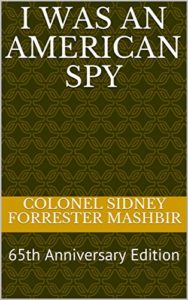


EBOOK REPUBLICATION OF COLONEL MASHBIR’S 1953 AUTOBIOGRAPHY


PARTING NOTE:

It was a pleasure meeting Robert and William Warren, two impressive gentlemen who proudly served our nation.

Colonel Robert F. Warren wrote a screenplay, and in association with U.S. military historian and writer, Navy Lt. Charles Wyatt, they completed an adaptation of that screenplay into a short novel titled: The Elephants of Trabong – This dramatic and engaging story is linked to Robert’s experiences during the Viet Nam War, where his assignment was to win the hearts and minds of the Vietnamese citizenry thru improving the economic life in their villages. It would definitely make a great movie!

*Representatives of the film industry can receive a synopsis of the screenplay and novel thru the below contacts:

William Warren:   [email protected]

Colonel Robert F. Warren also wrote an autobiography on his personal life story & military experiences in three wars. 

Blog link on the website for more information about Colonel Warren and his autobiography “ONLY IN MY AMERICA”.


Filed Under: Mashbir Archives Tagged With: Alice Mashbir, Allied Translator and Interpreter Section, American Spies, Army and Navy Club, Army and Navy Club in Washington DC, ATIS, Bernard Cornwell, Brad Meltzer, Charles Willoughby, Charles Wyatt, CIA, Colonel Mashbir, Colonel Mashbir Archives, Colonel Robert F. Warren, Colonel Robert Warren, Colonel Sidney Forrester Mashbir, Colonel Sidney Mashbir, Don Mashbir, Donald Mashbir, Douglas MacArthur, Dwight D. Eisenhower, first U.S. Military all-helicopter squadron, Forrester Mashbir, General Charles Willoughby, General Douglas MacArthur, General MacArthur, General Pershing, General Pershing in Mexico, General Willoughby, Great Kanto Earthquake, Helicopter Squadron 161, Heroes of World War Two, History of the CIA, HMH-363, Hotel Manager Inmaru, https://www.airzoo.org/, James Moriarty, Japanese Surrender Signing Ceremony, Jeff Sharra, Julian Kitchen Lamar Miller, Julian Lamar, Kalamazoo Aviation History Museum, Kelvin Bailey, Korean War, Lieutenant Charles Wyatt, Lord Louis Mountbatten, Lt. Colonel Don Conroy, Lt. General Kawabe, Marine Attack Squadron-331, Marine Corps League, Marine Corps League Toys for Tots, Mashbir Archive, Mashbir Archives, Michael Sharra, Michigan Aviation Hall of Fame, Mickey Mouse One, ONLY IN AMERICA, ONLY IN AMERICA By Robert (Bob) Warren, Pan-Pacific Club of Tokyo, Sands Hotel/Casino in Las Vegas, Sidney F. Mashbi, Sidney Mashbir, South Korean President Syngman Rhee, Stan S. Katz, Stan S. Katz blog, Takashiro, The Air Zoo, The Elephants of Trabong, The Emperor and the Spy, Toys for Tots, V-J Day, Viet Nam War, Vietnam War, VMA-331, Walt Disney, Walt Disney and Toys for Tots, William Warren, Willoughby, World War Two, WWII

Captain Sidney Mashbir’s successful 1922 secret mission prevented a potential war in Asia. However, the Great Kanto Earthquake of 1923 again destabilized Japan – During the challenging first months following that major disaster, Mashbir spearheaded a U.S. Medical Relief Effort to assist many of the injured Japanese.

March 8, 2020 by Stan S. Katz Leave a Comment

In 1922, Mashbir completed a dangerous mission in Vladivostok, Russia, preventing the outbreak of a regional war between Japan, China, and Russia, which might have expanded further!

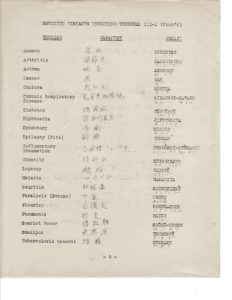
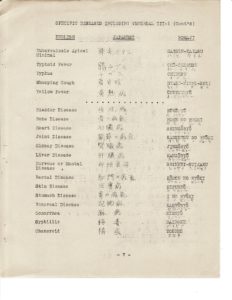
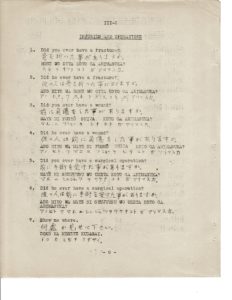
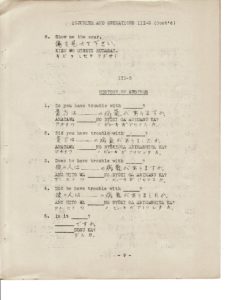
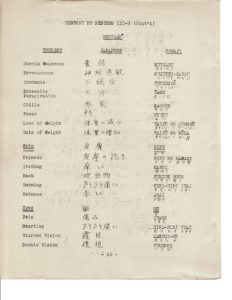
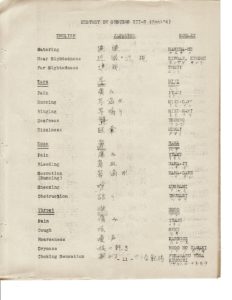
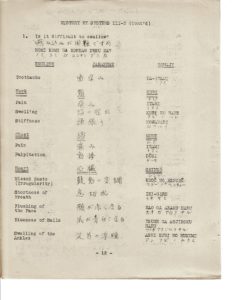
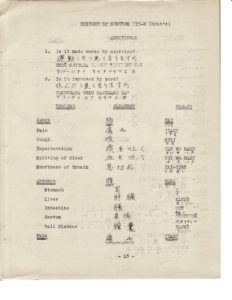
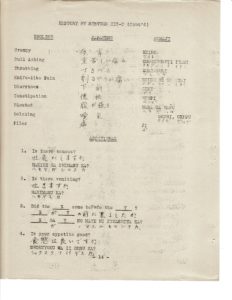
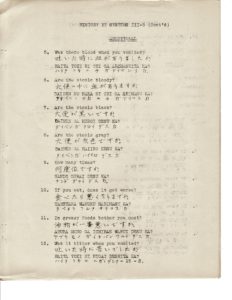
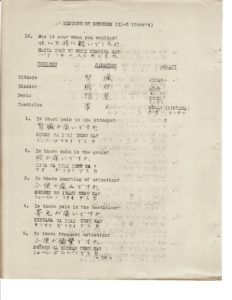
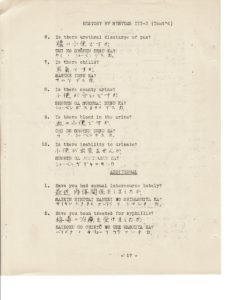
The following year on September 1, 1923, the most destructive natural disaster in modern Japanese history occurred, The Great Kantō Earthquake (関東大震災, Kantō daishinsai), a Japanese natural disaster in the Kantō region of the island of Honshū. This earthquake destroyed Tokyo, the port city of Yokohama, surrounding prefectures of Chiba, Kanagawa, and Shizuoka, and approximately 140,000 people died. During the challenging first months following that major disaster, Mashbir spearheaded an American Medical Relief Effort to assist many of the injured Japanese – As part of this humanitarian process, Mashbir created the first English – Japanese Medical Translation Dictionary that was used by English speaking health care workers while treating Japanese speaking patients.

The Great Kanto Earthquake, dramatically threw Japan back into a state of political and social instability. The Emperor and the Spy historical novel reveals Mashbir’s involvement during these dramatic events.


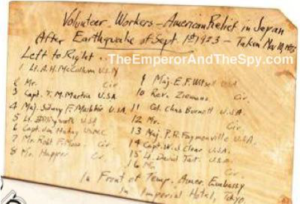
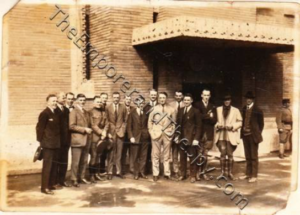
The above November 10th, 1923 photo is labeled: The Volunteer Workers American Relief in Japan

Mashbir (fourth from the left) led this group immediately after the Great Kanto Earthquake. These were the first relief workers to coordinate a major rescue/medical response to this major disaster. Mashbir and his team’s altruistic efforts were gratefully appreciated and remembered by the leaders of Japan. This picture was taken approximately two months after the earthquake, once things had been gotten under control, with Mashbir and his team proudly standing in front of the Imperial Hotel, Tokyo, after a job well done. The back of this photo is presented below.


Most of these volunteers’ names listed below:

1- Lieutenant A. H. McCollum, U. S. Navy
2- Unnamed civilian
3- Captain T. M. Martin, U.S. Army
4- Major Sidney F. Mashbir, U.S. Army
5- Lieutenant Dillingsworth, U.S. Army
6- Captain Joe Hickey, U.S. Marine Corps
7- Robert F. Moss, a civilian
8- Mr. Harper, a civilian
9- Major Edward Witsell, U.S. Army
10- Reverend Ziemans, civilian
11- Colonel Chas (Charles) Burnett U.S. Army
12- Unnamed civilian
13- Major P. R. Faymonville U.S. Army
14- Captain W. J. Clear, U. S. Army
15- Lieutenant David Tait, U. S. Army
16- Unnamed civilian

Side note: Who would have thought when this photo was taken, it would be almost a century later that this never before publicly seen photo would be shared over the world wide web, honoring these volunteers’ heroic efforts.

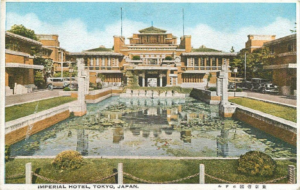
The backdrop for the above group photo, the Imperial Hotel, was Frank Lloyd Wright’s architectural masterpiece. It was one of the very few large structures not destroyed by the earthquake. Due to the vast destruction throughout Japan, this hotel was temporarily used as the American Embassy.


A 1920’s postcard photo of the Imperial Hotel.

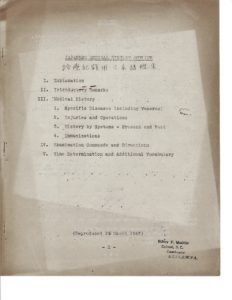
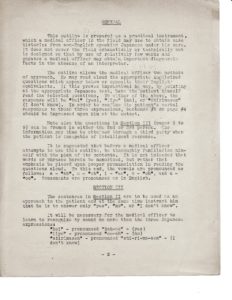
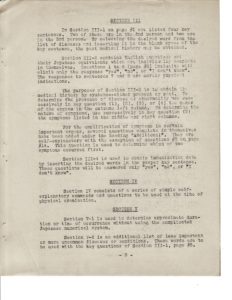
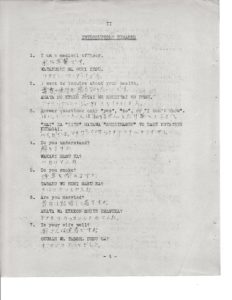
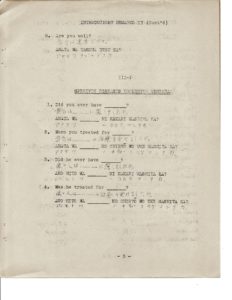
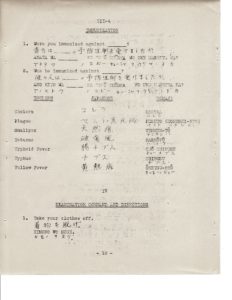
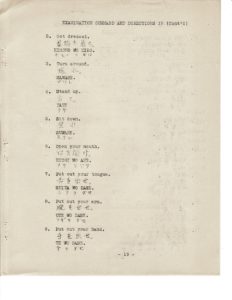
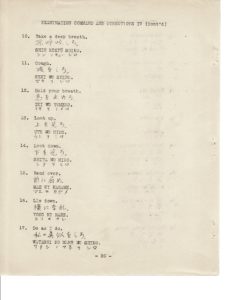
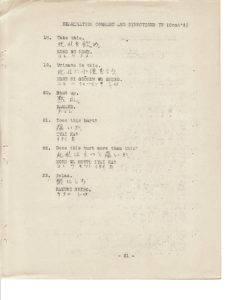
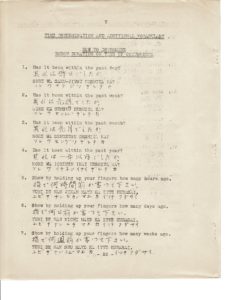
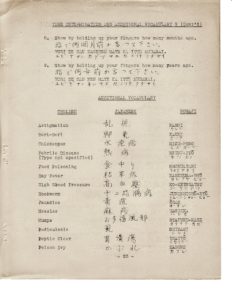
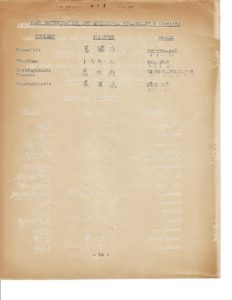
Captain Sidney Mashbir realized that language barriers would get in the way of English speaking emergency health care providers from being able to communicate with and assist the injured Japanese who spoke only Japanese, so he cleverly created an English to Japanese / Japanese to English Medical Translation Dictionary to better facilitate the  treatment of these injured Japanese during the traumatic aftermath of the Great Kanto Earthquake; further below is this 24 page bilingual medical dictionary.

It was republished in 1942, by the then Colonel Mashbir, probably to assist in the treatment of Japanese prisoners of war, who needed U.S. medical treatment. That conflict which Mashbir had devoted his efforts to prevent between the U.S. and Japan during the 1920s and 1930s, regrettably, could not be avoided. The below medical dictionary honors Colonel Mashbir’s altruistic intentions towards the Japanese, and it might also served as a template for an updated version for today to assist in medical situations involving English / Japanese translation while taking a patient’s medical history and to better understand the patient’s current symptoms/injuries.


Filed Under: Mashbir Archives Tagged With: 1923, A. H. McCollum, Captain Joe Hickey, Captain T. M. Martin, Captain W. J. Clear, Colonel Charles Burnett, Colonel Mashbir, Colonel Mashbir Archives, Colonel Sidney Mashbir, David Tait, Edward Witsell, English to Japan / Japanese to English Medical Dictionary, First English to Japanese Medical Dictionary, Great Kanto Earthquake, Imperial Hotel, Imperial Hotel 1922, Kantō daishinsai, Lieutenant A. H. McCollum, Lieutenant David Tait, Lieutenant Dillingsworth, Major Edward Witsell, Major P. R. Faymonville, Mashbir Archives, Mr. Harper 1823, P. R. Faymonville, Reverend Ziemans, Robert F. Moss, September 1, Sidney F. Mashbir, Stan S. Katz, Stan S. Katz blog, T. M. Martin, The art of diplomacy, The Art of Peace, The Art of Peace biography, The Emperor and the Spy, The Volunteer Workers American Relief in Japan, TheEmperorAndTheSpy.com, U.S. Japan, U.S. Japan goodwill, U.S. Japan relations, U.S.-Japan History, US Japan relations, W. J. Clear, World War Two, 関東大震災

A Time Capsule to Cornell University from over a Century Ago. Looking for suggestions and assistance to bring its fascinating contents to life through a documentary film, an illustrated book, and classroom curriculum.

February 13, 2020 by Stan S. Katz Leave a Comment

This Photo/Memory Album Presents a Intimate View of Student Life during the early 1900s.

By Dr. Stan S. Katz    –    February 14th, 2021


Most of the blog posts that you’ll find on this website are linked to historical relations between the U.S. and Japan. However, on occasion another interesting historical topic is discovered that sparks the imagination and inspires the sharing of its story with others.

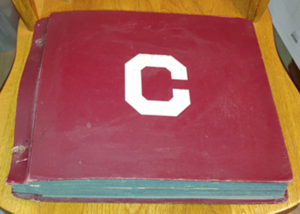
This Cornell University project began a dozen years ago in 2008, while exploring the Del Mar Antique Fair in southern California, when this maroon-colored, very old photo album/scrapbook with the white letter “C” printed on its cover caught my eye. The seller didn’t know much of the history linked to it, other than that it was connected to Cornell University, and that at least thirty individuals that morning had immersed themselves while examining its fascinating contents.

Having once been an antiquarian bookstore owner, this description grabbed my attention. After just a few minutes of scanning the amazing variety of items in the album, I knew that many other folks would enjoy this time capsule to university life from the distant past – So I purchased the album, thinking that one day I’d figure out how best to share this engaging material.

The album had been owned by a Cornell student, Melvin Lorrel Nichols (1894-1981), who majored in Chemistry, which coincidentally, was also my major at Brooklyn College (Class of 1973). However, Melvin graduated from Cornell almost a half century earlier, attending as an undergrad from 1914-1918. And it is specifically those four years that his album depicts. Melvin would later become a significant member of the Cornell Chemistry Dept. teaching staff for almost four decades.


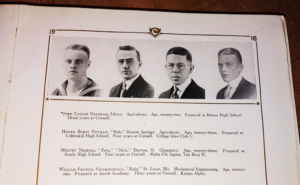
Top section of a university yearbook page from “The Cornellian and Class Book 1918”. It presents several members of the graduating class, including Melvin Nichols third from the left. Melvin’s nicknames were “Pete” and “Nick”.
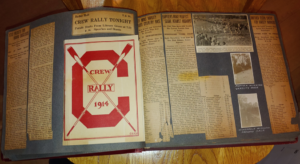
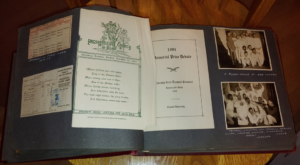
 

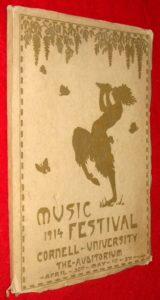
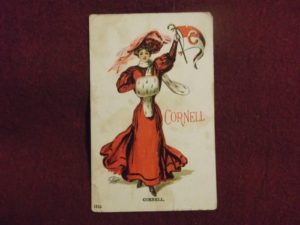
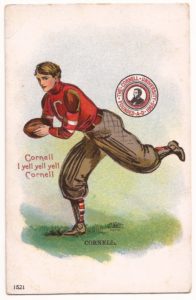
Below are some ephemera from the period: a 1914 musical event and some colorful 1916 postcards.


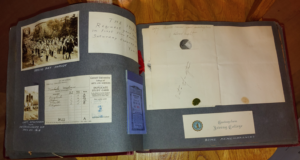
From his earliest days, Melvin saved diverse mementos of his time spent at Cornell. Above is the first page of the large album (10.25 x 13 inches, and 3 inches thick). Please note a future presentation of this material for a eBook or documentary film would scan and highlight each of these historical items to a higher image resolution than what is available for this blog post presentation.


Below is an enlarged section from the above album page:


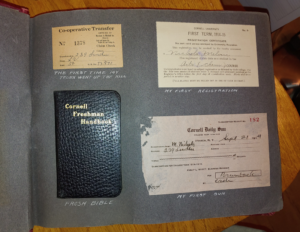
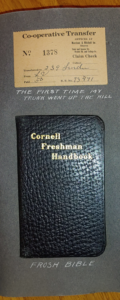
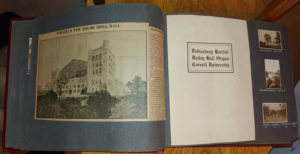
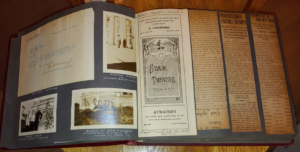
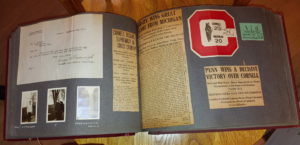
Both sides of the thirty-four pages of this album are filled with rare historical materials – Melvin was amazingly meticulous, his album displays interesting ephemera from all four of his student years, with many photos of him with his friends/fellow students. There is also a wide array of letters, student event pamphlets, colorful period postcards, newspaper clippings of intermural sport events, along with the original tickets to some of those games, and news clippings for other Cornell related topics. The illustration to the left displays his receipt for transporting his trunk up the hill during his first day at the school.

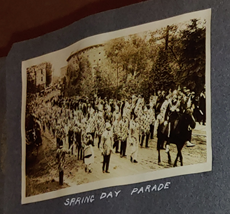
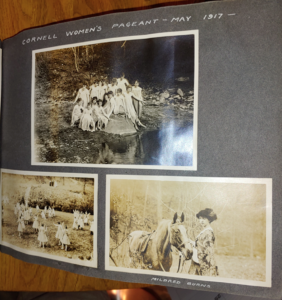
There is also the Cornell Freshman Handbook that he describes as the “Frosh Bible”, which contains 168 pages filled with the relevant topics that incoming students needed know about their school’s academic activities, fraternity and sorority related info, and a directory to city services to meet their needs, giving insights to life in the City of Ithaca during that period. The album also presents photos of fanciful university pageants, celebrations, and public events.

And with those years being impacted by World War One, some of Melvin’s photos are linked to the ROTC. As a senior, Melvin was temporarily drafted into the military. Despite the tragic backdrop of war, this album instead gives a sense of a pleasant & meaningful university experience being had, with Melvin most appreciative to have been able to attend Cornell with the financial support of student grants from the university.


Below is an enlarged photo from the prior illustration:


This album goes beyond exclusively revealing university life at Cornell, it also intimately presents what student life was probably like at hundreds of other fine universities during the early nineteen hundreds, prior to our current high tech computerized age, filled with its smart cell phones, Facebook, and social networking which has in many ways changed how we relate to one another. Early presidents of Cornell strove to create a sense of community among the students and faculty; they wanted their surroundings to have natural and poetic beauty, while also honoring the impressive stately architectural designs from the past – It was their intention that this would inspire students to feel better about themselves and the world they lived.

One of the goals of this blog post/illustrated article is to introduce this unique view of the past to others, perhaps leading to potential future joint historical/educational/entertainment projects. Whether it be as an illustrated eBook, an online museum exhibit, the source for a documentary on Cornell’s history, or perhaps, even an animated film that brings these photos and documents to life. Those who might interest in these creative pursuits such as historians, Cornell’s Alumni Association, those in media, such as film, and others, are invited to discuss the possibilities through the below email contacts. These email addresses are linked to an historical biography and novel titled: The Art of Peace & The Emperor and the Spy written by the author of this article. Those books also began with the acquisition of a rare collection historical documents.

[email protected]

[email protected]

-Besides the Album’s wonderful 250 items to draw from, there’s an additional one hundred antique items linked to Cornell history that have been collected, which could contribute to a colorful reminiscent sense of that period. These include Cornell’s illustrated yearbook, “The Cornellian and Class Book 1918”.


Additional biographical details about Melvin Lorrel Nichols, the creator of the 1914-1918 Cornell Album:

Born: November 30, 1894 in city of Dayton, Ohio.

Died: March 29th, 1981 in California.

Melvin Lorrel “Pete” Nichols was a chemistry professor and author.


Early life:

Nichols was the son of Joseph Wiseman Nichols, a cabinetmaker, and Sarah Rebecca Heidelbaugh. He was the youngest of six children. [Source: Geneology.com]


Personal life:

Melvin married Mary N. Bancroft in 1926. They had one daughter, Sarah, “Sally”.


Career:

Nichols was awarded his PhD from Cornell University in 1922. His thesis was “Dinitrosoresorcinol as a reagent for the quantitative determination of cobalt in the presence of nickel and other metals of the third group”.

He was awarded a Guggenheim Fellowship in Chemistry in 1929. (See Note 1)

Nichols was on the faculty at Cornell University from 1923-1962, rising to become Emeritus Professor of Chemistry.

“Pete” Nichols’ wrote two textbooks on analytical chemistry:        Gas Analysis, co-authored with L.M. Dennis, and a Laboratory Manual of Analytical Chemistry.

In 1950, Pete Nichols agreed to become Executive Director of Cornell’s Chemistry Department, a new position which involved supervision of the support facilities and the non-academic staff of what had become a large and complex establishment. He held this position until his retirement in 1962.

A letter of Tribute to Melvin Lorrel Nichols was written by fellow members of the Cornell faculty. (Note 2)


OVERVIEW OF THIS MEMORY ALBUM

1-It is engaging and entertaining, with a backdrop of nostalgia.

2-This relic is in many ways a commemorative to a young man and future imminent professor.

3-It is a testimonial, offering a unique window to student life at a fine university over a century ago, to the friendships and the various on and off campus activities of that time.

4-It depicts the academic and social values that were thought necessary to be passed on to future generations, representing a Window to the past.

5-It must be emphasized that this Cornell album assembled and protected hundreds of historical items called ephemera that would have otherwise been lost forever. The below definition of ephemera comes from The Ephemera Society of America:

“Precious primary source information . . . that is what the ephemera world considers its bits and bobs of vintage (and current), usually paper items. Much of it was likely expected, back in its day, to be briefly useful then discarded. Today such items which have survived the vagaries of time often reveal things we might not otherwise ever learn. A story last year in the New York Times reported the stunning information that NASA—unthinkably—had somehow managed to lose the original tapes of Mankind’s first landing on the moon! Surely this monumentally important video document was expected to be carefully coddled and treasured forever. And yet even something as priceless as that somehow proved ephemeral. As it happens, derivative copies do exist, so that particular record has not totally disappeared. But it could have. If information as important as that could be so easily lost for eternity, imagine how much lesser—yet culturally relevant—historical information has indeed been lost with the passage of time. Each collected piece of surviving paper Americana serves up information, and some of it available nowhere else on earth. One person’s trash is another person’s treasure.

“In a nutshell, to collectors “ephemera” are vintage printed or written items which originally served some specific purpose and were not expected to be retained or preserved, but which are now cherished. A few decades ago much of it was called “Paper Americana”, though ephemera is not necessarily American. Or even paper: these days the field has been expanded to include such things as tobacco tins, photographs, radio premiums, textile swatches, vinyl record albums, items made of celluloid or wood. Also included are various items which were indeed likely to have been saved, such as wedding invitations, marriage certificates, passports, birth certificates, wills, deeds, divorce papers, stock certificates, promissory notes, and many other vintage documents…

“Maurice Rickards, author of the definitive Encyclopedia of Ephemera and a founder of The Ephemera Society in England, dubbed such items “the minor transient documents of everyday life.” That organization says that—produced to meet the needs of the day—“such items reflect the moods and mores of past times in a way that more formal records cannot.” Besides being enjoyable to find and collect, vintage ephemera is valuable primary source information which offers unique windows into cultures past.”

(Note 3) presents more information about The Ephemera Society of America.


This Album might contribute to Classroom Curriculum:

Classroom Discussion Questions:

A-What does a well-rounded university education mean? As an individual and as a society, what makes us who we are culturally and academically, what are those values?

B-This album might serve as a springboard for classroom discussions about how the world has changed and in what ways have things remained the same?

C-Are there lessons that can be learned from that period a century ago, that might well serve us in our modern world?

D-As a related research project, there could be interviews of current university students, alumni, and faculty to hear their response to the album, giving an intergenerational insights to the interpretation of its contents.

E- In our time of rapidly advancing technology, filled with uncertainties regarding the future, this album invites students to compare life then and now, to recognize our roots, the values of our ancestors, and the foundation of who we are. Does this album perhaps serve as a compass/roadmap to cherished values of our society from long ago?

F-The album could augment the presentation of related historical material, such as the events of World War One. How did that conflict impact student life and the ways students saw themselves? Has the role of intra-mural sports in university life changed? The possibilities continues as the project unveils new insights into the album’s contents.

G-Are there universal values? Where are we going as a society and as a world? What might we be losing or gaining in the process of moving forward? The album is a sociological study into human nature, then and now.


NOTES


Note 1 – In 1929, Professor Melvin Lorrel Nichols was honored by receiving a Guggenheim Fellowship. That award is intended for individuals who have already demonstrated exceptional capacity for productive scholarship or exceptional creative ability.

Fellowships are awarded through two annual competitions: one open to citizens and permanent residents of the United States and Canada, and the other open to citizens and permanent residents of Latin America and the Caribbean. Candidates must apply to the Guggenheim Foundation in order to be considered in either of these competitions.

The Foundation receives approximately 3,000 applications each year. Although no one who applies is guaranteed success in the competition, there is no prescreening: all applications are reviewed. Approximately 175 Fellowships are awarded each year.

During the rigorous selection process, applicants will first be pooled with others working in the same field, and examined by experts in that field: the work of artists will be reviewed by artists, that of scientists by scientists, that of historians by historians, and so on. The Foundation has a network of several hundred advisers, who either meet at the Foundation offices to look at applicants’ work, or receive application materials to read offsite. These advisers, all of whom are themselves former Guggenheim Fellows, then submit reports critiquing and ranking the applications in their respective fields. Their recommendations are then forwarded to and weighed by a Committee of Selection, which then determines the number of awards to be made in each area. Occasionally, no application in a given area is considered strong enough to merit a Fellowship.

The Committee of Selection then forwards its recommendations to the Board of Trustees for final approval. The successful candidates in the United States and Canada competition are announced in early April; those in the Latin America and Caribbean competition, in early June. The Guggenheim Fellowship organization guarantees that their advisers and Committee of Selection members, as well as those who submit letters of reference, absolute confidentiality. Therefore, under no circumstances will the reasons for the rejection of an application be provided.

Source for Note 1: The John Simon Guggenheim Memorial Foundation website: https://www.gf.org/about/fellowship/

That organization’s website presents the below photo and technical details linked to Professor Nichols being honored with a Guggenheim Fellowship:


MELVIN L. NICHOLS

Fellow: Awarded 1929

Field of Study: Chemistry

Competition: U.S. & Canada

Born: 11-30-1894

Died: 03-29-1981


As published in the Foundation’s Report for 1929–30:

Nichols, Melvin Lorrel:  Appointed to make a study of the adsorption of anions by barium sulphate and a study of the conductivity of alkylated ammonia salts in non-aqueous solvents, in certain German and Austrian laboratories; tenure, twelve months from July 15, 1929.

Born November 30, 1894, at Dayton, Ohio.

Education: Cornell University, B. Chem., 1918, Ph. D., 1922.

Instructor in Analytical Chemistry, 1918–22, Assistant Professor, 1922—, Cornell University.

Publications: “Gas Analysis,” 1929. Articles and reviews in Journal of the American Chemical Society, Industrial and Engineering Chemistry, Journal of Physical Chemistry.


Note 2 – Cornell University Faculty Memorial Statement

Source: http://ecommons.library.cornell.edu/handle/1813/17813


Melvin L. Nichols

November 30, 1894 — March 29, 1981

Melvin L. “Pete” Nichols, emeritus professor of chemistry, who died March 29, 1981, at the age of eighty-six, enjoyed a career that almost perfectly characterizes a true-blue Cornellian. He was, in fact, a member of that very small group of our faculty that had been personally acquainted with every Cornell president. As Melvin Nichols, he left his home town of Dayton, Ohio, in 1914 to enter Cornell as a freshman. He remained in Ithaca, known to his many friends as Pete, until 1978, when, in failing health, he moved to California to be close to his only daughter, Sally. After receiving his Bachelor of Chemistry degree in 1918, he was appointed an instructor in chemistry at Cornell and simultaneously embarked on a graduate study program under Professor Orndorf, majoring in organic chemistry. He was awarded a Doctor of Philosophy degree in 1922 and was promptly appointed assistant professor in chemistry. He remained on the chemistry faculty until his retirement in 1962.

Nichols’s field of teaching and research was analytical chemistry, and for many years he was unofficial head of the analytical teaching group of the Chemistry Department. He wrote two textbooks on analytical chemistry, Gas Analysis, coauthored with L. M. Dennis, and Laboratory Manual of Analytical Chemistry. In 1950, Nichols agreed to become executive director of Cornell’s Chemistry Department, a new position which involved supervision of the support facilities and the nonacademic staff of what had become a large and complex establishment. He held this position until his retirement in 1962.

The forty-eight years of Pete Nichols’s life as a student and teacher at Cornell were years of great change for Cornell chemistry. The science itself became more physical and more theoretical. Applied fields such as agricultural chemistry, sanitary chemistry, and chemical microscopy, which had once been central at Cornell, were spun off or phased out. Industrial chemistry was transformed into chemical engineering and moved into the College of Engineering for its separate and independent development. There was a disastrous fire in 1916 which destroyed Morse Hall, the chemistry building; fortunately, a splendid new Baker Laboratory building opened in 1922. That chemistry at Cornell survived these changes and indeed grew stronger and more effective over the years was due in large measure to the successful adjustments and continuing contributions of Pete Nichols and other faculty members of his generation. Cornell is in their debt.

In 1926 Nichols married Mary Bancroft, the attractive and lively-minded daughter of one of Cornell’s eminent chemistry professors, Wilder D. Bancroft. When newcomers to Cornell first learned of this marriage, they were prone to mutter something about “marrying the boss’s daughter,” and were chagrined to learn that the true situation had been almost the exact opposite. Nichols was a coworker and protégé of the other strong-willed Cornell chemist of the time, L. M. Dennis, and Dennis and Bancroft had a long-established and well developed dislike of each other. Hence, to Dennis, a Nichols involvement with a Bancroft was akin to joining up with the enemy. It is a tribute to his tact and his persistence that Pete Nichols rode out the storm and kept his Cornell position.

Mary Nichols died suddenly in 1967, and Pete Nichols lived on alone in Ithaca, actively involved with his wide circle of friends. He will be missed by his Ithaca friends and colleagues as well as by the hundreds of Cornell students that he taught.

Albert W. Laubengayer,

William T. Miller,

Franklin A. Long

Cornell


Note 3 – History of the Ephemera Society of America from their website:

A small band of collectors interested in promoting the collecting, study, and preservation of ephemera established the Ephemera Society of America (ESA) in 1980, to serve as a link between and among collectors, archivists, researchers and dealers, and to encourage interest in all aspects of vintage paper. Five years earlier, in 1975, Maurice Rickards and his associates in England had established The Ephemera Society of the United Kingdom., and similar organizations have arisen in Canada, Austria, and Australia.

Shortly after ESA was formed, it was granted non-profit tax-exempt status as an educational organization. The society embarked upon a publishing program to educate its members and the general public about the world of ephemera. Issue #1 of our Ephemera News newsletter came out in the summer of 1981, and this regular newsletter continues its unbroken publication run to the present time. Printed as ink-on-paper until mid-2011, it is now entitled eNews and sent electronically each month to every member. ENews delivers news, details on conferences and other activities, a calendar of upcoming shows and events, auction notes, new book notices, links to stories of interest, announcements and other content of interest to ephemerists.

ESA publishes The Ephemera Journal, a highly regarded print publication devoted solely to illustrated scholarly articles on many different topics. Journal authors have included faculty and staff from a long list of distinguished institutions including the American Antiquarian Society, Winterthur, the Huntington Library, the Library Company of Philadelphia, Colonial Williamsburg, the Clements Library, Brown University and many other distinguished organizations. Many fine articles have come from independent scholars and collectors. https://www.ephemerasociety.org/


About the Author:

Stan S. Katz wrote the historical novel The Emperor and the Spy about an adventurous, high ranking U.S. intelligence agent Colonel Sidney Mashbir. He also authored the illustrated biography The Art of Peace about Prince Tokugawa Iesato, heir to the last Shogun of Japan. But when that dynasty ended, Prince Tokugawa instead became an international statesman who promoted good relations between U.S. and Japan.

Stan’s journey into historical writing began while he was the owner of two antiquarian bookstores. It was through these bookstores that he acquired the secret personal papers Colonel Mashbir. During the 1920s and ‘30s prior to WWII, Mashbir allied with many influential, peace loving Japanese leaders in an attempt maintain goodwill between their nations. Two of Mashbir’s closest Japanese allies were Prince Tokugawa Iesato and Baron Shibusawa Eiichi. Regrettably, WWII could not be prevented.

During his long military career, Mashbir served closely with General John Joseph Pershing during WWI, and Admiral Joseph King and General Douglas MacArthur during WWII. As one of MacArthur’s closest intelligence advisors, Mashbir took a pivotal role in shortening WWII in the Pacific. And during the post-war Occupation of Japan, he guided the U.S. and Japan to once again become allies. Colonel Mashbir’s primary source collection of historical documents unveiled significant unknown U.S. Japan relations during the first half of the twentieth century.

The website TheEmperorAndTheSpy.com presents many blog posts containing important rare and never before available photos and written documents linked to U.S. Japan history…One of these blog posts highlights a 1909 visit by Baron Shibusawa to Ithaca, New York, where the president of Cornell University, along with many Cornell professors, the mayor of the Ithaca, and other prominent individuals assembled to greet their honored guest from Japan. Baron Shibusawa Eiichi is remembered as a great humanitarian who promoted friendship between the East and the West, and is known as the Father of Modern Japanese Capitalism.

Based on Katz’s curiosity for international relations, for many years he’s been a member of and on the board of directors for the San Diego World Affairs Council, which is a local chapter the World Affairs Councils of America. Through this fine non-profit, non-partisan international affairs educational forum, he’s attended many fascinating presentations and met ambassadors, consul generals, and other political, economic, academic, and military representatives from around the globe. You’re invited to visit their websites to learn more about these organizations.


Filed Under: Tokugawa Archives Tagged With: Albert W. Laubengayer, Antique university album, Baron Eiichi Shibusawa, Baron Shibusawa, Baron Shibusawa Eiichi, Colonel Sidney Mashbir, Cornell University, DrStanKatz.com, Ephemera Society of America, Franklin A. Long, Guggenheim Fellowship, Historical documentary film, History of Cornell University, Melvin Lorrel Nichols, Melvin Nichols, Memory Album from Cornell University, President Theodore Roosevelt, Prince Iyesato Tokugawa, Prince Tokugawa, Prince Tokugawa Iesato, Shibusawa Eiichi, Stan S. Katz, Stan S. Katz blog, The Art of Peace, The Art of Peace biography, The Emperor and the Spy, TheEmperorAndTheSpy.com, Theodore Roosevelt, U.S. Japan relations, U.S.-Japan History, University Album, US Japan relations, William T. Miller, World War One

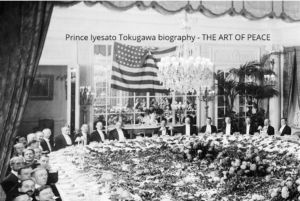
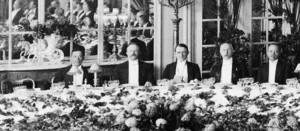
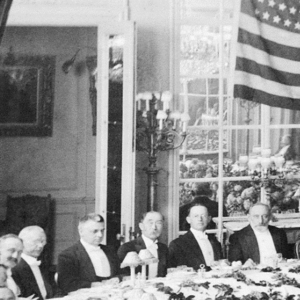
Former Presidents Theodore Roosevelt & William Howard Taft secretly attend a 1915 diplomatic banquet in N.Y.C. honoring the visit of Baron Shibusawa. Their goal to establish a strong US Japan alliance for World War One. This photo was only recently discovered.

February 6, 2020 by Stan S. Katz 7 Comments

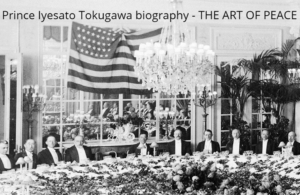
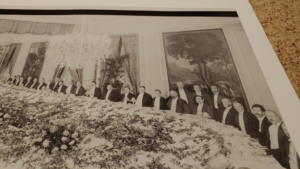
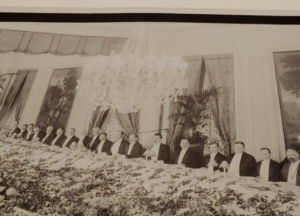
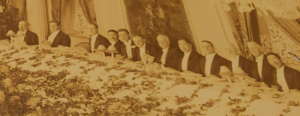
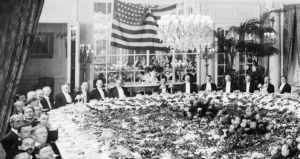
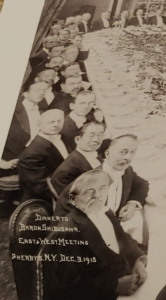
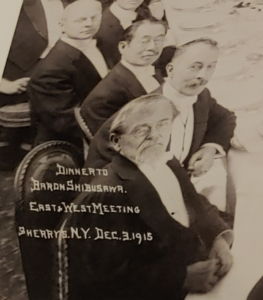
This is the only known photo of a significant 1915 U.S. Japan diplomatic event. The description on the photo’s lower left corner states:

Dinner to Baron Shibusawa. East & West Meeting, Sherry’s [Restaurant] New York City, December 3, 1915.  (Actual photo size: 20 by 12 inches.)

This original photo is age-darkened and missing a small segment in the lower left. These imperfections have been corrected during the restoration process as shown in the photos below:


INTRODUCTION

This almost discarded photo was acquired by the author of this blog post while researching for  a biography on Prince Tokugawa Iesato (1863-1940) titled The Art of Peace, which is also now available in a “general reader” edition titled: The Art of Diplomacy. Both versions also highlight Baron Shibusawa Eiichi (1840-1931). Prince Tokugawa & Baron Shibusawa were lifelong friends and allies who promoted successful domestic policies in Japan and strove for peace internationally. They were among the most powerful and inspiring leaders of Japan during the first decades of the twentieth century.

Prince Tokugawa held the influential position of President of Japan’s upper house of congress, the House of Peers, for thirty years, and was so politically influential in promoting democracy and international goodwill, that it was only after his death in 1940, that Japan was pressured into allying with the Axis Powers during World War Two.  

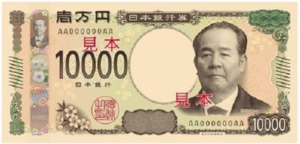
Baron Shibusawa is known as the ‘Father of Japan’s Modern Economy of Japan,” and recognized for having launched Japan’s first national bank, as well as helping start hundreds of other business ventures, many of which exist to this day. He also supported hundreds of social welfare organizations. To honor his memory in 2024, Baron Shibusawa’s likeness will be on the face of the highest denomination Japanese currency bill, the ten thousand yen note.


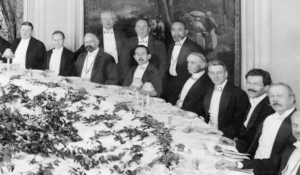
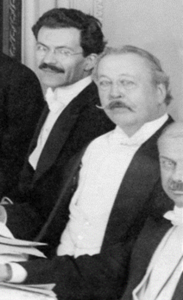
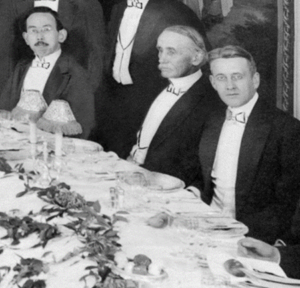
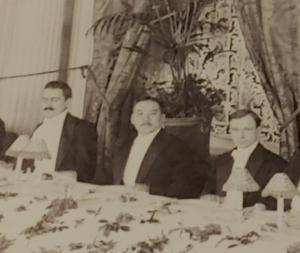
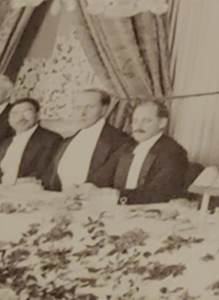
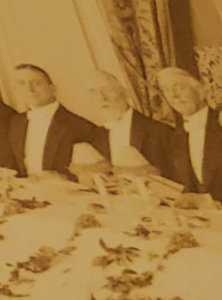
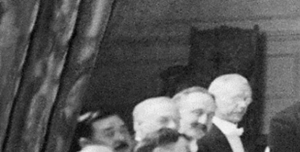
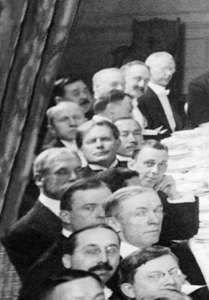
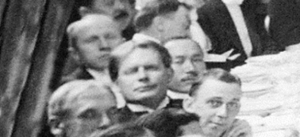
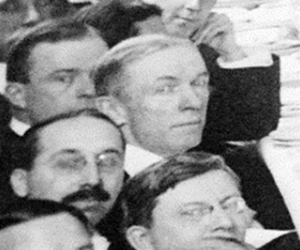
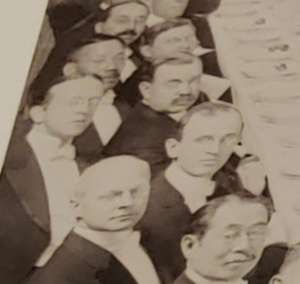
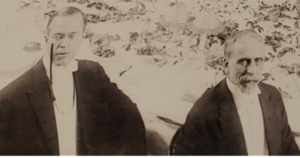
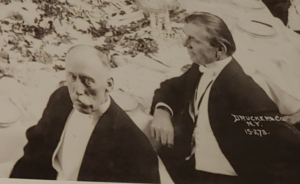
General visitors are most welcome to explore this material, while at the same time this blog post invites those who are able to kindly assist in identifying the attendees at this important 1915 diplomatic event. Small segments of the restored 1915 photo have been enlarged and each attendee has been given an ID number, with the numbering starting from the upper right corner of the photo and moving counterclockwise around the large banquet table.

Thanks go to out to the American Historical Association for highlighting this blog post in their website discussion room, so my fellow AHA members from around the world  might contribute to the identification of the unknown guests at this 1915 event. AHA membership includes university professors, high school teachers, archivists, librarians, general historians, historical writers, along with many other professionals who share a passion for history.

Of the sixty-five guests, thus far a dozen prominent individuals have either been identified or their names are known as having been at this event. They include: presidents of universities, political and social rights activists, founders of publishing firms, newspaper editors, journalists, biographical and historical fiction authors, also business/finance and government leaders. This photo offers a new perspective on early U.S. Japan relations, while highlighting many of the most influential individuals in the U.S. over a century ago.

-This is an invitation to those individuals or organizations who are able to identify any of the as-of-yet unknown individuals in the 1915 Photo, please share your insights thru the Comment section at the end of this blog post. Please include the attendee’s ID number and anything else you might know about that person, including internet links when available. Thank you so much for being part of  what I believe will be an engaging and enjoyable historical research project, and how exciting to see from where around the world this information will come from.

Thank you.


The Shibusawa Eiichi Memorial Foundation / Shibusawa Memorial Museum


This fine organization located in Tokyo commemorates the legacy of Baron Shibusawa Eiichi, known for his high ethical values in business and for his many social welfare/humanitarian contributions. The museum collects and displays documents and artifacts from his life. Adjoining the main museum building is the tranquil Old Shibusawa Garden. That garden and two structures from the original Shibusawa estate, the Bankoro Cottage and the Seien Bunko Library, date from the Emperor Taisho era (1912–26). These buildings have been designated as Important Cultural Properties by the Japanese government.

The Head Librarian for the Information Resources Center of the Shibusawa Eiichi Memorial Foundation, Toru Shigehara, kindly assisted in my research. They knew of the December 3rd 1915 banquet event based on a December 4th, 1915 New York Times article which mentioned the event and gave the names of some attendees, but they weren’t aware a photo had been taken of this event. They found it most surprising and exciting to hear that former U.S. Presidents Theodore Roosevelt and William Howard Taft had attended, because the December 4th, 1915 New York Times article made no mention of this. Below is a Review:

“Dear Dr. Stan S. Katz,
We appreciate your kindness and all the work you have done to promote understanding of Shibusawa Eiichi and US-Japan relations as a whole. I wish you all the best in your current and future endeavors.

With gratitude,”

Toru Shigehara: Head Librarian/Information Resources Center,
Shibusawa Eiichi Memorial Foundation and Museum located in Japan

——————————————————————————————————-

Of the sixty-five attendees at the event, the December 4th, 1915 New York Times article only mentioned the below ten individuals: Comparison photos could be found online for nine of them. Only one, M. Zumoto, had no photos available.  Four additional attendees have since also been identified, leaving fifty-two guests yet to be recognized. One possible clue: some attendees might have been members of the Japan Society or the Nippon Club. Both are U.S. Japan goodwill organizations that continue to be active to this day and are located in New York City.

Below are the names given in the New York Times article.

  • Baron Shibusawa Eiichi
  • Willard D. Straight
  • Osward G. Villard
  • William Morgan Shuster
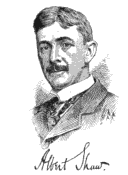
  • Dr. Albert Shaw 
  • Don C. Seitz 
  • Edward J. Wheeler
  • Dr. Toyokichi Iyenaga (one of the two hosts for the 1915 event)
  • Dr. Jōkichi Takamine (the other host for the 1915 event)
  • M. Zumoto – both the translator and secretary for Baron Shibusawa. He was also a part owner and editor of The Japan Times – Japan’s largest and oldest English-language daily newspaper, currently  published by The Japan Times, Ltd. (株式会社ジャパンタイムズ) of Tokyo. M. Zumoto was also the Director of the Oriental Information Agency of New York.


During the 1915 diplomatic event there was a frank discussion presented between Baron Shibusawa and Willard D. Straight on the following topics:

-How to improve relations between the U.S. and Japan.

-How to eliminate injustices and discrimination against Japanese-Americans living in the U.S.

-Both Shibusawa and Straight felt optimistic about Japan-U.S. relations and that problems could be solved with justice and benefit to both nations.

– They discussed the possibility of the U.S. and Japan working together to peacefully assist China in her development, to the economic gain of all three nations. The translator for Baron Shibusawa was M. Zumoto.

-Another discussion was between Osward G. Villard and Morgan Shuster regarding the recent outbreak of war in Europe. They recognized the U.S. might soon find itself in that conflict. They discussed how America’s resources might best be spent in preparation for that conflict. They commented that Japan and America should work together to go against the “criminal” powers who had started the war.

-Other speakers at the Baron Shibusawa event were Dr. Albert Shaw, Don C. Seitz, and Edward J. Wheeler.

Source: New York Times, December 4th, 1915: “Plea for Japanese Now in California: Baron Shibusawa Asks That Fair Treatment Be Accorded in Land Legislation. / Opportunities in China / He Urges That This Country Combine with Japan in Developing New Republic.”

During his 1915 visit to the U.S., Baron Shibusawa also met with President Woodrow Wilson.

What is most surprising about this 1915 banquet event is that in spite of the many magazine and newspaper editors and journalists in attendance, the media made no mention of Theodore Roosevelt and William Howard Taft being in attendance to honor Shibusawa – The reasons for this secrecy are open to conjecture, perhaps, with WWI having just begun in Europe, it was considered prudent not to advertise where U.S. and Japanese leaders could be targeted, in that these two nations would find themselves playing an essential role in the Allies’ victory in that major conflict.


TABLE OF CONTENTS

Prior Introduction

Section I – Presentation of larger segments from the 1915 banquet photo.

Section II – Presentation of smaller segments from the 1915 banquet photo, which have been further enlarged to aid in individual identification.

Section III – List of the already recognized attendees, with the source photos that helped identify them. This section will include crediting those who assisted in identifying them.


Section I

Below are some larger sections of the restored 1915 photo:

The first two photos highlight where during the event, Baron Shibusawa had probably been seated near Theodore Roosevelt – Roosevelt is centered beneath a grand chandelier and just two seats to his right is the vacant chair where Shibusawa sat. It took creativity on the part of the photographer to capture such a large gathering in one photo. Shibusawa went to the other end of the table to stand near William Howard Taft, allowing the photographer to incorporate all the attendees into one photo, while at the same time capture a larger image of their honored guest, Shibusawa. [Notice the reflection in the mirror behind Roosevelt, it reveals the front section of the table.] This event took place at Sherry’s, one of the most impressive New York City banquet facilities of its time.  


Enlarged segment from the restored photo.


Further enlarged section from the prior photo, highlighting Theodore Roosevelt centered beneath the chandelier.   

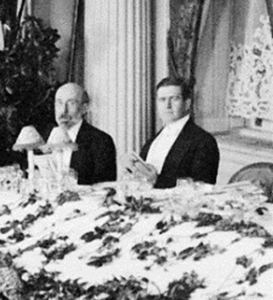
Shown below, Shibusawa is at the other end of the table closer to William Howard Taft (seated far right, next to the gentleman whose image reveals only half of his face).


Standing at Shibusawa’s right is the Japanese-American Dr. Jōkichi Takamine, one of the two hosts for this event. Dr. Takamine was a highly successful and respected chemist and businessman who helped establish a pharmaceutical company that continues to this day. Standing at Shibusawa’s left side is Count Chinda Sutemi Japanese Ambassador to the U.S.

Dr. Takamine, Ambassador Sutemi, Prince Tokugawa, and President Taft were all closely linked to the gifting of the cherry blossom trees to Washington, D.C. in 1912. Further details of this Japanese gift are presented in another blog post on this website.


Section II – Presentation of smaller segments of 1915 banquet photo:


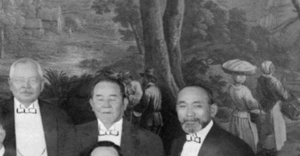
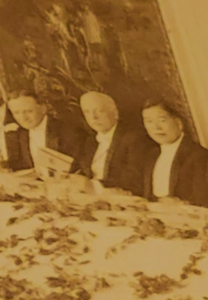
Attendees Right to Left: 1, 2, 3

1- Unknown

2- William Howard Taft (September 15, 1857 – March 8, 1930) the 27th president of the United States (1909–1913). Taft was the chosen successor of Theodore Roosevelt, and was succeeded by Woodrow Wilson. After Taft’s presidency, he became the 10th Chief Justice of the United States from July 11, 1921 – February 3, 1930, the only individual to hold both offices.

3- Albert Shaw (July 23, 1857 – June 25, 1947) was a prominent American journalist and academic of the early 20th century. In 1890, Shaw was elected professor of international law and political institutions at Cornell University, but resigned the post in 1891 to establish an American edition of the Review of Reviews. The Review of Reviews was a noted family of monthly journals founded in 1890-1893 by British reform journalist William Thomas Stead (1849–1912): It was established across three continents in London (1891), New York (1892) and Melbourne (1893). Shaw served as editor-in-chief of this publication until it ceased publication in 1937. Shaw was also a member of the American Antiquarian Society (AAS), located in Worcester, Massachusetts. This AAS was both a learned society and national research library of pre-twentieth century American history and culture. Founded in 1812, it is the oldest historical society in the United States with a national focus.


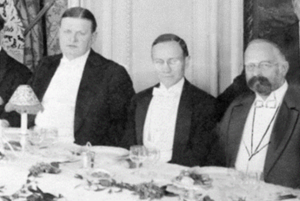
Attendees Right to Left: 4, 5, 6


4- Unknown


5- Edward Jewitt Wheeler (1859-1922) was the Editor of The Literary Digest. The Literary Digest was an influential American general interest weekly magazine published by Funk & Wagnalls. Founded by Isaac Kaufmann Funk in 1890, it eventually merged with two similar weekly magazines, Public Opinion and Current Opinion. Beginning with early issues, the emphasis was on opinion articles and an analysis of news events. It offered condensations of articles from American, Canadian and European publications. Type-only covers gave way to illustrated covers during the early 1900s. In the 1920s, the covers carried full-color reproductions of famous paintings. By 1927, The Literary Digest climbed to a circulation of over one million. In 1938, it merged with the Review of Reviews, only to fail soon after. Its subscriber list was bought by Time.

Wheeler was also the Editor of The Voice, 1884-1898; President of the Poetry Society of America, 1909-1919; Trustee of Ohio Wesleyan University; Officier de l’Instruction Publique. He was also Managing Editor of The Homiletic Review, a temperance publication.

Wheeler also served as Secretary of the Westerleigh Collegiate Institute (1896–1900). Westerleigh Collegiate Institute was the first school on Staten Island to provide a complete kindergarten-to-college education; the surrounding neighborhood, previously called National Prohibition Park, gradually came to be known as Westerleigh.


6- Unknown


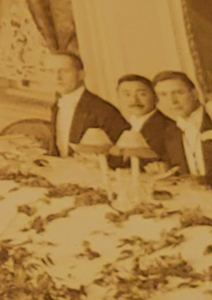
Attendees Right to Left: 7, 8, 9

7- Count Chinda Sutemi (珍田 捨巳, January 19, 1857 – January 16, 1929) was the Japanese Ambassador to the U.S. at the time of the 1915 banquet event. Sutemi studied at DePauw University and got his B.A. in 1881, and M.A. in 1884. From 1890 to 1894, he served as Japanese Consul in San Francisco, California. In 1897, he was appointed first Japanese Minister Plenipotentiary to Brazil, following the establishment of diplomatic relations between the two states in 1895. He served as Japanese Ambassador to Germany from 1908 to 1911, to the United States from 1912 to 1916, and to the United Kingdom from 1916 to 1920, during which time he took part in the Japanese delegation to the Paris Peace Conference in 1919 at the end of WWI…Sutemi was also a Methodist minister.

Count Chinda stood at Shibusawa’s left side, and Dr. Jōkichi Takamine was on Shibusawa’s right side in the photo: Ambassador Chinda and Dr. Jōkichi Takamine are closely linked to the gifting of cherry blossom trees to Washington, D.C. in 1912. It was Ambassador Chinda’s wife Japanese Viscountess Iwa Chinda and President Taft’s wife First Lady Helen Herron Taft, who each ceremonially planted one of the first two Japanese gifted cherry blossom trees in the U.S. Capital in 1912. This diplomatic gesture has since become the annual National Cherry Blossom Festival, one of the most celebrated goodwill events in Washington, D.C., attended by hundreds of thousands of Americans and visitors from around the world.


8- Baron Shibusawa Eiichi (渋沢 栄一, March 16, 1840 – November 11, 1931)


9- Dr. Jōkichi Takamine (高峰 譲吉, November 3, 1854 – July 22, 1922) a famous chemist and highly successful businessmen, who became the first President of Sankyo Company, Ltd., a pharmaceutical company. Sankyo Company Ltd. was founded in 1899, and was initially named Sankyo Shoten Company Ltd. It was launched through a joint investment by businessmen Matasaku Shiobara, Shotaro Nishimura and Genjiro Fukui. Two of their first successful products were the digestive enzyme Taka-Diastase® (launched in 1894, Dr. Jokichi Takamine discovered the enzyme from a fungus). In 1902, they launched Adrenalin®, an adrenal cortex hormone agent. Dr. Jokichi Takamine had discovered and patented the isolation of adrenalin. In 1910, Dr. Umetaro Suzuki, a future Sankyo scientific adviser, made the world’s first discovery of vitamin B1 (Orizanin®) in rice bran and established a foundation for the theory of vitamins.

In 1913, Sankyo Shoten Company, Ltd., changed its name to Sankyo Co., Ltd, and appointed Dr. Jokichi Takamine as its first president. He remained its president from March 1913 – July 1922.

In 2005, Sankyo Shoten Company, Ltd., merged with Daiichi Pharmaceutical Company, Ltd., both of them were century-old pharmaceutical companies. The name of the company from this merger is Daiichi Sankyo Company Ltd., a global company and the second largest pharmaceutical company in Japan. It is a producer of medical equipment, pharmaceutical products, and veterinary medicines. Number of employees 32,229 (as of December 2013). Company headquarters: Tokyo, Japan.

Sources: Wikipedia and the pharmaceutical company website: www.daiichisankyo.com

Additional information about Dr. Jōkichi Takamine: in 1905, he established The Nippon Club, to tighten the unity of the Japanese community and to develop a better relationship with the American people. Since then, The Nippon Club, which is the only Japanese social club in the U.S., has contributed to the continued friendship, not to mention ongoing business and cultural exchange between the two countries through various events, workshops and cultural classes. By holding athletic events and cultural activities, as well as by providing the facilities where these events can occur, The Nippon Club has cemented itself as one of New York City’s oldest cultural institutions. It continues to serve the community from the center of the world’s most international metropolitan area. Source: The Nippon Club website.


Attendees Right to Left: 10, 11, 12

10- Unknown

11- Willard Dickerman Straight (January 31, 1880 – December 1, 1918) American investment banker, publisher, reporter, Army Reserve officer, diplomat and by marriage, a member of the Whitney family. Straight was the founder of the American magazine: The New Republic, which remains one of the most influential liberal magazines in the United States from its launch in 1914. The magazine was begun by Straight with Herbert David Croly as its editor. The New Republic reflected the progressive movement and sought reforms in American government and society. Among its early editors or contributors were Randolph Silliman Bourne, Walter Lippmann, and Malcolm Cowley. The journal supported the formation of labour unions, the eight-hour workday, and woman suffrage. It also supported President Woodrow Wilson’s foreign policy during World War I, but later broke with him and opposed the Treaty of Versailles. The magazine’s popularity declined in the 1920s, when its liberal viewpoint was out of favour, but it revived in the 1930s. After earlier opposing him, The New Republic ended up supporting President Franklin D. Roosevelt’s administration and the New Deal. Source: The Editors of Encyclopaedia Britannica…Today, The New Republic continues to take a largely modern liberal stance on governmental fiscal policies and social issues.

12- Unknown


Additional notes:

During Baron Shibusawa’s 1915 visit to New York City, he was also the luncheon guest of Colonel Theodore Roosevelt (oldest son of former President Theodore Roosevelt) at Oyster Bay in Nassau County, on the North Shore of Long Island, 25 miles east of Manhattan. George Walbridge Perkins and Clarence H. Mackay were present at this luncheon to meet Baron Shibusawa.

While in the U.S., Baron Shibusawa also enjoyed a visit to the Pan-Pacific Exposition of 1915-1916, held in San Diego, California. The current expansive Balboa Park in San Diego, is largely composed of exhibition buildings from that wonderful event. The first beginnings of the Japanese Friendship Garden in Balboa Park, began with a popular Japanese Teahouse at that exposition.


Below are some larger segments from the 1915 restored photo. Certain segments of the photo have greater clarity in the half-tone versus the black and white version:


Right to left: Attendees numbered from 1 to 27


Right to left: Attendees numbered 10 to 27


Attendees Right to Left: 13, 14, 15

13- William Morgan Shuster (23 February 1877 in Washington, D.C. – 26 May 1960 in New York City), was an American lawyer, civil servant, and publisher, who is best known as the treasurer-general of Persia by appointment of the Iranian parliament, or Majles, from May to December 1911. Shuster tried to free Persia from Russian and British colonialism, so Persia could gain independence and control its own destiny. Shuster felt he could improve the Persian economy. However, due to great pressure put on him by Russia and Britain, Shuster was forced to leave Persia. He felt bitter and wrote a book condemning the colonial powers. Upon his return to the U.S., Shuster entered the publishing industry and became president of Century Publishing in New York. He led the firm, which had been established in 1870, through a merger with Appleton in 1933 and Crofts in 1947. By his death in 1960 the firm was known as Century-Appleton-Crofts.

14- Unknown

15- Unknown


Attendees Right to Left: 16, 17, 18

16- Unknown

17- Unknown

18- Unknown


Attendees Right to Left: 18 to 29


Attendees Right to Left: 19, 20, 21

19-  Don Carlos Seitz (1862-1935) American newspaper correspondent and manager. He was also an accomplished biographer and historian. He served as city editor (1889–91) of the Brooklyn Eagle, assistant publisher of the New York Recorder (1892–93) and managing editor of the Brooklyn World (1893–94), and thenceforth was connected with the New York World as advertising manager (1895–97) and as business manager after 1898.  Note: The Brooklyn Eagle, originally The Brooklyn Eagle and Kings County Democrat, was a daily newspaper published in the city and later borough of Brooklyn, New York, for 114 years from 1841 to 1955.

Don Carlos Seitz’s historical books and biographies include: Discoveries in Everyday Europe (1907), Writings by and about James McNeill Whistler (1910), Elba and Elsewhere (1910), Letters from Francis Parkman (1911), The Buccaneers (1912), Whistler Stories (1913), Braxton Bragg, general of the Confederacy (1924), Joseph Pulitzer; HIs Life and Letters (1924), Under the Black Flag: Exploits of the Most Notorious Pirates (1925), The Great Island: Some observations in and about the Crown Colony of Newfoundland (1926), and The James Gordon Bennetts: Father and Son Proprietors of the New York Herald (1928, a biography about newspaper publishers).


20- Unknown

21- Unknown


Attendees Right to Left: 22, 23, 24

22- Unknown

23- Unknown

24- John Huston Finley (October 19, 1863 – March 7, 1940) was a Professor of Politics at Princeton University from 1900 to 1903, and the third President of the City College of New York from 1903 until 1913, when he was appointed President of the University of the State of New York and the 2nd Commissioner of Education of the State of New York from 1913–1921. He was also the 9th President of the American Geographical Society from 1925–1934 – His position in the American Geographical Society placed him in contact with the great explorers and fliers of the day, who signed their names for him on a terrestrial globe, which he presented to the Society in 1929. During World War I he headed the Red Cross Commission in Palestine.

In 1921 Finley was appointed The New York Times associate editor. On April 21, 1937, The Times announced Dr. Finley’s appointment as editor-in-chief. He held that position until Nov. 16, 1938, when because of poor health he took the title of editor emeritus. During his long distinguished career he received honorary degrees from over thirty colleges and universities, and twelve governments bestowed thirteen decorations on him.

During the 1915 banquet event honoring Shibusawa, John H. Finley recalled an incident when the Baron visited the U.S. back in 1902. Mr. Finely stated that writing poetry was a passion for Baron Shibusawa. Finley related that Baron Shibusawa had become friendly with Townsend Harris, the first American Minister to Japan, who went there in 1856 and stayed many years. Mr. Harris died in New York in 1878, and on the day of Baron Shibusawa’s arrival to New York in 1902, he asked to be taken to his friend’s grave. When he reached it he pinned a personal poem he had written to Mr. Harris upon the tree overhanging the grave.


Attendees Right to Left: 25, 26, 27

25- Unknown

26-Unknown

27- Unknown

Vacant Seat between 27 and 28: presumed to be where Count Chinda Sutemi Japanese Ambassador to the U.S. sat during this event.


Attendees Right to Left: 28, 29

28- Unknown

29- Unknown


Attendees Right to Left: 28 to 54  


Attendees Right to Left: 30, 31, 32, 33, 34

30- Unknown

31- Unknown

32- Unknown

33- Theodore Roosevelt (October 27, 1858 – January 6, 1919) 26th President of the United States: in office September 14, 1901 – March 4, 1909

34- Dr. Toyokichi Iyenaga (1862-1936) one of the two hosts of the 1915 banquet. Dr. Iyenaga was Japanese by birth, but came to America early in his life, where he received a PhD degree from Oberlin in 1887 and a PhD degree from Johns Hopkins in 1890. After his education in the United States, he returned to Japan and from 1890 to 1895 he was professor of political science at Waseda University and Higher Commercial College in Tokyo, Japan. In 1895 he was appointed secretary for the Department of Foreign Affairs, and in 1898 he became a commissioner of the Formosan government to India, Persia, Turkey, and China. He was also lecturer at the University of Chicago from 1901 to 1920 and at Columbia University from 1913 until retirement. While in New York he operated a news bureau known as the East and West. He also spent some time in Washington, D.C. as an aide to the Japanese ambassador to the United States.


The Vacant seat between 34- Dr. Toyokichi Iyenaga and 35- Jacob Henry Schiff is presumed to be where Baron Shibusawa Eiichi sat during this event. This would place Dr. Toyokichi Iyenaga between Baron Shibusawa and Theodore Roosevelt to assist in translation between these two statesmen.


Attendees Right to Left: 35, 36, 37, 38, 39, 40

35- Jacob Henry Schiff (born Jakob Heinrich Schiff; January 10, 1847 – September 25, 1920) was a Jewish-American banker, businessman, and philanthropist. He helped finance the expansion of American railroads and the Japanese military efforts against Tsarist Russia during the 1904-1905 Russo-Japanese War.

Born in Frankfurt, Germany, Schiff migrated to the United States after the American Civil War and joined the investment firm Kuhn, Loeb & Co. From his base on Wall Street, he became a foremost Jewish leader from 1880 to 1920 in what later became known as the “Schiff era.” He grappled with all major Jewish issues and problems of the day, including the plight of Russian Jews under the Tsar, American and international anti-Semitism, care of needy Jewish immigrants, and the rise of Zionism. He became a director of many important corporations, including the National City Bank of New York, Equitable Life Assurance Society, Wells Fargo & Company, and the Union Pacific Railroad. As a sign of the close relationship with Baron Shibusawa, in the 1915 banquet, Mr. Schiff sits at the right side of Baron Shibusawa.

36- Unknown

37- Unknown

38- Unknown

39- Unknown


Attendees Right to Left: 39, 40, 41, 42,

40- Oswald Garrison Villard (1872–1949), was the publisher of both the New York Evening Post (which describes itself as the nation’s oldest continuously published daily newspaper), and The Nation (the oldest continuously published weekly magazine in the United States, covering progressive political and cultural news, opinion, and analysis). Oswald was the son of railroad tycoon Henry Villard and grandson of abolitionist William Lloyd Garrison. He used his fortune to promote liberal causes, including women’s suffrage, anti-imperialism, and Negro uplift. Villard originally supported Booker T. Washington, believing education was the solution to the “Negro problem,” but the Brownsville affair and Atlanta riot convinced him of the need for a stronger strategy. The “Committee for the Advancement of the Negro Race” (1906) he envisioned became the blueprint for the NAACP. Villard funded the NAACP’s budget and provided free office space in the New York Evening Post building.

41- Unknown

42- Believed to be Motosada Zumoto (aka M. Zumoto) the Japanese with dark mustache. Zumoto was both the translator and secretary for Baron Shibusawa – He was also a part owner and editor of The Japan Times – Japan’s largest and oldest English-language daily newspaper, currently  published by The Japan Times, Ltd. (株式会社ジャパンタイムズ) of Tokyo. M. Zumoto was also the Director of the Oriental Information Agency of New York. A full facial image of M. Zumoto is presented at the end of this blog in Section III. This image comes from another blog post on this website that presents a 1934 diplomatic event. 


Attendees 39 to 54, starting from the back of the photo and moving forward


Attendees 43 to 48 starting with the individual furthest back and moving forward:

43- Unknown (not looking forward)

44- Unknown

45-Unknown

46- Unknown

47- Unknown (resting head on his hand)

48- Unknown (eyes looked closed)

49- Unknown [only the top of his head is shown and his face does not appear in the following photo. A mystery guest.


Attendees 50 to 53 starting with the individual furthest back and moving forward:

50- Unknown

51- Unknown (entire face shown)

52- Unknown (has mustache)

53- Unknown (wearing glasses, chin is not visible)


Larger view of the left side of the banquet table: Attendees 35 to 61


Attendees 52 to 59 starting with the individual furthest back and moving forward:

52- Unknown (has dark mustache; was shown in prior photos)

53- Unknown (shown in prior photos)

54- Unknown (looks Asian or African American?)

55- Unknown (brown mustache)

56- Unknown

57- Unknown

58- Unknown

59- Unknown


Attendees 58 to 61 starting with the individual furthest back and moving forward:

58- Unknown (also listed in earlier photo)

59- Unknown (also listed earlier photo)

60- Unknown

61- Unknown


Left to Right: Attendees 61 to 65

The Vacant chair between attendees 63 and 64 is presumed to be where Dr. Jōkichi Takamine sat during this event. As one of the two hosts of this event, Dr. Takamine likely sat at one end of the large banquet table near William Howard Taft, while the other host, Dr. Toyokichi Iyenaga, sat at the other end of the table between Baron Eiichi Shibusawa and Theodore Roosevelt, allowing him to serve as a translator for these two statesmen.


Left to Right: Attendees 62 to 63

62- Unknown

63- Unknown


From Left to Right: Attendees 64 to 65

64- Unknown

65- Unknown


Based on suggestions from The American Historical Association fellow members and further research, here are the names of some Japanese who accompanied Baron Shibusawa during his 1915 visit to the U.S., who might be in the 1915 photo:

  • M. Zumoto – editor/part-owner of Japan Times, Director of the Oriental Information Agency of New York, both the translator and secretary for Baron Shibusawa.
  • The Baron’s son: T. Shibusawa
  • The Baron’s son M. Shibusawa
  • M. Masuda, the private secretary for Baron Shibusawa
  • Z. Horikoshi, a silk merchant who also accompanied Baron Shibusawa during his 1909 visit to the U.S.
  • K. Noguni
  • S. Hoyomi
  • I. Wakita, managing Director of the Tokyo-Sakaye Bank
  • T. Yokoyama – businessman 
  • K. Noguchi on the staff of the First Bank of Tokyo


Section III

As displayed above in Section II, there were many fascinating and inspiring individuals who attended the 1915 event honoring Baron Shibusawa’s visit. 

Below are the photos that were utilized for comparison.

This section will also include the names of those individuals and organizations who assist in identifying the guests at this event.


2-    William Howard Taft

Image result for william howard taft

Circa 1915  Photo source: Biography.com


3-           Albert Shaw

File:Portrait of Albert Shaw.jpg

Circa 1910                                             Circa 1989  

Photo source: Wikipedia


5-      Edward Jewitt Wheeler


Circa 1900. In the above photo he is forty-one years old.

In 1915, during the Shibusawa banquet, he was fifty-six years old.


7-     Count Chinda Sutemi Japanese Ambassador to the U.S.

File:Picture of Chinda Sutemi.jpg

Circa 1913 Photo source: Harris & Ewing


8-      Baron Shibusawa Eiichi

Circa 1918  Photo source: Wikipedia


9-          Jōkichi Takamine

File:Jokichi Takamine.jpg

Circa 1920  Photo source: Science History Institute


11-   Willard Dickerman Straight


Circa 1915  Photo source: Geni.com


13-      William Morgan Shuster


Circa 1912  Photo source: Wikipedia


19-       Don Carlos Seitz (1862-1935)


1931  Photo Source: The Library of Congress

In the above photo he was 69 years old.

In the 1915 photo, he was 53 years old.


24-     John Huston Finley (October 19, 1863 – March 7, 1940)


The above photo is labelled as no later than 1903 – Source: Wikipedia

John Huston Finley appears to be 40 years old.

How would he look twelve years later? 

In the 1915 banquet photo, he was 52 years old.


33-       Theodore Roosevelt

1911  Photo source: U.S. National Park Service


34-      Dr. Toyokichi Iyenaga


March 10, 1918  Photo source: Underwood & Underwood 


35-    Jacob Henry Schiff


1903 – Photo source: Wikipedia


40-             Oswald Garrison Villard


 Circa 1910  Photo source: NAACP Collection, Prints and Photographs Division, Library of Congress.


42-          M. Zumoto


February 27th, 1934 – Source: TheEmperorAndTheSpy.com photo archives


Section IV

The illustrated biography of Prince Tokugawa Iesato brings to life this fascinating period of history and the friendship and alliance between Prince Tokugawa and Baron Eiichi Shibusawa, as they promoted goodwill between the US and Japan.


Available in a Print and Kindle EBook Edition


Prince Tokugawa Iesato’s biography is also available in an expanded digital edition titled: THE ART OF PEACE. 

This edition is similar to THE ART OF DIPLOMACY, but it presents an additional 100 pages of historical notes to assist researchers.

Both versions offer a new significant perspective on U.S. Japan relations during the first half of the 20th Century.


Filed Under: Tokugawa Archives Tagged With: 1915, 1915 Diplomatic Banquet event, American Antiquarian Society, American edition of the Review of Reviews, Baron Eiichi Shibusawa, Baron Shibusawa, Baron Shibusawa Eiichi, Booker T. Washington, Century-Appleton-Crofts, Clarence H. Mackay, Colonel Theodore Roosevelt, Count Chinda Sutemi, Count Chinda Sutemi Japanese Ambassador to the U.S., December 3, Dinner to Baron Shibusawa. East & West Meeting, Don C. Seitz, Don Carlos Seitz, Don Seitz, Dr. Albert Shaw, Dr. Jōkichi Takamine, Dr. Takamine, Dr. Toyokichi Iyenaga, Editor of The Literary Digest, Edward J. Wheeler, Edward Jewitt Wheeler, Eiichi Shibusawa, Father of Japan’s Modern Economy of Japan, George Walbridge Perkins, Henry Villard, Herbert David Croly, History of American edition of the Review of Reviews, History of Century Publishing, History of Equitable Life Assurance Society, History of Japanese Friendship Garden, History of Kuhn, History of National City Bank of New York, History of New York Evening Post, History of the Japan Times, History of the Japanese Diet, History of the NAACP, History of The Nation magazine, History of the National Cherry Blossom Festival, History of the Nippon Club, History of the Poetry Society of America, History of the Union Pacific Railroad, History of Wells Fargo & Company, Isaac Kaufmann Funk, Jacob Henry Schiff, Jacob Schiff, Japan and WWI, Japan Times, John H. Finley, John Huston Finley, Loeb & Co., M. Zumoto, M. Zumoto - translator for Baron Shibusawa, NAACP, National Cherry Blossom Festival, Oswald Garrison Villard, Osward G. Villard, Pan-Pacific Exposition, Poetry Society of America, President of the Japanese Diet, President Taft, President Theodore Roosevelt, President Woodrow Wilson, Prince Iyesato Tokugawa, Prince Tokugawa, Prince Tokugawa Iesato, Prince William Howard Taft, Roosevelt and Japan, Russo-Japanese War, Sankyo Shoten Company, Sherry's Restaurant, Sherry’s New York City, Shibusawa Eiichi, Shibusawa Eiichi Memorial Foundation, Shibusawa Memorial Museum, Stan S. Katz, Taft and Japan, The Art of Peace, The Art of Peace biography, The Emperor and the Spy, The New Republic magazine, The Nippon Club, The Shibusawa Eiichi Memorial Foundation / Shibusawa Memorial Museum, TheEmperorAndTheSpy.com, Theodore Roosevelt, Townsend Harris, U.S. Japan relations, U.S.-Japan History, Whitney family, Willard D. Straight, Willard Dickerman Straight, William Howard Taft, William Lloyd Garrison, William Morgan Shuster, William Shuster, World War One, WWI and Japan, www.shibusawa.or.jp/english/museum/, 渋沢 栄一, 珍田 捨巳, 高峰 譲吉

Prince Tokugawa encouraged Emperor Hirohito’s younger brother Prince Takamatsu and Princess Takamatsu to take a fourteen month Goodwill World Tour during 1930-1931. In Washington, D.C., they were personally escorted by President Herbert Hoover down Pennsylvania Avenue, as part of their special reception.

January 14, 2020 by Stan S. Katz Leave a Comment


These rare antique photos present a long forgotten 1931 diplomatic event where Prince and Princess Takamatsu as a gesture of international goodwill visited the US Capital and were personally escorted down Pennsylvania Avenue. by President Herbert Hoover, as thousands of onlookers gathered to honor their visit. Surprisingly, it has proved difficult to find news coverage about the above diplomatic procession.

Left to right in the center of the procession photo: Japanese Ambassador to the U.S. Katsuji Debuchi speaks with President Hoover (wearing a top hat and holding a cane); Princess and Prince Takamatsu walk side by side.  Included above are two earlier individual photos of Princess and Prince Takamatsu.


In 1988 an international goodwill organization PRAEMIUM IMPERIALE was created to honor Prince Takamatsu and his efforts to utilize the arts as a means of bringing nations and peoples together in mutual appreciation and goodwill.

The below Sunday, Sept. 19th, 2021 full page announcement in the NEW YORK TIMES honors this prestigious organization’s 2021 artist award recipients.


The Praemium Imperiale is a global arts prize awarded annually by the Japan Art Association. Since its inauguration in 1988, it has been recognized as a  significant supporter of the arts – Six nomination committees, each chaired by an International Advisor, propose candidates in five fields: Painting, Sculpture, Architecture, Music and Theatre/Film.

The below link gives you a detailed introduction to Praemium Imperiale and its laureates in words, image, audio and video.

https://www.praemiumimperiale.org/en/


Prince Tokugawa’s biography highlights Prince and Princess Takamatsu, who served as representatives of Japan, promoting international friendship through the exchange of the arts and intercultural events. This biography includes many more rare photos of Prince Takamatsu and Princess Takamatsu’s exciting 1930-1931 Goodwill World Tour. Over the past two decades, a large collection of rare photos of Prince Takamatsu and Princess Takamatsu were collected by the author of this blog post. Perhaps, a film documentarian who also enjoys history will assist in creating a documentary about this Royal Couple, highlighting their 19301-1931 Goodwill World Tour.


PRINCE TOKUGAWA’S BIOGRAPHY  IS AVAILABLE IN TWO VERSIONS: “THE ART OF PEACE”  & “The ART OF DIPLOMACY”


PRINT & KINDLE EDITION


EXPANDED EBOOK EDITION


Filed Under: Tokugawa Archives Tagged With: 1931 U.S. Japan relations, Ambassador Grew, Ambassador Katsuji Debuchi, Baron Eiichi Shibusawa, Baron Shibusawa, Baron Shibusawa Eiichi, Colonel Mashbir, Colonel Mashbir Archives, Colonel Sidney Mashbir, Diplomacy, Diplomacy of Peace, Eiichi Shibusawa, Herbert Hoover, Historical biography, International Friendship, International Relations, Iyemasa Tokugawa, Japan China relations, Japan History, Japan U.S. Relations, Japanese Ambassador Debuchi, Japanese Royal Family, Katsuji Debuchi, President Herbert Hoover, President Hoover, Prince and Princess Takamatsu's World Tour, Prince Iyesato Tokugawa, Prince Takamatsu, Prince Tokugawa, Prince Tokugawa Archives, Prince Tokugawa Iesato, Princess Takamatsu, Shibusawa Eiichi, Stan S. Katz, Stan S. Katz blog, The Art of Di, The art of diplomacy, The Art of Diplomacy biography, The Art of Peace, The Art of Peace biography, The Emperor and the Spy, TheEmperorAndTheSpy.com, Tokugawa biography, U.S. Japan relations, U.S.-Japan History, US Japan relations, World War Two

Dec. 23, 1929 – J. Edgar Hoover oversees the protection detail for the visiting Japanese Naval Delegation in Washington, D.C. – U.S. Secretary of State Stimson and the Japanese Ambassador Debuchi greet the visitors and escort them to the White House to meet with President Hoover

July 8, 2019 by Stan S. Katz Leave a Comment

Dec. 23, 1929 – A rare photo of J. Edgar Hoover as he oversees the protection detail for the visiting Japanese Naval Delegation in Washington, D.C. The Japanese delegation were were on their way to attend negotiations in Europe for the ratification of the 1930 London Naval Treaty (officially the Treaty for the Limitation and Reduction of Naval Armament). The delegation was greeted at the Washington Union (Train) Station by U.S. Secretary of State Henry L. Stimson and the Japanese Ambassador Katsuji Debuchi; the delegation then visited the White House to meet with President Herbert Hoover.


December 23, 1929 – This photo offers rare candid view of J. Edgar Hoover, who is wearing the straw hat in the background and standing near a policeman. This photo is a sectional view of the larger group photo. This sectional view allowed the enlargement necessary to clearly view J. Edgar Hoover. This photo presents a unique glimpse of Hoover during a Bureau of Investigation (prior name of the FBI) field operation, when he wasn’t posing for the camera.

This photo highlights the arriving Japanese Naval Delegation in Washington, D.C., prior to the delegation being received by President Herbert Hoover at the White House. We see U. S. Secretary of State Henry L. Stimson (1867 – 1950) at the far right, with Japanese Ambassador to the U.S. Katsuji Debuchi  at the far left. They are greeting the arriving Japanese Naval Delegation at the Washington Union (Train) Station. The delegation was passing thru the U.S. on their way to Europe for the negotiations that would ratify the 1930 London Naval Arms (limitation) Conference. The 1930 The London Naval Treaty (officially the Treaty for the Limitation and Reduction of Naval Armament) was an agreement between Great Britain, Japan, France, Italy and the United States, signed on 22 April 1930. Seeking to address a loophole in the formidable 1922 Washington Naval Treaty (that created tonnage limits for each nation’s surface warships), it regulated submarine warfare and limited naval shipbuilding. Ratifications were exchanged in London on 27 October 1930, and the treaty went into effect on the same day.

One of the significant benefits of this treaty, beyond attempting to maintain peace, was that the Great Depression had just begun in late 1929, and the treaty encouraged less funds be spent in an international Arms Race, when that money could better be used for urgently needed social support programs during the economic downturn.


Above is the larger version of the December 23, 1929 photo as the Japanese Naval Delegation arrive in Washington, D.C., on their way to the 1930 London Naval Conference.

Front row, Left to right: Admiral Seizō Sakonji; Japanese Ambassador Katsuji Debuchi; , T. Kawasaki, Reijiro Wakatsuki chief of delegates; U.S. Secretary of State Stimson: Hirosi Saito, Madame Takarabe, and Madame Debuchi. Back row right side: Takeshi Takarabe, assistant chief delegate (wearing glasses and standing behind his wife).


The individual in the background wearing a straw hat, adjacent to the policeman is J. Edgar Hoover (see below photo enlargements):


John Edgar Hoover (January 1, 1895 – May 2, 1972) was the first Director of the Federal Bureau of Investigation (FBI) of the United States and an American law enforcement administrator. He was first appointed as the director of the Bureau of Investigation – the FBI’s predecessor – in 1924 and was instrumental in founding the FBI in 1935, where he remained director for another 37 years until his death in 1972 at the age of 77.

The Dec. 23, 1929 group photo was taken in front of the south main entrance to the Washington Union Station. Below is a circa 1929 postcard of the train station. The descriptive reverse side of the postcard is also displayed below:


It was a surprising discovery noticing that J. Edgar Hoover appeared in the Dec. 23rd, 1929 photo. The photo was acquired while doing research for the historical novel The Emperor and the Spy: The Secret Alliance to Prevent WWII, and the illustrated biography The Art of Peace by Stan S. Katz.

The Emperor and the Spy focuses on the life of a high level U.S. intelligence agent Colonel Sidney Mashbir who befriended and allied with Japanese leaders, including members of the Japanese royal family during the 1920s and 1930s, in a valiant attempt to maintain goodwill between their nations.

The Art of Peace biography is in many ways a nonfictional sequel to the novel and highlights the pivotal behind the scenes events in U.S. Japan relations during the first half of the twentieth century. The book highlights one of Colonel Mashbir’s closest and most influential Japanese allies Prince Iyesato Tokugawa (1863-1940).

For further information visit the website TheEmperorAndTheSpy.com


Link to the Introduction of THE ART OF PEACE


Link to Introduction for THE EMPEROR AND THE SPY


Filed Under: Tokugawa Archives Tagged With: 1915 U.S. Japan relations, 1930 London Naval Treaty, Admiral Seizō Sakonji, Aisuke Kabayama, Ambassador Katsuji Debuchi, Count Aisuke Kabayama, F.B.I., Federal Bureau of Investigation, Henry L. Stimson, Herbert Hoover, Hirosi Saito, J. Edgar Hoover, Japanese Ambassador Katsuji Debuchi, Katsuji Debuchi, London Naval Treaty, Madame Debuchi, Madame Takarabe, President Herbert Hoover, President Hoover, Prince Iyesato Tokugawa, Prince Tokugawa Iesato, Reijiro Wakatsuki, Secretary of State Henry L. Stimson, Seizō Sakonji, Stan S. Katz, Stan S. Katz blog, T. Kawasaki, Takeshi Takarabe, The Art of Peace, The Art of Peace biography, The Emperor and the Spy, TheEmperorAndTheSpy.com, Tokugawa Iesato, U.S. Japan Diplomacy, U.S. Secretary of State Henry L. Stimson

Sept. 20th, 1917 Dinner Event to Honor the new U.S. Ambassador to Japan Roland S. Morris at the Bellevue Stratford, Hotel, Philadelphia. This event is linked to the 1917-1918 Viscount Ishii goodwill delegation visit.

April 10, 2019 by Stan S. Katz Leave a Comment


Circa 1917: Roland Sletor Morris. Following his Sept. 20th, 1917 reception in Philadelphia, Morris soon proceeded to Japan. Source: Library of Congress /Bain News Service.


The interior of the Program/Menu to the reception is presented below.

This diplomatic event and the prominent individuals who attended it, offers a window to several significant international issues of that day.


Dinner to Honorable Roland S. Morris

American Ambassador to Japan

on Thursday evening September 20th, 1917

The Bellevue-Stratford [Hotel], Philadelphia


Speakers

–Honorable William Potter (ex-Minister to Italy)

Toastmaster

–Honorable Thomas B. Smith (November 2, 1869–April 17, 1949) served as a member of the Pennsylvania House of Representatives and was the 82nd Mayor of Philadelphia from 1916 until 1920.

–His Excellency Aimaro Sato (aka Yoshimaro Satō (佐藤 愛麿, April 22, 1857 – January 12, 1934) was the Japanese Ambassador to the United States from 1916 to 1918.

–Honorable Frank Lyon Polk Frank Lyon Polk (September 13, 1871 – February 7, 1943) was a prominent United States lawyer and diplomat, who was also a name partner of the law firm today known as Davis Polk & Wardwell. At the time of this reception he held the position of Counselor Department of State

–Honorable Alexander Mitchell Palmer (May 4, 1872 – May 11, 1936), was United States Attorney General from 1919 to 1921. He is best known for overseeing the Palmer Raids during the Red Scare (U.S. efforts against communists in America) of 1919–20. Palmer selected J. Edgar Hoover to his position in newly formed federal intelligence organization that would become the F.B.I.

–Honorable Robert von Moschzisker (March 6, 1870 – November 21, 1939) a Justice of the Supreme Court of Pennsylvania from 1909 to 1921 and Chief Justice from 1921 to 1930.

–Francis A. Lewis, Esq.

–William A. Glasgow, Jr., Esq. (April 29, 1865 – March 14, 1930) [Note 8]                  

–Honorable Roland S. Morris

American Ambassador to Japan


The reception for Morris took place at the Bellevue-Stratford Hotel, a landmark building at 200 S. Broad Street at the corner of Walnut Street in Center City, Philadelphia, Pennsylvania.


Engraved 1916 letterhead of the Bellevue-Stratford Hotel, Philadelphia, PA, with vignettes of both that hotel, as well as those of the Waldorf and Astoria Hotels in New York all of which were then operating under the management of George Boldt. Source courtesy of: “The Cooper Collection of U.S. Hotel History” [1]


The below news article describes this festive diplomatic ballroom event, with 600 attendees, including many members Philadelphia’s judiciary, two U.S. senators, a fellow U.S. ambassador, and many other prominent supporters of the civic life in this city and State.

The Philadelphia Inquirer, Philadelphia, Pennsylvania, Sept. 20th, 1917, Thu • Page 10


Below is another news article that described the Sept. 20th diplomatic event:

Evening Public Ledger, Philadelphia, Pennsylvania, Sept. 21, 1917, Friday • Page 9


At the event His Excellency Aimaro Sato Japanese Ambassador to the United States, stated that, “He rejoiced in the appointment of Mr. Morris as Ambassador to his country. He said he considered him the man to bring about the kind of relations which are needed in this time of world turmoil.”

Ambassador Morris stated, “I believe there are no pending questions between America and Japan which, if approached in a frank and generous spirit, are not susceptible of an honorable and fair judgement.” Those are not. They were uttered by his Excellency, Viscount Ishii.


Eleven days earlier, Ambassador Morris and his wife entertained Viscount Ishii and his peace mission. During 1917-1918, Ishii and his delegation travelled the U.S., attempting to negotiate a compromise with the U.S. to ease U.S. Japan tensions. See below news article:

The Philadelphia Inquirer, Philadelphia, Pennsylvania, Sept. 9th, 1917, Sunday • Page 64


The result of Ishii’s visit was the Lansing: Ishii Agreement a diplomatic note signed between the U.S. and Japan on November 2, 1917 linked to their disputes with regards to China. In the published text of the Agreement, signed by U.S. Secretary of State Robert Lansing and Japanese special envoy Ishii Kikujirō, both parties pledged to uphold the Open Door Policy in China, with respect to its territorial and administrative integrity. However, the U.S. acknowledged that Japan had “special interests” in China due to its geographic proximity, especially in those areas of China adjacent to Japanese territory, which was in full alignment to the Open Door Policy. [2]

In a secret protocol attached to the public Agreement, both parties agreed not to take advantage of the special opportunities presented by World War I to seek special rights or privileges in China at the expense of other nations allied in the war effort against Germany.

Note: An upcoming blog post on this website will focus on the Lansing: Ishii Agreement


Some general biographical information about Roland Sletor Morris (March 11, 1874 – November 23, 1945): Morris was a U.S. diplomat and politician. He served as U.S. Ambassador to Japan from 1917 to 1921, and is perhaps best remembered for his special missions to Siberia in 1918 and 1919. He was one of the founding partners of the law firm of Duane Morris, in Philadelphia. For additional biographical info about Ambassador Morris see notes: [3] [4] [5] [6] Morris’ official papers are in the Library of Congress.


Some pivotal issues of the day during Morris’s time as Ambassador to Japan, which affected U.S., European, Russian, Chinese and Japanese relations:

-The Bolshevik Revolution of 1917 combined with destruction of World War One destabilized mainly Europe and Russia, and in its aftermath, created uncertainties as to who would now take the leadership roles in Asia. Would the prior now weakened European colonial powers retain their positions, and to what degree would the rise Japanese influence impact the situation? [7]

-Japan had been an active ally of the democracies in WWI, and she felt she deserved to be treated as an equal to the European powers and the U.S. Despite her support in WWI, she felt dishonored when she saw racism shown against Japanese Americans living in the U.S. She viewed the great instability and civil war in Russia, and felt she was justified to have a larger presence in China, so as to contain the Russian Bolshevik movement from moving into China.

-The U.S. took the stance that the best way for China to resist moving towards communism, was for China’s territory to remain intact. The U.S. accepted that prior colonial powers could continue to hold significant influence in China, but that China not be divided up by those nations. Instead, the U.S. promoted the Open Door Policy with the hope China would move towards democracy. There was idealism and optimism to this approach, which could not stand up to the future destabilizing rise of communism and fascism leading to World War Two.


                  AMBASSADOR MORRIS ARRIVES IN JAPAN


Circa 1918: U.S. Ambassador Roland Sletor Morris going to call on Japanese Emperor Taisho. Source: George Grantham Bain Collection (Library of Congress).


Circa 1918: Roland S. Morris in Tokyo, seated in front of artwork.

Source: George Grantham Bain Collection (Library of Congress).


Ambassador Roland S. Morris accompanied by U.S. naval officers of the U.S.S. Brooklyn (ACR-3) – Right to left, Captain Althaus, Admiral Roger, Ambassador Morris, Lt. Commander Smith, and Lt. Commander Estes at Vladivostok, Russia. Circa 1918 to 1919.


Postcard: Springfield College Archives and Special Collections

Courtesy of: Cliff Smith YMCA Postcard Collection


U.S.S. Brooklyn (ACR-3) at anchor, c. 1898.

United States Navy

Built: 1893–1896

In commission:     1896–1921

Namesake:  City of Brooklyn, New York


Portrait photo of Roland Sletor Morris

Book source: The World’s Work, 1919: https://archive.org/stream/worldswork38gard#page/566/mode/2up

Ambassador Morris was in Japan, taking a supportive role for the White Russians who are resisting the Bolshevik takeover of the important port city of Vladivostok.


The historical novel The Emperor and the Spy dramatically presents the exciting events surrounding this period of history in Vladivostok, and how a regional war almost erupted, but was prevented in 1922 by an American military intelligence agent Captain Sidney Mashbir.


Available in Print, EBook, and Audiobook:

Here are links to the book.

Barnes & Nobles link

Amazon Link


1921 Ambassador Roland S. Morris is called back from Japan to Washington, D.C. to negotiate with Japanese Ambassador to the U.S. Baron Shidehara. In 1921, Baron Shidehara accompanied Prince Iyesato Tokugawa, who headed Japanese delegation to the Washington Naval Arms Conference in the U.S. capital – Where they met with the leaders of many other nations to work out a naval arms limitation treaty, which was signed in 1922.

Book source for the photo: The World’s Work, 1921: https://archive.org/stream/worldswork41gard#page/318/mode/2up

Author: Underwood & Underwood


The Art of Peace illustrated biography highlights the diplomatic engagements between leaders of the U.S. and Japan during the first four decades of the twentieth century, in their support of democracy and their creative pursuit of goodwill, in spite of the turbulent times they lived. So influential was Prince Tokugawa and his Japanese supporters, that it would only be after Tokugawa’s passing in 1940, that Japan was pressured to ally with the Axis Powers in WWII.


Link to the Introduction:

THE ART OF PEACE


NOTES

[1] Constructed in 1904 and expanded to its present size in 1912, Bellevue-Stratford Hotel has continued as a well-known institution for more than a century and is still widely known by that original, historic name. In 1988 the building was converted to a mixed-use development. It has been known since then as The Bellevue. The hotel portion is currently managed by Hyatt as The Bellevue Hotel.]

[2] Tuchman, Stilwell and the American Experience in China, 1911–1945, page 48

[3] Biography and History from: Princeton University Library Finding Aids: Morris, Roland S. (Roland Sletor), 1874-1945.

“Roland S. (Sletor) Morris was a leader of the Democratic Party in Pennsylvania and was the ambassador to Japan from 1917-1921…born in Olympia, Washington on March 11, 1874 to Thomas Burnside Morris and Sarah Arndt Sletor. Morris attended the Lawrenceville School before entering Princeton University in September 1892. He graduated in June 1896, and went to the University of Pennsylvania Law School from 1896-1899, graduating cum laude. After receiving his law degree, Morris practiced law in Philadelphia at the firm of Duane, Morris and Heckscher. Morris was also politically active; he was the Chairman of the Democratic State Finance Committee in 1908 and from 1913-1916; additionally, he was a delegate or delegate at large to the Democratic National Convention in 1904, 1908, 1912, 1920, and 1928. President Woodrow Wilson appointed him as Ambassador to Japan from 1917-1921, and sent him on a special mission to Siberia from 1918-1919. Morris was a professor of international law at the University of Pennsylvania beginning in 1924, President of the American Philosophical Society, a trustee of both Princeton University and Temple University, and a Regent of the Smithsonian Institute.”

[4] In 1934, Morris lost the Pennsylvania Democratic U.S. Senate primary to Joseph Guffey, who was subsequently elected. Source: “Pennsylvania Oracle”. Time Magazine. 1934-05-28.

[5] Morris was one of the founding partners in 1904, of the law firm Duane, Morris, Heckscher and Roberts that is currently known as Duane Morris, which has offices in the United States, London, Singapore, Viet Nam, Oman, Myanmar, Shanghai and Taiwan. Morris also served as the Chancellor of the Philadelphia Bar Association, 1933 to 1935.  Source: The Duane Morris firm website.

[6] Morris was one of the reception hosts at the 1934 Japan Society of New York City Annual Gala Dinner event honoring the visit of Prince Iyesato Tokugawa. A blog post for that event is included on this website. Source: TheEmperorAndTheSpy.com blog

[7] The Russian Revolution began during the First World War. The revolution erupted in the context of Russia’s major military losses during that War, which resulted in much of the Russian Army being ready to mutiny. The situation climaxed with the October Revolution in 1917, a Bolshevik-led armed insurrection by workers and soldiers in Petrograd that successfully overthrew the Provisional Government, transferring all its authority to the Soviets.

The Russian Revolution was a period of political and social revolution across the territory of the Russian Empire, commencing with the abolition of the monarchy in 1917, and concluding in 1923 after the Bolshevik establishment of the Soviet Union, resulting in the end of the Civil War. They also established Soviet power in the newly independent republics of Armenia, Azerbaijan, Belarus, Georgia and Ukraine, and brought these jurisdictions into unification under the Union of Soviet Socialist Republics (USSR) in 1922. Victorious, they reconstituted themselves as the Communist Party.

[8] William A. Glasgow, Jr., Esq. (April 29, 1865 – March 14, 1930) was one of the speakers at the Ambassador Morris dinner event.                        Source: Ancestry.com. Since there is no Wikipedia page, the below obituary announcement is included to honor his memory.

Filed Under: Tokugawa Archives Tagged With: Admiral Roger, Aimaro Sato, Alexander Mitchell Palmer, Ambassador Aimaro Sato, Ambassador Morris, Ambassador Satō, Baron Eiichi Shibusawa, Baron Shibusawa, Baron Shibusawa Eiichi, Baron Shidehara, Bellevue-Stratford Hotel, Bolsheviks, Capt. Althaus, Captain Althaus, Chinese History, Colonel Mashbir, Colonel Sidney Mashbir, Communism, Diplomacy, Duane Morris, Duane Morris Law Firm, Eiichi Shibusawa, Emperor Taisho, Esq., Francis A. Lewis, Frank Lyon Polk, Historical biography, History of Communism, Honorable Thomas B. Smith, Honorable William Potter, in Philadelphia, International Friendship, International Relations, J. Edgar Hoover, Japan China relations, Japan History, Japan U.S. Relations, Jr., Lansing: Ishii Agreement, law firm of Duane Morris, Lt. Commander Estes, Lt. Commander Smith, Mayor of Philadelphia Thomas B. Smith, Mayor Thomas B. Smith, Prince Iyesato Tokugawa, Prince Tokugawa, Prince Tokugawa Iesato, Robert von Moschzisker, Roland S. Morris, Roland Sletor Morris, Russian History, Shibusawa Eiichi, Stan S. Katz, Stan S. Katz blog, The Art of Peace, The Art of Peace biography, The Emperor and the Spy, TheEmperorAndTheSpy.com, U.S. Japan relations, U.S.-Japan History, U.S.S. Brooklyn, U.S.S. Brooklyn (ACR-3), Viscount Ishii, Vladivostok, Washington Naval Arms Conference, William A. Glasgow, William Potter, William Potter (ex-Minister to Italy), World War One, World War Two, Yoshimaro Satō, 佐藤 愛麿

  • « Previous Page
  • 1
  • 2

Copyright © 2026 Stan S. Katz